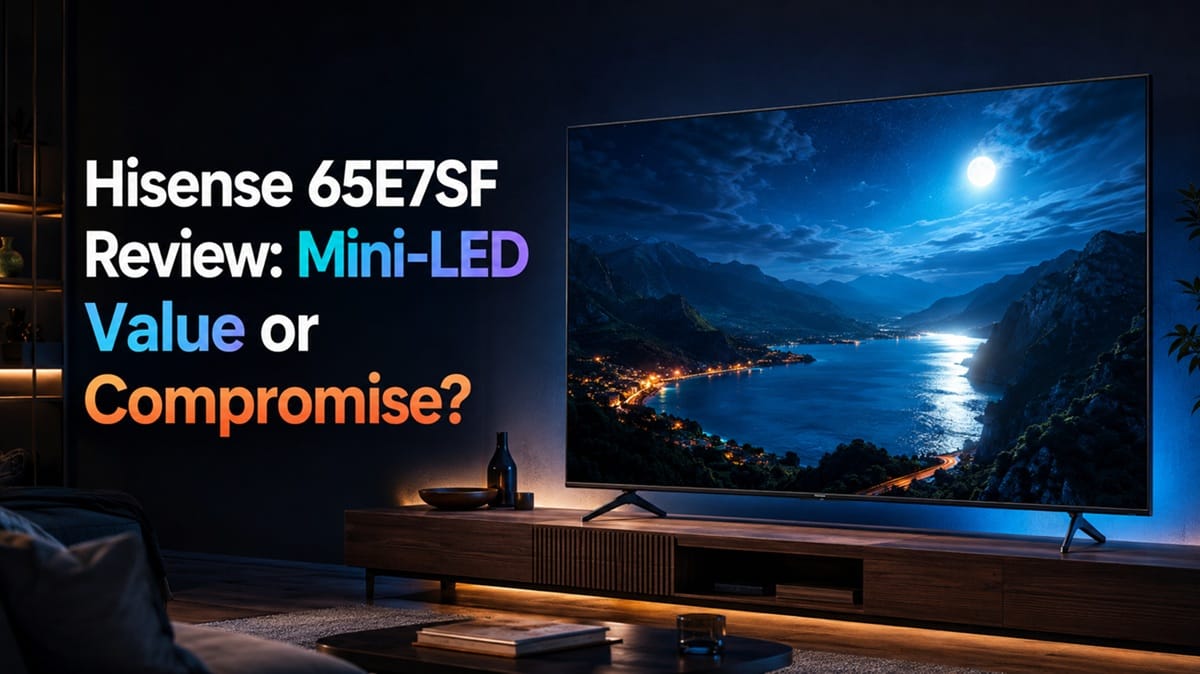
Hisense 65E7SF Review: Does This Mini-LED Undercut Hisense’s Own Flagship?
Last updated: August 2026
🕒 9 min read
Disclosure: As an Amazon Associate I earn from qualifying purchases. This article contains affiliate links — we may earn a small commission if you buy through them, at no extra cost to you.
Mini-LED backlighting used to be reserved for a brand’s most expensive TVs. Hisense’s E7 series is built to blur that line, and this Hisense 65E7SF review exists to answer one question: does it blur the line enough, or does it just borrow the marketing language from Hisense’s own step-up sets without matching the hardware?
This 65-inch Hi-QLED Mini-LED set sits directly below Hisense’s U7SG ULED tier in the brand’s 2026 lineup, at a noticeably lower price — which means the real tradeoff isn’t Mini-LED versus no Mini-LED, it’s how much of Hisense’s better implementation you’re giving up to save money. This review walks through the spec sheet, the smart-TV platform, and where the E7SF’s limits are most likely to show, weighed against our best 4K TVs of 2026 picks for how this year’s budget Mini-LED and QLED sets actually compare on picture quality per dollar. The short answer involves at least one real limitation Hisense doesn’t put on the spec sheet.
Table of Contents
Quick Verdict
At a Glance
★★★★★ 7.6 / 10
At a Glance
Picture Quality
Gaming
Audio
Value
👍 Best For: Budget-focused buyers who want real Mini-LED contrast in a 65-inch set for everyday streaming, sports, and casual gaming.
👎 Skip If: You need confirmed high zone-count local dimming or full-bandwidth HDMI 2.1 gaming across every port.
One-Line Verdict: Solid Mini-LED value at 65 inches, with the caveat that Hisense keeps its most detailed specs — and best gaming numbers — for the pricier U7SG.
🛒 Check Availability on AmazonProduct Specs at a Glance
Product Specs
Hisense 65E7SF
Mini-LED Hi-QLED · 144Hz Native · Fire TV
| 💡 Backlight | Mini-LED (Hi-QLED) |
| 🔄 Refresh Rate | Native 144Hz |
| 🎨 HDR Formats | Dolby Vision IQ, HDR10+ Adaptive, HDR10, HLG |
| 🔊 Audio | Dolby Atmos support |
| 📡 Platform | Fire TV with Alexa+ |
| 🎮 Gaming | FreeSync Premium |
| 📐 Screen Size | 65-inch Class |
Design & Build Quality
Materials & Finish
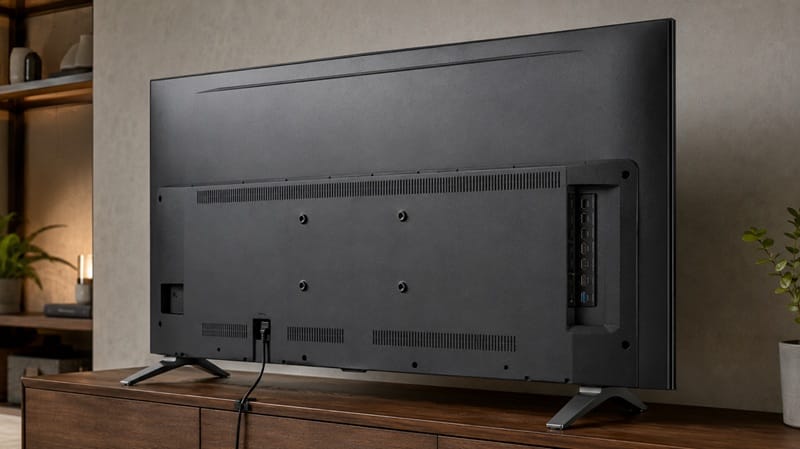
The 65E7SF follows the same visual language as the rest of Hisense’s 2026 mid-range lineup: a slim plastic-and-metal bezel, a matte finish, and a footprint built around a wide-set dual-leg stand rather than a single center pedestal. Based on Hisense’s official product listing, the E7 series is marketed on its Mini-LED backlight and “Hi-QLED” color layer rather than on premium materials, which tracks with its position below the U7SG in the brand’s own hierarchy. It’s not a set designed to impress on shelf presence — it’s designed to look clean in a media console and disappear once the screen is on.
Ports & Connectivity
Hisense confirms FreeSync Premium support and Dolby Atmos pass-through for the E7 series, though the official specifications don’t break out exactly how many of the TV’s HDMI ports run at full HDMI 2.1 bandwidth for this specific model. That’s worth confirming against the printed spec sheet on the box or Hisense’s support documentation before you plan a console-and-soundbar setup around it, rather than assuming it matches the U7SG’s HDMI setup port-for-port.
Performance & Real-World Use
Everyday Streaming and Sports
According to Hisense’s own specifications, the E7 series uses “hundreds” of Mini-LED dimming zones paired with the brand’s Hi-QLED color layer — the specific combination Hisense is using to set the E7 apart from its non-Mini-LED models this year. Hisense’s support documentation for this model lists the same Dolby Vision IQ, HDR10+ Adaptive, HDR10, and HLG format support carried across the E7 line, which covers the major streaming and broadcast HDR standards you’d run into on a typical Fire TV app lineup.
Casual and Competitive Gaming
The native 144Hz refresh rate and FreeSync Premium support make a reasonably strong case for casual and mid-tier competitive play, based on the specifications Hisense publishes for this model. Without a published input-lag figure or a confirmed full-bandwidth HDMI 2.1 spec per port, though, it’s not the set to buy specifically for the newest 4K/120Hz console titles if that ceiling matters to you — that’s squarely the territory Hisense positions its higher U7SG tier for instead.
Bright Room and Daytime Viewing
Hisense markets the E7 series’ Mini-LED backlight partly on daytime brightness, and a QLED color layer generally holds up better against ambient light than a standard LED panel does. Based on the specification sheet alone, this reads as one of the set’s stronger real-world use cases — a living room with west-facing windows or all-day background sports viewing — more than it reads as a dedicated dark-room home theater pick.
Key Features Breakdown
How the Mini-LED Backlight Actually Works
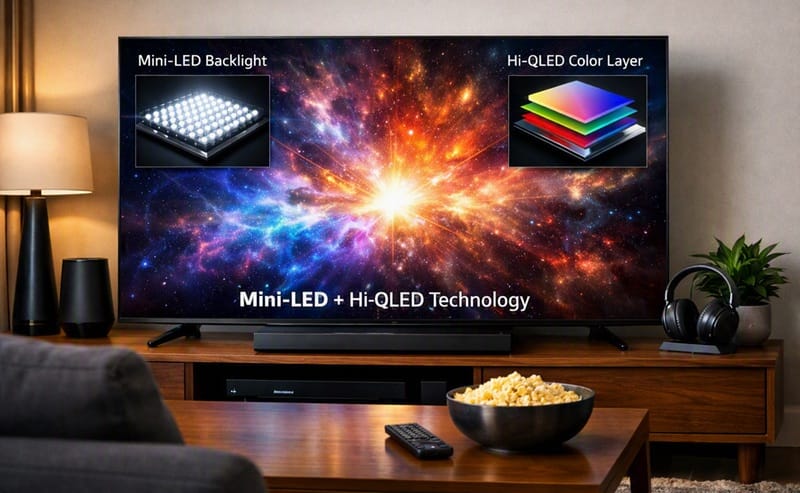
Where the E7 series differs mechanically from a standard LED/QLED set is in how the backlight itself is built. Instead of one uniform light source behind the panel, Mini-LED packs in far smaller LEDs that Hisense groups into independently controlled zones — dimming or brightening in sections rather than lighting the whole screen at a single, uniform level. That’s what makes a bright object next to a dark background look more controlled than it would on an edge-lit panel. Hisense doesn’t publish how many zones the 65-inch E7SF specifically uses, which is the gap covered in more detail further down.
Fire TV with Alexa+
The 65E7SF ships on Fire TV rather than Google TV, which puts it on a different smart-platform track than Hisense’s Google TV-based U7SG and S7 models. For anyone already running Echo speakers, Ring cameras, or other Fire TV devices, that platform consistency is worth more in daily use than it looks on a spec sheet — one remote, one voice assistant, one app layout across the household.
The Good, the Bad, and the Ugly
Pros
- ✅ Real Mini-LED backlighting at a mid-range price — brings localized dimming to a segment that’s traditionally been edge-lit only.
- ✅ Native 144Hz refresh with FreeSync Premium — comfortably ahead of standard 60Hz sets for casual gaming and sports.
- ✅ Full HDR format coverage — Dolby Vision IQ, HDR10+ Adaptive, HDR10, and HLG all supported per Hisense’s spec sheet.
Cons
- ❌ No published dimming zone count — Hisense’s marketing language (“hundreds of zones”) isn’t backed by a specific number for this model.
- ❌ HDMI 2.1 bandwidth per port isn’t confirmed — worth verifying directly before building a console setup around it.
The Ugly
The uncomfortable part of recommending the 65E7SF is that Hisense hasn’t published the one number that would actually settle the “how much local dimming am I getting” question — the zone count. If precise blooming and contrast control around bright objects on a dark background is your main concern, that’s a real gap in the available information, not just a nitpick. Hisense’s own step-up U7SG series publishes more of that detail, if a documented spec sheet matters more to you than saving money.
Who Should Buy This — and Who Shouldn’t
Buy This If…
The 65E7SF makes the most sense as an upgrade for someone replacing an older set with a single uniform backlight — the kind that can’t dim different parts of the screen independently — who wants real Mini-LED contrast and a wider color gamut without paying flagship prices. Think of it less like the entry point to premium TV technology and more like the “trim level” version of it — the same basic engine, fewer of the extras, at a meaningfully lower cost.
It’s a solid fit for general family streaming, casual gaming, and daytime sports viewing where absolute picture-quality precision matters less than getting most of the benefit for less money. Anyone weighing Mini-LED against OLED at this size and budget first should start with our OLED vs Mini LED compared breakdown before deciding which technology fits their room.
If Mini-LED and QLED both feel like unfamiliar territory and you’re comparing brands as much as models, our Samsung Crystal UHD buying guide is a useful side-by-side reference point for how a competing brand’s entry-level lineup is priced and specced against Hisense’s.
Skip This If…
Skip the 65E7SF if lab-verified specs are a dealbreaker rather than a nice-to-have — the dimming-zone count and gaming numbers that matter most to competitive players and home-theater purists simply aren’t published yet for this model. If that documentation matters more to you than the price gap, Hisense’s own U7SG is the more transparent option on paper.
Final Verdict
Is It Worth Buying?
Judged as what it’s priced to be — an entry point into real Mini-LED contrast, not a discount version of Hisense’s flagship tier — the 65E7SF holds up well. Buyers who want that step up from a standard LED set without paying for the Hisense 85E7SF review‘s larger sibling or the pricier U7SG will likely be satisfied, as long as the missing zone-count and HDMI-bandwidth details don’t matter for how they plan to use it.
Sizing further up the same E7 line, our Hisense 100E7SF review looks at whether that same unpublished zone count becomes a bigger concern once the same Hi-QLED Mini-LED panel is stretched across 100 inches instead of 65.
🛒 Check Availability on Amazon
Frequently Asked Questions
Is the Hisense 65E7SF a good TV for the price?
For the price, yes — you get Mini-LED backlighting and full HDR format support in a segment that’s traditionally been edge-lit only. Treat the picture-quality claims as manufacturer-sourced, since Hisense hasn’t published a specific dimming-zone count or lab-verified contrast numbers for this model.
How does the 65E7SF compare to the Hisense 65U7SG?
The U7SG sits above the E7SF in Hisense’s own lineup and is generally positioned with more documented gaming and picture-quality specifications. For a closer look at how that step-up model performs, see our independent Hisense TV testing overview at RTINGS, which currently covers several higher-tier Hisense models rather than the E7SF specifically.
Is the Hisense 65E7SF good for gaming?
Native 144Hz refresh and FreeSync Premium support make it a solid pick for casual and mid-tier gaming, based on Hisense’s spec sheet. Competitive players chasing the lowest possible input lag or full 4K/120Hz console performance should look at Hisense’s higher gaming-focused tiers instead.
Who should avoid the Hisense 65E7SF?
If lab-verified specs matter more to you than saving money, step up to a Hisense tier — like the U7SG — that already publishes more of that detail.
Does the Hisense 65E7SF support Dolby Vision and Dolby Atmos?
Yes — Hisense’s official specifications confirm Dolby Vision IQ support alongside HDR10+ Adaptive, HDR10, and HLG, plus Dolby Atmos audio pass-through. No pricing or promotional details are confirmed here, since Hisense doesn’t publish fixed retail pricing through its own specification pages.

iYaiii
Editor, GearPulse360
iYaiii is the editor and founder of GearPulse360, specializing in TV reviews and consumer electronics. He researches every recommendation before publishing.
✅ Based on Hisense’s official specifications and editorial research — last verified August 2026