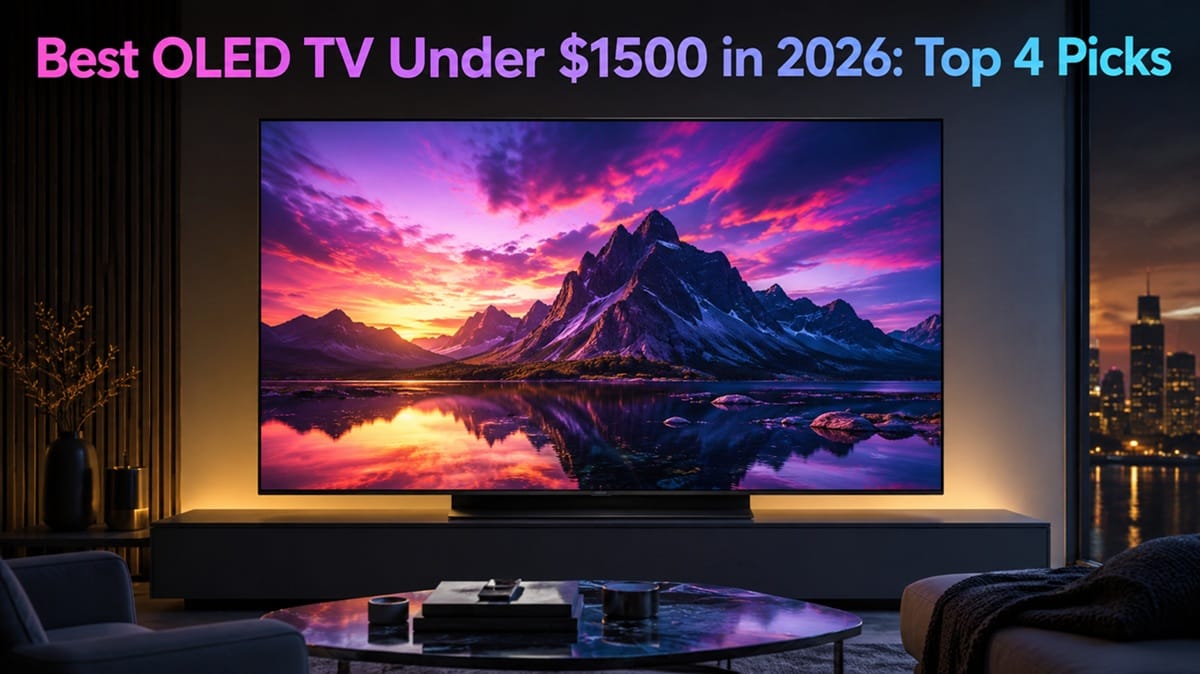
Best OLED TVs Under $1500 in 2026: Where the Extra Budget Actually Goes
Last updated: June 2026. Picks reflect model availability and pricing current at time of publication.
🕒 9 min read
Disclosure: As an Amazon Associate I earn from qualifying purchases. This article contains affiliate links — we may earn a small commission if you buy through them, at no extra cost to you.
At $1,500, something shifts. You’re not just buying an OLED — you’re buying a noticeably better one. The jump from the sub-$1,000 bracket isn’t incremental: you get a newer generation processor, Glare Free coating on select models, and in some cases a full suite of HDMI 2.1 ports across every input. For anyone who spends serious time in front of their TV — whether that’s movies, gaming, or both — that difference is felt every single day.
We put together this guide for buyers who’ve already decided on OLED and want to know exactly which model earns that extra few hundred dollars. Our top pick is the LG C6 55″, a 2026 release that improves on an already excellent formula. Depending on your room, your console setup, or how big you want to go, one of the other three picks will serve you better.
Table of Contents
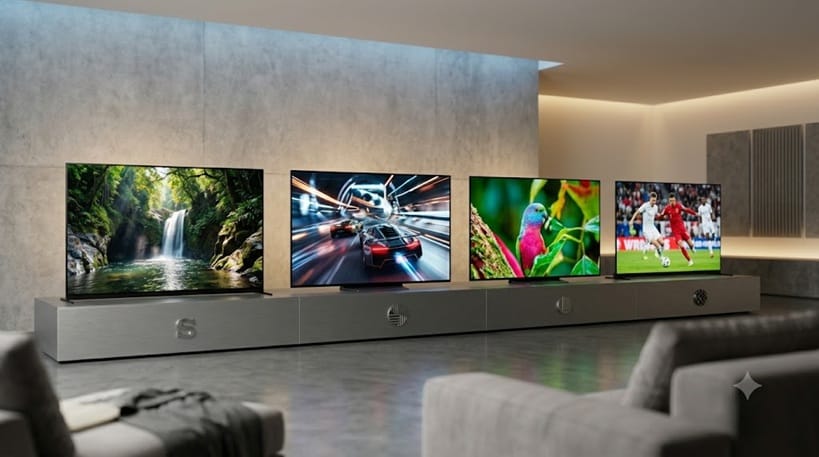
Best OLED TVs under $1500: Quick Comparison
| Pick | Model | Size | Best For |
|---|---|---|---|
| Best Overall | LG C6 2026 | 55″ | All-around |
| Best for Gaming | Samsung S90H 2026 | 42″ | Gaming / desk |
| Best for Movies & PS5 | Sony BRAVIA XR8B 2025 | 55″ | Movies / PS5 |
| Best Large Screen | LG C5 2025 | 65″ | Living room |
Prices checked at time of publishing. Amazon prices change frequently — click through for current pricing.
Best Overall OLED TV Under $1,500: LG C6 55″
The C6 is LG’s 2026 mid-range OLED, and it represents the clearest case for spending $1,400 instead of $900. The Alpha 11 AI Gen3 processor — a step up from the C5’s Alpha 9 Gen8 — handles upscaling and picture optimization with noticeably more precision. In practice, that means streaming content in 1080p or 4K SDR looks sharper and more film-like than it did on previous C-series TVs.
The panel itself is still WOLED, same as the C5. But the combination of the new processor and LG’s Brightness Booster tech pushes peak brightness high enough that casual daytime viewing is no longer a weakness. Add in the Glare Free coating, and this is a TV that works in a real living room — not just a blacked-out home theater.
Buy This If…
- You want the newest available technology without pushing past $1,500
- You use multiple HDMI devices simultaneously — all four ports are full 2.1 bandwidth
- You watch a mix of content: movies, sports, gaming, and streaming
Skip This If…
- You primarily play PS5 and want Sony’s exclusive Auto HDR Tone Mapping features
- You need 65″ — the C6 currently tops out at 55″ in this price range
- You’re a Samsung HDR10+ household and want full compatibility across your ecosystem
Best OLED TV Under $1500 for Gaming: Samsung S90H 42″
The 42″ S90H occupies a niche that very few TVs fill well: a high-performance OLED that’s small enough to sit on a desk, fast enough for competitive gaming, and refined enough to double as a living room set. At 165Hz, it’s the highest refresh rate OLED in this guide — useful for PC gamers who push frame rates past 144.
Samsung’s Glare Free coating is the other standout feature here. Most OLEDs reflect overhead lighting like a mirror, which makes daytime gaming frustrating. The S90H handles this better than almost any OLED at any price point, which matters a lot if your setup isn’t in a dedicated dark room.
One note worth flagging: the 42″ S90H uses OLED HDR, not OLED HDR+ (which is reserved for Samsung’s 55″ and larger S90H models). No Dolby Vision support either — Samsung uses HDR10+ exclusively, so check your content library before committing.
Buy This If…
- You want an OLED that works at a desk or in a room with ambient light
- You game on PC and want to push beyond 144fps — see our best OLED TVs for gaming for broader options
- Compact size is a priority — 42″ OLED quality at this price is rare
Skip This If…
- Dolby Vision is important — this model doesn’t support it
- You watch a lot of Apple TV+ or Disney+ content where DV is the primary HDR format
- You want a primary living room TV — 42″ is likely too small for that role
Best OLED TVs under $1500 for Movies and PS5: Sony BRAVIA XR8B 55″
The BRAVIA XR8B earns its spot here on ecosystem and processing, not panel technology — like the other three picks in this guide, it runs a WOLED panel. (Sony does sell a QD-OLED model at a similar name — the BRAVIA 8 II — but that’s a separate, pricier SKU; don’t confuse the two when shopping.) What sets the XR8B apart is Sony’s XR Processor tuned specifically for film-accurate tone mapping, full Dolby Vision support, and PS5 integration that no other pick in this guide can match.
For PS5 owners specifically, no TV in this guide comes close to the XR8B’s integration. Auto HDR Tone Mapping, Auto Genre Picture Mode, and the PS5’s dedicated Game Menu all work natively with this TV — features that Sony and PlayStation developed together. On other brands you get HDMI 2.1 and VRR, which is great, but not the same level of console-specific optimization.
The trade-offs are real though. Only two of the four HDMI ports are full 2.1 bandwidth, and the 120Hz ceiling means PC gamers chasing high frame rates should look elsewhere. For a cinema-first viewer with a PS5, those trade-offs are easy to live with.
Buy This If…
- You own a PS5 and want the deepest integration available at this price — see our best OLED TVs for PS5 for models built specifically around that use case
- Movies are your primary use case — Sony’s XR processing and film-tuned picture modes are exceptional for cinema content. See our best OLED TVs for movies for a full comparison.
- You prefer Google TV’s app ecosystem over webOS or Tizen
Skip This If…
- You have three or more HDMI 2.1 devices — only two ports support it
- PC gaming above 120Hz is important to you
- You’re in a bright room — no Glare Free coating means reflections can be distracting
Best Large Screen OLED TV Under $1500: LG C5 65″
Let’s be direct about why the C5 is here instead of a 2026 model: pricing. The 65″ LG C5 has dropped significantly at Amazon, making it one of the few times you can get a 65″ OLED from a top-tier brand well under this guide’s budget. The 65″ LG C6, by comparison, hasn’t seen meaningful discounts yet and remains considerably more expensive at 65″. Check Amazon for the current price on both — the gap is worth confirming before you decide.
For a living room TV that most people sit 8 to 12 feet from, the 65″ C5 makes a stronger case than any 55″ in this guide. OLED picture quality at 65″ in a dark room is exactly what the format was designed for — and the C5’s Alpha 9 Gen8 processor, four full HDMI 2.1 ports, and Dolby Vision support mean you’re not compromising on anything substantive to get the size.
Buy This If…
- You want the biggest screen possible at this budget and sit 8–12 feet away
- Your room is light-controlled or you mostly watch in the evening
- You want four full-bandwidth HDMI 2.1 ports and complete Dolby Vision support
Skip This If…
- Your room gets a lot of direct sunlight — no anti-glare coating on the C5
- Having the newest model year matters to you — the C6 is the 2026 update
- 65″ is too large for your space — measure your viewing distance before buying
Before diving into what specs actually matter here, it’s worth anchoring this guide to a comparison that trips up a lot of buyers: if you’re debating whether to go OLED or stick with QLED at this price, our full OLED vs QLED comparison addresses that question directly.
How They Compare: Full Spec Breakdown
LG C6 55″ Best Overall 2026 | Samsung S90H 42″ Best for Gaming 2026 | Sony XR8B 55″ Movies & PS5 2025 | LG C5 65″ Best Large Screen 2025 | |
|---|---|---|---|---|
| Screen size | 55″ | 42″ | 55″ | 65″ |
| Processor | Alpha 11 Gen3 | NQ4 AI Gen3 | XR Processor | Alpha 9 Gen8 |
| Refresh rate | 120Hz / VRR 165Hz | 165Hz | 120Hz | 144Hz |
| HDMI 2.1 ports | 4 / 4 | 4 / 4 | 2 / 42 ports are 2.1 | 4 / 4 |
| Dolby Vision | ✓ | ✗HDR10+ only | ✓ | ✓ |
| Glare Free | ✓ | ✓ | ✗ | ✗ |
| Smart OS | webOS 2026 | Tizen 2026 | Google TV | webOS 25 |
| PS5 features | Basic | Basic | Full suite | Basic |
| Buy on Amazon | Amazon | Amazon | Amazon | Amazon |
What to Look for in an OLED TV Under $1,500
Panel type at this tier: why all four picks are WOLED
All four picks in this guide — the LG C6, Samsung S90H 42″, Sony XR8B, and LG C5 — use WOLED, the panel technology where a white OLED light source passes through a color filter layer. It’s proven, efficient, and produces excellent picture quality in real-world conditions. Samsung’s own QD-OLED tech exists (it’s what powers the larger 55″/65″/77″ S90H and S95H models), but at the 42″ size and at this specific price point, neither Samsung nor Sony currently ships a QD-OLED panel — Samsung Display doesn’t produce QD-OLED in 42-inch, and Sony’s QD-OLED model (the BRAVIA 8 II) sits above this budget.
If QD-OLED’s wider color volume matters more to you than staying under $1,500, our best OLED TVs under $2,000 guide covers picks that do use it. For the technical breakdown of how the two panel types differ, see our QD-OLED vs WOLED comparison.
HDMI 2.1 — how many ports actually matter
Every TV in this guide has four HDMI ports. What varies is how many of those ports are full-bandwidth HDMI 2.1 (48Gbps). The LG C6, Samsung S90H, and LG C5 all give you four full-bandwidth ports — meaning you can run a PS5, Xbox Series X, and a PC gaming setup simultaneously without compromising. The Sony XR8B gives you two. That’s enough for most users, but if you have a multi-device setup, it’s a meaningful difference worth planning around.
Refresh rate and what it means for gaming
120Hz is the current PS5 and Xbox Series X ceiling — so any TV in this guide handles console gaming at its theoretical maximum. The Samsung S90H’s 165Hz is specifically useful for PC gaming, where a capable GPU can push frame rates past 120. For most buyers, 120Hz vs 144Hz vs 165Hz is not a meaningful distinction in daily use. Where refresh rate actually matters more is VRR support, which smooths out fluctuating frame rates — and all four picks here support VRR through G-Sync and FreeSync.
Glare Free coating
This is underrated at the $1,500 tier. Standard OLED panels — including the Sony XR8B and LG C5 in this guide — have highly reflective glass surfaces. In a room with overhead lighting or windows, that can make the image look washed out during daytime viewing. The LG C6 and Samsung S90H both include Glare Free anti-reflective coatings, which reduce specular reflections significantly. If your TV placement involves any ambient light, this feature is worth prioritizing.
What you gain stepping up from the sub-$1,000 tier
If you’ve come from looking at our best OLED TVs under $1,000, the main upgrades at this tier are: newer generation processors, Glare Free coating on select models, a larger size ceiling with the LG C5, and in the Samsung’s case, a higher refresh rate ceiling. The picture technology — deep blacks, infinite contrast — is fundamentally the same. You’re buying refinement, not a different class of image.
Is a $1,500 OLED Worth It vs QLED at the Same Price?
Yes — with one specific caveat. At $1,500, a QLED TV will typically be larger (75″ or 85″ vs 55″–65″ for OLED) and brighter in peak nits. If you watch in a very bright room and screen size matters more than anything else, a high-end QLED or Mini LED at this budget can make sense.
But in terms of picture quality fundamentals — contrast, black levels, shadow detail, and color accuracy in a controlled environment — OLED wins decisively at $1,500. The infinite contrast ratio that comes from self-emissive pixels isn’t something any backlight-based technology fully replicates, regardless of price. For movies, dark-room gaming, and general streaming in the evening, the gap is visible and meaningful.
The buyer who should consider QLED instead: someone who primarily watches sport or live TV in a bright living room, wants 75″ or larger, and doesn’t watch much film or play games at night. Everyone else at this budget is better served by OLED.
How We Picked These TVs
Our picks are based on cross-referencing manufacturer specifications with third-party lab measurements from trusted sources like RTINGS, and real-world review data from publications that test TVs in controlled conditions. Specific data points we prioritized: measured peak brightness (real scene and 10% window), input lag at 4K/120Hz, color gamut coverage (DCI-P3), and contrast ratio under standardized test conditions. We also verify Amazon availability and pricing at time of publication — models that aren’t consistently available or that price significantly above $1,500 don’t make the list.
We update this guide when new model releases or significant price drops change what’s available at this budget. The picks here reflect the best available options in June 2026. For current-year 2026 model comparisons, LG’s official TV lineup page is the authoritative source for confirmed specifications.
Our criteria, in order of priority: picture quality fundamentals, gaming spec completeness, build and software quality, and confirmed pricing within this guide’s budget ceiling. We don’t accept payment from manufacturers to include products.
Looking at more than just this price tier? Our best OLED TVs of 2026 guide covers top picks across LG, Sony, and Samsung — ranked by picture quality, gaming specs, and value.
Frequently Asked Questions
Which is the best OLED TV under $1,500 right now?
Is it worth spending $1,500 on an OLED instead of buying a cheaper OLED TV?
Does the LG C6 have burn-in risk?
How does the LG C6 compare to the Samsung S90H at this budget?
Is the Sony BRAVIA XR8B a 2025 or 2026 model?

iYaiii
Editor, GearPulse360
iYaiii is the editor and founder of GearPulse360, specializing in TV reviews and consumer electronics. He researches every recommendation before publishing.
✅ Based on spec analysis and LG’s, Samsung’s, and Sony’s official data plus RTINGS — last verified June 2026