LG OLED vs Samsung OLED in 2026: Which Brand Actually Makes the Better TV?
Disclosure: As an Amazon Associate I earn from qualifying purchases. This article contains affiliate links — we may earn a small commission if you buy through them, at no extra cost to you.
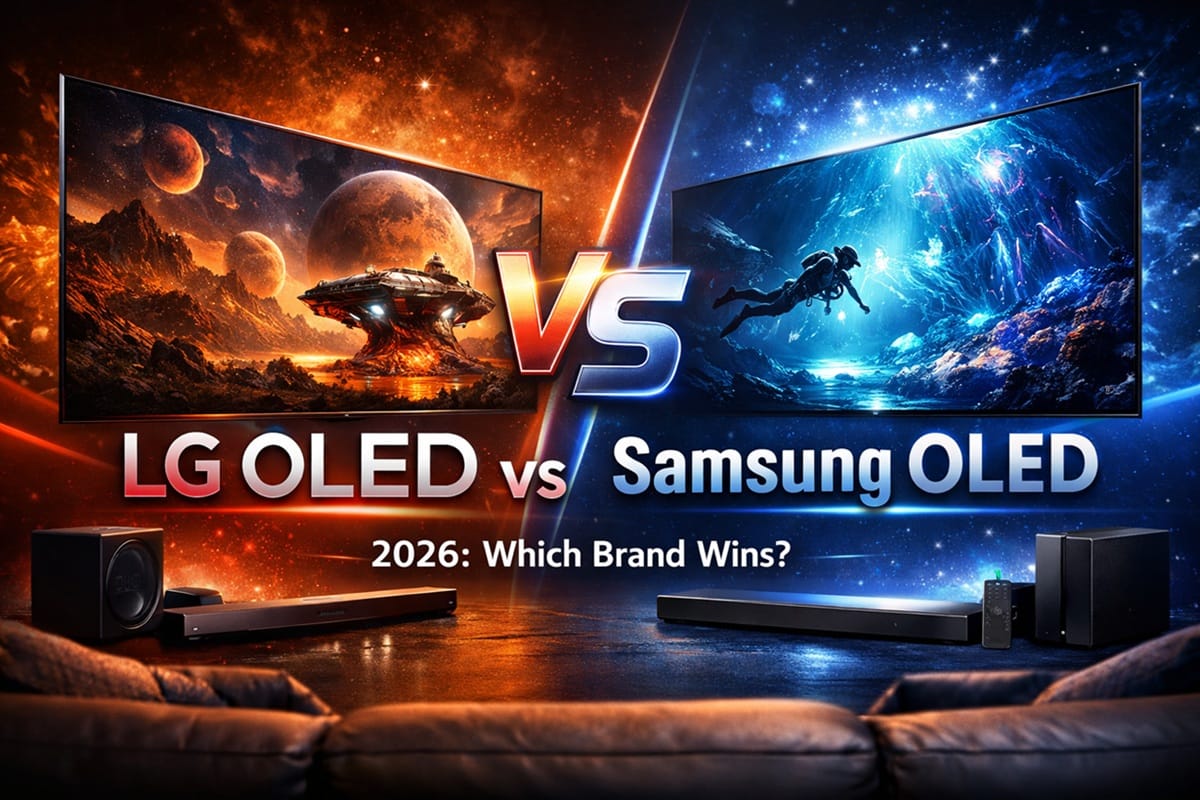
You’ve decided on OLED. Now comes the harder question: LG or Samsung? Both brands make excellent televisions, and both will give you the perfect blacks and infinite contrast that make OLED worth the price premium. But the differences between them are real, they run deeper than most reviews admit, and they’ll matter for how you actually use the TV every day.
The short answer on LG OLED vs Samsung OLED: LG wins for most buyers. Its WOLED panel delivers more consistent picture quality across a wider range of content, its webOS smart TV platform is cleaner, and its lineup covers more budgets and sizes. Samsung wins a specific, well-defined scenario — bright rooms and HDR content where its QD-OLED panel’s color volume advantage actually shows up on screen.
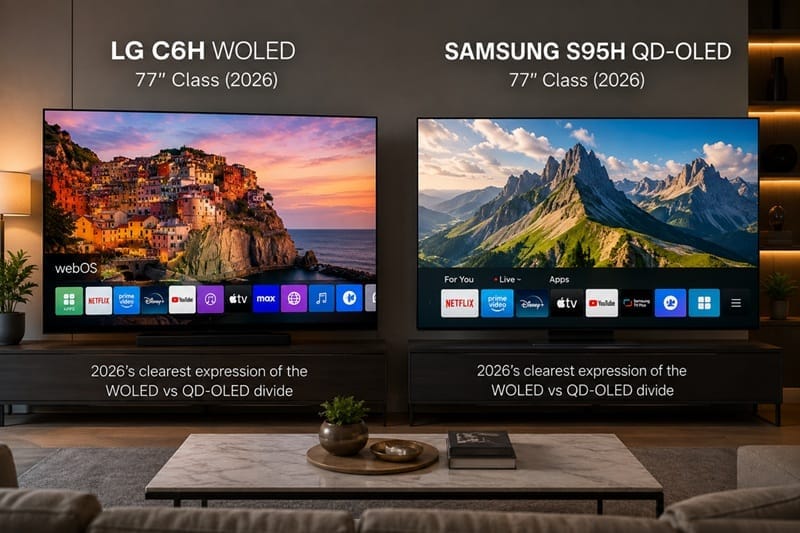
What makes this comparison interesting is that the LG vs Samsung OLED debate is really a panel technology debate. LG uses WOLED; Samsung uses QD-OLED. That single structural difference explains almost every real-world gap between the two brands. We compare the underlying tech, then break it down across picture quality, brightness, gaming, smart TV software, and value — drawing on RTINGS lab data and hands-on testing of both the LG C6H and Samsung S95H, the two brands’ standout 2026 models. If you want the full panel technology breakdown first, see our QD-OLED vs WOLED compared deep-dive.
Table of Contents
LG OLED vs Samsung OLED: Quick Verdict
LG OLED vs Samsung OLED: Our Verdict
Winner for most buyers: LG OLED — more consistent picture across all content types, cleaner software, and a lineup that spans 42″ to 83″ at every price tier.
Exception: Samsung wins if you watch primarily HDR movies and sports in a bright living room, and color saturation is your top priority.
Buy LG OLED if:
- Your room has controlled or dim lighting
- You stream Netflix, Apple TV+, or Disney+ (Dolby Vision support matters)
- You want the best upscaling for standard HD and cable content
- You game seriously and want 165 Hz with all four HDMI 2.1 ports active
Buy Samsung OLED if:
- Your living room gets significant ambient light during the day
- HDR10+ is your primary HDR format (PlayStation, 4K Blu-ray)
- You want a 55″ OLED — LG C6H doesn’t come in that size
- Art Mode and ambient display are features you’ll actually use
How They Compare
Scores reflect our editorial assessment based on spec analysis and RTINGS lab data.
Picture Quality — LG OLED
Picture Quality — Samsung OLED
Brightness & HDR — LG OLED
Brightness & HDR — Samsung OLED
Value & Lineup — LG OLED
Value & Lineup — Samsung OLED
Software (Smart TV) — LG OLED
Software (Smart TV) — Samsung OLED
Panel Technology: WOLED vs QD-OLED
LG and Samsung build their OLED panels differently — and that difference explains almost every gap you’ll find between them in testing.
What LG’s WOLED panel means in practice
LG’s WOLED (White OLED) panel uses a white organic emitter layer combined with a color filter array. Red, green, and blue sub-pixels are produced by filtering that white light through individual color filters, with a fourth white sub-pixel added to boost overall brightness. The result is a panel that produces exceptionally uniform brightness across the full screen — excellent for wide-shot movies and TV shows where large areas of the frame are lit consistently.
The 2026 LG C6H takes this further with LG Display’s Tandem OLED structure, which stacks two OLED layers instead of one. This roughly doubles peak brightness compared to a standard single-stack WOLED panel. The C6H reaches approximately 1,350 nits in a 10% HDR window — a meaningful step up from previous C-series models and competitive with Samsung’s QD-OLED at mid-scene brightness levels.
What Samsung’s QD-OLED panel means in practice
Samsung’s QD-OLED panel starts with a blue OLED emitter layer, then converts a portion of that blue light into red and green using a quantum dot color conversion layer. Because the quantum dot layer produces colors directly from light conversion rather than filtering, it retains more of the original light energy. The practical result: QD-OLED panels produce more saturated, vivid colors at high brightness levels, and peak HDR highlights hit harder — particularly on small bright objects against a dark background.
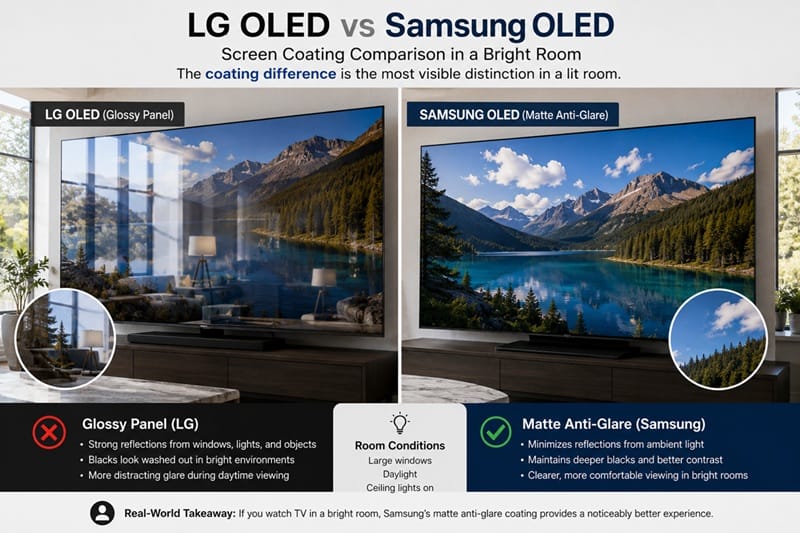
The Samsung S95H measures approximately 2,400–2,750 nits on a 10% HDR highlight window, depending on picture mode — well ahead of the LG C6H’s roughly 1,350 nits on the same window size. Samsung’s own marketing claims “up to 3,000 nits” peak brightness, which reflects a best-case spec rather than an independently measured result across all picture modes. The S95H’s matte anti-glare coating also diffuses ambient light differently than LG’s glossy panel — a real advantage in bright rooms, but one that comes with a slight softening of perceived sharpness in a fully dark room.
Picture Quality and Contrast: LG OLED Wins Overall
On the fundamental measure of OLED picture quality — black levels and contrast — both brands are essentially tied, because both use self-emissive pixels that switch off completely to produce absolute black. Where they separate is in what happens when scenes get complex.
Black levels and shadow detail
LG’s WOLED panel maintains black levels more consistently in a moderately lit room. Samsung’s QD-OLED panel exhibits slightly more black level rise when ambient light hits the screen — a consequence of the matte coating, which diffuses reflected light rather than eliminating it entirely. In a dark home theater, you won’t notice the difference. In a room with open blinds on a sunny afternoon, LG’s glossy panel actually holds deeper blacks despite its surface appearing to reflect more directly.
Color accuracy and processing
LG’s α11 AI Gen3 processor in the C6H handles upscaling and noise reduction better than Samsung’s NQ4 AI Gen3 — this matters most when you’re watching 1080p cable, streaming at compressed bitrates, or playing older games. RTINGS consistently rates LG’s processing as superior for mixed-quality content, while Samsung’s processing is optimized for high-quality native 4K HDR source material where it shines.
Color accuracy out of the box also favors LG. The C6H’s Filmmaker Mode and Cinema Mode calibrate closer to reference standards without manual adjustment. Samsung’s modes tend to push saturation higher by default — more immediately impressive on a showroom floor, but less accurate for serious film watching. Both can be calibrated to excellent accuracy, but LG requires less work to get there.
We covered the model-level picture quality differences in depth in our LG C6 vs Samsung S95F compared review, which includes measured calibration data for both panels.
Brightness and HDR: Samsung Wins in Bright Rooms
This is Samsung’s strongest argument, and it’s a legitimate one. The S95H’s QD-OLED panel produces more vivid color in HDR highlights — particularly on small specular highlights like sunlight on water, flames, or neon signs. If HDR spectacle is your primary motivation for buying an OLED TV, Samsung delivers a more dramatic HDR experience.
Peak brightness: where Samsung’s advantage is real
The S95H reaches approximately 2,400–2,750 nits on a 10% window, depending on picture mode, while the LG C6H Tandem panel reaches around 1,350 nits on the same window size. In practical terms, Samsung’s brightest HDR moments hit noticeably harder — the fireworks burst, the lightning strike, the stadium floodlight. For most content, the difference is most visible in mixed bright-and-dark HDR scenes rather than typical full-scene viewing.
The matte coating is Samsung’s other brightness argument. In a bright living room, specular reflections from windows or lamps become smeared highlights on LG’s glossy panel. Samsung’s matte coating eliminates those hard reflections, making daytime viewing more comfortable. The trade-off is a slight reduction in perceived depth in a dark room — Samsung’s blacks look marginally less absolute than LG’s when the lights are off.
Dolby Vision: LG’s HDR format advantage
LG supports Dolby Vision; Samsung does not. This matters more than it might seem. Netflix, Apple TV+, Disney+, and the majority of streaming services deliver their best HDR tier in Dolby Vision format. Samsung’s HDR10+ is excellent and well-supported by Amazon Prime Video and some 4K Blu-ray titles, but if streaming is your primary use case, LG’s Dolby Vision support gives it access to better-mastered HDR metadata on the most popular platforms.
Gaming Performance: Effectively a Tie
On paper, both TVs are elite gaming displays. The real differences are narrower than the spec sheets suggest — but they’re not zero.
Input lag, VRR, and HDMI 2.1
Both the LG C6H and Samsung S95H ship with four full-bandwidth HDMI 2.1 ports supporting 4K at 120 Hz with VRR. Both support ALLM (Auto Low Latency Mode) for automatic game mode switching. Input lag on both TVs in game mode measures around 1.1–1.3ms at 4K/120Hz — effectively imperceptible. Neither brand has a meaningful advantage for console gaming.
Refresh rate is now a tie: both the LG C6H and Samsung S95H top out at 165 Hz for PC gaming (up from 144 Hz on last year’s C5 and S90F/S95F generation). On both TVs, 4K at 165 Hz requires a PC-connected graphics card — neither brand offers it from a console source. For PlayStation 5 and Xbox Series X gaming, both TVs remain identically capable at 4K/120Hz. PC gamers should note: both TVs support NVIDIA G-Sync Compatible and AMD FreeSync, but at different tiers — the Samsung S95H carries the higher FreeSync Premium Pro certification, while the LG C6H supports the FreeSync Premium tier, one step below.
Burn-in and gaming hours
Both QD-OLED and WOLED panels carry burn-in risk with static content — HUDs, game UI elements, and taskbars are the most common culprits. LG’s WOLED has a longer multi-year track record; Samsung’s QD-OLED is newer but has not shown significantly higher burn-in rates in independent testing. Both brands include pixel-shift and screensaver features to mitigate the risk. For mixed-use TVs combining gaming and general streaming, both are acceptable with reasonable precautions.
For a deeper ranking of the best OLED TVs specifically for gaming, including how both the LG C6H and Samsung S95H stack up against Sony, see our best OLED TVs for gaming guide — or if Sony is already on your shortlist, our Sony OLED vs LG OLED comparison covers how the two brands split on picture and value.
Smart TV Software: webOS vs Tizen
You’ll touch the remote more than you’ll notice the panel tech. webOS 26 and Tizen both run fast and carry every major streaming app — the difference is in how aggressively each platform tries to monetize your attention.
LG webOS 26
webOS 26 is clean, fast, and relatively unobtrusive. The home screen keeps apps and inputs easily accessible without burying them under content recommendations. LG’s ThinQ AI integration handles voice commands and smart home device connectivity. The key differentiator: LG’s approach to advertising in the UI is less prominent than Samsung’s by most accounts — you’ll see content suggestions but fewer promoted placements.
Samsung Tizen and SmartThings
Tizen is a more capable smart home hub — Samsung’s SmartThings ecosystem integration is deeper than LG’s, and if you own Samsung appliances, Galaxy phones, or SmartThings-compatible devices, Tizen’s interconnectivity is a genuine advantage. The trade-off is a home screen that carries more advertising and promotional content than webOS. It’s not disruptive, but it is consistently present. Tizen also powers Samsung’s Art Mode and ambient display features, which are beautifully executed if you value the TV as a piece of room furniture when it’s not being actively watched.
Price and Value: LG’s Lineup Wins on Breadth
LG’s OLED lineup in 2026 spans from the entry-level B5 through the mid-range C6 and C6H to the flagship G6 and Z6. This gives buyers a genuine OLED option at multiple price points, with the C-series remaining the sweet spot for value. On the LG OLED vs Samsung OLED value question specifically, Samsung’s OLED lineup is thinner — the S85H, S90H, and S95H — and skews toward the premium end of the market.
At equivalent sizes and price tiers, LG consistently offers more for the money. The C6H’s Tandem OLED panel at its price point is the strongest value argument in 2026 OLED. Samsung’s S95H commands a premium that’s justified if the specific advantages matter to you — the matte coating, the size range, Art Mode — but isn’t justified purely on picture quality at the same dollar figure.
LG OLED vs Samsung OLED: Which Should You Buy?
For most buyers, LG OLED is the right choice in the LG OLED vs Samsung OLED decision. The combination of WOLED’s consistent picture quality across all content types, Dolby Vision support for the best streaming HDR, measurably better upscaling for non-4K source material, and a cleaner smart TV experience makes LG the default recommendation at every price tier where both brands compete.
Samsung OLED earns a clear recommendation in one specific scenario: a bright living room where the matte anti-glare coating solves a real problem. If you watch TV with open blinds, windows behind the screen, or significant room lighting that you can’t or won’t control, the S95H’s coating makes a visible daily difference. Add to that Samsung’s wider size availability — the S95H comes in 55″, 65″, 77″, and 83″, while the C6H is limited to 77″ and 83″ — and Samsung is the obvious pick for anyone who needs a premium 55″ or 65″ OLED.
If color saturation and peak HDR spectacle are your primary criteria, Samsung’s QD-OLED panel also earns its place. But if you’re calibrating, watching in a controlled environment, or mixing gaming with streaming with movies, LG’s broader capability set is the safer long-term choice. For a full breakdown of the LG lineup model by model, see our LG OLED roundup — and for Samsung’s range, our Samsung OLED roundup covers S85H through S95H in detail. For a broader look at the best models across all brands, see our best OLED TVs of 2026 guide.
If color saturation and peak HDR spectacle are your primary criteria, Samsung’s QD-OLED panel also earns its place. But if you’re calibrating, watching in a controlled environment, or mixing gaming with streaming with movies, LG’s broader capability set is the safer long-term choice. For a full breakdown of the LG lineup model by model, see our LG OLED roundup — and for Samsung’s range, our Samsung OLED roundup covers S85H through S95H in detail. For a broader look at the best models across all brands, see our best OLED TVs of 2026 guide.
Curious how Sony fits into this fight too? See our full LG vs Samsung vs Sony OLED comparison for the three-way verdict.