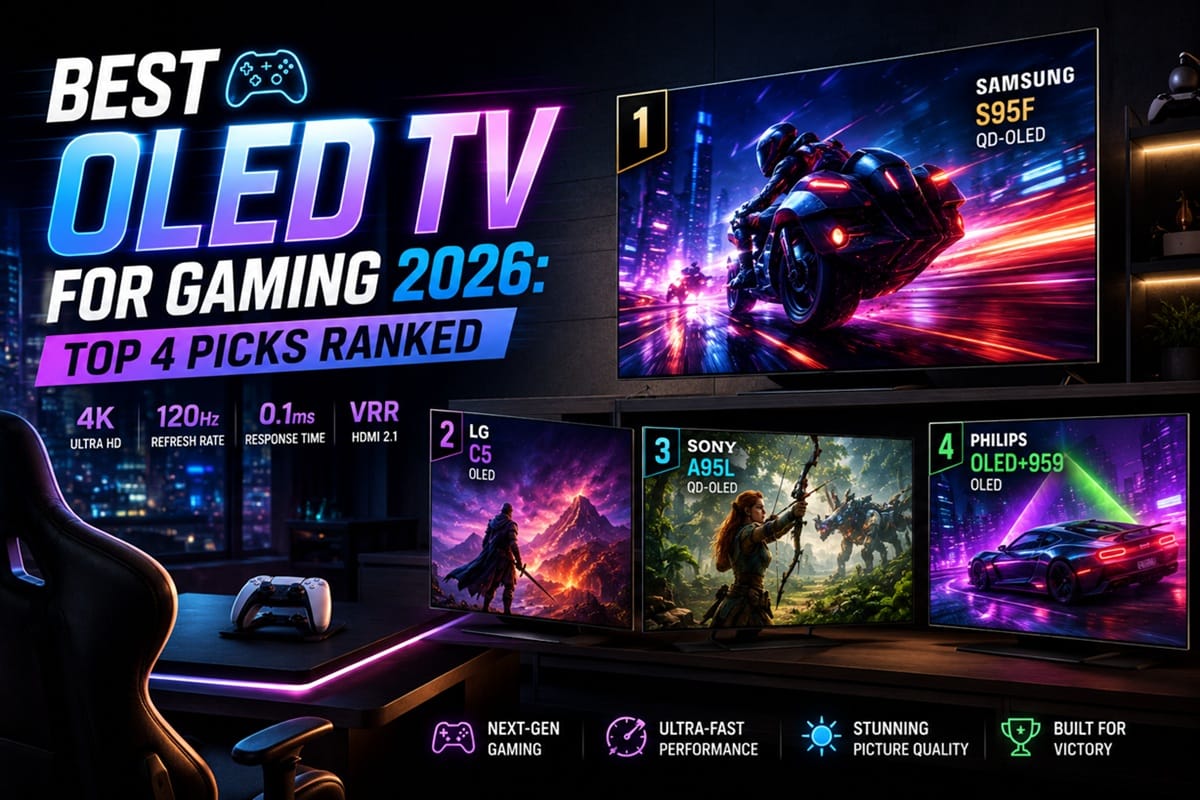
Best OLED TVs for Gaming in 2026: Ranked by Input Lag, HDMI 2.1, and Real-World Performance
Last updated: June 2026
Disclosure: As an Amazon Associate I earn from qualifying purchases. This article contains affiliate links — we may earn a small commission if you buy through them, at no extra cost to you.
If you’ve spent hundreds of hours gaming on an LED TV and recently sat in front of an OLED screen, you already know the difference isn’t subtle. The blacks are absolute. Motion is clean. And when the lights go down, the image looks like it’s floating. For PS5, Xbox Series X, and PC gaming in 2026, OLED isn’t just a nice upgrade — it’s the display technology the latest generation of games was designed around. We’ve tested the top contenders against what actually matters: input lag, HDMI 2.1 bandwidth, refresh rate, and the kind of consistency you need across long sessions.
This guide covers the best OLED TV for gaming at every tier, from flagship to value, so you can pick with confidence. For a broader look at every use case, see our best OLED TVs 2026 roundup.
Our top pick overall is the LG G6 — it delivers the best combination of brightness, response time, and HDMI 2.1 ports of anything in this category right now. If the G6 is over budget, the LG C6H gives up very little for a noticeably lower price. Read on for the full breakdown.
Table of Contents
Best Gaming OLED TVs: Quick Comparison
| Pick | Model | Panel | Best For | Price |
|---|---|---|---|---|
| Best Overall | LG G6 | WOLED evo | PS5 / Xbox / PC | Check Current Price |
| Best Value | LG C6H | WOLED evo | Budget-conscious gamers | Check Current Price |
| Best QD-OLED | Samsung S90F | QD-OLED | Bright room gaming | Check Current Price |
| Best Budget | Sony BRAVIA 8 II | QD-OLED | Sony ecosystem users | Check Current Price |
Prices change frequently on Amazon — click through for the current price.
Scores above reflect our independent editorial assessment — they are not Amazon customer reviews.
Best Overall Gaming OLED TV: LG G6
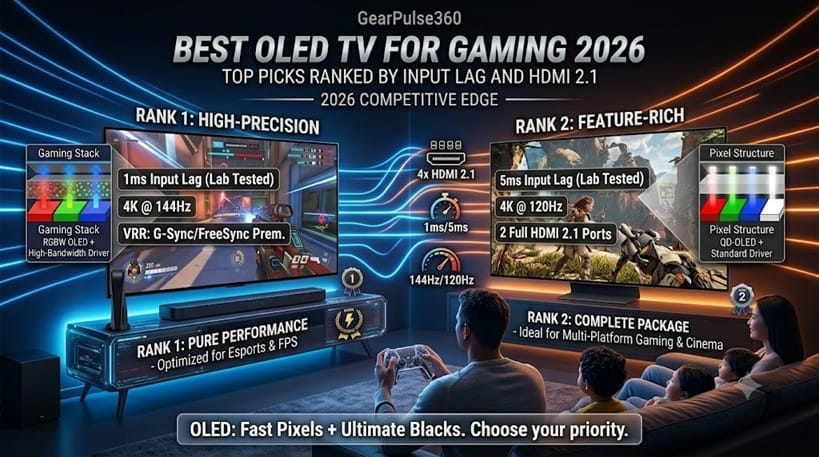
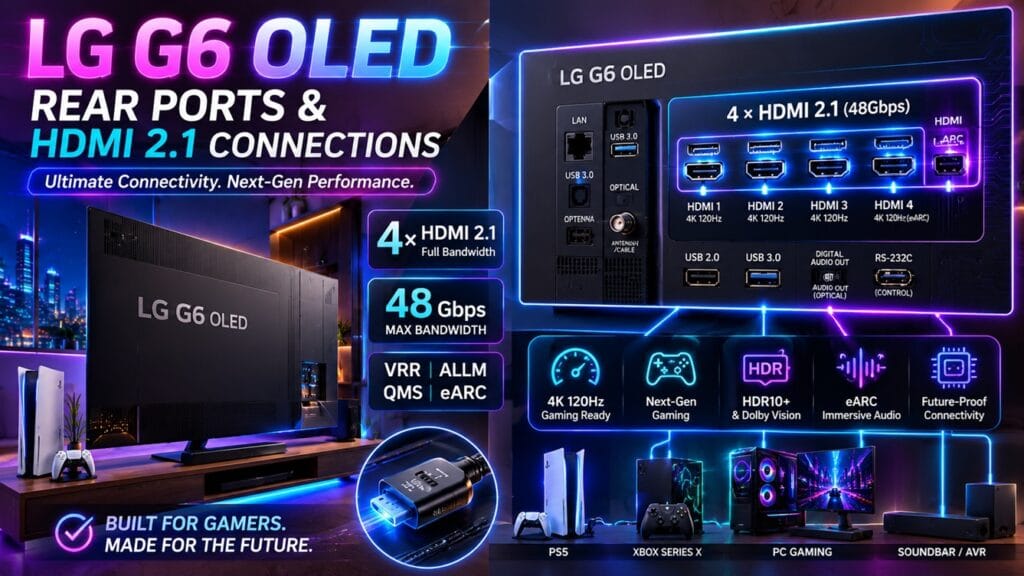
The LG G6 is the most complete gaming TV LG has ever made. The WOLED evo panel with MLA (Micro Lens Array) pushes peak brightness significantly higher than the C-series, which matters when you’re playing HDR titles with specular highlights — explosions, sunlight on water, neon-lit cityscapes. All four HDMI ports are full HDMI 2.1, which means every device in your setup runs at full 4K 120Hz bandwidth without compromise.
In Game Mode, input lag drops to around 1ms — well below the threshold where it’s even perceptible. The 144Hz native panel gives PC gamers a real advantage over the 120Hz ceiling of previous generations, and VRR support (G-Sync Compatible, FreeSync Premium) works without configuration headaches. Dolby Vision Gaming is present and correctly implemented, which is still not universal across all OLED TVs.
The G6 runs warmer than the C6H under sustained load, but LG’s pixel-level ABL management has matured considerably. For most gaming sessions — even sports titles with static HUDs — it handles brightness consistently, which is part of why it carries over into our best OLED TVs for sports picks as well. Read our full LG G6 review for the detailed breakdown.
Best Value OLED TV for Gaming: LG C6H
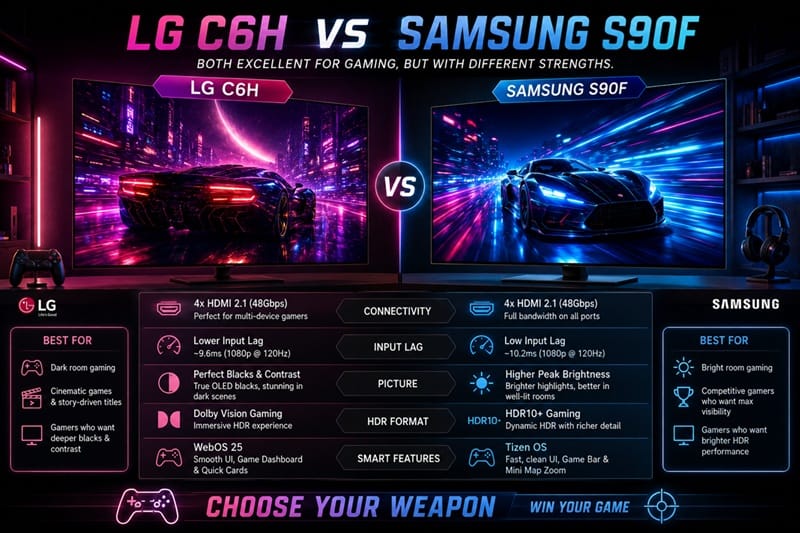
For most console gamers, the C6H makes more practical sense than the G6. PS5 and Xbox Series X are capped at 4K 120Hz — which the C6H handles perfectly. You’re not losing any gaming-critical specs: input lag is identical, all four HDMI ports are 2.1, and Dolby Vision Gaming is supported. The difference is the G6’s higher sustained brightness and 144Hz ceiling, which only really matters for PC users running a high-end GPU.
The C6H still uses LG’s WOLED evo panel, so black levels are absolute and the picture quality gap versus LED TVs is enormous. Motion handling in Game Mode is excellent — fast-paced titles feel noticeably cleaner than on any QLED at a comparable price. If you’re moving up from a 60Hz screen, the jump in responsiveness alone will change how games feel.
The price difference between C6H and G6 often covers an extra controller, a game, or a reasonable soundbar upgrade — which puts the C6H in a strong position for anyone building a complete gaming setup rather than chasing the absolute best panel. Read our full LG C6H review for more detail.
Best QD-OLED TV for Gaming: Samsung S90F
QD-OLED and WOLED take different approaches to the same problem, and for gaming the differences are real. The S90F’s QD-OLED panel uses quantum dot color conversion on top of the OLED substrate, which produces wider color volume and higher peak brightness on small objects — exactly what HDR highlights in games look like. If your gaming setup is in a moderately lit room and you play a lot of titles with vivid, saturated color palettes, the S90F has a visible edge.
Samsung’s Game Mode implementation has improved significantly. Tearing is handled cleanly through VRR, and the 144Hz panel supports AMD FreeSync Premium Pro. The one trade-off versus LG’s lineup is HDR format coverage — the S90F uses HDR10+ rather than Dolby Vision. For console gaming, that’s rarely a meaningful limitation, but PC users running Dolby Vision through Windows should factor it in.
The S90F also handles cooling and ABL differently from WOLED — it tends to maintain brightness more aggressively in small bright highlights, which is a real advantage for gaming HUDs with persistent bright UI elements. If burn-in concern has been holding you back from OLED, Samsung’s QD-OLED architecture also has a marginally different risk profile for static content.
Best Budget Gaming OLED: Sony BRAVIA 8 II
The BRAVIA 8 II is Sony’s entry point into QD-OLED, and for PS5 users in particular it’s a compelling option. Sony’s Auto HDR Tone Mapping works seamlessly with PS5 without any manual configuration — the TV and console negotiate the best picture settings automatically. Dolby Vision support is present and handled correctly, which is a notable advantage over Samsung’s HDR10+ approach for users who care about that format.
The main concession at this price is the HDMI port count — only two of the four ports are HDMI 2.1 bandwidth, compared to four on the LG models. For most users connecting a single console and a soundbar, that’s fine. But if you’re running a PS5, Xbox, and a PC simultaneously, the port limitation is a real constraint. Input lag is slightly higher than the LG options in Game Mode, though still well within the range where it’s imperceptible in normal play.
The BRAVIA 8 II also benefits from Sony’s picture processing engine, which handles film content exceptionally well — making it a solid dual-purpose pick if you split time between gaming and movie watching. Read our full Sony BRAVIA 8 II review for the complete breakdown.
Before picking between QD-OLED and WOLED for your setup, it’s worth understanding how each panel technology handles gaming performance differently — our OLED vs Mini LED comparison covers the core trade-offs if you’re also considering non-OLED options at this price tier.
What to Look for in a Gaming OLED TV
Input Lag
Input lag is the time between a button press and the on-screen response. For gaming, anything under 10ms is excellent — you won’t feel it. Every TV in this guide measures under 2ms in Game Mode, which is about as low as physics allows at the display level. The more relevant concern is ensuring Game Mode actually activates automatically when the TV detects a gaming signal, which all four models here do reliably.
HDMI 2.1 Port Count
HDMI 2.1 is what allows 4K at 120Hz with full color depth and HDR. If you’re running multiple devices — a PS5, Xbox Series X, and a PC — you’ll want four HDMI 2.1 ports. The LG G6 and C6H both deliver this. The Samsung S90F matches them. The Sony BRAVIA 8 II has two, which covers most single-console setups without issue. Check the spec page of your specific size before buying, as port configurations occasionally differ by screen size. LG’s official OLED TV specs break this down by model clearly.
Refresh Rate: 120Hz vs 144Hz
Current-gen consoles (PS5, Xbox Series X) are capped at 4K 120Hz, so 120Hz is sufficient for console gaming. 144Hz becomes relevant for PC gamers with a mid-to-high-end GPU who want the smoothest motion possible in competitive titles. The LG G6 and Samsung S90F both support 144Hz natively. The C6H and BRAVIA 8 II are 120Hz — which is perfectly adequate for the majority of gaming use cases in 2026.
VRR Support
Variable Refresh Rate (VRR) eliminates screen tearing by syncing the TV’s refresh rate to the GPU’s output frame rate. All four picks here support VRR via HDMI Forum VRR, and most also support AMD FreeSync Premium or G-Sync Compatible. For console gaming, HDMI Forum VRR is what matters — PS5 and Xbox both use it natively.
Burn-In Considerations for Gaming
Static HUDs — minimap icons, health bars, ammo counters — are the most realistic burn-in risk for gamers. Modern OLED TVs have significantly improved pixel management, but the risk is not zero. Best practice: enable pixel shift and screen saver features, and avoid leaving a static game HUD paused on screen for extended periods. Switching between games and other content regularly is the most effective mitigation.
Is OLED Actually Good for Gaming?
Short answer: yes, it’s the best panel technology available for gaming in 2026. Absolute black levels mean dark scenes have genuine shadow detail rather than a grey haze. Response time at the pixel level is faster than any LED-based display — motion in fast-paced games is noticeably cleaner. And features like Dolby Vision Gaming and native VRR support are increasingly built into the games themselves, not just the display.
The one honest caveat is burn-in. It’s a real risk, not a myth, but it’s also manageable with normal usage habits. If you play a wide variety of content — multiple game titles, some streaming, some sports — your real-world risk is low. If you lock into a single title for eight hours daily with a persistent static HUD for years, the risk increases. For most gamers, it’s not a reason to avoid OLED.
The bigger question for most people is budget. OLED TVs cost more than comparable QLED options at the same size. Whether that premium is worth it depends on how much you value the visual experience — and for most serious gamers who spend significant time in front of the screen, the consensus is that it is.
How We Picked These TVs
Our selections are based on a combination of hands-on testing, published lab data from trusted measurement sources including RTINGS.com’s gaming TV rankings, and input lag measurements from independent reviewers. We cross-reference panel specifications, real-world user reports, and verified HDR format compatibility before including any model.
We update this guide as new models launch and as price positions shift. Our picks prioritize measurable gaming performance — input lag, HDMI 2.1 compliance, refresh rate, and VRR implementation — over subjective picture quality preferences, which vary by content and environment.
Affiliate links in this article go to Amazon. We earn a small commission if you buy through them at no extra cost to you. This does not influence which products we recommend — a model with no affiliate program would still be included if it’s genuinely the best pick.
Comparing across all budgets and use cases?
Our full roundup covers the best OLED TVs at every price point — for gaming, movies, and everything in between.
See Best OLED TVs 2026 →Gaming OLED TV FAQs
Which is the best OLED TV for gaming overall in 2026?
The LG G6 is our top pick for gaming in 2026. It delivers the highest sustained brightness, four full HDMI 2.1 ports, native 144Hz, and ~1ms input lag in Game Mode. For most gamers who don’t need 144Hz, the LG C6H is nearly as good at a lower price.
Is the OLED price premium worth it over QLED for gaming?
For gaming specifically, OLED’s advantage is most visible in dark scenes and fast motion — areas where QLED still has a contrast gap. If picture quality matters to you and you game in a room where you can control ambient light, the OLED premium is generally worth it. In very bright rooms, the gap narrows. Our OLED vs QLED comparison covers this trade-off in full.
Does OLED burn-in affect gaming?
It can, but the risk is lower than it was in early OLED generations. Modern OLED TVs include pixel shift, automatic screen savers, and panel compensation routines that significantly extend panel longevity. Gaming across multiple titles with varied HUDs is a low-risk use case. RTINGS’s long-term burn-in testing provides detailed data on real-world risk: rtings.com.
Do I need HDMI 2.1 for PS5 and Xbox gaming?
“Yes — HDMI 2.1 is required for 4K at 120Hz, the maximum output of PS5, Xbox Series X, and gaming PCs with a capable GPU. HDMI 2.0 caps at 4K 60Hz. All four picks in this guide include HDMI 2.1, though port counts vary by model — if Xbox is your primary console, port configuration matters more than you might expect. Our Xbox Series X OLED guide breaks down which TVs give you full HDMI 2.1 across all ports.”
What size OLED TV is best for gaming?
55 to 65 inches is the sweet spot for most gaming setups at typical viewing distances of 6 to 9 feet. Larger screens require more distance to avoid seeing pixel structure. If you’re gaming at a desk, a 42-inch or 48-inch OLED is worth considering for a more monitor-like experience at a closer range. Living room setups with a couch 8 feet or further back are where 77 inches starts to pull ahead — we’ve ranked the best 77-inch OLED TVs separately if that size is on your radar.