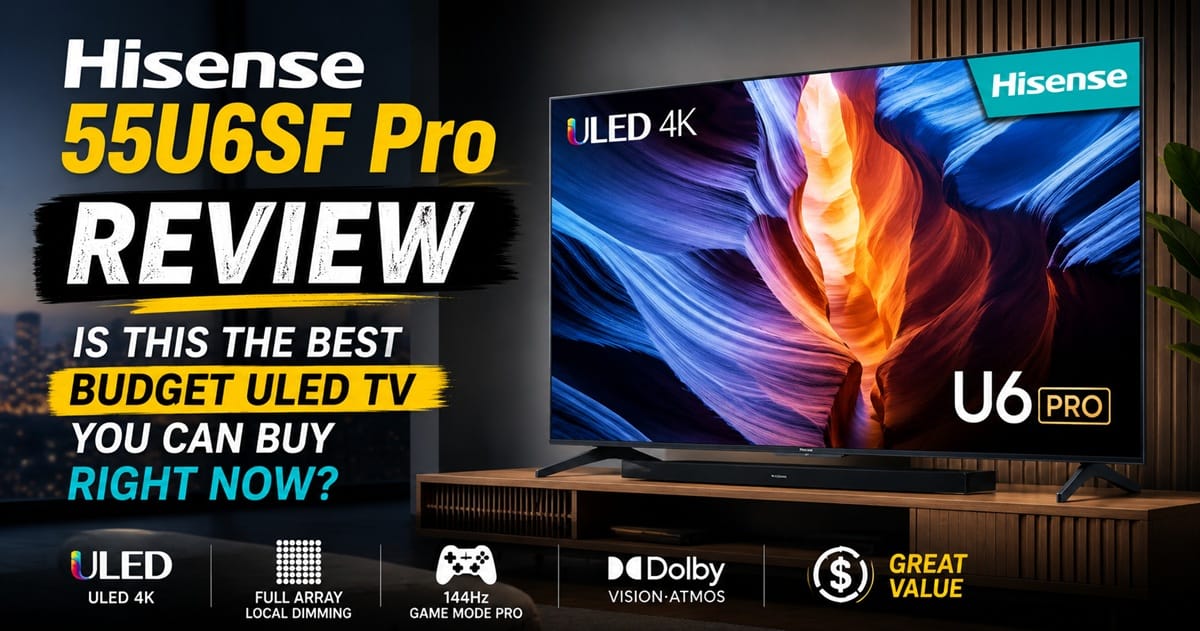
Hisense 55U6SF Pro Review 2026: Worth Buying?
Last updated: June 2026,🕒 9 min read
Disclosure: As an Amazon Associate I earn from qualifying purchases. This article contains affiliate links — we may earn a small commission if you buy through them, at no extra cost to you.
A native 144Hz refresh rate used to mean spending well over a thousand dollars on a TV. That math has gotten more forgiving every year, and the Hisense 55U6SF Pro is one of the clearer examples of how far it’s shifted — a Mini-LED panel with genuine gaming specs at a price bracket that used to only buy basic LED.
This review breaks down what the U6SF Pro actually delivers, where Hisense cut corners to hit this price, and who it’s actually built for. If you’re weighing it against pricier panel technology before deciding, our best OLED TVs of 2026 roundup covers where OLED still pulls ahead — and where it doesn’t matter as much as the spec sheet suggests.
Table of Contents
Quick Verdict: Is the Hisense 55U6SF Pro Worth It in 2026?
At a Glance
★★★★☆ Rating: 7.7/10
👍 Best For: Budget-conscious buyers who want genuine 144Hz gaming and real Mini-LED contrast without flagship pricing; secondary-room or first-apartment buyers; households that want Dolby Vision and HDR10+ without paying for a premium tier.
👎 Skip If: You want OLED-level black levels and contrast in a dedicated dark room; you need flagship-tier brightness and a high local dimming zone count; or you’re shopping at the top of the Mini-LED budget range and could stretch toward a higher tier instead.
Verdict: A budget Mini-LED panel that actually delivers on its gaming spec sheet — with real-world trade-offs worth understanding before you buy.
Hisense 55U6SF Pro Specifications at a Glance
Design and Build Quality
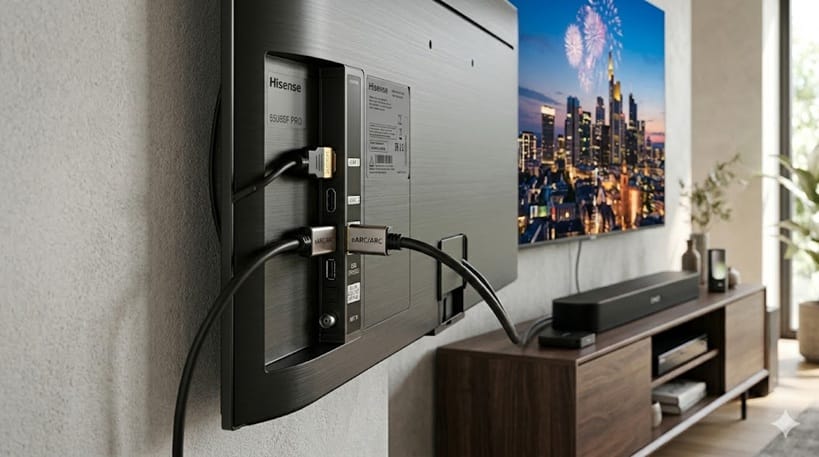
The U6SF Pro keeps to Hisense’s current design language — slim bezels, a clean stand, nothing architectural about it. What’s worth knowing before it arrives is the anti-reflection, glare-free screen treatment. It genuinely cuts down on daytime glare from windows and overhead lighting, which matters more on a budget TV than people expect, since cheaper panels often get placed in brighter, less controlled rooms.
Hisense markets this as a step into Mini-LED without moving into a higher-priced tier, and the build reflects that positioning — solid enough for daily use, without the heavier glass or premium materials you’d find on the brand’s step-up U7 series. Full specifications and panel details are available on Hisense’s official U6SF Pro product page.
Performance and Real-World Use
Everyday Streaming and HDR
This is where the U6SF Pro’s “Total HDR Solution” branding earns its keep — Dolby Vision, Dolby Vision IQ, HDR10, HDR10+, HDR10+ Adaptive, and HLG are all supported, which covers nearly everything Netflix, Disney+, and Apple TV+ throw at it. Dolby Vision IQ specifically adjusts tone mapping to ambient light automatically, so the picture doesn’t need constant manual mode-switching between a sunlit afternoon and a dark evening. The set is also IMAX Enhanced and Pantone Color Validated, which on paper signals more consistent, accurate color reproduction than a typical budget panel.
Gaming at 144Hz
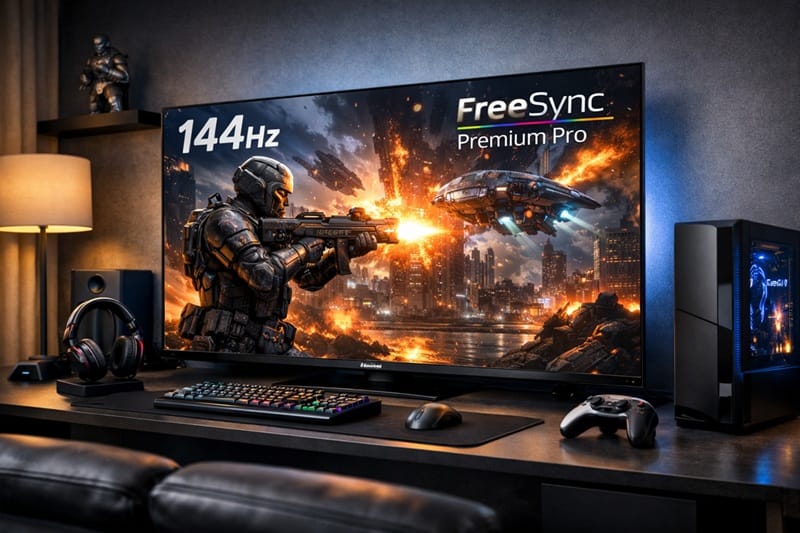
The headline spec here is a native 144Hz refresh rate with Motion Rate 480 processing, backed by AMD FreeSync Premium Pro certification. At this price point, that combination is genuinely uncommon — most budget TVs cap out at 60Hz with no real VRR support. Based on Hisense’s official specifications and energy documentation, the U6SF Pro is positioned as a legitimate option for buyers who want smoother motion in fast-paced games without paying for a flagship gaming TV.
We have not seen independent third-party lab testing of input lag or real-world VRR stability for this exact 2026 model yet, since it only just began shipping — so treat the gaming specs as manufacturer-confirmed rather than independently verified for now. Hisense’s own official energy and specification documentation confirms the panel’s core figures.
Where Mini-LED Shows Its Limits
The honest trade-off: this is an entry-level Mini-LED implementation, not a flagship one. Hisense doesn’t publish a specific local dimming zone count for the U6SF Pro the way it does for the step-up U7 series, which is itself a signal that zone density here is modest. In practice, that means less precise contrast control than Hisense’s pricier Mini-LED sets, and a real gap versus OLED in dark-room viewing where per-pixel control matters most.
If absolute black levels and contrast are the priority, this isn’t the panel for that — and it’s worth being upfront about that before getting into the rest of the review. For a deeper look at exactly where that gap shows up and where it doesn’t matter as much, our OLED vs Mini LED comparison breaks down the brightness, contrast, and gaming trade-offs between the two technologies.
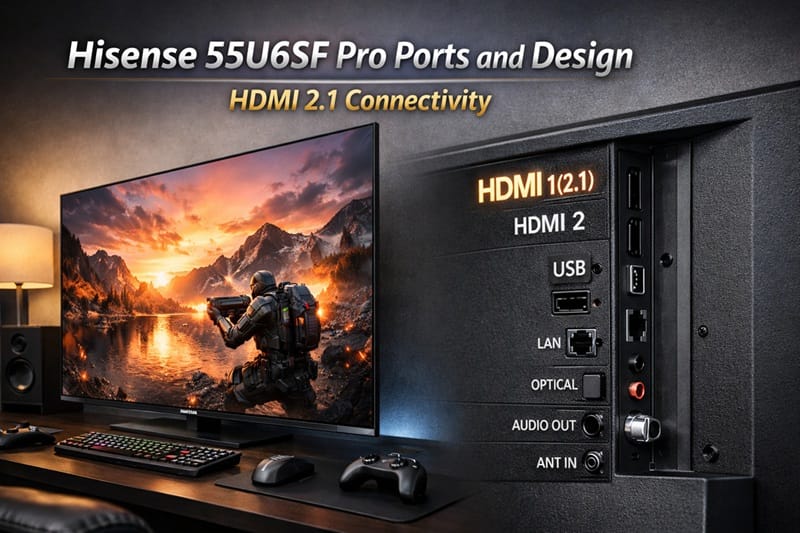
Key Features Breakdown
Hi-QLED Mini-LED with Full-Array Local Dimming
Mini-LED backlighting splits the panel into zones that can dim or brighten independently, which is the entire reason this TV outperforms a basic LED set on contrast. Combined with Hisense’s Hi-QLED quantum dot color layer, the result is a brighter, more saturated picture than older ULED generations — without claiming OLED-level precision, which it doesn’t have.
Hi-View AI Engine
Hisense’s scene-adaptive processing analyzes content in real time and adjusts brightness, contrast, and sharpness automatically — sports get extra motion handling, movies get more cinematic tone mapping, and games prioritize low-latency response. It’s a background feature most buyers won’t think about, but it’s doing real work across everyday viewing.
Built-In Subwoofer
A genuinely useful inclusion at this price — most budget TVs rely entirely on thin downward-firing drivers. The built-in subwoofer adds real low-end to dialogue and movie soundtracks, which won’t replace a soundbar but meaningfully improves the out-of-the-box experience for buyers who aren’t planning to add separate audio.
The Good, the Bad, and the Ugly
Pros:
✅ Native 144Hz with FreeSync Premium Pro — rare at this price bracket, and a real differentiator for budget-minded gamers.
✅ Mini-LED with full-array local dimming delivers a meaningful contrast step up over standard LED panels.
✅ Dolby Vision IQ and the full HDR format suite cover virtually every streaming source.
✅ Built-in subwoofer adds real low-end without needing a separate soundbar.
✅ Anti-reflection screen treatment genuinely helps in brighter rooms.
Cons:
❌ Dimming zone count isn’t published and is presumably modest compared to Hisense’s own step-up U7 series.
❌ Brightness ceiling sits below higher Hisense tiers and well below flagship Mini-LED competitors.
❌ Fire TV’s interface and ad placement won’t suit everyone, especially buyers coming from Google TV or Roku.
The Ugly
Here’s the part worth being direct about: this TV’s spec sheet — Mini-LED, 144Hz, FreeSync Premium Pro — reads like something from a much higher price tier, and that can create expectations the panel itself doesn’t fully back up. The gaming specs are real and genuinely uncommon at this price. The contrast and brightness ceiling are not flagship-level, and Hisense’s own silence on zone count for this model is a tell. If your priority is deep, OLED-style black levels in a dark room, this isn’t the panel that delivers that — no Mini-LED at this price point is.
Who Should Buy This — and Who Shouldn’t
Buy This If
The U6SF Pro makes sense if you want a genuine step up from basic LED — real Mini-LED contrast, a properly fast 144Hz panel with working VRR, and full HDR format support — without paying flagship prices. It’s a strong fit for a secondary room, a first apartment TV, or a household that wants Dolby Vision and good gaming specs on a tighter budget. If you’re still deciding between this kind of budget Mini-LED and stepping up to OLED, our full OLED vs QLED comparison walks through exactly where the picture-quality gap matters and where it doesn’t.
And if your budget has more room to work with, our best OLED TVs under $1,000 picks are worth a look before you commit. Or if it’s screen size rather than picture refinement you’re chasing, Hisense’s own 85U6SF Pro review covers the same U6 Pro platform scaled all the way up to 85 inches.
Skip This If
If you watch primarily in a dark, dedicated home theater setup, the contrast and black-level gap versus OLED will bother you more than the price difference justifies closing. The same goes if you’re chasing the brightest possible HDR highlights — Hisense’s own higher Mini-LED tiers, and OLED at a similar budget tier, both outperform this panel’s brightness ceiling. And if 144Hz gaming and Mini-LED contrast aren’t priorities for you at all, our Samsung Crystal UHD buying guide covers a simpler, even more budget-focused 4K tier. For a much smaller secondary-room or bedroom set, Hisense’s own 40QD4SR review is worth a look — it drops down to a Full HD panel at a fraction of the size and price.
Final Verdict: Is the Hisense 55U6SF Pro Worth It in 2026?
For a budget-conscious buyer who wants real Mini-LED contrast and genuinely fast gaming specs without flagship pricing, the Hisense 55U6SF Pro earns its place. Native 144Hz with FreeSync Premium Pro at this price is the standout, and the full HDR format suite means it won’t feel limited on any major streaming platform. The honest caveat is the brightness and dimming-zone ceiling — this is an entry Mini-LED implementation, not a flagship one, and buyers prioritizing dark-room contrast should look elsewhere.
If you’re still working out whether the OLED price premium is worth paying at all before settling on a budget Mini-LED like this one, our broader breakdown of whether OLED is worth it in 2026 lays out the tradeoffs in more detail.
Frequently Asked Questions
Is the Hisense 55U6SF Pro Mini-LED or QLED?
It’s Mini-LED — specifically Hisense’s Hi-QLED Mini-LED with full-array local dimming, combining a Mini-LED backlight with quantum dot color filtering. It is not a basic edge-lit QLED panel, which matters for the contrast and brightness gains it delivers over older budget TVs.
Is the Hisense 55U6SF Pro good for gaming?
Yes, notably so for its price tier. It supports a native 144Hz refresh rate, Motion Rate 480 processing, and AMD FreeSync Premium Pro for variable refresh rate. Those specs are uncommon at this price point and make it a legitimate option for budget-focused gamers, though independent input-lag testing for this exact 2026 model isn’t available yet.
How does the Hisense 55U6SF Pro compare to past Hisense U6 models?
The U6 line has historically been Hisense’s entry-level ULED tier. The previous-generation Hisense U6N, for example, was tested independently by RTINGS as a budget-friendly, standard-LED set without Mini-LED backlighting. The 2026 U6SF Pro represents a real step up from that generation specifically because it adds Mini-LED with full-array local dimming and a native 144Hz panel — features the older U6N generation didn’t have.
Does the Hisense 55U6SF Pro support Dolby Vision?
Yes. It supports Dolby Vision, Dolby Vision IQ (which adjusts tone mapping to ambient room lighting automatically), HDR10, HDR10+, HDR10+ Adaptive, and HLG — covering effectively every major HDR format used by current streaming services.

iYaiii
Editor, GearPulse360
iYaiii is the editor and founder of GearPulse360, specializing in TV reviews and consumer electronics. He researches every recommendation before publishing.
✅ Based on spec analysis and manufacturer documentation — last verified June 2026