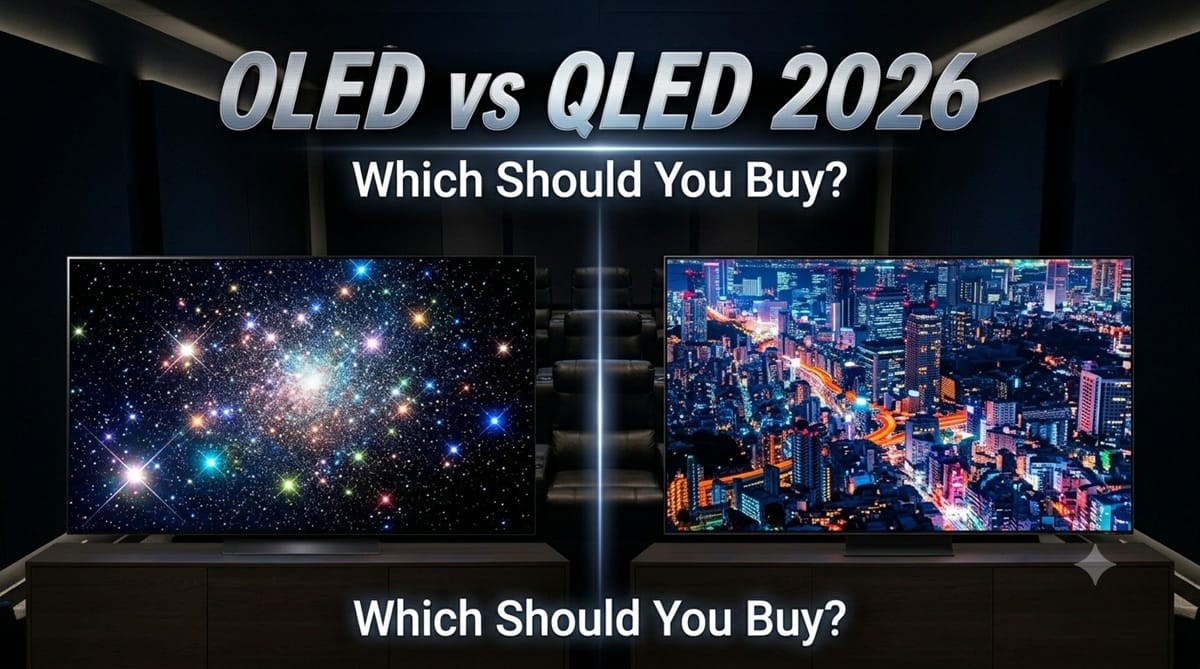
OLED vs QLED in 2026: Which TV Technology Is Actually Worth Your Money?
Last updated: June 2026
Disclosure: As an Amazon Associate I earn from qualifying purchases. This article contains affiliate links — we may earn a small commission if you buy through them, at no extra cost to you. Our recommendations are always editorially independent.
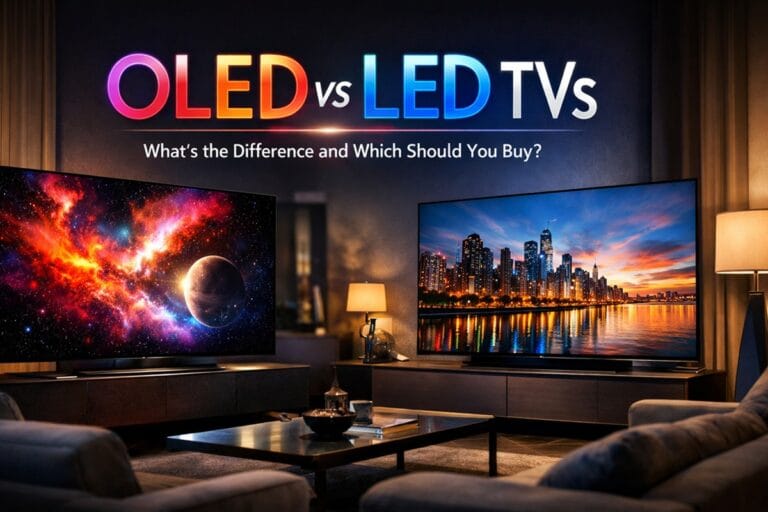
Walk into any electronics store and the TVs that stop people aren’t always the most expensive ones — they’re the ones labeled OLED. But the Samsung next to it says QLED and costs $400 less. Both claim to be the better picture. So which one actually is?
Here’s the short version: OLED wins on picture quality in a dark or dim room, delivering contrast and color accuracy that QLED simply can’t match at the hardware level. But QLED wins on brightness, screen size per dollar, and durability in bright rooms — and for many living rooms, those advantages matter more than perfect blacks.
In this comparison, we cover contrast, brightness, gaming performance, value, and use-case fit. We’re not comparing specific models — if you’re also weighing OLED against Mini LED, we cover that technology matchup separately.
Table of Contents
OLED vs QLED: Quick Verdict
OLED vs QLED: Our Verdict
Winner for most buyers: Depends on your room — OLED for dark rooms and gaming, QLED for bright rooms and budget-conscious buyers.
Exception: QD-OLED (Samsung S95F, Sony Bravia 8 II) closes the brightness gap significantly and is worth considering if you want the best of both.
Buy OLED if:
- You watch movies or TV in a dim or dark room
- Gaming performance and response time are priorities
- You want the most accurate, cinematic picture quality
Buy QLED if:
- Your living room gets strong natural light during the day
- You want a 75″ or larger screen without a steep price jump
- Your budget is under $800 for a 55″ TV
How They Compare
Contrast & Black Levels — OLED
Contrast & Black Levels — QLED
Brightness & HDR — OLED
Brightness & HDR — QLED
Gaming Performance — OLED
Gaming Performance — QLED
Price & Value — OLED
Price & Value — QLED
Scores reflect our independent editorial assessment — not Amazon customer reviews.
How OLED and QLED Actually Differ
What Is OLED?
OLED stands for Organic Light-Emitting Diode. Every pixel in an OLED panel produces its own light and can switch off completely — which is why OLED blacks are absolute black, not just “very dark.” There’s no backlight behind the panel, so there’s no light bleed and no blooming around bright objects. For a deeper look at the underlying technology, see our guide on what OLED TV technology is.
The two main OLED panel types today are WOLED (used by LG, Sony, and Panasonic) and QD-OLED (used by Samsung and Sony on their premium lines). QD-OLED adds a quantum dot layer on top of a blue OLED emitter, which boosts color volume and brightness significantly compared to traditional WOLED panels.
What Is QLED?
QLED — Quantum Light-Emitting Diode — is Samsung’s branding for LED-backlit LCD TVs enhanced with a quantum dot filter. The quantum dots improve color accuracy and brightness over standard LED LCD, but the panel still relies on a backlight behind the screen. That backlight is the key structural limitation: even with advanced local dimming zones, a QLED can’t turn off individual pixels.
The Key Structural Difference
OLED controls light at the pixel level. QLED controls light in zones, sometimes hundreds of them, but never individually. This is why OLED vs QLED for bright rooms comparisons always come back to contrast — it’s a fundamental hardware difference, not a tuning issue. No amount of local dimming makes a backlit panel match the black levels of a self-emissive one.
Contrast and Black Levels: OLED Wins
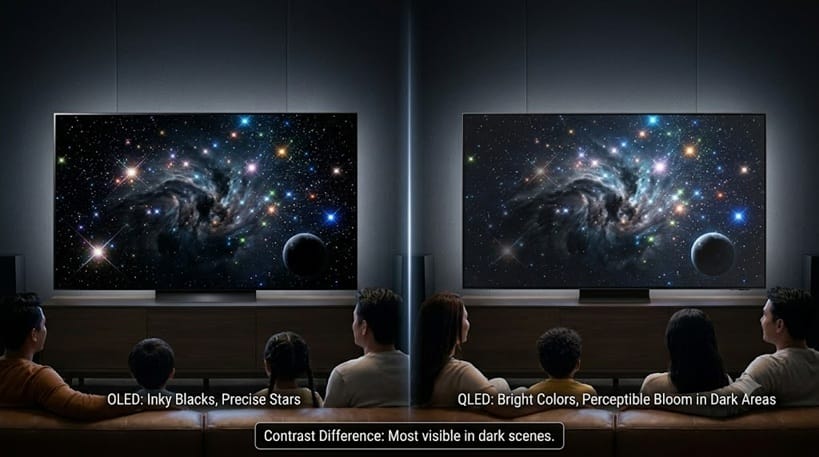
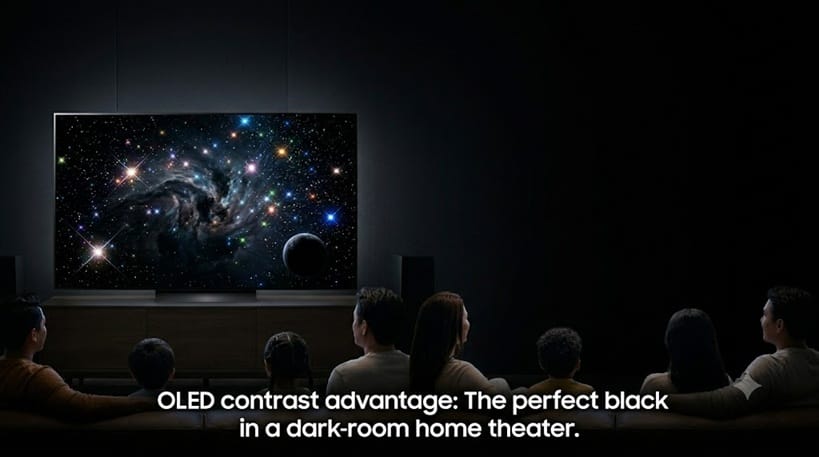
Put both TVs in a dark room and play any scene with deep shadows — a nighttime cityscape, a candlelit room, outer space. On OLED, the dark areas are genuinely black. On QLED, they’re a dark gray, because the backlight behind the panel can’t fully switch off. That’s not a calibration issue. It’s physics.
Where You Notice It Most
OLED pixels emit their own light and turn off completely when displaying black — measured at 0 nits. QLED panels with full-array local dimming can hit around 0.05 nits minimum, which sounds negligible until you see both screens next to each other. The QLED also struggles with “blooming” — a faint halo around bright objects against dark backgrounds, like subtitles over a night sky. OLED doesn’t have this problem at all.
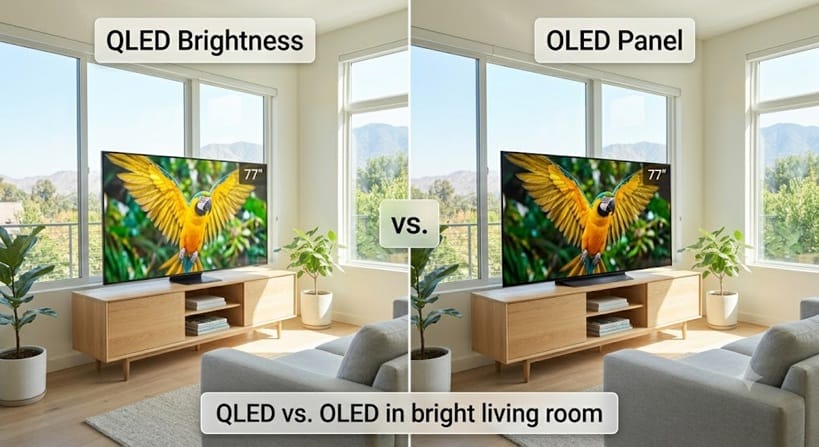
In a bright room, the gap narrows significantly. When ambient light is reflecting off the screen, absolute black levels matter far less than brightness and anti-glare performance — which is where QLED has the stronger argument.
Brightness and HDR: QLED Wins
The same backlight that hurts QLED’s contrast is what makes it genuinely better in a bright room. High-end QLED TVs like the Samsung QN90D sustain over 2,000 nits in HDR highlights — some models push past 3,000 nits in small bright windows. Most WOLED panels (LG C-series, Sony A-series) top out around 800 to 1,100 nits. That’s a meaningful real-world gap when there’s sunlight coming through a window.
QD-OLED Changes the Equation
The more interesting comparison in 2026 is actually QD-OLED versus standard QLED. Panels like those in the Samsung S95F and Sony Bravia 8 II now hit around 1,300–1,500 nits peak, according to RTINGS peak brightness data. That’s still behind the top QLED numbers, but it’s enough for most living rooms — and it comes with OLED’s contrast intact.
For anyone who mostly watches in the evening or can control their room lighting, OLED’s 800–1,100 nits is plenty for a satisfying HDR picture. The brightness gap only becomes a real deciding factor if daylight viewing is a daily reality.
Gaming Performance: OLED Wins
Response time is where OLED has an advantage that QLED simply can’t engineer away. OLED panels respond in 0.1 to 0.2 milliseconds — fast enough that motion blur is essentially a non-issue even in the most frantic scenes. QLED panels typically land between 1 and 5 milliseconds, which is fine for most games but does show up as faint trailing on fast-moving objects if you look for it.
What Both Technologies Offer
Neither technology is a bottleneck for standard gaming features in 2026. Both support 4K at 120Hz, HDMI 2.1, VRR, ALLM, and compatibility with G-Sync and FreeSync. If you’re playing at 60fps on a console, the response time difference won’t change your experience much. It starts to matter at 120fps in competitive titles where every frame counts.
The one gaming scenario where QLED holds its own is a bright room setup with HDR-heavy titles. More nits means highlight details pop harder — explosions, UI elements, and environmental lighting all benefit. But for most gamers watching in a normal room at night, OLED is the stronger choice.
Price and Value: QLED Wins
At 55 inches, entry-level QLED TVs start around $400–$500. A comparable OLED at the same size starts around $900. That gap is consistent across every size tier — and it widens as screens get bigger. A 75″ QLED can cost half what a 75″ OLED does at similar feature levels.
Where OLED catches up on value is at the premium end. If you’re already budgeting $1,500 or more, an OLED like the LG C6H becomes a much easier call — the picture quality difference at that price point is real and noticeable every day. Our LG C6 vs Samsung S95F comparison goes deep on exactly what that premium gets you in practice. If you’re shopping in that range, our roundup of the best OLED TVs under $2,000 covers the strongest picks across brands.
OLED vs QLED by Use Case
| Use Case | Winner | Why |
|---|---|---|
| Movies in a dark room | OLED | Infinite contrast, true blacks, no blooming |
| Daytime TV / sports | QLED | Higher brightness fights ambient light better |
| Competitive gaming | OLED | 0.1–0.2ms response time vs 1–5ms on QLED |
| Bright living room | QLED | Brightness and anti-reflective coatings hold up |
| Budget-conscious buyer | QLED | More screen for the money at every size |
Winner reflects our independent editorial assessment based on panel technology characteristics.
Which Should You Buy?
For most buyers, the honest answer is QLED — not because it’s better, but because most living rooms are bright enough that the OLED advantage doesn’t fully show up. A 65″ mid-range QLED watched in a room with windows during the day will look better than a 55″ OLED at the same price point. Screen size and brightness win in that environment.
If you watch in a dim room and care about picture quality above all else — movies, dark dramas, gaming at night — OLED is worth the premium. The difference is not subtle once you’ve seen it. True black levels and per-pixel contrast create a sense of depth that a backlit panel doesn’t replicate, regardless of how good its local dimming is. It’s also worth factoring in if you’re prone to OLED vs QLED for eye strain during long night-time sessions — flicker-free dimming is one more reason dim-room viewers tend to prefer OLED.The middle ground belongs to QD-OLED. The Samsung S95F and Sony Bravia 8 II are genuinely bright enough for most rooms while keeping OLED’s contrast advantage. They cost more than standard QLED but deliver a picture that holds up across more viewing conditions than traditional WOLED. If budget allows, it’s the most versatile choice in 2026.
📍 See our top OLED picks for 2026 We’ve ranked the best models by budget, use case, and size — WOLED and QD-OLED both covered. See Best OLED TVs 2026 → .
OLED vs QLED: Common Questions
Is OLED better than QLED for movies?
Yes, in a dim or dark room. OLED’s per-pixel contrast means shadow detail and dark scenes look the way a director intended — genuinely black, not dark gray. HDR content benefits the most: OLED can show a bright highlight and a completely black background on the same frame, simultaneously, without any blooming between them.
Is OLED worth the price premium over QLED?
It depends on your room. If you’re watching in a bright space, a good QLED will honestly look better day-to-day because its brightness advantage outweighs OLED’s contrast in that environment. If you watch mostly at night or in a controlled setting, OLED is worth every penny — RTINGS data consistently shows the contrast and response time gaps holding across every generation of panels.
Does OLED still have burn-in risk compared to QLED?
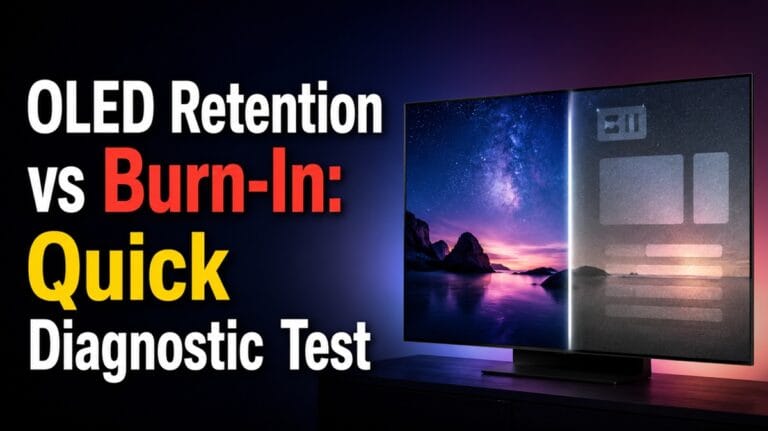
QLED can’t burn in — it’s LCD technology and doesn’t retain image memory. OLED burn-in is real, but in 2026 it’s much less of a concern than it was a few years ago. Pixel refresh cycles, ABL, and improved panel longevity mean normal mixed-use viewing — streaming, gaming, general TV — is very unlikely to cause issues. The risk is mostly for people who leave a static image or HUD on screen for extreme hours, which isn’t how most people use a TV.
Will QLED close the gap with OLED?
On brightness, QD-OLED has already largely closed it — ~1,400 nits is enough for most rooms. On contrast and pixel response time, the gap is structural and isn’t going away: a backlit panel can’t do what a self-emissive one does at the pixel level. Mini LED has made QLED much better than it was, but OLED’s contrast lead in 2026 is still real and consistent.
Which is better for streaming — OLED or QLED?
For streaming specifically, panel type matters less than you’d think — app support, smart-platform speed, and HDR format compatibility come down to the TV’s processor and software, not whether it’s OLED or QLED. Where panel type does matter is room lighting: OLED’s contrast holds up better for evening streaming sessions, while QLED’s brightness is the safer pick if you’re streaming mostly during the day. See our guide to the best OLED TVs for streaming for picks ranked specifically on app support and HDR compatibility.

iYaiii
Editor, GearPulse360
iYaiii is the editor and founder of GearPulse360, specializing in TV reviews and consumer electronics. He tests and researches every recommendation before publishing.
✅ Based on spec analysis and LG official – Samsung’s official and RTINGS data — last verified June 2026