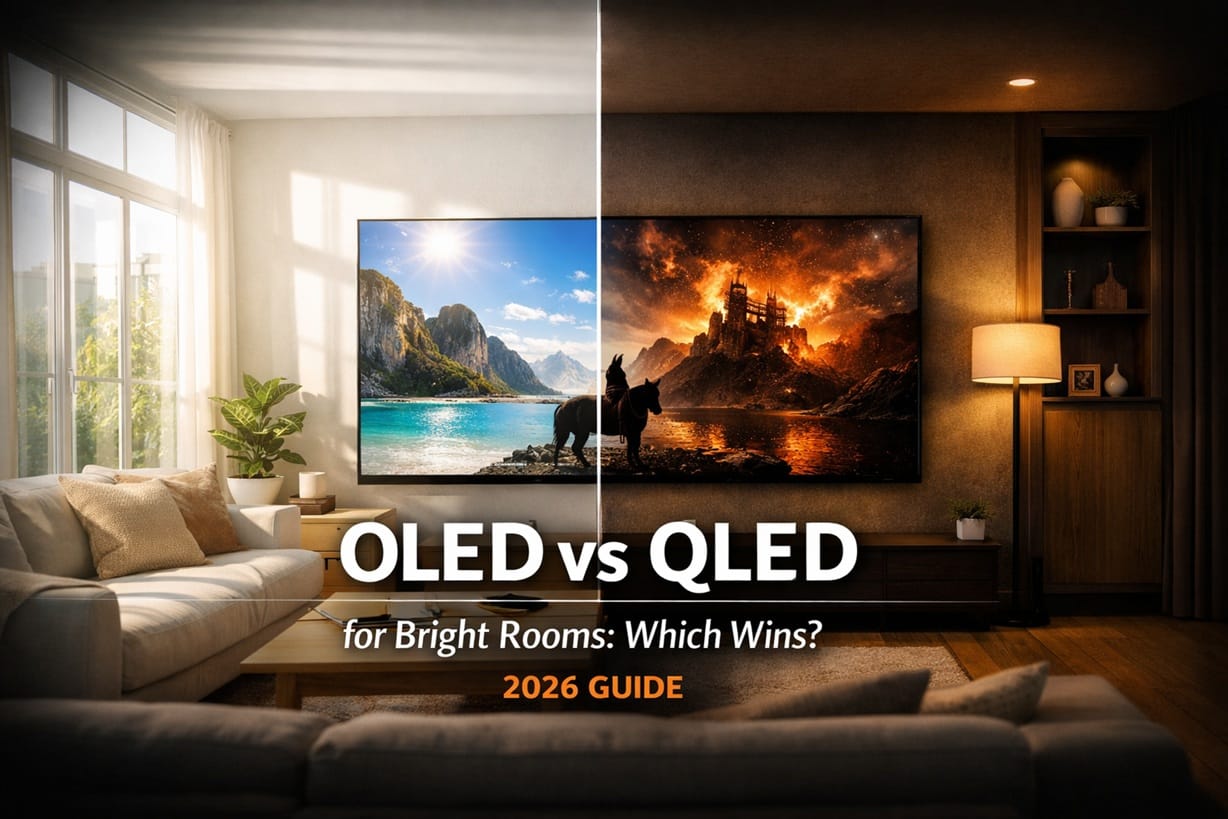
OLED vs QLED for Bright Rooms: Which TV Actually Handles Ambient Light Better?
Last updated: June 2026
🕒 8 min read
Disclosure: As an Amazon Associate I earn from qualifying purchases. This article contains affiliate links — we may earn a small commission if you buy through them, at no extra cost to you.
A friend tells you not to buy an OLED because your living room gets afternoon sun. You’ve read that QLED is brighter. But you’ve also seen OLED pictures that look stunning. So which one is actually right for your home?
Here’s the short version: QD-OLED is the better pick for most normally bright living rooms in 2026 — the gap that used to favor QLED outright has narrowed to the point where it only decides things in genuinely extreme sunlight. Standard WOLED panels and older-generation coatings are where the old warning still applies.
In this comparison, we’ll cover peak brightness, anti-reflective coatings, and real-world viewing conditions so you can tell which room you actually have. We’ve also done our full OLED vs QLED comparison for buyers who want a broader look at the two technologies beyond just room brightness.
Table of Contents
OLED vs QLED for Bright Rooms: Quick Verdict
OLED vs QLED: Our Bright Room Verdict
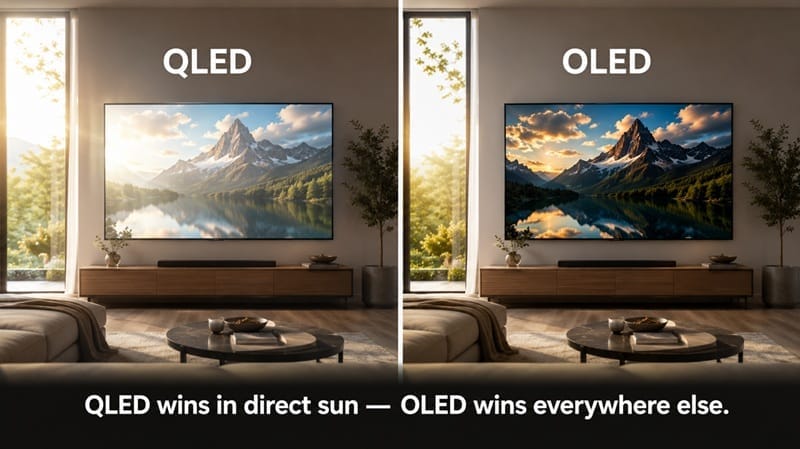
Winner for most buyers: QD-OLED — it combines OLED’s contrast advantage with brightness and anti-reflection performance that holds up well in normally lit rooms.
Exception: QLED (particularly Neo QLED / Mini LED) wins decisively if your room gets direct sunlight with no light control for most of the viewing day.
Buy QLED if:
- Your room has direct sun hitting the screen from south or west-facing windows
- You watch primarily during peak daylight hours with no curtains or blinds
- Raw peak brightness (2,000+ nits) matters more to you than contrast depth
Buy OLED (QD-OLED specifically) if:
- Your room is bright but not in direct sunlight — office lighting, indirect windows
- You watch a mix of daytime and evening content
- Picture quality, color accuracy, and contrast matter as much as brightness
How They Compare
Peak Brightness — QLED
Peak Brightness — OLED (QD-OLED)
Reflection Handling — QLED
Reflection Handling — OLED (QD-OLED)
Contrast in Ambient Light — QLED
Contrast in Ambient Light — OLED (QD-OLED)
Value for Money — QLED
Value for Money — OLED (QD-OLED)
Prices change frequently — click through for current pricing.
Ready to act on that verdict? See our full picks for best OLED TVs for bright rooms →
How OLED and QLED Actually Differ
What Is OLED?
OLED panels use self-emissive pixels — each one produces its own light and can switch off completely for true black. We go deeper on how that actually works in our guide to what OLED TV technology is. The limitation is heat: pushing self-emissive pixels too bright degrades the organic material, which is historically why QLED had the upper hand in sunny rooms.
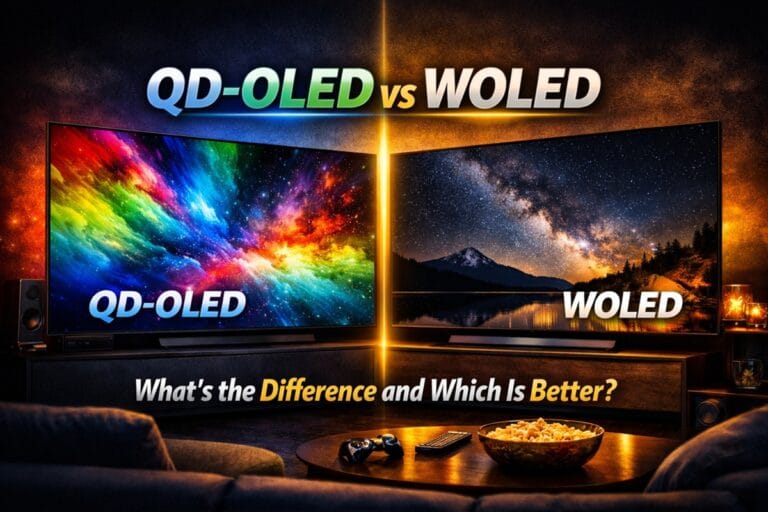
There are two OLED types on the market, and they behave differently in ambient light. WOLED (used in LG’s C5 and B5) stacks white subpixels behind color filters, which caps both peak brightness and how effective the anti-reflective coating can be. QD-OLED (Samsung S90H/S95H, Sony Bravia 8) uses quantum dots over a blue OLED base, which produces meaningfully higher brightness and generally better reflection handling.
What Is QLED?
QLED is Samsung’s term for LCD TVs enhanced with quantum-dot filters. The backlight can push far higher peak brightness than most OLED panels — entry-level QLED sits around 600–800 nits, while premium Neo QLED with Mini LED backlighting regularly clears 1,800–2,000 nits. That raw output is the core argument for QLED in a bright room.
The trade-off is contrast. Because QLED relies on a backlight, blacks are never truly black — they’re dark gray at best, even on the strongest Mini LED sets. In a well-lit room that matters less, but the moment ambient light drops, the gap becomes obvious.
Reflection Handling: The Factor Most Comparisons Skip
Peak brightness gets all the attention in this debate, but reflection handling matters just as much — arguably more in a normally lit room. A 2,000-nit TV that reflects a lamp straight into your eyes isn’t actually more watchable than an 800-nit OLED that diffuses that same lamp into a soft haze.
QD-OLED vs WOLED: A Critical Distinction
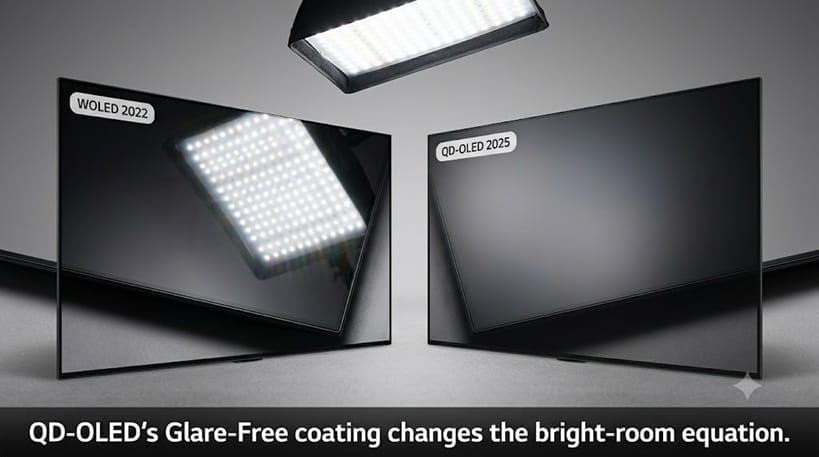
Panel type makes a significant difference here. Samsung’s QD-OLED panels carry a Glare-Free coating on the S90H and S95H — it handles mirror-like reflections extremely well, so you won’t see a sharp image of the room reflected in the screen. The trade-off is that very dark scenes can show slightly elevated black levels under bright lighting. Samsung deliberately chose to eliminate mirror-sharp reflections that pull your eye away from the picture, even if it costs a little absolute black depth. How much that coating actually helps day to day — and where it still falls short against direct window light — is its own question; our breakdown of Samsung OLED anti-glare bright-room performance covers that in more detail than fits here.
LG’s WOLED panels (C5, G5) take a different approach. The reflection is diffused rather than matte-blocked, so blacks look deeper than on the Samsung — but more of the ambient light ends up as a visible haze on dark content. Owners of glossy WOLED TVs in moderately bright rooms often find themselves repositioning lights or adding curtains; QD-OLED owners less so.
QLED’s Reflection Situation
QLED handles reflections with raw power instead of coatings. A Neo QLED running at 1,800 nits simply drowns out most lamp reflections — the screen is bright enough that your eye focuses on the content rather than the glare. It works, but it’s a brute-force solution: the matte anti-glare coatings some Samsung QLED models use can slightly soften fine detail in exchange for that glare resistance.
Contrast Under Ambient Light: Where OLED Fights Back
Here’s what the “OLED struggles in bright rooms” argument misses: ambient light hurts QLED’s contrast too, just differently. In a lit room, a QLED’s backlight bleed becomes more visible, not less — the slight grayness of dark areas on an LCD panel shows up against the room’s own light level. OLED’s blacks stay genuinely black with a lamp on behind you, because there’s no backlight to bleed in the first place.
Picture a dim, single-light-source scene in a movie: on a QLED in a lit room it looks flat and gray; on an OLED the blacks hold. The cases where QLED wins outright are genuinely extreme — a TV facing a floor-to-ceiling south-facing window with no curtains at peak sun.
OLED vs QLED for Bright Rooms: Side-by-Side
| Room / Situation | Winner | Why |
|---|---|---|
| Direct sunlight, no blinds | QLED | Raw brightness wins — OLED can’t match 2,000+ nits at full-room output |
| Bright living room, indirect windows | QD-OLED | Glare-Free coating handles reflections; contrast makes the image richer overall |
| Office or overhead lighting only | QD-OLED | No direct light source to reflect; OLED contrast superiority takes over |
| Mixed day and evening viewing | QD-OLED | Handles daylight adequately; transforms at night in a way QLED can’t match |
| Sports bar / high-ambient commercial | QLED | Extreme brightness and wide viewing angle flexibility; OLED not recommended here |
Which Should You Buy?
For most people reading this — someone whose living room gets natural light through windows but isn’t a greenhouse — QD-OLED is the better TV. It handles a bright room well enough during the day and rewards you with picture quality QLED can’t match in the evening, which is where most viewing actually happens.
If your room gets genuine direct sunlight hitting the screen for several hours a day with no practical way to control it, QLED is the right call. A Neo QLED gives you Mini LED brightness that punches through most ambient conditions, plus decent — if not OLED-level — contrast. You’ll live with grayer blacks, but the image holds up in conditions that would wash out any OLED.
Don’t need flagship-level brightness? A step-down Neo QLED still leans into the same bright-room strengths at a lower price point than the flagship. Our Samsung 55QN80H review covers where it holds up against sunlight and where the step-down from the flagship actually shows.
One thing worth noting: standard WOLED (LG C5, LG B5) sits in a difficult middle ground for bright rooms — it doesn’t have QLED’s brightness advantage, and it doesn’t have QD-OLED’s reflection handling. It’s still an excellent TV for most conditions and a strong value, but if bright-room performance is your primary concern, QD-OLED is the OLED to consider. We’ve laid out the complete trade-offs — not just brightness — in our OLED pros and cons breakdown.
Our Verdict
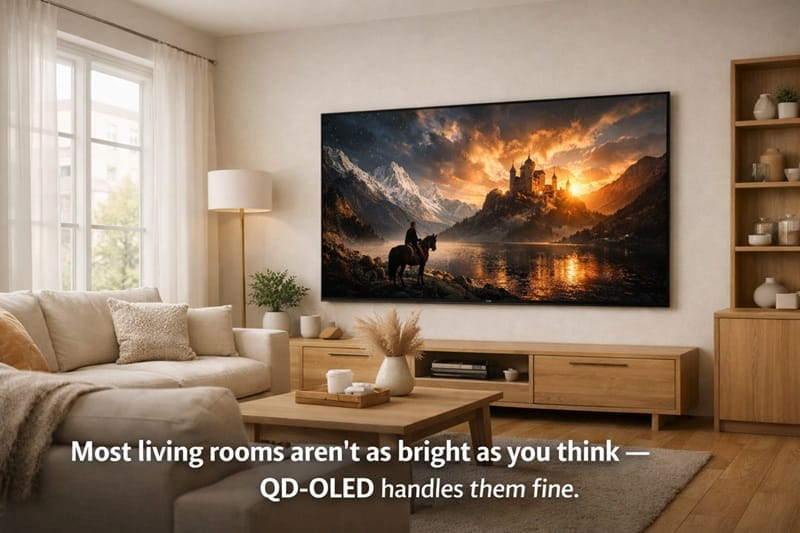
QLED wins only in truly extreme ambient light. For the bright-but-normal living rooms most people have, QD-OLED now holds its own during the day — and dominates at night. If you’re choosing between the two for a single room, go QD-OLED unless direct sun genuinely hits the screen.
Prices change frequently — click for current pricing.
📍 Want to see how every OLED stacks up, not just in bright rooms? Check out our full ranking of the best OLED TVs of 2026 — ranked by budget, use case, and size.
OLED vs QLED for Bright Rooms: Common Questions
Is OLED really bad for bright rooms?
If bright-room performance is genuinely your top priority, yes — the Glare-Free coating and higher peak brightness are the specific things standard WOLED lacks. If your room is only moderately bright rather than sun-drenched, a WOLED set will still perform well for most content, and the premium may not be worth it for your specific room.
Does QLED always look better than OLED in daylight?
No. QLED wins on peak nits, but perceived picture quality in a lit room comes down to reflection handling, contrast, and the actual content on screen. On anything with dark areas — most movies, drama, and even a lot of sports broadcasts — OLED’s contrast can make the image look more three-dimensional even in a lit room, because the dark areas stay genuinely dark while bright areas stay vivid.
Which OLED is best for a bright living room?
If bright room performance is your priority among OLED options, go with a QD-OLED panel — specifically the Samsung S95F or Sony Bravia 8. Both use Glare-Free or equivalent coatings and hit 300–500 nits higher peak brightness than standard WOLED. The LG G5 and G6 are also improved options over the C-series for bright rooms.
Will OLED eventually match QLED in brightness?
It’s already closer than most people realize, and the trajectory is clear. Primary RGB Tandem OLED panels — like those in the LG G6 — briefly hit over 4,000 nits in peak HDR measurements, a number that would have seemed impossible for OLED three years ago — though that figure is measured on a tiny highlight window, not the whole screen. Sustained full-screen brightness is still lower than Neo QLED. Meanwhile QD-OLED has improved from around 800 nits to over 1,500 nits in about four product generations — figures based on RTINGS’ standardized HDR brightness measurements. The gap is narrowing faster on the OLED side than QLED is advancing, but it hasn’t closed.
Is a standard WOLED like the LG C5 usable in a moderately bright room?
Yes, for most typical living rooms — ambient light from windows, standard ceiling lights, no direct sun on the screen — the LG C5 performs better than its specs alone suggest. It’s not the right choice if bright-room performance is your top priority, but for an average household with a mix of daytime and evening use, it holds up fine for most content.

iYaiii
Editor, GearPulse360
iYaiii is the editor and founder of GearPulse360, specializing in TV reviews and consumer electronics. He researches every recommendation before publishing.
✅ Based on spec analysis and Samsung’s, LG’s, and Sony’s official data plus RTINGS — last verified June 2026