Best 65-Inch OLED TVs in 2026: Ranked and Reviewed for Every Budget
Last updated: June 2026
Disclosure: As an Amazon Associate I earn from qualifying purchases. This article contains affiliate links — we may earn a small commission if you buy through them, at no extra cost to you.
Sixty-five inches is where OLED TVs make the most sense. It’s large enough to deliver a genuinely cinematic picture, yet still fits comfortably in most living rooms without dominating the space. And in 2026, the range of best 65-inch OLED TVs available at this size is better than it’s ever been — from sharp-value panels to flagship-tier brightness that outperforms anything from a few years ago. If you’re upgrading from an older LED TV or sizing up from a 55-inch set, this is the size we’d start with. For a broader look across all sizes and budgets.
We’ve narrowed the 65-inch field down to four picks that cover the most common buyer scenarios — best overall, best for bright rooms and gaming, best picture quality for movies, and best value. All four models are available now on Amazon. Our top overall pick is the LG C6, which offers the best combination of picture quality, smart features, and everyday usability at this size.
Table of Contents
Best 65-Inch OLED TVs: Quick Comparison
| Pick | Model | Panel | Best For | Check Price |
|---|---|---|---|---|
| Best Overall | LG C6 65″ | OLED evo (WOLED) | Movies, gaming, everyday watching | Amazon → |
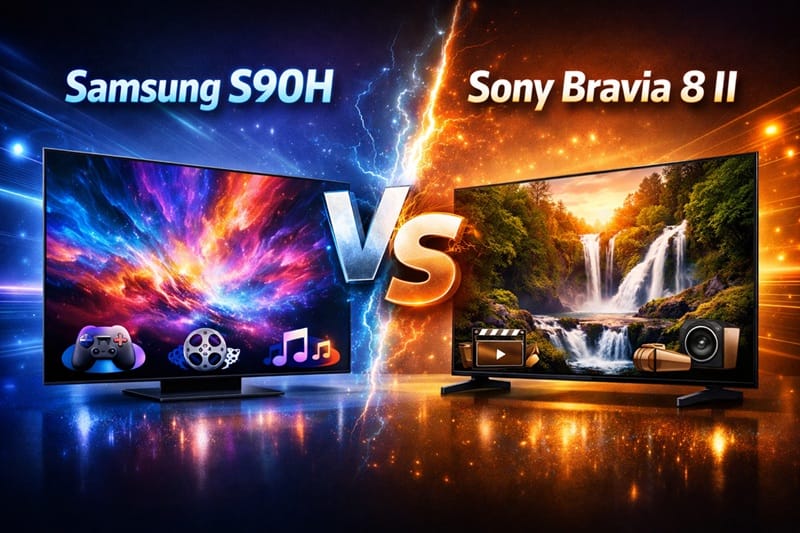
| Best for Bright Rooms & Gaming | Samsung S90H 65″ | QD-OLED | Bright rooms, PS5 & Xbox gaming | Amazon → |
| Best Picture Quality | Sony BRAVIA 8 II 65″ 2025 model — no 2026 replacement at this size | QD-OLED | Movies, home theater, PS5 | Amazon → |
| Best Value | Samsung S85H 65″ | WOLED | Budget-conscious OLED buyers | Amazon → |
Prices change frequently — click through for current pricing. | Our Score reflects our independent editorial assessment — not Amazon customer reviews.
BEST OVERALLLG C6 65-Inch OLED evo TV (OLED65C6PUA, 2026)
LG 65-Inch OLED evo AI C6 4K Smart TV (OLED65C6PUA, 2026)
The most well-rounded 65-inch OLED TV in 2026 — strong picture, excellent gaming specs, and a smart platform that actually works.
| Screen size | 65″ |
| Panel type | OLED evo (WOLED, standard) |
| Processor | Alpha 11 AI Gen3 |
| Refresh rate | 120Hz |
| HDMI 2.1 ports | 4 |
| HDR formats | Dolby Vision, HDR10, HLG |
| Best for | Movies, gaming, everyday streaming |
| ✓ Pros | |
| 1. | Alpha 11 Gen3 processor — sharpest upscaling on a C-series OLED yet |
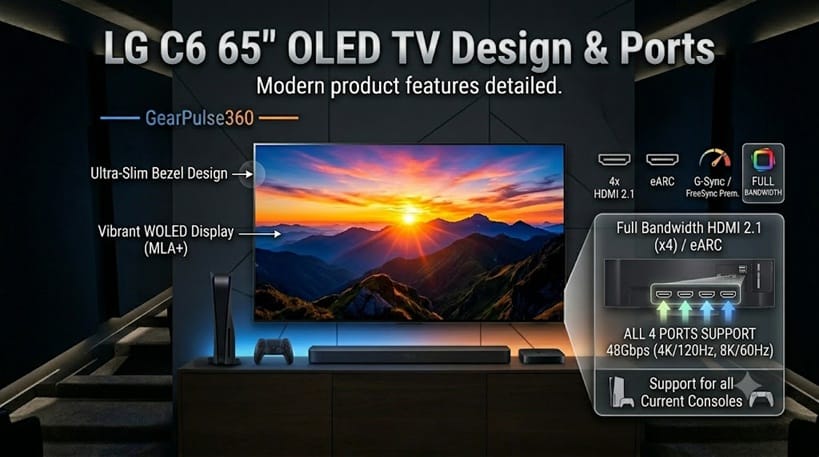
| 2. | 4x full HDMI 2.1 ports — covers all current and future consoles |
| 3. | webOS 2026 is fast, clean, and genuinely smart |
| ✗ Cons | |
| 1. | OLED EX panel at 65″ — lower peak brightness than the G6 or QD-OLED rivals |
Prices change frequently — click for current price.
The LG C6 earns its place as our top 65-inch OLED pick for most people in 2026. The 65-inch model uses LG’s established OLED evo panel — the same core technology proven across the C-series — paired with the Alpha 11 AI Gen3 processor for noticeably sharper upscaling and more accurate tone mapping than its C5 predecessor. Shadow detail and color gradients are a clear step up, particularly in darker scenes where WOLED’s pixel-level black delivers its biggest advantage over LED alternatives.
All four HDMI ports are full-bandwidth HDMI 2.1, which matters if you’re gaming on a PS5 or Xbox Series X and plan to add a second console later. The C6 handles 4K/120Hz with VRR and ALLM enabled across all four ports — not a given at this price tier. webOS 2026, powered by Google Gemini and Microsoft Copilot integration, also makes this one of the smarter smart TVs available right now.
One thing worth knowing: the 65-inch C6 uses an OLED EX panel rather than the Tandem OLED found in the 77-inch model and above. That means peak brightness is somewhat lower than the G6 or Sony BRAVIA 8 II. For most rooms with moderate ambient light, that’s a non-issue. But if your living room gets strong direct sunlight in the afternoon, the Samsung S90H below may be a better fit.
Who Should Buy the LG C6 65″
This is the right pick if you want an excellent all-rounder without paying flagship prices. It handles movies, sports, gaming, and streaming equally well. If you’re coming from a non-OLED TV, the step up in picture quality will be immediately obvious.
BEST FOR BRIGHT ROOMS & GAMINGSamsung S90H 65″ (QN65S90H, 2026)
Samsung 65-Inch OLED S90H 4K Samsung Vision AI Smart TV (2026)
A QD-OLED panel with Glare Free 3.0 coating makes this the strongest 65-inch OLED for sunlit rooms and serious gamers.
| Screen size | 65″ |
| Panel type | QD-OLED (Glare Free 3.0) |
| Processor | NQ4 AI Gen3 |
| Refresh rate | 165Hz (Motion Xcelerator) |
| HDMI 2.1 ports | 4 |
| HDR formats | HDR+, Dolby Atmos |
| Best for | Bright living rooms, PS5, Xbox Series X |
| ✓ Pros | |
| 1. | Glare Free 3.0 — handles bright rooms better than any other OLED at this tier |
| 2. | 165Hz QD-OLED — among the fastest refresh rates on any 65-inch OLED |
| 3. | 15% brighter than S90F — meaningful HDR improvement over last year |
| ✗ Cons | |
| 1. | No Dolby Vision — uses HDR+ instead, which trails Dolby Vision in tone mapping quality |
Prices change frequently — click for current price.
The Samsung S90H solves the single biggest real-world complaint about OLED TVs: reflections. Its Glare Free 3.0 coating — now brought down from the flagship S95H to this mid-range model for 2026 — significantly reduces screen reflections without the washed-out appearance that plagued earlier anti-glare coatings. If your room has windows opposite the TV, this is the pick that lets you watch in the afternoon without closing the blinds.
The QD-OLED panel also runs 15% brighter than the S90F it replaces, which contributes to better HDR highlights in well-lit environments. The 165Hz refresh rate via Motion Xcelerator is one of the fastest available on an OLED at 65 inches, and with VRR support for both FreeSync and G-Sync Compatible, it’s well-equipped for both console and PC gaming setups.
Samsung’s Tizen OS is polished and responsive, with Samsung Vision AI handling automatic picture adjustments by content type — useful if you switch between gaming, sports, and films regularly. If gaming is a primary use case, also check our best OLED TVs for gaming guide for a deeper breakdown by input lag and VRR performance across all budgets.
Who Should Buy the Samsung S90H 65″
This is the right pick for buyers with bright living rooms or those who prioritize gaming performance alongside everyday watching. The Glare Free coating genuinely makes a difference if you can’t always control your room’s light.
BEST PICTURE QUALITYSony BRAVIA 8 II 65″ (K-65XR80M2, 2025)
Sony BRAVIA 8 II 65-Inch QD-OLED 4K Smart Google TV (K-65XR80M2, 2025)
Sony’s XR Processor delivers the most cinematically accurate picture at 65 inches — the pick for dedicated movie watchers and home theater setups.
| Screen size | 65″ |
| Panel type | QD-OLED |
| Processor | XR Processor with AI Technology |
| Refresh rate | 120Hz |
| HDMI 2.1 ports | 4 |
| HDR formats | Dolby Vision, HDR10, HLG |
| Best for | Movies, home theater, PlayStation 5 |
| ✓ Pros | |
| 1. | XR Processor — object-based contrast produces the most cinematic picture at this size |
| 2. | Widest color volume at 65″ — colors stay accurate even at peak brightness |
| 3. | PS5 Auto HDR Tone Mapping and Auto Genre Picture Mode — best Sony-PlayStation integration |
| ✗ Cons | |
| 1. | 2025 model — Sony released no new 65″ QD-OLED in 2026, so no spec update this cycle |
Prices change frequently — click for current price.
Sony released no new QD-OLED replacement at 65 inches for 2026 — the BRAVIA 8 II remains the current flagship at this size and continues to compete strongly against newer models. It sits above the rest of the 65-inch OLED field specifically for picture processing. Sony’s XR Processor approaches image quality from a different angle than LG or Samsung — it analyzes content zone-by-zone to reproduce what Sony calls “object-based” contrast, where highlights and shadows are individually tuned rather than globally adjusted. The result is a picture that reviewers consistently describe as having unusual depth and three-dimensionality, particularly in film content.
On a QD-OLED panel, the BRAVIA 8 II also delivers some of the widest color volume at 65 inches — meaning colors stay saturated and accurate even at peak brightness levels. Dolby Vision support is excellent, and Sony’s Calibrated modes (Cinema, Netflix, Prime) are among the most accurate out-of-the-box picture presets available without manual calibration. For PS5 owners, it includes Sony’s exclusive Auto HDR Tone Mapping and Auto Genre Picture Mode for gaming.
It’s worth noting that the BRAVIA 8 II is a 2025 model — Sony’s 2026 OLED lineup did not introduce a new QD-OLED replacement. The Bravia 8 II remains Sony’s current flagship OLED for the 65-inch size, and it continues to be one of the strongest performers at this price point. If you’re drawn to Sony’s processing approach, our OLED vs Mini LED compared article explains why QD-OLED at this tier competes differently from Mini LED alternatives.
Who Should Buy the Sony BRAVIA 8 II 65″
This is the right pick for serious movie watchers, anyone building a dedicated home theater, or PS5 owners who want Sony’s ecosystem integrations. If picture accuracy in films matters more to you than gaming refresh rates, this is the one to get — or browse our full best OLED TVs for movies roundup for other movie-first picks across every budget.
BEST VALUESamsung S85H 65″ (QN65S85H, 2026)
Samsung 65-Inch OLED S85H 4K Samsung Vision AI Smart TV (2026)
Samsung’s entry-level 2026 OLED brings perfect blacks and solid smart features to buyers who want OLED at the most accessible price point in this size.
| Screen size | 65″ |
| Panel type | WOLED |
| Processor | NQ4 AI Gen2 |
| Refresh rate | 120Hz |
| HDMI 2.1 ports | 4 |
| HDR formats | HDR, Dolby Atmos |
| Best for | Budget-conscious OLED buyers, first-time OLED upgrade |
| ✓ Pros | |
| 1. | Most affordable entry into 65-inch OLED in Samsung’s 2026 lineup |
| 2. | Perfect pixel-level blacks — a genuine step up from any LED or QLED TV |
| 3. | Tizen OS 10.0 with Samsung Vision AI — competitive smart features at value price |
| ✗ Cons | |
| 1. | WOLED panel + Gen2 processor — noticeably lower brightness and color volume than the S90H |
Prices change frequently — click for current price.
The Samsung S85H makes OLED’s most important quality — perfect pixel-level black — available at the most accessible price in Samsung’s 2026 lineup. If you’re coming from an LED or QLED TV and want to experience what genuine OLED contrast looks like without committing to a flagship budget, this is where to start at 65 inches.
Compared to the S90H, the S85H uses a WOLED panel rather than QD-OLED, which means slightly lower peak brightness and a somewhat narrower color gamut. It also runs on the NQ4 AI Gen2 processor rather than the Gen3 found in the S90H and S95H. In practice, the picture is still miles ahead of any non-OLED TV at this price, and Tizen OS 10.0 with Samsung Vision AI keeps it competitive on smart features.
If you’re debating whether the best 65-inch OLED TVs are worth stepping up from a budget QLED, our full OLED vs QLED comparison breaks down exactly what you’re gaining and where the tradeoffs land at different price points. And if your budget is tighter overall, our best OLED TVs under $1,000 covers the best options at a lower price tier.
Who Should Buy the Samsung S85H 65″
This is the right pick if you want genuine OLED quality at the lowest entry point in Samsung’s current lineup. It’s an honest first-time OLED upgrade — the picture will be a meaningful improvement over any LED TV, without the premium price of the S90H or S95H. If you’d rather stay in LG’s ecosystem at a similar price, our LG OLED65B6GUA review covers how LG’s equivalent entry-level 65-inch pick stacks up.
Not sure whether OLED is the right technology for your room at all? Before committing to any of these picks, it’s worth reading how OLED vs Mini LED compared at this price tier — especially if your room has significant ambient light.
What to Look for in a 65-Inch OLED TV
Panel Type: WOLED vs QD-OLED
At 65 inches in 2026, you’ll encounter two main panel technologies. WOLED (used by LG and Samsung’s entry-level sets) produces exceptional black levels and consistent off-angle viewing, but its peak brightness is somewhat lower than QD-OLED. QD-OLED (used in the Samsung S90H and Sony BRAVIA 8 II) adds quantum dot technology on top of an OLED base, producing significantly wider color volume and higher peak brightness — making it better for HDR content in moderate ambient light.
Neither is objectively “better” — the right choice depends on your room conditions and primary use case. For dark room movie watching, WOLED’s perfect blacks are hard to fault. For bright rooms or peak-HDR-performance enthusiasts, QD-OLED has the edge. For further context on how these technologies compare at a spec level, What Hi-Fi’s 65-inch TV testing includes hands-on panel comparison across all the models above.
Peak Brightness
OLED TVs have historically struggled with peak brightness compared to high-end Mini LED sets. That gap is narrowing fast in 2026, but it still matters when choosing a 65-inch model. The LG C6 at 65 inches uses an OLED EX panel, which is brighter than its predecessors but below what the Tandem OLED panels in larger sizes achieve. The Samsung S90H’s QD-OLED panel runs brighter still, and Glare Free 3.0 adds effective anti-reflection on top of that. If you’re choosing between rooms — a dedicated dim viewing room vs a bright open-plan living area — peak brightness should weigh more heavily in the latter.
HDMI 2.1 Ports
All four picks include four HDMI 2.1 ports. This is worth verifying on any TV you consider, because some manufacturers include HDMI 2.1 on only two ports while the remaining two are limited to HDMI 2.0. At 65 inches with a PS5 or Xbox Series X connected, you’ll want at least two full-bandwidth ports — ideally four if you plan to add a PC or second console later. All four picks here clear that bar cleanly.
Smart Platform
LG runs webOS 2026 with Google Gemini and Microsoft Copilot integration. Samsung runs Tizen OS 10.0 with Samsung Vision AI. Sony runs Google TV. All three are mature, app-complete platforms. The meaningful differences come down to ecosystem preference: if you’re already in the Google ecosystem (Chromecast, Google Home), Sony’s Google TV integrates most naturally. If you use Samsung SmartThings for other home devices, Tizen coheres well. LG’s webOS remains one of the fastest and cleanest interfaces in the category.
Is 65 Inches the Right Size for Your Room?
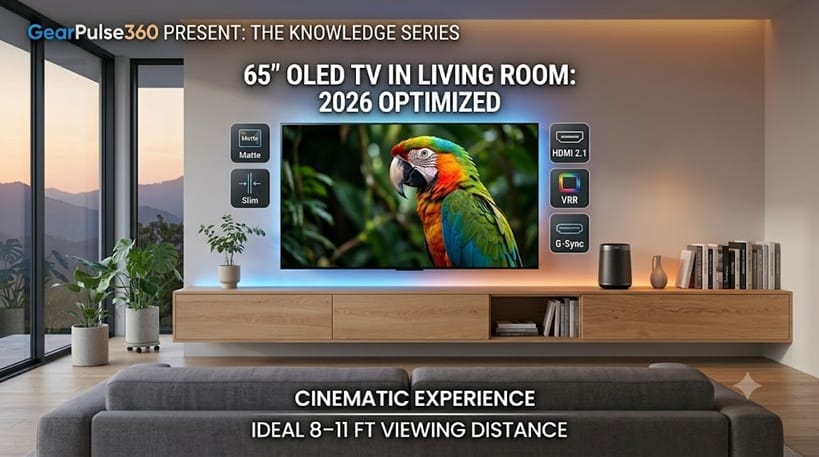
The standard recommendation for 65-inch TVs is a viewing distance between 8 and 13.5 feet. THX’s guideline for a 30-degree field of view — a comfortable immersive experience — puts the ideal distance at around 8.5 feet for 65 inches. At that distance, you’ll notice the difference between a 65-inch and 55-inch set clearly. If your sofa is closer than 7 feet, our best 55-inch OLED TVs picks may be more comfortable for extended watching.
| Viewing Distance | Recommended TV Size | Notes |
|---|---|---|
| 6–8 ft | 55″ | 65″ may feel too close |
| 8–11 ft | 65″ | Sweet spot for 65-inch OLED |
| 11–14 ft | 77″ | 65″ starts to feel small |
| 14 ft+ | 83″+ | Large dedicated home theater |
If you’re measuring and landing right at the 11-foot mark, it’s worth considering whether you’d be happier sizing up to our best 77-inch OLED TVs picks. The best 65-inch OLED TVs here are excellent, but the jump from 65 to 77 inches is more noticeable than the jump from 55 to 65 — particularly with OLED’s contrast on a larger panel. If your room gives you more than 14 feet to work with, our best 83-inch OLED TVs picks are worth a look for a dedicated home theater setup.
How We Picked These TVs
Our picks are based on a combination of hands-on research, published lab measurements from trusted sources including RTINGS.com, and manufacturer specification review. We evaluate 65-inch OLED TVs across four criteria: picture quality (contrast, color accuracy, peak brightness), gaming readiness (input lag, VRR support, HDMI 2.1 count), smart platform usability, and overall value relative to price.
We update this guide when new models are released or when pricing shifts significantly enough to change our value recommendations. The four picks above represent the strongest options currently available on Amazon at the time of this update — June 2026.
📍 Comparing across all sizes and budgets? Our full roundup covers the best OLED TVs at every price point — from under $1,000 to flagship tier. See Best OLED TVs 2026 → .
65-Inch OLED TV FAQs
Which 65-inch OLED TV is the best overall in 2026?
The LG C6 (OLED65C6PUA, 2026) is our top overall pick for 65 inches. It offers the best combination of picture quality, four full HDMI 2.1 ports, and smart platform usability for the broadest range of buyers. It’s excellent for movies, gaming, and everyday streaming without requiring a flagship budget.
Is the 65-inch OLED worth it over a 65-inch QLED at the same price?
For most buyers in a normally-lit room, yes. OLED’s pixel-level black produces a contrast advantage that’s immediately visible in dark scenes — something no QLED backlight can fully replicate. The meaningful exception is a very bright room, where a high-end Mini LED QLED may hold up better.
Do 65-inch OLED TVs have burn-in issues?
Burn-in risk on modern OLED TVs is low for typical home use, but it’s not zero. All four picks here include pixel-refresh and screen protection features that significantly reduce the risk. The biggest risk factor is displaying static content — like a news ticker or HUD element in a video game — for many hours per day over years. For a detailed breakdown of how real this risk is in 2026, see our guide on does OLED burn-in still matter in 2026 — RTINGS.com also maintains ongoing burn-in test data on current OLED panels that’s worth reviewing before you buy.
What’s the difference between the Samsung S85H, S90H, and S95H at 65 inches?
The S85H uses a WOLED panel and Samsung’s Gen2 processor — it’s the value entry point. The S90H steps up to a QD-OLED panel with Glare Free 3.0 and the Gen3 processor, adding meaningful brightness and color volume. The S95H is the flagship, with the highest peak brightness and a premium FloatLayer design. For most buyers, the S90H hits the best balance between those two steps.
Is 65 inches too big for a bedroom?
It depends on viewing distance. If your bedroom viewing distance is under 8 feet, a 55-inch set will be more comfortable for extended watching. For a master bedroom with the TV across the room — typically 9 to 11 feet — 65 inches works well. For smaller bedroom setups, the best 65-inch OLED TVs here are better suited to a main living room where the added size pays off most clearly.

iYaiii
Editor, GearPulse360. Covers OLED TVs, home theater, and consumer electronics. Focused on cutting through spec noise to give real-world buying advice.
✅ Based on spec analysis and LG’s – Samsung’s official and RTINGS data — last verified June 2026