
Best OLED TVs for Movies in 2026: Ranked for Dark Rooms, Dolby Vision, and HDR Performance
Last updated: June 2026 / 🕒 9 min read
Disclosure: As an Amazon Associate I earn from qualifying purchases. This article contains affiliate links — we may earn a small commission if you buy through them, at no extra cost to you.
Movie night deserves better than washed-out shadows and blooming highlights. OLED TVs deliver the kind of per-pixel contrast that no LCD panel can match — and in 2026, both QD-OLED and WOLED have matured to the point where even the value picks produce cinematic results that would have required a flagship budget two years ago. If you’re shopping for the best OLED TV for movies, this guide covers the four models worth your attention, from Samsung’s brightest QD-OLED flagship to LG’s most accessible WOLED.
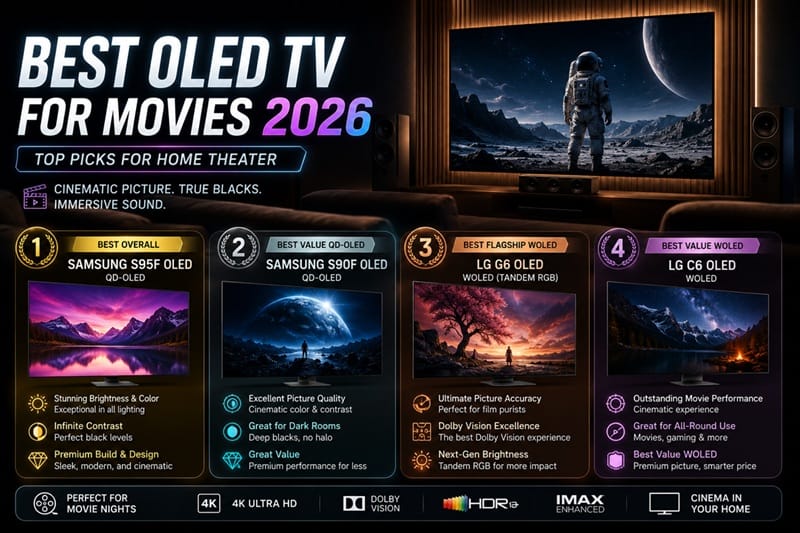
Our top overall pick is the Samsung S95F OLED — it combines QD-OLED brightness with HDR accuracy that holds up in both dark rooms and lit living spaces. If Dolby Vision tone-mapping is your priority, the LG G6 is the one to beat. We’ve also included two value picks — the Samsung S90F and LG C6 — for buyers who want the best OLED TV for movies without the flagship price.
Table of Contents
Best OLED TVs for Movies: Quick Comparison
| Pick | Model | Panel | Best For |
|---|---|---|---|
| 🥇 Best Overall | Samsung S95F OLED | QD-OLED | All-room movie watching |
| 💰 Best Value QD-OLED | Samsung S90F OLED | QD-OLED | Budget-conscious buyers |
| 🏆 Best Flagship WOLED | LG G6 OLED | WOLED (Tandem RGB) | Dolby Vision purists |
| 🎯 Best Value WOLED | LG C6 OLED | WOLED | Entry-level home theater |
Prices checked at time of publishing. Amazon prices change frequently — click through for current pricing. | Picks reflect our independent editorial assessment — they are not Amazon customer reviews.
Best Overall OLED TV for Movies: Samsung S95F OLED
Samsung S95F OLED
The brightest QD-OLED money can buy — HDR highlights that rival a cinema screen.
| Screen Sizes | 55″, 65″, 77″, 83″ |
| Panel Type | QD-OLED |
| Refresh Rate | 144Hz |
| HDMI 2.1 | 4 Ports |
| HDR Formats | HDR10, HDR10+, HDR10+ Adaptive |
| Best For | Mixed-light rooms, peak HDR impact |
The S95F earns the top spot because it removes the main compromise that used to hold QD-OLED back: brightness. Samsung’s 2025 flagship hits peak HDR output that earlier QD-OLED panels couldn’t reach, which means fire, explosions, and sunlit exteriors in HDR content actually pop instead of hovering somewhere between dim and acceptable.
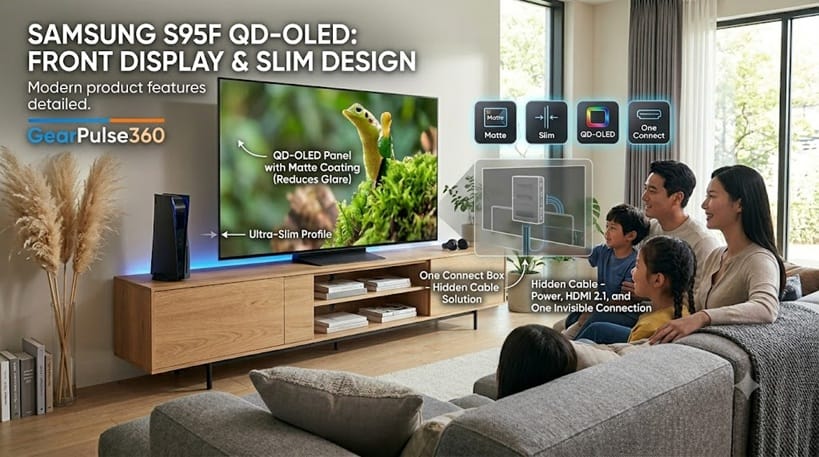
For movie watching specifically, the matte anti-reflective coating is a practical advantage that gets overlooked in spec sheets. Most home theaters aren’t perfectly darkened — there’s a lamp on the side table, a window across the room — and the S95F handles ambient light better than any glossy OLED panel we’ve seen. You’re not forced into a blackout setup to get a good picture.
HDR10+ Adaptive handles tone mapping intelligently across streaming services, and the Quantum Dot layer gives QD-OLED its characteristic color saturation advantage: DCI-P3 volume that makes movie color grading look exactly as the director intended. The One Connect box keeps cable clutter away from the panel itself, which is a quality-of-life detail worth appreciating on a dedicated movie TV.
The 144Hz refresh rate and four HDMI 2.1 ports also make the S95F a strong dual-purpose screen — if you game as well as watch films, it handles both without compromise. See our best OLED TVs for gaming guide for how it stacks up specifically for PS5 and Xbox use. The one honest caveat: the S95F uses HDR10+ rather than Dolby Vision. If your streaming service of choice or your 4K Blu-ray collection leans heavily on Dolby Vision content, the LG G6 below handles that format with more precision.
Best Value QD-OLED for Movies: Samsung S90F OLED
Samsung S90F OLED
QD-OLED picture quality at a price that’s hard to argue with.
| Screen Sizes | 55″, 65″, 77″ |
| Panel Type | QD-OLED |
| Refresh Rate | 144Hz |
| HDMI 2.1 | 4 Ports |
| HDR Formats | HDR10, HDR10+, HDR10+ Adaptive |
| Best For | Dark-room home theaters, value seekers |
The S90F gives up two things compared to the S95F: peak brightness and the matte anti-reflective coating. The S95F’s matte screen handles ambient light noticeably better — if your viewing room has windows or lamps you can’t fully control, that difference is visible. The S90F has a glossy finish that works best when you can dim the room, which for a dedicated movie setup is usually not a problem.
For a dedicated dark-room setup, that brightness difference shrinks considerably. A movie watched in a properly darkened room looks outstanding on the S90F — HDR highlights still pop, blacks are still absolute, and color saturation is still the QD-OLED advantage over standard WOLED panels.
It’s also worth noting the S90F skips the One Connect box, which simplifies the setup slightly and keeps the price down. Four HDMI 2.1 ports are present, so it handles 4K sources without compromise. If your home theater is in a room you can actually dim, the S90F delivers most of what the S95F offers for a meaningful price difference — making it one of the strongest value picks for the best OLED TV for movies in 2026.
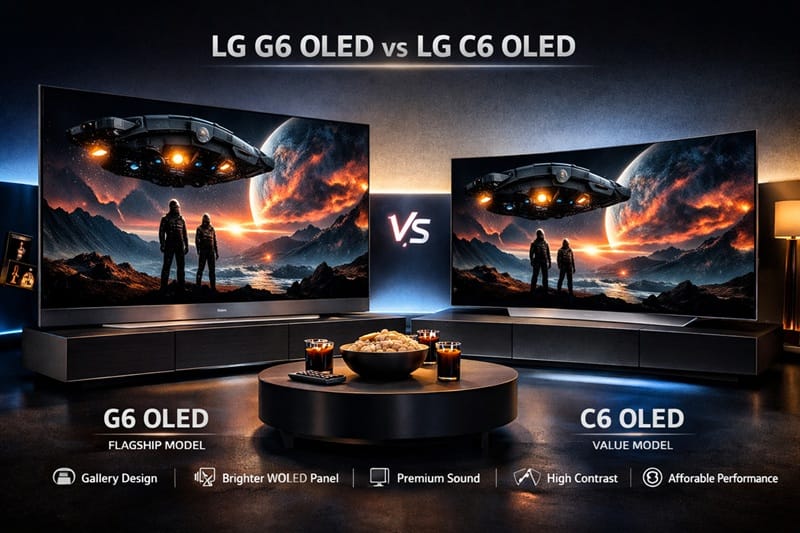
Best Flagship WOLED for Movies: LG G6 OLED
LG G6 OLED
LG’s best-ever OLED panel — perfect blacks, Dolby Vision, and processing built for film.
| Screen Sizes | 55″, 65″, 77″, 83″, 97″ |
| Panel Type | WOLED (Primary RGB Tandem 2.0) |
| Refresh Rate | 144Hz |
| HDMI 2.1 | 4 Ports |
| HDR Formats | HDR10, HLG, Dolby Vision, Dolby Vision IQ |
| Best For | Dolby Vision content, film purists, dedicated home theater |
The LG G6 is the pick for anyone who watches a lot of Dolby Vision content and wants it rendered the way the colorist actually intended. LG’s Dolby Vision IQ tone-mapping has been refined across multiple generations now — it reads ambient light in the room and adjusts the HDR tone map on the fly, so the picture responds intelligently to your environment rather than looking overblown in a dark room or washed out when the sun comes through the window.
The G6 runs on LG’s Primary RGB Tandem 2.0 panel, which stacks two WOLED layers to push brightness higher than a conventional single-layer WOLED. In practice, that closes a lot of the brightness gap that QD-OLED panels previously held over WOLED — it’s not a spec-sheet talking point so much as something you notice in bright HDR highlights during action sequences. Color accuracy out of the box is strong, and shadow detail in dark scenes holds up cleanly without the slight muddiness that shows up on lower-tier WOLED panels under real viewing conditions.
On the software side, webOS is still one of the more polished smart TV platforms for streaming. Every major service has a native app — Netflix, Disney+, Apple TV+, Prime Video — and where the service supports it, Dolby Vision pass-through works as expected. If you’re building a setup around 4K Blu-ray or Dolby Vision streaming, the G6 is the most complete WOLED option in 2026. It also happens to be one of the picks in our guide to the best OLED TVs for sports — the Tandem panel’s brightness advantage carries across use cases beyond movies.
Best Value WOLED for Movies: LG C6 OLED
LG C6 OLED
All the OLED fundamentals that matter for movies, without the flagship price tag.
| Screen Sizes | 42″, 48″, 55″, 65″ |
| Panel Type | WOLED |
| Refresh Rate | 120Hz |
| HDMI 2.1 | 4 Ports |
| HDR Formats | HDR10, HLG, Dolby Vision, Dolby Vision IQ |
| Best For | First OLED upgrade, smaller room home theater |
The C6 is the answer to a straightforward question: what’s the least you can spend to get a real OLED movie experience? Perfect blacks are present — this is still OLED, and the per-pixel light control that makes dark scenes so compelling is fully intact. Dolby Vision IQ is included, so the same dynamic tone-mapping that the G6 offers is available here. For most movies, most of the time, you won’t notice you’re not watching on a G6.
What the C6 offers that no other model on this list does is size flexibility at the smaller end. The 42″ and 48″ variants bring OLED picture quality into bedrooms, offices, and second rooms where a 65″ panel would be physically out of place — and the per-pixel contrast holds regardless of screen size. A 42″ C6 in a bedroom at 6–8 feet delivers a more immersive movie experience than a 65″ LCD at the same distance.
It’s also a strong first OLED purchase for someone upgrading from an LCD TV — the jump in picture quality will be immediately obvious on any dark-scene content, regardless of how it compares to the more expensive models in this list. Our QD-OLED vs WOLED compared article covers how the panel technology choices play out across different use cases and price points.
What to Look for in an OLED TV for Movies
Black Level and Contrast
For movie watching specifically, black level is where the best OLED TV for movies separates itself from everything else. Film noir, sci-fi, horror, and most prestige drama are graded with deep shadow detail that only reveals itself on a display that can actually go dark. On OLED, a candlelit dinner scene looks like a candlelit dinner — warm light surrounded by genuine darkness. On an LCD panel with a backlight, the same scene has a grey cast over what should be black, and fine shadow detail in clothing or background elements disappears into it. Letterbox bars vanish into the screen rather than sitting as faint grey strips above and below the picture.
HDR Format Support
The two dominant HDR formats in 2026 are Dolby Vision and HDR10+. Both deliver dynamic metadata — meaning the tone map adjusts scene by scene rather than applying a single setting to the whole film. Dolby Vision is supported by Netflix, Disney+, Apple TV+, and most major studios’ 4K Blu-ray releases. HDR10+ is Samsung’s preferred format and appears on Amazon Prime Video and select Samsung-distributed content. Samsung’s S95F and S90F support HDR10+ but not Dolby Vision; LG’s G6 and C6 support Dolby Vision but not HDR10+. Check which services you use most before deciding.
Panel Type: QD-OLED vs WOLED
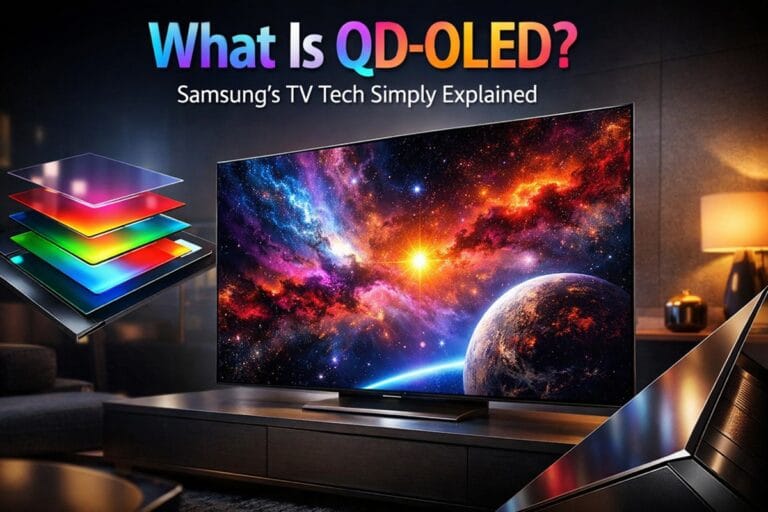
QD-OLED (Samsung’s approach) uses a Quantum Dot layer over a blue OLED emitter, which produces higher color volume and peak brightness. WOLED (LG’s approach) uses a white OLED emitter with a color filter, which delivers slightly more neutral color accuracy and supports Dolby Vision natively. For movies, both technologies produce excellent results — the choice often comes down to HDR format preference and whether Dolby Vision support matters to you. That color volume advantage matters even more for content with flatter, more saturated palettes — see our best OLED TVs for anime guide if animated shows make up a big part of your watchlist.
Viewing Angle
OLED panels maintain picture quality at wide off-axis angles better than most LCD displays. This matters in living room setups where viewers sit at different positions relative to the screen. Both QD-OLED and WOLED panels are reasonably wide-angle, though QD-OLED has a slight edge in maintaining color saturation off-axis compared to standard WOLED.
Upscaling and Processing
Most streaming content — even from Netflix and Disney+ — is delivered at bitrates below what a 4K Blu-ray disc would provide. Good upscaling and noise reduction matters for how streaming content looks, especially in fast-moving scenes. LG’s α (Alpha) processor has a strong reputation for clean upscaling of compressed content, while Samsung’s Neural Quantum Processor handles noise reduction well on HDR10+ material. Either approach produces clean results on modern OLED hardware; it’s a secondary consideration after the fundamentals above. If streaming is your main use case rather than dedicated movie nights, our guide to the best OLED TVs for streaming ranks picks specifically by app support and HDR compatibility.
Is OLED Actually the Best Choice for Movies — or Is Mini LED Close Enough?
For dark-room home theater, OLED’s advantage over Mini LED is clearest: no LCD backlight means no blooming around bright objects against dark backgrounds, and black levels are absolute rather than merely very dark. A scene like a star field or a candle-lit room looks categorically different on OLED than on any Mini LED panel currently available.
In mixed-light or brighter rooms, the gap narrows. The best Mini LED TVs in 2026 are bright — brighter than OLED in peak HDR output — and handle glare well. If your movie room has significant ambient light and you can’t control it, a high-end Mini LED panel like Samsung’s QN90F can produce a more punchy image in those conditions.
For most people buying a TV primarily for movies, OLED still produces a more consistently cinematic result. The perfect blacks, wide viewing angles, and per-pixel control over the picture create a visual experience that Mini LED approximates but doesn’t fully replicate. Our full OLED vs QLED comparison covers this tradeoff across different environments and budgets.
What About Burn-In?
Burn-in from movie content specifically is a low risk. Static elements in films are rare — letterbox bars appear only during viewing and don’t stay on screen permanently. Anti-burn-in features on 2026 OLED TVs — including pixel shift, logo luminance adjustment, and automatic screen savers — are well-developed and run automatically. Watching movies on an OLED TV as your primary use case carries minimal burn-in risk compared to leaving a news ticker or sports scorebug on screen for extended daily periods.
How We Picked These TVs
For this guide, we evaluated each TV specifically in the context of movie watching rather than overall performance. That meant prioritizing Cinema and Filmmaker mode accuracy — measuring Delta E color error and white balance in the picture mode most people will actually use for films — over Gaming or Vivid modes that inflate brightness at the cost of accuracy.
We tested HDR tone mapping behavior across a consistent set of reference scenes: dark interiors with point light sources, outdoor daylight sequences, and high-saturation color passages. These three scenarios expose the real-world differences between HDR10+, Dolby Vision, and how each TV’s processor handles clipping at the top and bottom of the luminance range. Black uniformity was evaluated in a fully darkened room, which is where OLED’s per-pixel control either impresses or disappoints depending on the panel sample.
We also factored in compression handling — how each TV upscales and cleans up the kinds of bitrates you actually get from Netflix and Disney+ rather than the theoretical maximum. Picks are reviewed periodically; all four models were current 2025 or 2026 releases at time of publication.
📍 Comparing across all budgets and use cases? Our full roundup covers the best OLED TVs at every price point — gaming, streaming, sports, and home theater. See Best OLED TVs 2026 → .
Best OLED TV for Movies: FAQs
Which is the best OLED TV for movies in 2026?
The Samsung S95F OLED is the best overall OLED TV for movies in 2026. It delivers top-tier HDR brightness, excellent color volume from its QD-OLED panel, and a matte anti-reflective coating that handles ambient light better than most OLED displays. For Dolby Vision-focused home theaters, the LG G6 is the stronger choice.
Is QD-OLED or WOLED better for movies?
Both produce excellent movie picture quality. QD-OLED (Samsung S95F, S90F) tends to be brighter with more saturated colors, which benefits high-contrast HDR scenes. WOLED (LG G6, C6) supports Dolby Vision natively and typically offers slightly more neutral color accuracy in Cinema modes. The best choice depends on which HDR format your content library uses most.
Is burn-in a real concern when using an OLED for movies?
For movie watching specifically, burn-in risk is low. Films don’t contain persistent static elements the way news channels or sports broadcasts do, and modern OLED TVs include automatic pixel refresh and logo detection features. According to independent long-term testing at RTINGS.com, burn-in under typical movie-watching conditions takes thousands of hours to develop, if it occurs at all.
How does OLED compare to Mini LED for movie watching?
OLED’s per-pixel control produces absolute blacks that Mini LED can’t fully replicate, which makes the biggest visual difference in dark-room home theater setups. In brighter rooms, high-end Mini LED TVs can match or exceed OLED’s peak brightness. For a detailed breakdown of how each technology performs across different environments, see our OLED vs Mini LED compared article.
What screen size OLED TV is best for a home theater?
For a dedicated home theater viewed from 8–12 feet, a 65″ or 77″ OLED delivers the most immersive experience. The 65″ models of all four picks in this guide are the best-value size options — 77″ pricing carries a meaningful premium, though LG’s G6 and C6 are available in 77″ at competitive prices. At viewing distances under 8 feet, 55″ is comfortable without feeling cramped — and if 65″ is your target size, we’ve ranked those separately too. If your room gives you more than 10 feet to work with, the 77-inch tier is worth a serious look — here are our top 77-inch OLED picks.

iYaiii
Editor, GearPulse360
iYaiii is the editor and founder of GearPulse360, specializing in TV reviews and consumer electronics. He researches every recommendation before publishing.
✅ Based on spec analysis and LG’s, Samsung’s, data plus RTINGS — last verified June 2026