OLED Panel Types Explained: WOLED vs QD-OLED vs Evo vs EX
Last updated: June 2026 | 🕒 7 min read
Disclosure: As an Amazon Associate I earn from qualifying purchases. This article contains affiliate links — we may earn a small commission if you buy through them, at no extra cost to you.
You’re comparing two TV listings side by side. One says “OLED evo.” The other says “QD-OLED.” A third mentions “OLED with EX Technology.” At a glance, that looks like three or four competing screen technologies — and like picking the wrong one might cost you picture quality.
That assumption is what trips up most shoppers at this stage. Based on manufacturer specifications from LG Display and LG Electronics, cross-referenced against independent panel testing data from RTINGS, only two of those four terms are actual competing panel technologies. The other two are branding and engineering layered on top of one of them — not separate panel chemistries you’re choosing between.
Consider this your OLED panel types explained, in plain language — building on our explainer on what WOLED is. By the end, you’ll be able to read a 2026 TV spec sheet without guessing what any of these labels actually mean.
Table of Contents
The Short Answer: OLED Panel Types Explained
There are two real OLED panel types on the market: WOLED (made by LG Display, used in TVs from LG, Sony, Panasonic, and others) and QD-OLED (made by Samsung Display, used in Samsung and select Sony models). “OLED evo” and “OLED with EX Technology” aren’t competing panel types. Both sit on top of WOLED specifically — one is a consumer brightness tier, the other is the underlying manufacturing process most WOLED panels already use.
What WOLED, QD-OLED, Evo, and EX Actually Are
The Two Real Panel Types — WOLED vs. QD-OLED
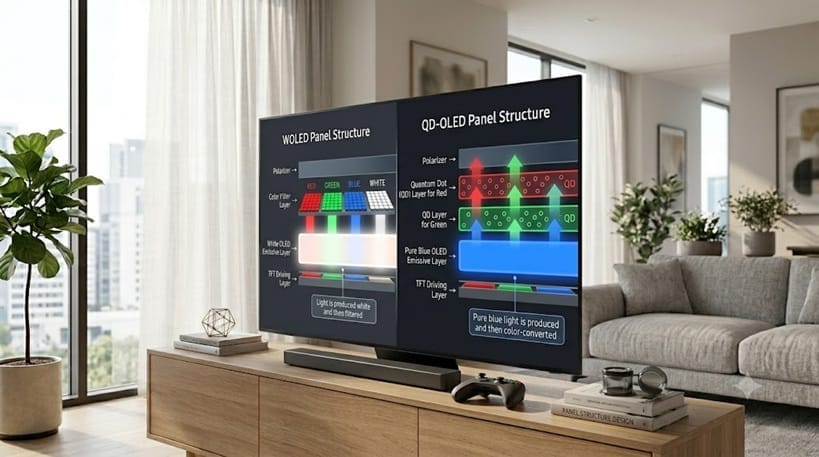
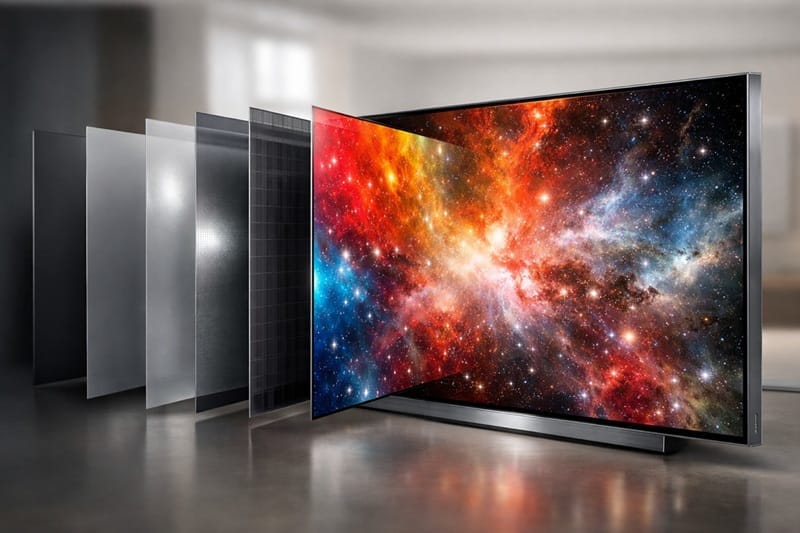
Both panel types are self-emissive, meaning every pixel produces its own light instead of relying on a backlight. Where they differ is how that light gets made. Think of it like two different recipes for producing color from light: WOLED starts with a white light source and filters it down into red, green, and blue through color filters. QD-OLED starts with a blue light source and converts part of it upward into red and green using a layer of quantum dots.
That difference in approach is also what separates WOLED from what QD-OLED is at a manufacturing level — filtering down versus converting up. It’s also why the two panel types land in different places on brightness, color volume, and how they handle ambient light, which we’ll get into below.
One area where the two panel types don’t meaningfully differ is gaming response time. Because both WOLED and QD-OLED pixels light up and shut off individually rather than through a backlight, near-instant pixel response is a property of OLED as a category, not something either panel type has an advantage on. If response time is your main concern when shopping, the WOLED-vs-QD-OLED decision matters far less than it does for brightness or color.
Where “Evo” and “EX” Actually Fit In
“OLED evo” is LG Electronics’ consumer branding for its higher-brightness WOLED models, typically the G-series and similar tiers, built around what LG calls Brightness Booster technology. According to LG’s official OLED evo product page, current OLED evo models pair that brightness hardware with LG’s AI processor for additional picture enhancement — but the panel underneath is still WOLED, not a third panel chemistry.
“OLED with EX Technology” refers to something different: a deuterium-based manufacturing process developed by LG Display that increases brightness and panel lifespan at the production level. Based on editorial research into LG Display’s manufacturing rollout, EX technology became the standard process across nearly all WOLED panel production starting in 2022 — which means most WOLED TVs sold since then, regardless of brand or whether “EX” appears anywhere in the marketing, are already built on EX-generation panels.
If you’re shopping with this distinction in mind, it’s worth keeping the bigger picture in view too — our best OLED TVs of 2026 roundup ranks top picks across both panel types by use case and budget, so panel chemistry is only one piece of the decision.
Why the OLED Panel Types Get Confusing in 2026
The confusion mostly comes from EX and Evo operating at different levels that don’t map cleanly onto each other. EX is a manufacturing-level upgrade baked into nearly every WOLED panel made since 2022, whether or not a brand chooses to mention it. Evo is a separate, brand-specific marketing tier that LG applies to a subset of its own lineup, on top of whatever manufacturing generation the panel already uses.
That’s also where WOLED and QD-OLED genuinely diverge in ways that matter for shopping. According to independent panel testing, QD-OLED’s quantum dot layer skips a polarizer step that WOLED panels rely on, which helps QD-OLED reach higher peak brightness and wider color volume — but that same missing layer can make QD-OLED panels more susceptible to black levels rising under ambient light. WOLED panels, by contrast, tend to hold steadier blacks in rooms with some ambient light, at the cost of a brightness ceiling that even Evo-tier WOLED panels don’t fully close. We cover this trade-off in far more depth in our full QD-OLED vs WOLED compared breakdown.
One more term worth ruling out while you’re sorting through the naming: none of this relates to MicroLED. It sounds like it could be a third OLED panel type, but it’s a completely separate, non-OLED display category — self-emissive inorganic LEDs sold as modular, professionally installed panels rather than a standard TV. If you’ve seen the term used loosely alongside WOLED or QD-OLED, our MicroLED vs OLED comparison explains why it’s not actually part of this decision for most buyers.
What This Means for You in Practice
Here’s the practical side of OLED panel types explained — how the four terms typically sort out once you’re actually choosing between TVs on a shelf or a spec sheet:
Who Should Pay Attention to This
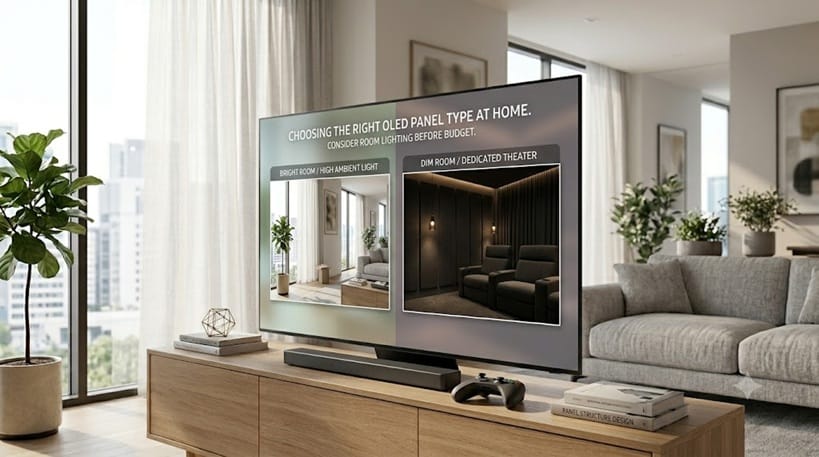
If you’re comparing two WOLED TVs at different price points — say, an entry-level model against a G-series evo model — the Evo distinction is worth caring about. The brightness gap between tiers is real and shows up most in daytime or bright-room viewing.
Who Doesn’t Need to Worry About This
If your actual decision is bigger than panel tiers — choosing between brand families entirely — Evo and EX won’t change that call much, since both brands’ current lineups already reflect their respective panel type’s strengths. That’s a separate question we answer directly in LG OLED vs Samsung OLED compared.
FAQs: OLED Panel Types
OLED panel types explained: what are the main ones in 2026?
There are two: WOLED, made by LG Display and used across several TV brands, and QD-OLED, made by Samsung Display. According to RTINGS’ independent panel testing, the two differ most in peak brightness, color volume, and how each handles ambient light in the room.
Is OLED evo the same as QD-OLED?
No. OLED evo is LG’s brightness-focused branding for select WOLED models — it’s still a WOLED panel, not a competing panel type. QD-OLED is Samsung Display’s separate panel technology built around quantum dots rather than color filters.
Does every WOLED TV have EX technology?
Most do — 2022 is the cutoff to keep in mind. That’s when LG Display shifted its WOLED production to the EX-generation process as the default, so a WOLED TV bought new today almost certainly already has it, whether or not the brand prints the “EX” name on the spec sheet.
Should I pick OLED evo or QD-OLED for a bright room?
Either can work, but for the same general price tier, OLED evo models tend to prioritize peak brightness specifically, while QD-OLED prioritizes color volume alongside brightness. If you’re narrowing down specific evo models, our LG OLED roundup breaks down which current models actually carry Brightness Booster tiers.
Will QD-OLED replace WOLED panels entirely?
Not based on current production trends. LG Display continues investing in WOLED manufacturing alongside Samsung Display’s QD-OLED line, and both panel types currently ship across multiple TV brands rather than one displacing the other. For a closer look at where each side’s roadmap is actually headed, see our full breakdown of whether QD-OLED is the future of TV.

iYaiii
Editor, GearPulse360
iYaiii is the editor and founder of GearPulse360, specializing in TV reviews and consumer electronics. He researches every recommendation before publishing.
✅ Based on spec analysis and LG’s and Samsung’s official data plus RTINGS — last verified June 2026