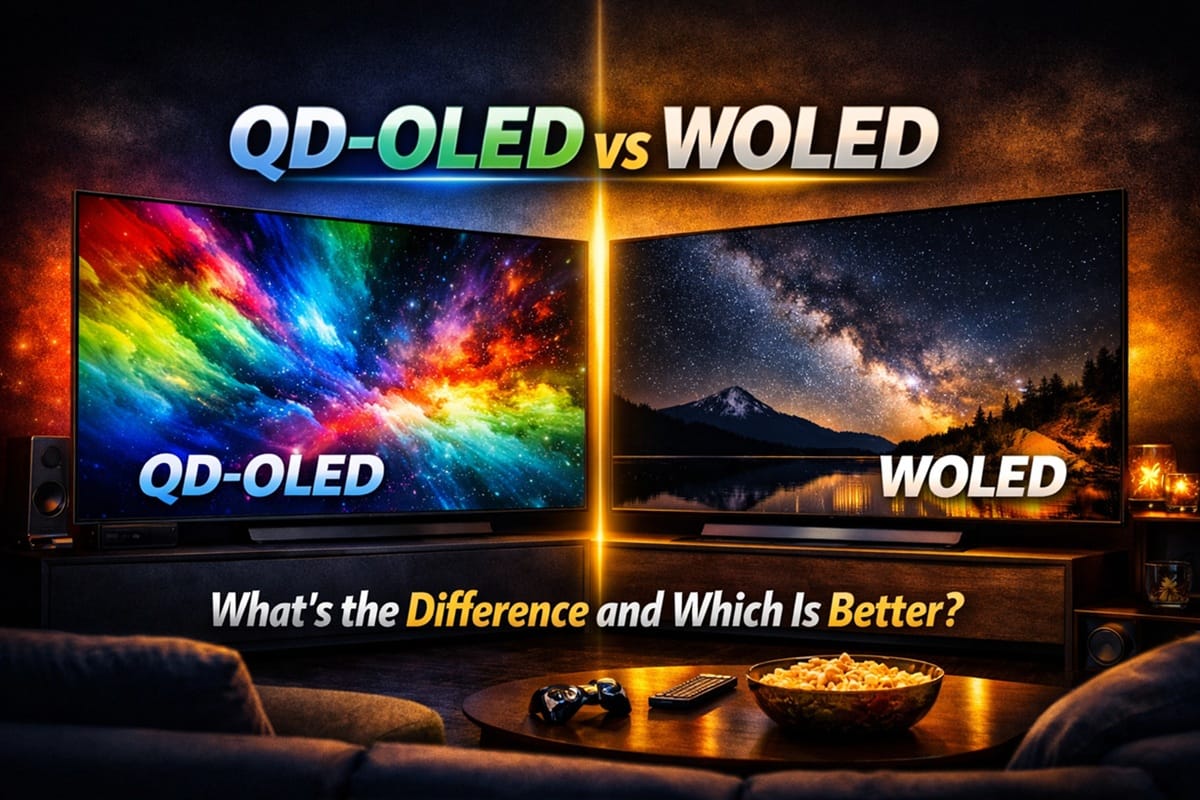
QD-OLED vs WOLED: What’s the Difference and Which Panel Type Is Better?
Heads up: We use affiliate links — if you buy through them, we earn a small commission at no extra cost to you. Our recommendations are always editorially independent. (Full disclosure)
You’ve already decided on OLED. Now you’re staring at a spec sheet that says one TV uses QD-OLED and another uses WOLED — and wondering whether that distinction actually matters or if it’s just marketing language dressed up in letters. It matters, but probably not in the way the spec sheets imply.
Here’s the short version: QD-OLED wins for most buyers in 2026, mainly because of higher peak brightness and richer color volume — advantages you’ll notice in a normal living room with mixed lighting. WOLED isn’t behind; it’s the better choice if you care about a wider size selection, lower cost per inch, or out-of-box color accuracy without calibration.
This article breaks down the real differences across picture quality, brightness, gaming, price, and burn-in risk.
Still deciding between OLED and other technologies? See our full OLED vs QLED comparison first.
Or if size and budget have you weighing the bigger LED-backlit alternative, OLED vs Mini LED compared covers that one.
Table of Contents
QD-OLED vs WOLED: Quick Verdict
QD-OLED vs WOLED: Our Verdict
Winner for most buyers: QD-OLED — higher peak brightness and wider color volume give it a visible edge in real living-room conditions.
Exception: WOLED wins if you want a 42″, 48″, or 97″ screen, a lower starting price, or a Sony or LG TV with class-leading picture processing.
Buy QD-OLED if:
- Your room gets natural light during viewing hours
- HDR movies and gaming are your main use cases
- You’re choosing a Samsung S95H or Sony Bravia 8 II
Buy WOLED if:
- You want a 42″ or 48″ OLED for a desk or bedroom
- You prefer LG’s broader lineup, or want a Samsung OLED without flagship pricing (S90H, S85H)
- Out-of-box color accuracy matters and you won’t be calibrating
How They Compare
Which wins for your situation?
Tap any use case above to see which panel wins for you.
Editorial assessment — based on measured specs and real-world observation.
How QD-OLED vs WOLED Actually Work
Both technologies start from the same foundation — individual pixels that emit their own light and can switch off completely, producing true black. Understanding what OLED TV technology is at a basic level helps here, but the split between QD-OLED and WOLED comes down to one structural choice: how each panel generates color.
The QD-OLED approach (Samsung, Sony)
QD-OLED uses a blue OLED layer as its light source, then passes that light through a quantum dot filter to convert it into red and green. Samsung developed this architecture and supplies the panels to Sony for the A95L. For a detailed breakdown of the underlying panel structure, Samsung Display’s QD-OLED technology page explains the emission layers directly. The result is a very wide color gamut — quantum dots are exceptionally efficient at producing pure, saturated red and green, which is why QD-OLED panels consistently measure above 90% of DCI-P3 color space.
The WOLED approach (LG, Sony, Philips)
LG’s panels — used in every LG OLED and in Sony’s non-QD-OLED models — emit white light from the OLED layer, then filter it through a traditional RGBW color filter. If you want the full breakdown of what WOLED is and why that extra subpixel exists, we cover it in more depth there. The extra W (white) subpixel is what enables higher brightness in non-HDR content. WOLED’s color gamut is slightly narrower than QD-OLED, but LG’s image processors (particularly in the C5 and G5) do an excellent job of making colors look accurate and natural without looking oversaturated.
Why the architecture gap matters
The core trade-off is this: QD-OLED is better at producing intense, vivid color in bright conditions. WOLED is better at producing neutral, balanced color straight out of the box. Neither is “wrong” — they reflect different engineering priorities.
Picture Quality and Color: QD-OLED Wins, With a Caveat
On paper, QD-OLED covers a wider color volume — roughly 91–95% DCI-P3 vs WOLED’s 83–87% on comparable panels. In practice, that gap shows up most clearly in HDR content with vivid reds and greens: saturated sports jerseys, neon cityscapes, fire and lava sequences. The QD-OLED image can look more “alive” in those moments. Anime leans on this same kind of flat, saturated color work even more heavily than live-action does — if that’s most of what you watch, our best OLED TVs for anime guide ranks the model-level picks for it.
Where WOLED holds its own
The caveat is calibration. WOLED panels — especially LG’s Evo generation and Sony’s XR-processed models — often measure closer to D65 white point out of the box. Colors look accurate rather than punchy. For buyers who watch a lot of cinema-graded content (Criterion Collection films, documentary, prestige TV) and don’t plan to calibrate, WOLED can feel more faithful to what the director intended.
Which looks better for movies?
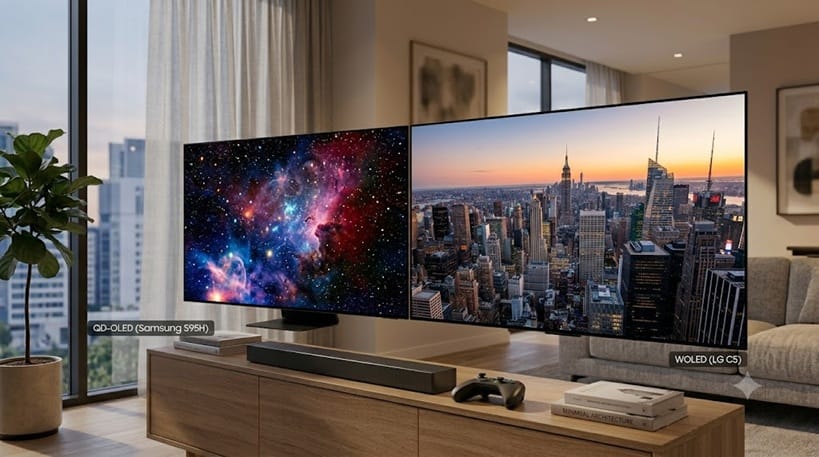
In a dark room with professionally graded HDR content, the gap closes significantly. A well-configured LG C5 and a Samsung S95H side by side are harder to separate than the spec sheets suggest. QD-OLED still has an edge in color pop, but it’s not a dramatic difference. Most people who sit down with either panel come away impressed.
QD-OLED vs WOLED Brightness: The Clearest Gap Between the Two
This is where the difference is most measurable. Current QD-OLED panels — Samsung S95H, Sony A95L — typically reach 1,600–2,000 nits peak HDR brightness on a 10% window pattern, depending on content and mode. LG’s WOLED Evo panels in the C5 and G5 typically measure around 1,300–1,500 nits under the same conditions. That’s a roughly 25–35% brightness advantage for QD-OLED.
Does that difference matter in a real room?
Yes — specifically in two scenarios. First, if your living room gets sunlight during the hours you watch TV, QD-OLED specular highlights (the bright points in a car chrome reflection or a sun flare) stay vivid where WOLED starts to look slightly washed. Second, for HDR gaming in a mixed-light environment, the extra headroom makes highlights feel more like they punch through the scene rather than sitting on top of it.
In a properly darkened home theater room, both panels are more than bright enough. Nobody watching Dune Part Two at night is going to feel shortchanged by WOLED’s output. The brightness gap is a living-room advantage, not a deal-breaker for dark-room viewers. Both panel types are self-emissive too, so if OLED vs QLED for eye strain is part of your decision, that flicker-free advantage over QLED applies equally whether you land on QD-OLED or WOLED.
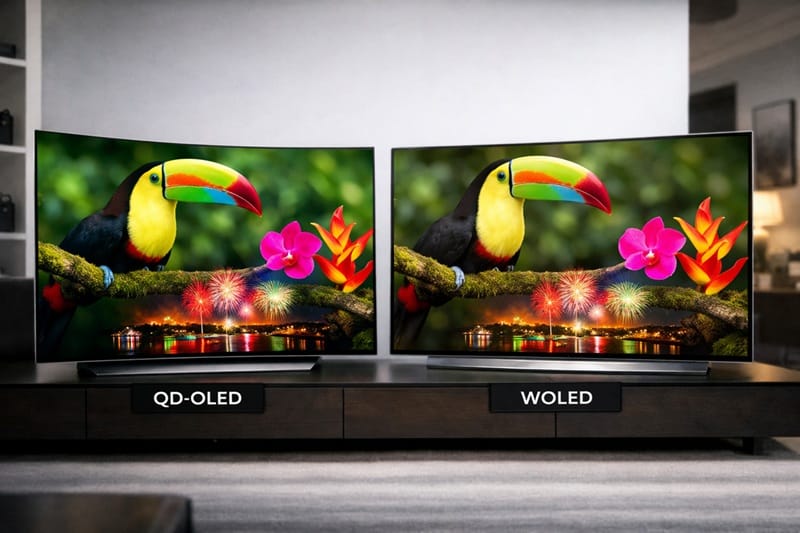
Gaming Performance: Excellent on Both, Minor Differences
Both QD-OLED vs WOLED are genuinely great gaming panels. You’re getting true 4K 120Hz, VRR (FreeSync Premium Pro and HDMI Forum VRR), ALLM, and input lag well under 2ms in game mode across all major models from Samsung, LG, and Sony. There’s no bad choice here.
Where QD-OLED has a small edge
Samsung’s anti-reflection coating on QD-OLED panels handles glare better than LG’s matte-style coating in most gaming setups where a light source is behind or beside the screen. For desk gaming in a bright room, the Samsung S95H tends to look cleaner. QD-OLED’s higher brightness also benefits HDR gaming directly — the visual range between dark shadows and bright explosions is slightly wider.
Where WOLED gives you more options
LG makes a 42″ and 48″ WOLED panel that’s genuinely suited to desk or monitor-distance gaming. QD-OLED doesn’t go below 55″. If you’re gaming at close range and want an OLED experience, WOLED is your only path. LG’s 42″ C5 and 48″ C5 are standout options at that size — no QD-OLED equivalent exists.
Price and Size Range: WOLED Is the Practical Winner
WOLED is available in 42″, 48″, 55″, 65″, 77″, 83″, and 97″ — a range that QD-OLED simply can’t match. QD-OLED is currently available in 55″, 65″, and 77″ only. That’s not a minor limitation; it means anyone who wants an OLED under 55″ or over 77″ has no choice but WOLED.
On price, WOLED offers a lower floor — and that price difference widened in 2026. LG’s B5 still sits at the entry tier of the OLED market on WOLED Evo, and Samsung now has two WOLED tiers of its own, the S85H and S90H, both meaningfully cheaper than stepping up to QD-OLED. The cheapest QD-OLED option from Samsung is now the flagship S95H — Samsung consolidated QD-OLED into its top tier for 2026, so there’s no longer a budget-friendly Samsung QD-OLED model the way the S90F filled that role last year.
At the 65″ size, you can usually find a capable WOLED panel for meaningfully less than the equivalent QD-OLED. That gap matters more than ever when the picture quality difference is less dramatic than the price difference.
When the QD-OLED premium is worth it
If you’re buying at the 65″ or 77″ tier, watch a lot of HDR content, and your room isn’t light-controlled, the QD-OLED premium is justifiable. If you’re buying at 55″, watch mostly streaming, and your room is reasonably dim in the evenings, a 55″ LG C5, LG B5, or Samsung S90H will likely satisfy you more than its price difference would suggest.
QD-OLED vs WOLED by Use Case
Use case assessments are editorial — based on measured specs and real-world observation, not user reviews.
Which Should You Buy?
For most buyers shopping at 55″–77″ in a room with any ambient light, QD-OLED is the stronger all-round choice in 2026. As of mid-2026, QD-OLED still holds a measurable brightness lead over current WOLED Evo panels — and that advantage is real in everyday viewing conditions, not just in a lab.
If size flexibility matters — or your budget is better served by the LG B5, entry C5, or Samsung’s new S85H and S90H — WOLED is by no means a compromise. LG’s WOLED Evo panels are among the best display panels made, and Sony’s picture processing on WOLED models like the A80L can make them look exceptional without touching a single setting. The difference between the two technologies is smaller than the marketing language makes it sound.
The most important variable isn’t actually the panel type — it’s the specific model and the image processor sitting in front of the panel. A Sony A95L (QD-OLED) and an LG G5 (WOLED) both outperform their own brand’s cheaper models regardless of panel.
For the brand-level decision, LG OLED vs Samsung OLED compared goes deeper on how each lineup stacks up.
And if Sony is in the mix for you, Sony OLED vs LG OLED compared breaks down that matchup specifically.
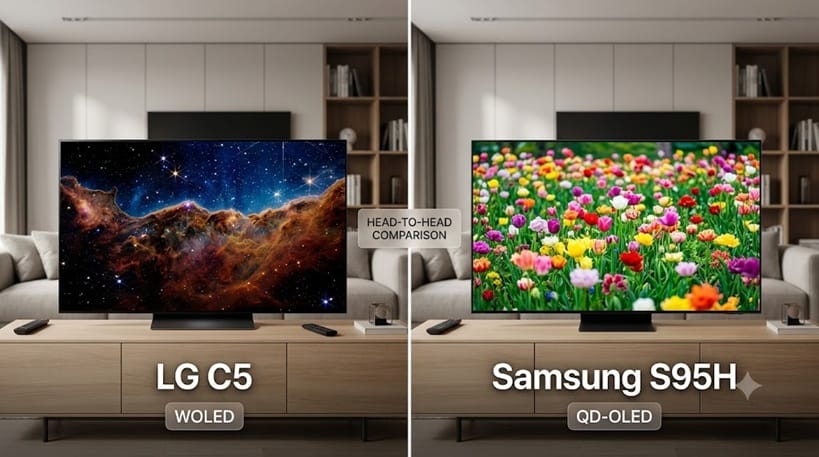
QD-OLED vs WOLED: Common Questions
Is QD-OLED better than WOLED for movies?
In a bright room, yes — QD-OLED’s higher peak brightness keeps HDR highlights vivid in a way WOLED can’t quite match. In a dark room, the gap narrows considerably and comes down more to personal preference: QD-OLED leans more saturated, WOLED leans more accurate. Neither is the “wrong” choice for movie watching.
Is QD-OLED worth the premium over WOLED?
At the 65″–77″ flagship tier, the premium is justified if you watch a lot of HDR content in a room with ambient light. At the 55″ entry-to-mid tier, an LG C5 or B5 gets you excellent WOLED performance at a price where the QD-OLED upgrade is harder to justify. If you’re still piecing together what QD-OLED is under the hood, that context helps make the price gap feel more concrete. Check current pricing on both before deciding — that difference fluctuates.
Also consider: LG G5 — if you’ve decided WOLED is the right call, it’s LG’s brightest WOLED Evo panel and the closest flagship-tier answer to QD-OLED’s brightness advantage.
Does QD-OLED burn-in faster than WOLED?
No meaningful difference has been established. Both technologies carry similar burn-in risk under heavy static-image use — think news tickers, persistent HUD elements in gaming, or always-on screensavers. With normal mixed-use viewing, both panels are considered low-risk for the average household. For a detailed look at current data, RTINGS.com’s long-term burn-in testing is the most rigorous independent source available.
Which OLED panel does Sony use — QD-OLED or WOLED?
Sony uses both. The A95L and A95K use Samsung’s QD-OLED panel. The A80L, A90K, and other Bravia models use LG’s WOLED panel. Sony’s own XR processor sits on top of either panel — which is why Sony TVs often look different from comparable Samsung or LG models despite using the same underlying display hardware.
Will WOLED close the brightness gap with QD-OLED?
LG has made consistent brightness improvements each generation — the G5’s WOLED Evo panel is meaningfully brighter than the C3 from two years ago. The difference has narrowed, though QD-OLED still leads in 2026. Whether WOLED fully closes it in the next generation depends on LG’s roadmap. For buyers shopping now, QD-OLED holds a real but not insurmountable brightness lead.

iYaiii
Editor, GearPulse360
iYaiii is the editor and founder of GearPulse360, specializing in TV reviews and consumer electronics. He tests and researches every recommendation before publishing.
✅ Based on spec analysis and LG’s, Samsung’s, and Sony’s official data plus RTINGS — last verified June 2026