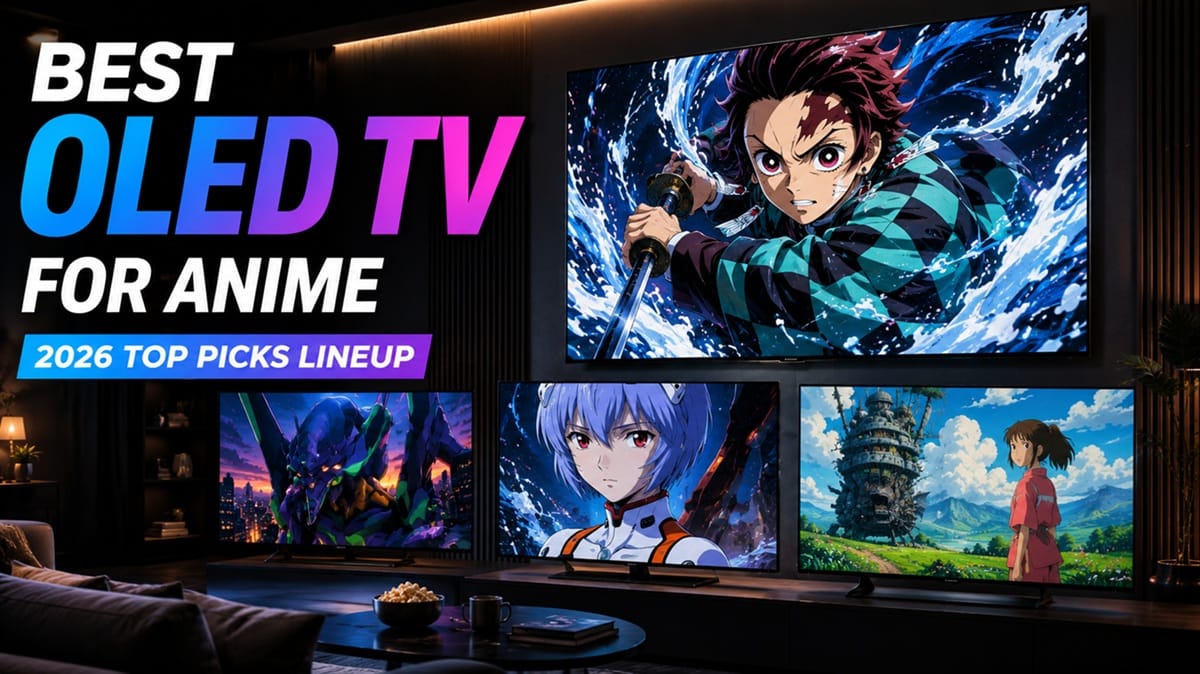
Best OLED TVs for Anime in 2026: Why OLED Is the Only Choice for Animation
Last updated: June 2026 | 🕒 9 min read
Disclosure: As an Amazon Associate I earn from qualifying purchases. This article contains affiliate links — we may earn a small commission if you buy through them, at no extra cost to you.
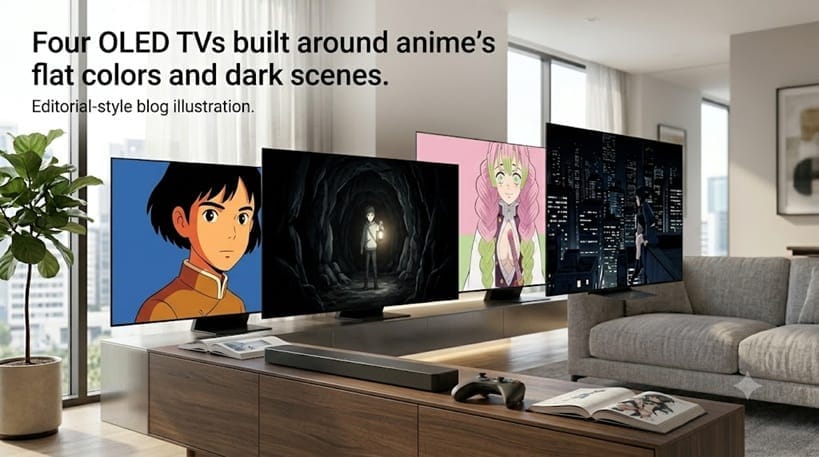
If you’ve ever watched a sword glow or a magic effect cut across a night sky on an LED or QLED TV, you’ve probably noticed the soft grey halo it leaves behind. That’s blooming, and it’s the local-dimming backlight trying — and failing — to dim everything around a bright object on a flat, dark background. Anime leans on exactly that combination: flat color fields, sharp line art, and bright effects against dark scenes. OLED skips the problem entirely, since every pixel produces and switches off its own light.
This guide isn’t for movie buffs chasing 24fps motion or competitive gamers chasing input lag — both have their own guides linked below. It’s built around finding the best OLED TV for anime specifically: the picks that handle its color and contrast better than anything else on the market. Our top pick is Samsung’s S95F for its color volume, but a true QD-OLED panel isn’t strictly required — one of our four picks below uses LG’s latest WOLED panel and still earns its spot.
Table of Contents
Best OLED TVs for Anime: Quick Comparison
| Pick | Model | Size | Best For | Price |
|---|---|---|---|---|
| Best Overall | Samsung S95F | 65″ | Highest color volume | Check Price |
| Best for Color Accuracy | Sony Bravia 8 II | 65″ | Out-of-box accuracy | Check Price |
| Best Value | Samsung S90F | 65″ | QD-OLED on a budget | Check Price |
| Best Newest Model | LG C6 | 65″ | Dolby Vision + 2026 processing | Check Price |
Prices checked at time of publishing. Amazon prices change frequently — click through for current pricing. | Star ratings and scores above reflect our independent editorial assessment — they are not Amazon customer reviews.
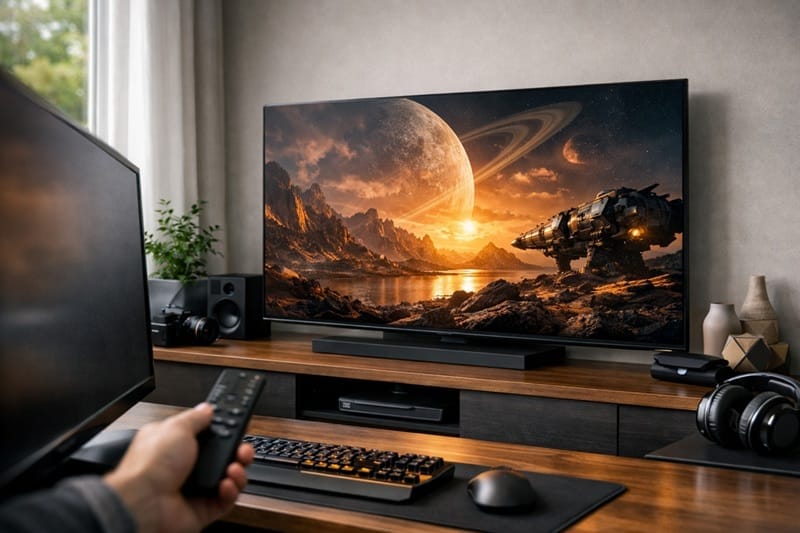
Best Overall OLED TV for Anime: Samsung S95F
Anime’s color palette is part of the art style — flat skies, saturated effect work, and skin tones that lean stylized rather than photographic. Based on Samsung’s published specs, the S95F’s third-generation QD-OLED panel is built to push more of that color out at higher brightness than a standard OLED, instead of clipping it down to stay within a narrower gamut. According to RTINGS’ measurements, the S95F’s color volume sits at the top of Samsung’s current lineup.
The Glare Free 2.0 matte coating also matters more for anime than for movies, since long binge sessions often happen during the day rather than in a darkened home theater. It trades a small amount of glossy-screen contrast for a screen that stays readable with a window or lamp nearby. The one real trade-off is Dolby Vision — Samsung TVs don’t support it, so HDR10+ titles get the full treatment while Dolby Vision-mastered streams fall back to HDR10. For full specs, see Samsung’s official S95F page.
Best for Color Accuracy: Sony Bravia 8 II
Sony’s XR processor takes the same general category of QD-OLED panel as Samsung’s and tunes it with a different priority: getting close to an accurate picture without the viewer touching a single setting. For a hobby built on watching a specific art style as the studio intended it, that’s a real advantage over a TV that needs calibration to look its best. Based on RTINGS’ review of the Bravia 8 II, it needs minimal adjustment in its Professional picture mode to look accurate — a real plus if you’d rather watch than tune settings, even if it isn’t the single most accurate panel on the market straight out of the box.
The catch is connectivity. Of the four HDMI ports, only two run full-bandwidth HDMI 2.1, and one of those doubles as the eARC port for a soundbar — fine for a single streaming box, tighter if you’re also running a game console on the same TV. The glossy screen also means a south-facing window or overhead light will show up as glare more readily than on the Glare Free Samsung above. Full specs are on Sony’s official spec page.
Best Value: Samsung S90F
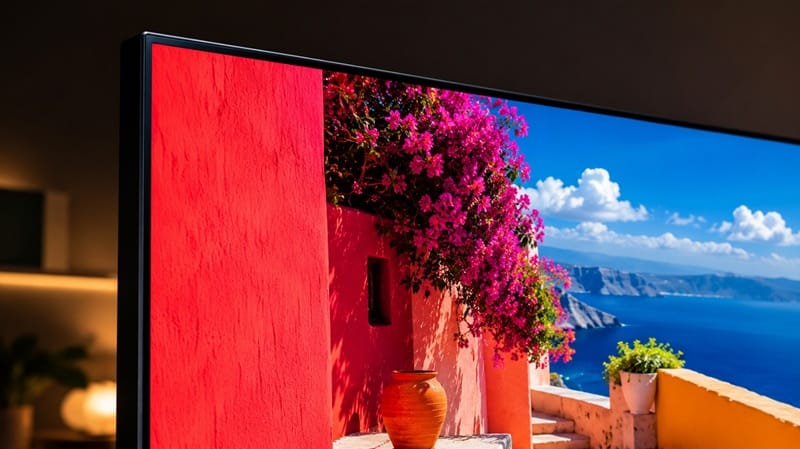
The S90F sits one rung below the S95F in Samsung’s lineup, and the gap shows up in peak brightness and the lack of the Glare Free coating — not in the underlying color technology. It’s still a genuine QD-OLED panel, which means the same wider color volume that makes flat anime palettes look saturated rather than flat-looking carries over here too. According to Samsung’s official spec page, it’s the most affordable way into that panel type in this guide.
Four full-bandwidth HDMI 2.1 ports is also a real edge over the pricier Sony pick above — useful if anime streaming shares a TV with a game console. The costs are straightforward: no Dolby Vision, and a glossy screen that needs a bit more thought about room lighting than the Glare Free models. See Samsung’s S90F page for the full spec sheet.
Best Newest Model: LG C6
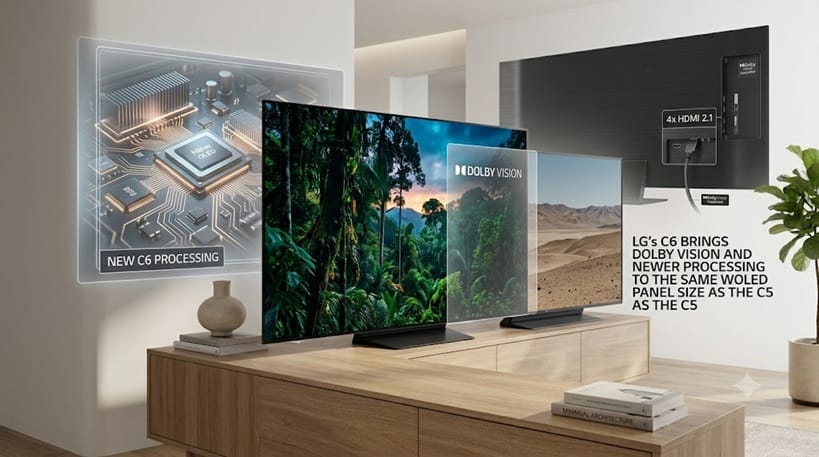
The C6 uses the same standard WOLED panel size-for-size as last year’s C5 — LG saves its brighter Tandem panel for the larger 77- and 83-inch C6H models. What’s actually new is the Alpha 11 AI Processor Gen3 underneath it, which according to LG’s published specs runs a 12-bit tone and color pipeline instead of the usual 10-bit. For anime specifically, that shows up in smoother gradients across the kind of soft sky and lighting transitions hand-painted backgrounds rely on, where lower-bit processing can show visible color banding.
It’s also the only pick here with Dolby Vision, which matters for any anime streamed in that format rather than HDR10. The real compromise is color volume: a WOLED panel, even a refined one, doesn’t reach the saturation ceiling of the QD-OLED picks above. If color volume is the single spec you care about most, the S95F or S90F will out-perform it; if you want the newest processing and Dolby Vision in the mix, the C6 earns its place. See LG’s official C6 page for full specs.
Color volume and panel type matter more here than refresh rate or input lag — if those are bigger priorities for you, our QD-OLED vs WOLED compared breakdown covers the trade-offs in more depth than we can fit into one buying guide.
What to Look for in an Anime OLED TV
Color Volume and Wide Color Gamut
Color volume measures how saturated a color stays as brightness increases, not just how wide the color gamut is on paper. Anime relies on flat, often highly saturated color fills rather than the more muted, photographic palettes typical of live-action — so a panel that holds onto saturation at higher brightness reproduces those scenes more accurately than one that doesn’t. QD-OLED panels generally measure higher here than WOLED panels of the same generation, which is the core reason three of the four picks above use one. If you want the deeper explanation of how that panel difference actually works, we cover it in what QD-OLED is.
Per-Pixel Contrast and No Blooming
This is the spec that makes OLED non-negotiable for anime in the first place. Because every pixel is its own light source, a bright lightning effect on a black night sky stays exactly as wide as it’s drawn, with no grey halo bleeding into the surrounding darkness. Mini-LED and QLED panels dim in zones rather than per pixel, and a zone is almost always larger than a single bright effect against a dark background — which is exactly the layout anime uses constantly.
Refresh Rate and Motion Handling
Most anime is still produced and broadcast at 24fps, so a sky-high refresh rate isn’t doing the heavy lifting some shoppers assume it is. What it does help with is panning shots and fast action sequences, where good motion processing keeps line art crisp instead of smeared. 120Hz and above with VRR support, which all four picks here have, is more than enough headroom for this content.
HDR Format Support
HDR matters less for the format war and more for which streams you’ll actually watch. Crunchyroll and most anime-specific HDR releases use HDR10, which every pick here supports. Dolby Vision adds a benefit mainly for titles licensed through Netflix or Sony Pictures Core that were mastered in that format — which is why it’s worth checking which streaming service carries the specific shows you watch before treating Dolby Vision as a must-have.
Burn-in Risk and Built-In Protections
This is the fair objection to raise about OLED for anime specifically: long binge sessions with a static subtitle bar and a channel logo sitting in the same spot for hours is the textbook scenario for image retention. Every TV on this list ships with pixel-shifting, logo dimming, and periodic compensation cycles built in, and real-world burn-in from normal streaming use is uncommon on modern panels rather than a guaranteed outcome. It’s a legitimate factor to weigh, just not a reason to rule out OLED outright.
Is OLED Actually Good for Anime, or Just a Marketing Angle?
It’s a fair question — anime is 2D content, and a TV built to win benchmarks on live-action contrast and motion might seem like overkill for something that doesn’t have real-world lighting to render. But the flat-color-fill, sharp-edge, high-contrast structure that makes anime visually distinctive is precisely the layout where backlit LED and QLED panels struggle most, independent of how good their specs look on paper. OLED’s per-pixel control isn’t a marketing angle here — it’s a direct match for the source material’s own visual language.
That said, you don’t need to chase every spec on this list to get the benefit. If color volume isn’t your top priority and you’d rather have the newest processing and Dolby Vision, the LG C6 above is a legitimate choice over the QD-OLED picks. And if you’re weighing this purchase against a TV that needs to double for movie night, a movie-focused guide is built around a different set of priorities entirely — slower motion, deeper shadow detail — worth a look if anime won’t be the only thing on screen (see the FAQ below for that comparison).
How We Picked These TVs
We started from Samsung, Sony, and LG’s official 2026 spec pages for panel type, processor generation, and HDR format support, then cross-checked color volume and panel-type claims against RTINGS’ published measurements where a review existed for the exact model. Where a manufacturer’s spec sheet and an independent measurement disagreed, we used the independently measured figure.
Pricing for each pick was checked against the manufacturer’s listed price and at least one major retailer at the time of writing, though Amazon and other retail prices shift often enough that we don’t quote specific figures here — click through to any “Check Price” link for what it’s selling for right now.
📍 Not sure anime is the only thing you’ll watch on this TV? See how these same panel types stack up across every other use case in our full best OLED TVs of 2026 roundup.
Best OLED TVs for Anime FAQs
Which OLED TV is best overall for anime?
The Samsung S95F is our top pick, thanks to its third-generation QD-OLED panel delivering the highest color volume of the four TVs in this guide. Anime’s saturated, flat color fields show that difference more clearly than most live-action content does.
Is a QD-OLED TV worth it just for watching anime?
It’s worth it if color volume is the spec you’re chasing specifically — that’s the one area WOLED genuinely can’t match. But QD-OLED and WOLED pricing has converged enough at 65 inches that it’s worth checking current prices on both before assuming the QD-OLED pick costs noticeably more; the price gap that used to justify skipping it has narrowed.
Will watching anime on OLED cause burn-in from subtitles?
It’s a real risk factor with any static on-screen element left in the same spot for hours at a time, but modern OLED panels include pixel-shifting and logo-dimming features specifically to manage it. Based on RTINGS’ published longevity testing, normal streaming habits rarely produce visible burn-in on current-generation panels.
How is an anime-focused pick different from an OLED TV for movies?
Movie-focused picks weight 24fps motion handling and shadow detail in dark, photographic scenes more heavily, while an anime-focused pick weights color volume and per-pixel contrast on flat color fields instead. There’s overlap, but the priority order shifts — see our best OLED TVs for movies guide if movie night matters just as much.
Does TV size matter for watching anime?
Less than panel type and color performance, honestly. A 65-inch screen at a typical living-room viewing distance works well for any of the four picks above; what changes the experience more is color volume and contrast than a few extra inches of screen.

iYaiii
Editor, GearPulse360
iYaiii is the editor and founder of GearPulse360, specializing in TV reviews and consumer electronics. He researches every recommendation before publishing.
✅ Based on spec analysis and Samsung’s, Sony’s, and LG’s official data plus RTINGS — last verified June 2026