How OLED TVs Work: The Technology Behind the Picture
Last updated: June 2026
🕒 7 min read
Disclosure: GearPulse360 is a participant in the Amazon Associates Program. Some pages on this site contain affiliate links, and we may earn a commission from qualifying purchases at no extra cost to you.
Point an OLED TV at a starry night sky, and the black around each star disappears completely. Point almost any other TV at the same scene, and you’ll catch a faint gray haze where the screen is trying — and failing — to go fully dark.
If you’ve shopped for a TV recently, you’ve seen terms like “self-lit pixels” and “infinite contrast” all over OLED marketing, and it’s fair to wonder how much of that is real engineering versus clever copywriting. Based on manufacturer specifications cross-referenced against RTINGS’ independent testing, the short version is: it’s mostly real, though “OLED” isn’t one single technology — WOLED and QD-OLED build their pictures differently.
This guide walks through how OLED TVs work at the panel level, why that mechanism creates OLED’s signature contrast and color, and where the WOLED/QD-OLED split actually matters when you’re shopping. If you want the broader primer first, our explainer on what OLED TV technology is covers the basics this guide builds on.
Table of Contents
The Short Answer: How OLED TVs Actually Work
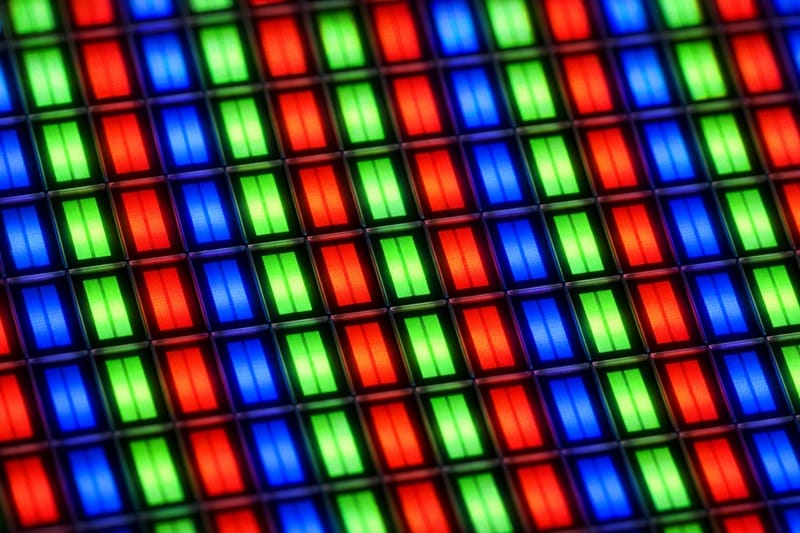
OLED TVs work by giving every individual pixel its own light source, made from a thin organic compound that glows when an electric current passes through it. There’s no backlight shining through a layer of liquid crystals like in LED/LCD TVs — each pixel turns fully on, fully off, or anywhere in between, entirely on its own. That’s what makes true black, high contrast, and wide viewing angles possible without any extra hardware fighting against them.
How OLED TVs Work: Self-Emissive Pixels Explained
What “Self-Emissive” Actually Means
“Self-emissive” simply means the pixel makes its own light, instead of letting light from somewhere else pass through it. Each OLED pixel is built from a few thin layers of organic material sandwiched between two electrodes. When current flows through that stack, the organic layer emits light directly.
That’s a fundamentally different design from LED/LCD TVs, where a separate backlight shines constantly behind the screen, and a layer of liquid crystals opens or closes like tiny shutters to let varying amounts of that light through. According to LG’s official OLED technology page, this is also why panels are marketed as having “self-lit pixels” — each one switches independently, with nothing standing behind it.
Why Removing the Backlight Changes Everything
Think of an LED/LCD screen like a stained-glass window lit by a floodlight behind it — even the darkest panes let a little light bleed through, because the floodlight never turns off. An OLED panel is more like a wall of individual light bulbs: when the bulb representing a dark pixel switches off, it’s actually off, with nothing behind it to leak through.
That’s the single change that explains most of what people notice about OLED picture quality — true black instead of dark gray, very high contrast because there’s no light bleeding into shadows, and consistent color from any seat in the room since there’s no backlight shining unevenly through layers at an angle.
That fast, independent switching also explains why OLED pixels respond to a changing image almost instantly, with response times far quicker than an LED/LCD panel typically needs. That’s part of why OLED has become a popular pick for gaming, even though the underlying reason has nothing to do with gaming itself — it’s simply a side effect of how the pixels turn on and off.
That backlight-vs-self-emissive difference is really the whole story behind why OLED and standard LED TVs look so different side by side — we break down the rest of that comparison, including price and lifespan, in our full OLED vs LED comparison.
Why Panel Type Matters When You’re Shopping in 2026
WOLED vs QD-OLED: Two Ways of Building the Same Mechanism
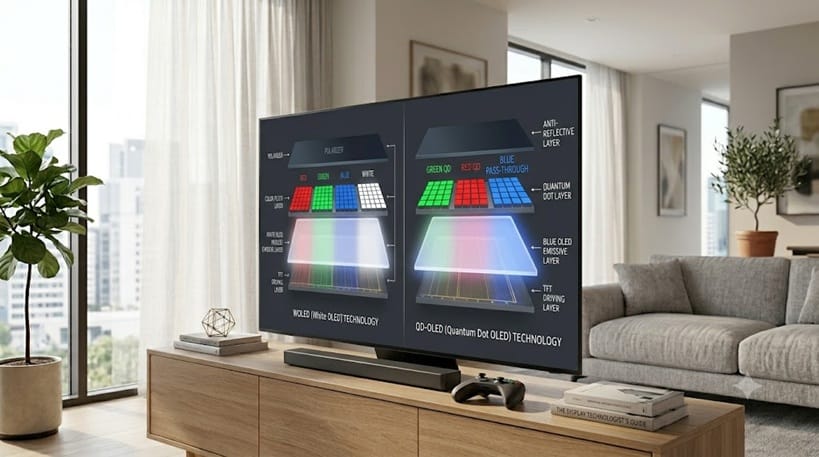
Every OLED panel on the market in 2026 uses the same self-emissive principle described above, but manufacturers reach it in two different ways. WOLED panels, used by LG and most OLED TV brands, pair white-emitting organic layers with a color filter to produce red, green, and blue. According to Samsung’s official OLED TV page, its QD-OLED panels instead pair a blue-emitting layer with a quantum dot layer that converts that blue light into red and green.
Neither approach changes the core mechanism — both are still self-emissive, pixel-level light sources. But the filtering method affects how efficiently each panel turns that light into the color you actually see, and that difference is exactly why brightness and color volume can vary noticeably between a WOLED and a QD-OLED TV at similar price points. We cover this split in more depth in our QD-OLED vs WOLED comparison.
What This Means for Brightness and Color in Today’s Models
In practice, this is why two TVs can both be labeled “OLED” yet look different side by side, especially in brighter scenes. The color-conversion method has a direct effect on how much of the panel’s light output reaches your eyes as visible color, rather than how “premium” a model happens to be.
Quantum dots are generally more efficient at converting light into saturated color than a traditional color filter, and that efficiency advantage helps explain why some QD-OLED models post higher peak brightness in colorful HDR scenes, according to brand-published brightness specs and current independently-measured numbers across model lines — not because one panel is more “OLED” than the other.
Once you understand why panel type affects brightness and color, the rest of the buying decision comes down to matching that to your room and budget. Our best OLED TVs of 2026 roundup breaks down the current top picks by size, brightness needs, and price.
Is This Just Marketing, or Does It Actually Matter?
Real Engineering vs. Marketing Polish
It’s a reasonable question, and the honest answer is: the underlying mechanism is real, but not every marketing phrase built on top of it is equally meaningful. “Self-emissive” and “infinite contrast” describe genuine, measurable properties of how the panel works — they’re not exaggerations.
Terms like “Perfect Black” or specific color-fidelity percentages, though, are brand-specific marketing labels layered on top of that real mechanism, and they vary in how they’re measured. Cross-referencing brand claims against independent test data, the safer approach is to treat the self-emissive mechanism as the comparable fact, and treat any brand-specific certification language as a bonus claim worth a second look rather than something to take at face value.
Does “Organic” Mean the Pixels Wear Out?
One more question that comes up once people learn the pixels are organic: does that mean they degrade? Organic materials do shift slightly with use over very long timeframes, and that’s the reason manufacturers build in pixel-shifting and compensation cycles — but for normal viewing habits, this isn’t something that should factor into whether the underlying mechanism is “real.”
What This Means for You in Practice
Who Should Pay Attention to This
If you’re choosing between two OLED TVs and trying to figure out why one costs more or looks brighter in store lighting, panel type is usually the answer. Knowing whether you’re looking at WOLED or QD-OLED tells you more about real-world differences than the marketing name on the box. This also matters if you’re shopping specifically for gaming — the same self-emissive mechanism that creates true black is what gives OLED panels their fast response times, so panel type matters less here than it does for HDR brightness. If you’re still deciding whether the OLED premium is worth it for your situation at all, our is OLED worth it in 2026 breakdown is the next read.
Who Doesn’t Need to Worry
If you’ve already decided OLED is right for you and you’re just comparing similarly-priced models from one brand, the underlying mechanism is identical enough across that brand’s current lineup that you don’t need to re-litigate the panel science for every model. The differences that matter more at that point are size, refresh rate, and connectivity rather than the core display technology.
How OLED TVs Work: FAQs
How do OLED TVs work, and is it mostly marketing?
OLED TVs work by giving each pixel its own organic, light-emitting layer, so there’s no backlight involved at all — that part is real engineering, not a marketing trick. According to RTINGS’ independent comparison of OLED versus LED display technology, the self-emissive design is what drives OLED’s measured advantages in black level and viewing angle.
Is QD-OLED newer or more advanced than WOLED?
Not in the sense of one replacing the other. Both are mature, currently-in-production panel technologies developed on different timelines by different display makers, and each continues to be refined independently. Treating QD-OLED as a “next generation” upgrade over WOLED — or the reverse — isn’t accurate; they’re parallel engineering paths to the same self-emissive result, not sequential versions of the same product.
Does the self-emissive design make OLED TVs more fragile?
Not in any way that affects normal use. The organic layers are sealed inside the panel like any other display component, and overall panel construction — not the self-emissive principle itself — is what determines durability and repairability. The self-emissive design does remove an entire component category that LED/LCD TVs rely on — the backlight and light-guide assembly — though real-world reliability ultimately comes down to build quality and warranty coverage rather than panel type alone.
How can I tell which panel type a specific TV uses?
Check the manufacturer’s spec sheet first — panel type is usually listed there even when it’s not part of the marketing headline. If it’s still unclear, RTINGS’ model database confirms panel type independently for most current TVs. The model number alone isn’t a reliable shortcut, since panel type can vary by series within the same brand and the same year.
Will OLED TV technology change again soon?
Panel makers continue refining how efficiently each pixel converts current into visible light, which is the area most likely to keep improving. The core self-emissive mechanism described in this guide, though, has been the foundation of OLED display technology for years and isn’t expected to change. If you’re shopping today, that means the explanation above will stay accurate for the foreseeable future, even as brightness and color-conversion efficiency keep improving model over model.

iYaiii
Editor, GearPulse360
iYaiii is the editor and founder of GearPulse360, specializing in TV reviews and consumer electronics. He researches every recommendation before publishing.
✅ Based on spec analysis and LG’s and Samsung’s official data plus RTINGS data — last verified June 2026