What Is OLED TV Technology? A Plain-English Explanation
Disclosure: As an Amazon Associate I earn from qualifying purchases. This article contains affiliate links — we may earn a small commission if you buy through them, at no extra cost to you.
If you’ve been TV shopping recently, you’ve probably asked yourself: what is OLED TV, and why does it cost so much more than everything else on the shelf? It’s a fair question. What is an OLED TV compared to the LED sets most of us have owned for years? The answer isn’t complicated — but it does explain why OLED looks so different the moment you see it.
This guide covers exactly what is OLED TV technology, how it works inside the panel, what it does well, where it falls short, and whether it makes sense for your room and budget.
Table of Contents
What Is an OLED TV, in Plain Terms?
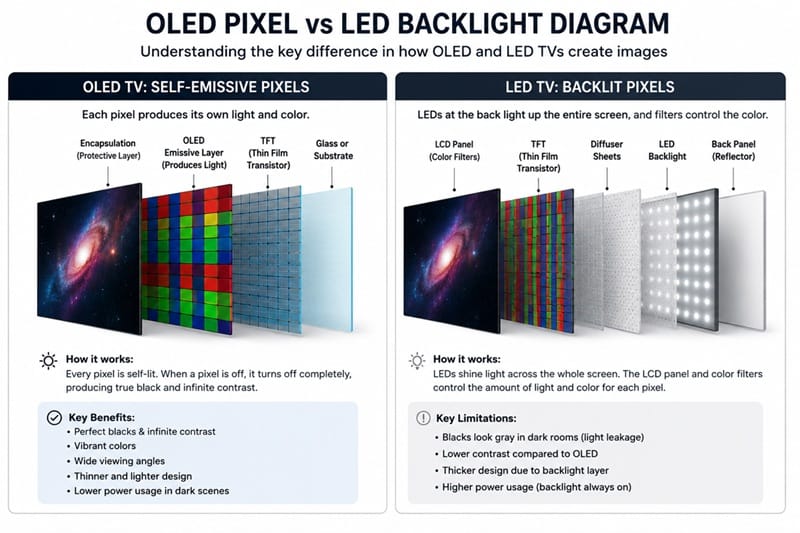
So what is OLED TV exactly? OLED stands for Organic Light-Emitting Diode. What is an OLED TV at its core? A screen where every single pixel generates its own light and can switch completely off independently.
A standard LED TV uses a backlight behind the panel to light up the entire screen. The pixels act as filters in front of that backlight — opening and closing to control how much light passes through. The backlight itself never fully turns off, so “black” on an LED TV is really just a dimmed dark gray.
What is an OLED TV doing differently? There is no backlight at all. Each OLED pixel is its own light source. When a pixel needs to show black, it turns off entirely — zero light, zero glow. That is the foundation of what is OLED TV technology, and it’s why the contrast looks so dramatically different compared to LED. For the full picture on price, longevity, and which one actually fits your room, see our full OLED vs LED comparison.
How OLED TV Technology Works Inside the Panel
Each pixel in an OLED TV contains an organic compound — a carbon-based material — that emits light when electricity runs through it. A 4K OLED TV panel contains around 8.3 million of these self-emissive pixels, all independently controlled by the TV’s processor in real time.
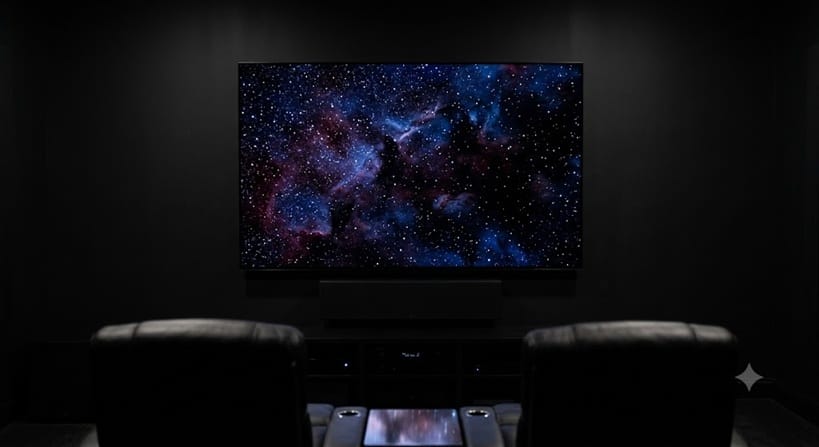
When a dark scene plays — a night sky, a cave, a cinema letterbox bar — the pixels showing those dark areas simply turn off. The pixels next to themด showing a bright flame or a spotlight stay fully lit. Since there is no shared backlight connecting them, there is no bleed or halo between the two. That pixel-level precision is the core of what is OLED TV picture quality.
Why OLED TV Contrast Is Described as “Infinite”
Contrast ratio describes the difference between the brightest white and darkest black a screen can produce. LED TVs achieve around 1,000:1 to 5,000:1 in real conditions. What is an OLED TV contrast ratio? It’s described as infinite — because a pixel that is off emits no light to measure. In practice, this means HDR content on an OLED TV looks like a genuinely different medium compared to the same content on an LED screen.
What “Organic” Actually Means in OLED TV Technology
The “organic” in OLED TV technology refers to the carbon-based molecular structure of the light-emitting layer — not eco-friendly materials. These organic molecules are highly efficient at converting electricity into light. The trade-off is that they degrade gradually with use, which is the root cause of OLED TV burn-in risk (explained below).
That’s the short version of the mechanism — for the complete breakdown of why removing the backlight changes everything about picture quality, see our full guide on how OLED TVs work.
What Does an OLED TV Do Better Than LED?
The strengths of an OLED TV flow directly from self-emissive pixels. These are consistent, measurable advantages — not marketing claims — independently tested and documented by labs including RTINGS.com.
Black Levels and Contrast on an OLED TV
This is where what is OLED TV technology really proves its worth. True per-pixel black means any bright object — a distant star, a neon sign, a lamp — stands out with zero glow around it. For movie watching in a dim room, no other consumer TV technology at a comparable price point matches what an OLED TV produces here.
Viewing Angles
An OLED TV holds accurate color and contrast up to about 60 degrees off-center. Most LED TVs — especially VA panel types — shift noticeably in color when viewed from the side. If your sofa is wide or you watch from different positions in the room, an OLED TV handles off-angle viewing significantly better than most alternatives.
Response Time and Gaming on an OLED TV
OLED TV pixels respond in approximately 0.1ms, far faster than LED panels. At 120Hz, this produces sharper motion and less blur during fast gaming or sports content. Most current OLED TVs also support VRR, ALLM, and 4K/120fps input, making an OLED TV one of the strongest options available for PS5 and Xbox Series X.
Panel Thinness
Without a backlight assembly, an OLED TV panel can be built under 4mm thick. That physical difference is immediately visible — OLED TVs look and feel closer to a framed picture than a traditional screen.
The Limitations of an OLED TV
Knowing what an OLED TV doesn’t do well is just as important as its strengths. There are three trade-offs that matter to real buyers.
Peak Brightness Is Lower Than QLED or Mini LED
Because the organic material in an OLED TV degrades faster at very high brightness, manufacturers cap peak output to protect longevity. Most OLED TVs peak between 800–1,500 nits. “High-end QLED and Mini LED TVs reach 1,500–3,000+ nits. For a full breakdown of how they compare, see our OLED vs Mini LED comparison.”
In a dark room this doesn’t matter — what is OLED TV performance in that context is still superior. But in a bright living room with direct sunlight, a high-brightness QLED or Mini LED holds up better during the day. See our full OLED vs QLED comparison for a room-by-room breakdown.
Burn-In Risk on an OLED TV
The organic pixels in an OLED TV wear down slightly with extended use. If the same static image stays on screen for many hours daily — a news ticker, a game HUD, a sports scoreboard — that pattern can ghost into the panel permanently. This is burn-in.
For most home users watching varied content, what is OLED TV burn-in risk in practice? Low. Modern OLED TVs include pixel shifting, automatic brightness limiting, and scheduled pixel refresh cycles that significantly reduce risk. It becomes a real concern mainly in commercial settings — a bar running one channel all day, or a PC monitor with a persistent static taskbar for eight-plus hours daily.
Price Premium
What is an OLED TV going to cost you? More than LED/LCD — manufacturing is more complex. A 65-inch OLED TV starts around $1,000–$1,300. A comparable LED TV often runs $400–$700. The gap has narrowed significantly — smaller OLED TV sizes now start under $800 — but the premium remains real at 77 inches and above.
QD-OLED vs WOLED: Two Types of OLED TV Panel
If you’ve looked at LG, Samsung, and Sony and wondered why they all sell “OLED” but get reviewed differently, it’s because what is OLED TV technology differs slightly between manufacturers. There are two distinct panel types in consumer TVs today.
WOLED — Used in LG and Sony OLED TVs
LG Display’s WOLED panels use a white OLED emitter with a color filter to produce color output. All LG OLED TVs — the C5, G5, and Z5 lineup — use WOLED panels. Sony sources the same LG Display panels for most of its OLED TV range. WOLED has been in mass production since 2013, and its longevity and brightness uniformity are well established.
QD-OLED — Used in Samsung and Sony BRAVIA 8 II
Samsung Display’s QD-OLED panels layer quantum dots on top of a blue OLED emitter. This produces higher peak brightness and more saturated reds and greens than standard WOLED. The Samsung S90F, S95F, and Sony BRAVIA 8 II all use QD-OLED panels — for a deeper look at what QD-OLED is and how the panel actually works, we’ve covered it separately.
For a full side-by-side breakdown of both OLED TV panel types, see our guide to QD-OLED vs WOLED.
📍 Ready to choose your OLED TV? See our top-tested picks for every budget and use case.: Best OLED TVs of 2026.
Is an OLED TV Right for You?
Now that you know what OLED TV technology is and how it works, the question is whether it fits your specific situation. The answer comes down to two things: your room and your budget.
Buy an OLED TV If…
- You watch movies or TV in a dim or dark room — this is where OLED TV picture quality is unmatched
- Multiple people sit at different angles from the screen — OLED viewing angles are significantly better than most LED panels
- Gaming is a priority — OLED TV response time and 120Hz support are among the best available
- Picture quality matters more to you than saving $300–$500
Skip OLED If…
- Your room gets direct sunlight during viewing hours — a bright QLED or Mini LED TV will look better
- The TV will run the same content all day in a commercial environment
- You need 83 inches or larger on a tighter budget — large-format OLED TV options are limited and expensive above 77 inches
Still weighing whether the price is justified? Our deeper look at is OLED worth it in 2026 gives an honest verdict. For a complete rundown of what OLED does well and where it falls short, see our OLED TV pros and cons breakdown.
Frequently Asked Questions About OLED TV Technology
What is OLED TV technology in simple terms?
An OLED TV is a screen where every pixel produces its own light and can switch completely off. Unlike a regular LED TV — which uses a backlight behind the panel — OLED pixels work independently. The result is true black, higher contrast, and better picture quality in dark viewing conditions. OLED stands for Organic Light-Emitting Diode.
Is an OLED TV worth buying in 2026?
For most people who watch TV in a dim room, yes. OLED TV picture quality — particularly the black levels and contrast — is better than any comparably priced LED alternative. If your room is very bright during viewing, a high-brightness QLED or Mini LED may be a better fit. Price has come down significantly: 65-inch OLED TVs now start around $1,000–$1,300. Panel technology has also moved forward meaningfully this year — see how OLED TVs improved in 2026 for what’s actually changed.
How is an OLED TV different from QLED?
OLED TV pixels generate their own light and switch off completely to show true black. QLED TVs use an LED backlight with quantum dots added to improve color and brightness. OLED wins on black levels, contrast, and viewing angles. QLED wins on peak brightness. See our OLED vs QLED comparison for a full breakdown by use case.
Does OLED TV burn-in actually happen?
It can, but it’s uncommon in normal home use. Burn-in requires the same static image on screen for many hours a day over an extended period. Watching TV, gaming, and streaming with varied content doesn’t create those conditions. Modern OLED TVs also include built-in protection features that reduce the risk further. It’s mainly a concern for commercial displays or dedicated PC monitors with persistent static UI elements.
What are the two types of OLED TV panels?
WOLED (made by LG Display) and QD-OLED (made by Samsung Display). WOLED is used in LG OLED TVs and most Sony OLED TVs. QD-OLED is used in Samsung’s S90F and S95F, and the Sony BRAVIA 8 II. QD-OLED generally offers higher peak brightness and richer color saturation. WOLED has a longer track record and more consistent brightness uniformity. See our QD-OLED vs WOLED guide for the full comparison.

iYaiii
Editor, GearPulse360
iYaiii is the editor and founder of GearPulse360, specializing in TV reviews and consumer electronics. He tests and researches every recommendation before publishing.
✅ Based on spec analysis and RTINGS data — last verified June 2026