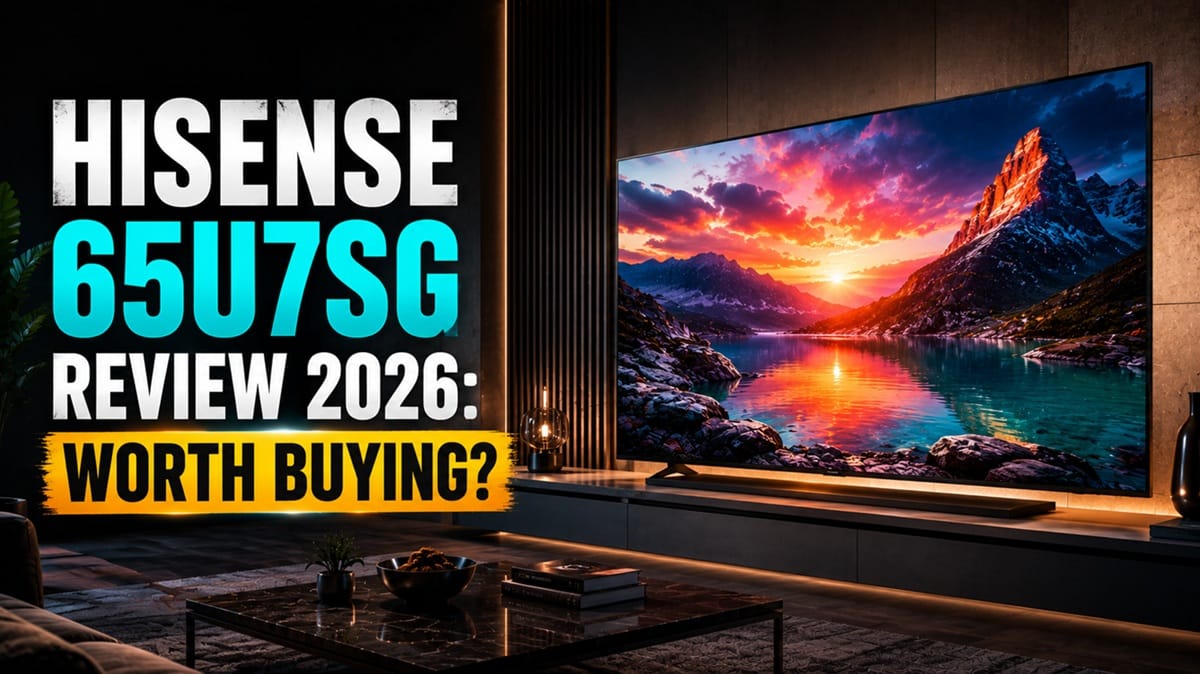
Hisense 65U7SG Review: A Mini-LED Standout With One Real Catch
Last updated: July 2026
🕒 9 min read
Disclosure: As an Amazon Associate I earn from qualifying purchases. This article contains affiliate links — we may earn a small commission if you buy through them, at no extra cost to you.
Hisense quietly reshuffled its entire mid-range lineup for 2026. The U8 series, which used to be the ceiling for “affordable” Hisense TVs, moved up into flagship RGB Mini-LED territory this year, leaving the Hisense 65U7SG as the brand’s new top standard Mini-LED model. That’s a meaningful promotion, and in this Hisense 65U7SG review we’re checking whether the picture and gaming performance actually hold up to that new position, or whether it’s still priced and built like a step-down model wearing a bigger badge.
Based on independent lab testing from RTINGS and Hisense’s own published specifications, the short answer is: mostly yes, with one limitation that matters more to some households than others. If you’re cross-shopping against a TCL Mini-LED set or a Samsung 65M70H, the U7SG’s biggest advantage is peak brightness — its weak point is viewing angle. We’ll get into exactly where that trade-off shows up. For the wider field of 2026 releases across every brand and budget, our best 4K TVs of 2026 guide breaks down how the rest of this year’s mid-range crop shapes up on the same measures.
Table of Contents
Quick Verdict
At a Glance
★★★★☆★ 8 / 10
At a Glance
Picture Quality
Gaming
Audio
Value
👍 Best For: Bright rooms, sports and casual gaming, and buyers who want flagship-adjacent brightness without flagship pricing.
👎 Skip If: You need a wide seating arrangement or a home theater setup where multiple viewing angles matter.
One-Line Verdict: One of the brightest, best-value Mini-LED sets Hisense has released — as long as everyone’s watching from roughly in front of it.
🛒 Check Availability on AmazonProduct Specs at a Glance
Product Specs
Hisense 65U7SG
VA LCD · Mini-LED Local Dimming (Hi-QLED) · Google TV
| ☀️ Peak Brightness | Up to 3,000 nits (advertised) |
| 🎮 Refresh Rate | 165Hz native, VRR to 330Hz @ 1080p |
| 🔲 Local Dimming Zones | 960 (65-inch) |
| 🎬 HDR Formats | Dolby Vision, HDR10+, HLG |
| 🔌 HDMI 2.1 Ports | 4 (full bandwidth) |
| 📺 Screen Finish | Matte anti-reflective |
| 🔊 Audio | 2.1.2ch, 50W, Dolby Atmos (per Hisense) |
Design & Build Quality
Materials & Finish
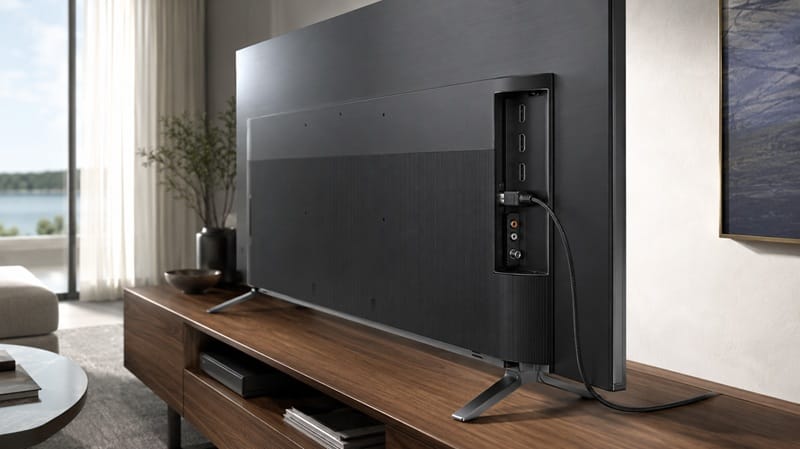
The 65U7SG uses a center-mounted stand with thin bezels on all four sides, and Hisense gave the back panel a grid-textured finish that reads as more premium than the plastic on the outgoing U75QG. According to Hisense’s official product page, the panel’s matte anti-reflective coating is one of the bigger upgrades this generation — it replaces the glossy finish used on last year’s model.
That coating matters more than it sounds. Dolby Vision is designed to preserve highlight detail dynamically, but a glossy panel can undercut that benefit the moment a window or lamp reflects into the screen. The matte layer here is what lets the U7SG’s Dolby Vision support actually show up in a lit room instead of fighting reflections.
Ports & Connectivity
All four HDMI inputs run at full HDMI 2.1 bandwidth, and the TV includes an ATSC 3.0 tuner for over-the-air 4K broadcasts. Cable routing channels run through the stand’s feet, which keeps the setup tidy if you’re not wall-mounting.
Performance & Real-World Use
Bright and Dark Room Viewing
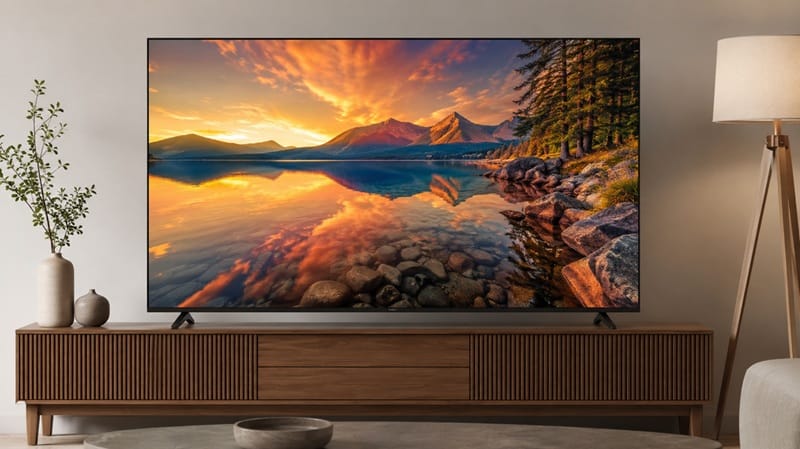
According to Hisense’s official specifications and RTINGS testing, the 65-inch model ships with 960 local dimming zones and an advertised peak brightness up to 3,000 nits. RTINGS’ lab results back that up, describing the U7SG’s SDR peak brightness as fantastic and more than capable of overcoming glare in a bright living room. Contrast and black uniformity also tested well, with RTINGS noting deep, consistent blacks in dark scenes once local dimming is enabled.
That brightness and contrast performance is strong out of the box, but Dolby Vision specifically can still look a shade cooler and flatter than expected until the color temperature is dialed in. If that’s the picture you’re seeing on yours, our guide on why a Hisense TV looks washed out in Dolby Vision covers the Dynamic Tone Mapping and calibration settings that usually fix it.
Gaming Performance
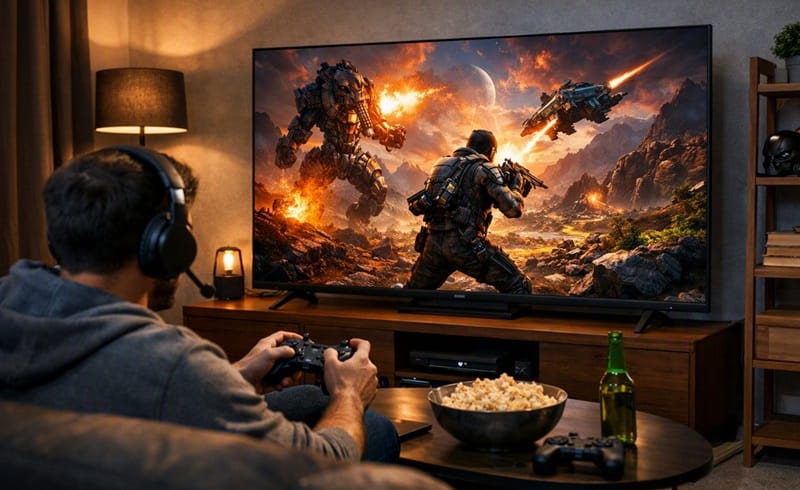
This is where the U7SG’s repositioning shows up most clearly. RTINGS measured incredibly low input lag across every supported mode, and the set is fully compatible with PS5 and Xbox Series X|S features — 4K/120Hz, VRR, ALLM, and Dolby Vision gaming all worked without issue in testing. Native 165Hz and VRR up to 330Hz at 1080p put it ahead of most sets at this price.
The trade-off, based on the same RTINGS data, is response time. Fast motion — particularly fast panning or competitive shooters — shows some blur because pixel transitions don’t fully complete at the TV’s fastest refresh rates, and a mild flicker effect appears when VRR frame rates drop through certain thresholds. Casual and story-driven gaming is less likely to be affected; competitive players sensitive to motion clarity are the ones most likely to notice.
Everyday Streaming and Sound
The set runs Google TV version 14 on a MediaTek Pentonic 800 processor with 4GB of RAM, according to Hisense’s official specifications. On audio, Hisense advertises a 2.1.2-channel, 50W Dolby Atmos speaker system, though RTINGS’ own teardown of the back panel notes a single center-mounted speaker enclosure — worth flagging if a precise multi-driver layout matters to you. RTINGS’ frequency-response testing did find the sound fairly well-balanced across volume levels, with clear dialogue — solid for a built-in system, though a soundbar is still the better call for movie nights.
Google TV runs smoothly on the 65U7SG day to day, and that processor and RAM combination is part of why. Like any smart TV platform, though, it’s not entirely immune to an occasional freeze or unexpected restart from a stuck update or a memory-heavy app. If that ever happens on yours, our guide to Hisense TVs that keep freezing and restarting walks through what’s usually behind it and how to fix it.
Key Features Breakdown
Hi-QLED MiniLED Pro Backlight
The 960-zone backlight on the 65-inch model is the main reason the U7SG can chase 3,000-nit highlights without the picture looking washed out. It’s also the reason contrast holds up as well as it does once the lights go down.
Hi-View AI Engine Pro
Hisense’s processor handles upscaling and noise reduction for lower-quality sources — RTINGS specifically called out strong performance smoothing macro-blocking in compressed streaming content without losing fine detail, which matters if most of your viewing comes from cable or lower-bitrate apps rather than 4K Blu-ray.
The Good, the Bad, and the Ugly
Pros
- ✅ Excellent peak brightness — RTINGS measured it bright enough to overcome glare even in a very bright room.
- ✅ Strong native contrast and black levels — dark scenes stay detailed instead of crushing to gray.
- ✅ Full-featured gaming spec sheet — 165Hz native, VRR to 330Hz, ALLM, and low input lag across the board.
Cons
- ❌ Visible dirty screen effect — RTINGS flagged uneven gray uniformity that’s most noticeable in flat, mid-gray content like sports broadcasts.
- ❌ Response time lags the refresh rate — fast motion isn’t as crisp as the 165Hz spec alone would suggest.
The Ugly
If your room has a wide couch or multiple seating angles, this is the spec that matters most: RTINGS measured a mediocre viewing angle, with color and contrast fading noticeably once you move off-center. It’s a VA-panel limitation, not unique to Hisense, but it’s real — anyone planning to watch from the side of the room regularly should treat it as a genuine deal-breaker rather than a minor quirk.
Who Should Buy This — and Who Shouldn’t
Buy This If…
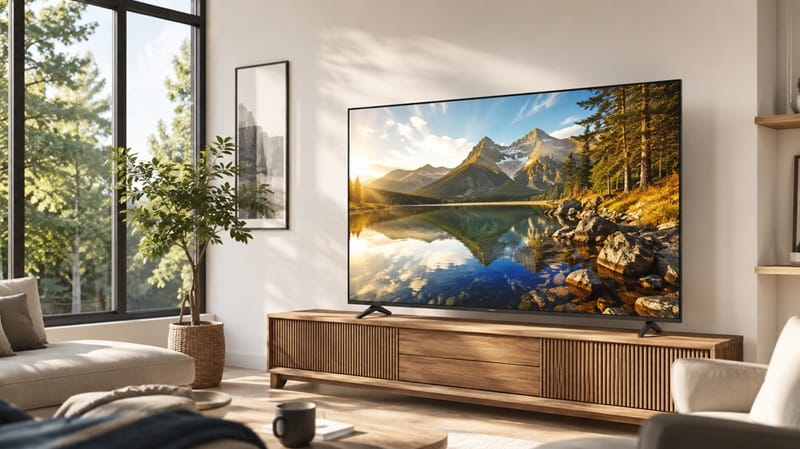
The Hisense 65U7SG review verdict comes down clearly in favor of buyers with bright, sun-facing living rooms, or anyone who games casually and wants high refresh rates without flagship pricing. Think of it less like a dedicated home-theater display and more like a daily-driver TV built to fight glare and keep up with fast-paced sports and games — a job it handles better than most sets in its price range. If you want the fuller technical case for Mini-LED over OLED in exactly this kind of room, our OLED vs Mini LED compared breakdown walks through it.
And if 65 inches isn’t quite big enough for your room, our Hisense 75U7SG review covers how the same Hi-QLED Mini-LED panel and gaming spec sheet hold up once you step up to 75 inches — brightness and zone count shift slightly at that size, and it’s worth knowing before you upgrade. For an even larger, more budget-oriented option outside the U7SG line, our Hisense 85E7SF review is worth a look too.
Skip This If…
Anyone building a dedicated dark home theater with a wide, multi-seat couch should look elsewhere — the viewing-angle drop-off will bother people sitting off to the side more than the brightness gains will impress the ones sitting dead-center. Competitive gamers sensitive to motion blur may also want to compare against a TCL Mini-LED alternative, which trades some of the U7SG’s brightness for different motion-handling characteristics.
If you were eyeing the step-up U8QG for that same dark-room setup, brightness alone isn’t the deciding factor — RTINGS’ testing traced the U8QG’s Dolby Vision picture problems to Dynamic Tone Mapping overshooting the mastering data specifically in dim, movie-viewing conditions, which is exactly where accuracy matters most.
Final Verdict
Hisense 65U7SG Review: Is It Worth Buying?
The Hisense 65U7SG earns its promotion to the top of Hisense’s standard Mini-LED lineup. It’s bright, handles HDR highlights well, and comes loaded with gaming features that used to be reserved for pricier sets — the viewing angle limitation is real, but it’s a predictable VA-panel trade-off rather than a flaw unique to this model. Compared to the TCL 65QM64L review, the U7SG generally pulls ahead on brightness and dimming precision, while the TCL remains worth a look for buyers prioritizing a different balance of price and motion handling. For most bright-room, front-and-center setups, the U7SG is the stronger pick. 🛒 Check Availability on Amazon
Buying with a bit more peace of mind also means knowing how Hisense stands behind the set if something does go wrong. If you’re weighing that risk, our breakdown of what gets a Hisense TV warranty claim denied covers the exclusions worth knowing about before you need them.
Frequently Asked Questions
Hisense 65U7SG Review: Is It a Good TV in 2026?
Yes, for bright or moderately lit rooms and casual-to-mid-level gaming. It’s now Hisense’s top standard Mini-LED model, and RTINGS’ lab testing confirms strong brightness, contrast, and gaming responsiveness for the price.
How does the Hisense 65U7SG compare to the TCL 65QM64L?
According to RTINGS’ testing, the U7SG generally outperforms similarly priced TCL Mini-LED sets on peak brightness and reflection handling, though motion handling differs between the two. Our Final Verdict section above covers the full side-by-side comparison.
Is the Hisense 65U7SG good for gaming?
Mostly yes. It supports native 165Hz, VRR up to 330Hz at 1080p, ALLM, and full PS5/Xbox Series X|S compatibility with low input lag. The one caveat is response time — fast-motion content can show some blur compared to the refresh rate alone.
Who should avoid the Hisense 65U7SG?
Anyone seated off to the side more often than dead-center should be cautious. RTINGS measured a mediocre viewing angle typical of VA-panel Mini-LED sets, so picture quality drops noticeably once you’re not looking at the screen head-on.
Does the matte anti-glare coating on the 65U7SG actually help?
Based on RTINGS’ reflection testing, yes — the matte finish significantly reduces the visibility of direct reflections and performs well even in bright rooms. Note that this coating is specific to the 55–85-inch models; the 100-inch and larger sizes use a glossy finish instead.

iYaiii
Editor, GearPulse360
iYaiii is the editor and founder of GearPulse360, specializing in TV reviews and consumer electronics. He researches every recommendation before publishing.
✅ Based on spec analysis and Hisense’s official and RTINGS data — last verified July 2026