Samsung 83S90H Review: Is Samsung’s Biggest Mid-Range OLED Worth It in 2026?
Last updated: July 2026
🕒 9 min read
Disclosure: As an Amazon Associate I earn from qualifying purchases. This article contains affiliate links — we may earn a small commission if you buy through them, at no extra cost to you.
Go big enough with an OLED TV, and Samsung’s own flagship stops having an advantage over its mid-range set. That’s the strange situation buyers run into with the Samsung 83S90H review question: at every size from 55 to 77 inches, Samsung’s step-up S95H uses a QD-OLED panel that the S90H doesn’t get. At 83 inches, that gap disappears — the S95H switches to the same WOLED panel as the S90H, made by LG Display. If you’re set on the biggest screen Samsung’s OLED lineup offers, that single fact changes the entire buying decision.
RTINGS bought and tested the 65-inch S90H and states its results also apply to the 55- and 83-inch versions, since all three share the same standard WOLED panel — only the 48- and 77-inch sizes get a different RGB tandem panel.
Drawing on that testing plus Samsung’s official specifications, we’ll walk through what the 83-inch S90H gets right, where it falls short of Samsung’s own flagship, and how it stacks up against the similarly sized LG OLED83C6 — and if 83 inches turns out to be more screen than your room needs, our best OLED TVs of 2026 roundup covers every size and budget.
Table of Contents
Quick Verdict
At a Glance
★★★★☆★ 8.1 / 10
At a Glance
Picture Quality
Gaming
Audio
Value
👍 Best For: Buyers who want the largest OLED screen in Samsung’s lineup for a dedicated home theater or big living room, without paying flagship S95H pricing.
👎 Skip If: Your room can’t comfortably seat you 8+ feet from the screen, or you specifically want QD-OLED color volume — the 83-inch class doesn’t offer it from Samsung at any tier.
One-Line Verdict: The Samsung 83S90H is the rare case where going bigger doesn’t mean giving up more to Samsung’s own flagship.
🛒 Check Availability on AmazonSamsung 83S90H Specs at a Glance
Product Specs
Samsung 83S90H (QN83S90HAEXZA)
WOLED (LG Display) · NQ4 AI Gen3 Processor · Samsung Vision AI / Tizen
| 📺 Panel type | WOLED |
| 🎮 Refresh rate | 165Hz native |
| 🖥️ Screen size | 83 inches |
| ✨ Anti-glare | Glare Free coating |
| 🎮 Gaming sync | VRR, G-Sync Compatible, FreeSync Premium Pro |
| 🧠 Processor | NQ4 AI Gen3 |
Design & Build Quality
Materials & Finish
At 83 inches, the S90H’s ultra-thin OLED panel construction is more visually dramatic than on smaller sizes — Samsung’s official specifications list the same Glare Free matte coating used across the rest of the 2026 S90H lineup — worth noting here specifically, since a screen this large is almost guaranteed to sit across from a window or lamp in most living rooms.
Per Samsung’s published spec sheet, the panel construction carries the same profile as the rest of the S90H line — a slim upper panel with the processing electronics housed in a thicker lower section — just scaled up rather than redesigned for the larger size.
Ports & Connectivity
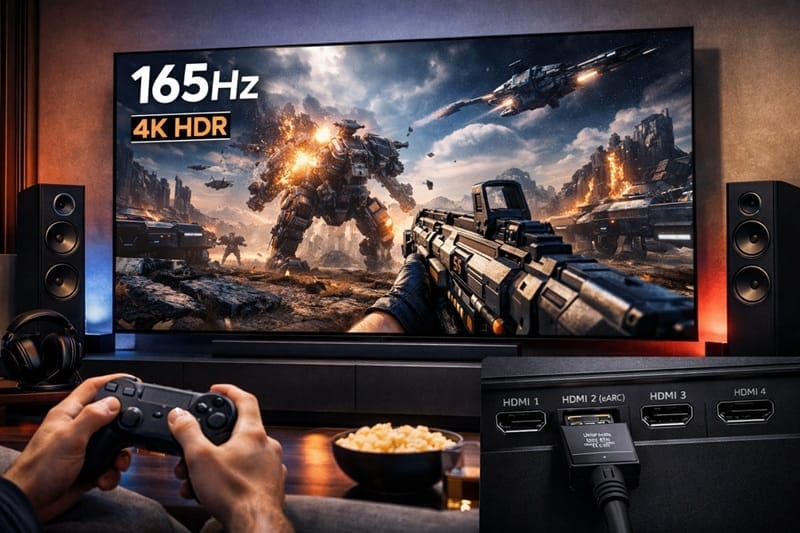
The 83S90H carries Samsung’s standard HDMI 2.1 port set forward, supporting 4K at up to 165Hz for PC-connected games and VRR for consoles. Wall-mounting a screen this size is worth planning for ahead of time — the VESA mount pattern is the same as smaller S90H sizes, but the added weight of an 83-inch panel means checking your mount’s rated capacity before buying, not after delivery.
Performance & Real-World Use
Big-Screen Movie Nights
RTINGS’ testing found the S90H has a nearly infinite contrast ratio with perfect black uniformity and no haloing around bright highlights — the core OLED strength that matters most on a screen this large, since dark scenes are where upscaled or lower-bitrate content tends to fall apart first. Viewing angle also tested as excellent, with only a slight green shift off-axis and no meaningful brightness or black-level loss — a bigger factor here than on smaller sets, since side seating is far more common around an 83-inch panel.
According to Samsung’s product page, the NQ4 AI Gen3 processor also handles 4K AI upscaling the same way across every S90H size — RTINGS separately rated its low-quality content smoothing and upscaling sharpness as very good to excellent, which helps on a screen where lower-resolution sources show their limits fastest.
Gaming at Giant Scale
The 83S90H carries Samsung’s full Ultimate Gaming Pack forward — 165Hz native refresh, full HDMI Forum VRR, Nvidia G-Sync Compatible certification, and AMD FreeSync Premium Pro — the same spec sheet as the smaller S90H sizes, with no gaming feature cut for going bigger. RTINGS’ testing rated color and detail transitions as outstanding at every refresh rate tier (60Hz, 120Hz, and the full 165Hz), meaning fast motion stays sharp with very little overshoot, and input lag came in very low with Auto Low Latency Mode support on both PS5 and Xbox Series X|S.
For PC gaming specifically, hitting the full 165Hz ceiling still requires a graphics card capable of pushing that frame rate at native 4K, which is a heavier lift at 83 inches’ worth of pixels than most current GPUs comfortably sustain outside of less demanding titles.
Bright Room Viewing
RTINGS rated the S90H’s matte Glare Free coating as outstanding at reducing direct reflections, describing it as doing “an amazing job handling glare” — and since the coating treats the panel surface rather than compensating for screen size, that performance should carry over to the 83-inch version the same way it does on the tested 65-inch unit. The trade-off RTINGS documents does hold up, though: black levels rise slightly more in a bright room than on a glossy WOLED like the LG C6, even as they stay noticeably deeper than Samsung’s own QD-OLED sets, the S95F and S95H, under the same ambient lighting.
Samsung 83S90H Key Features Breakdown
The Same Panel Tech as the LG C6
According to RTINGS’ panel technology testing, the standard-size S90H — which includes the 83-inch model — uses LG Display’s OLED-EX WOLED panel, the same panel found in the LG C6 OLED. That’s a notable detail for a Samsung TV: the picture-quality foundation underneath the 83S90H isn’t a Samsung-made panel at all, it’s the same core panel technology as its most direct competitor.
RTINGS also notes the white subpixel in this panel design boosts brightness but slightly weakens color separation between red and green — a trade-off that applies here but not to the 48- and 77-inch S90H sizes, which use a different RGB tandem panel instead.
WOLED Panel Parity With the S95H at This Size
This is the detail that makes the Samsung 83S90H review worth reading closely if you’re comparing it against Samsung’s own flagship: at 55, 65, and 77 inches, the S95H uses QD-OLED and the S90H doesn’t, creating a real picture-quality gap between the two tiers. At 83 inches, per the CSV-verified spec breakdown behind this site’s Samsung coverage, the S95H switches to the same WOLED panel as the S90H — mirroring the same panel split Samsung used on the 2025 S95F at this size.
In other words, stepping up to the 83-inch S95H buys you FloatLayer design, Art Store access, and better audio hardware, but not a fundamentally different picture-quality panel the way it does at smaller sizes.
NQ4 AI Gen3 Processor & Upscaling
This is the same processor generation Samsung ships across its 2026 mid-range and flagship OLED lineup, not a step-down chip reserved for the largest size. For a household mixing cable, streaming, and older library content, the practical benefit is more consistent upscaling quality regardless of source — which matters more at 83 inches, where upscaling artifacts are easier to spot than on a 55-inch set viewed from the same distance.
The Good, the Bad, and the Ugly
Pros
- ✅ Perfect blacks with no haloing — RTINGS’ testing confirms a nearly infinite contrast ratio and clean black uniformity, the core OLED advantage that shows up most clearly on a screen this size.
- ✅ Outstanding reflection handling — the Glare Free matte coating tested as one of the best on the market at killing direct reflections, a bigger win here than on a smaller screen with less surface area facing your windows.
- ✅ No gaming feature cut for going biggest — 165Hz, full VRR, G-Sync Compatible, and FreeSync Premium Pro all carry over, with RTINGS rating motion transitions as outstanding at every refresh rate tested.
Cons
- ❌ No Dolby Vision support — RTINGS’ format testing confirms HDR10 and HDR10+ only. Buyers with a Dolby Vision-heavy library won’t get that metadata support here, and it’s not something a different S90H size fixes.
- ❌ Aggressive brightness limiting in large bright scenes — RTINGS found HDR highlights look strong in small areas, but overall brightness drops noticeably once more of the screen is lit at once, which is more noticeable across an 83-inch panel than a smaller one.
- ❌ Some stutter in slow camera pans — a side effect RTINGS attributes to the panel’s near-instantaneous response time; most viewers won’t notice it outside of deliberate slow panning shots, but it’s a documented trade-off, not a hypothetical one.
The Ugly
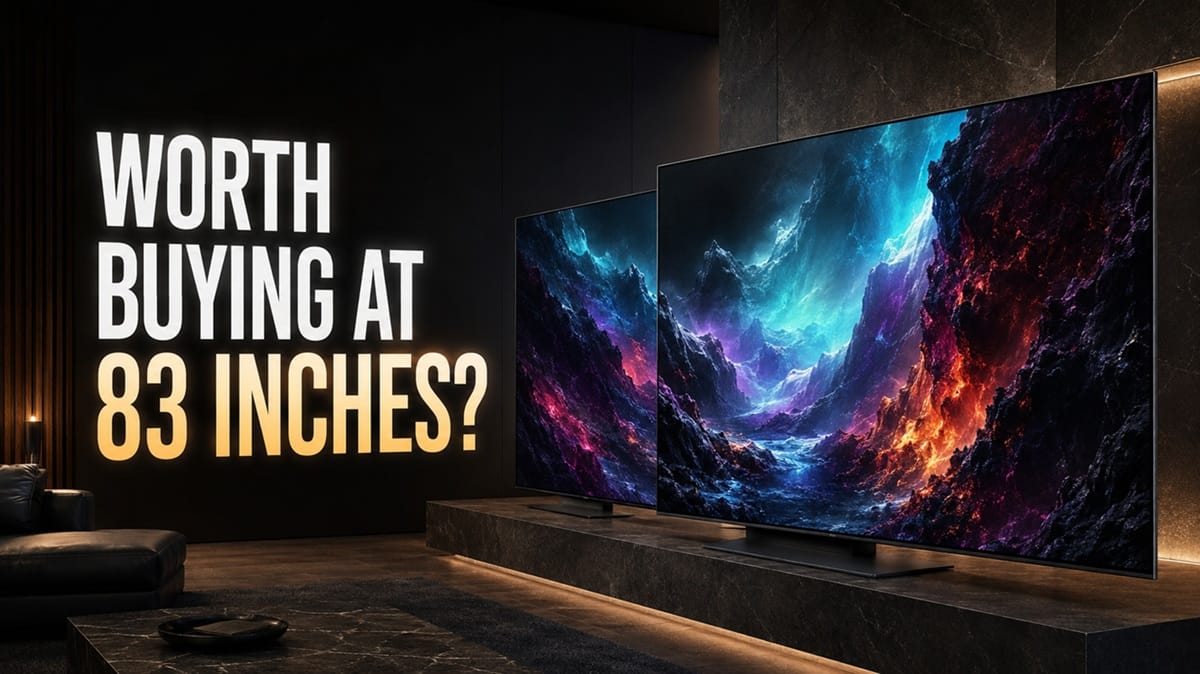
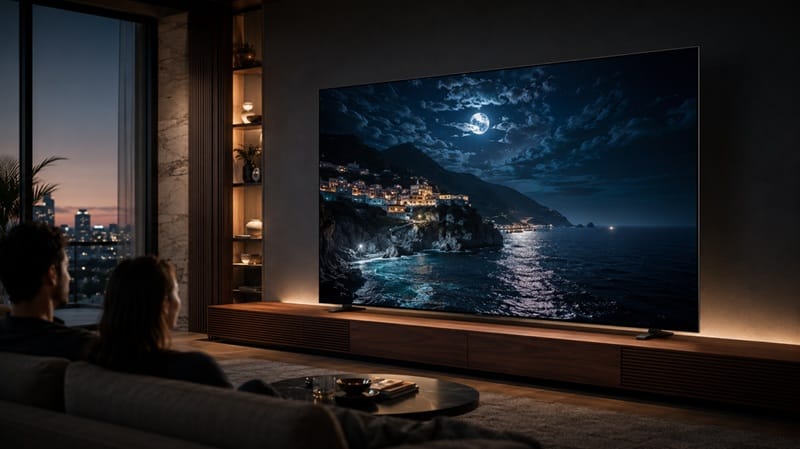
One of the most common regrets buyers report with any 83-inch TV isn’t about the TV itself — it’s realizing after delivery that the room can’t seat viewers far enough back for the size to work. General THX-style viewing distance guidance for 4K puts the ideal seating distance for an 83-inch screen at roughly 8 to 10.5 feet; sit noticeably closer than that on a regular basis, and even RTINGS-confirmed strengths like sharp upscaling and outstanding motion handling start mattering less than simple eye strain. Combine that with the brightness limiting RTINGS documented in large bright scenes, and a too-close seating distance in a bright room is where this TV disappoints fastest.
Who Should Buy the Samsung 83S90H — and Who Shouldn’t
Buy This If
The 83S90H makes the most sense for buyers who’ve already committed to a dedicated home theater or a large living room with real seating distance, and who want the biggest screen in Samsung’s OLED catalog without paying flagship pricing to get there. Think of it like choosing the largest size in a well-built car’s trim lineup rather than upgrading to the luxury trim — you’re scaling up the same core platform, not trading up to a different one. If you’re weighing this against Samsung’s step-up option specifically, our Samsung S90H vs S95H comparison breaks down exactly what the S95H adds at each size, including where that gap disappears.
For a size-specific shortlist against other brands at 83 inches, our best 83-inch OLED TVs roundup lines up the full field.
Skip This If
Skip the 83S90H if your room can’t actually seat you far enough back, or if you specifically want Samsung’s QD-OLED color volume — the 83-inch class simply doesn’t offer that from Samsung at any current tier. Buyers in that position are better served by a 65- or 77-inch Samsung S95H, or by the similarly priced LG OLED83C6, which uses LG’s own tandem WOLED panel and adds Dolby Vision support the S90H doesn’t have.
Final Verdict: Is the Samsung 83S90H Worth Buying?
Is It Worth Buying?
For buyers set on the largest OLED Samsung sells, the Samsung 83S90H review comes down to one core fact: RTINGS-confirmed strengths like perfect blacks and outstanding reflection handling carry over to this size intact, and the usual reason to pay more for the S95H mostly evaporates once you’re shopping at 83 inches specifically. It won’t outperform the LG OLED83C6 on HDR format support, and it isn’t a fit for rooms too small to seat viewers back far enough — but for a dedicated big-screen setup, it’s a reasonable way to get Samsung’s biggest OLED without flagship pricing.
For a broader look at how Samsung’s approach compares to the competition at this scale, see our LG OLED vs Samsung OLED comparison. 🛒 Check Availability on Amazon
Frequently Asked Questions
Is the Samsung 83S90H a good TV in 2026?
Yes, for the right room. RTINGS’ testing of the S90H line found perfect black uniformity, outstanding reflection handling, and excellent gaming responsiveness — strengths that hold up at 83 inches per RTINGS’ own size-validity note. The main thing to get right isn’t the TV itself, it’s making sure your seating distance actually suits a screen this large.
How does the Samsung 83S90H compare to the 83S95H?
At 83 inches, both use the same WOLED panel, so the S95H’s advantage narrows mostly to design (FloatLayer, Art Store access) and audio rather than picture quality. In its general S90H-vs-S95H comparison, RTINGS’ S90H review notes the S95H gets brighter with more vibrant HDR colors, but the S90H actually holds its black levels better in a bright room — a trade-off worth weighing against the size-specific panel parity at 83 inches.
Is 83 inches too big for a living room?
It depends entirely on seating distance rather than room square footage — general 4K viewing guidance puts the ideal distance for an 83-inch screen around 8 to 10.5 feet. If your couch sits closer than that, a 77-inch or 65-inch S90H will likely look sharper and more comfortable to watch than the 83-inch version.
Does the Samsung 83S90H support Dolby Vision?
No — RTINGS’ format-support testing lists HDR10, HDR10+, and HLG, with no Dolby Vision decoding anywhere in the signal chain. If a Dolby Vision-heavy library matters more to you than screen size, that’s actually the bigger decision to make first: HDR10+ is the format Samsung is backing company-wide in 2026, so upsizing to 83 inches or upgrading to the S95H won’t change the outcome — only switching brands to something like the LG OLED83C6 would.
Can the Samsung 83S90H handle PC gaming at 165Hz?
The panel supports native 165Hz with a PC-connected graphics card that outputs at that refresh rate, plus VRR, G-Sync Compatible certification, and FreeSync Premium Pro. Sustaining 165fps at native 4K across an 83-inch panel’s full resolution is demanding on the GPU side, so the ceiling is more achievable in lighter titles than in the most graphically intensive releases.

iYaiii
Editor, GearPulse360
iYaiii is the editor and founder of GearPulse360, specializing in TV reviews and consumer electronics. He researches every recommendation before publishing.
✅ Based on spec analysis and Samsung’s official and RTINGS data (65-inch tested, validity confirmed for 83-inch) — last verified July 2026