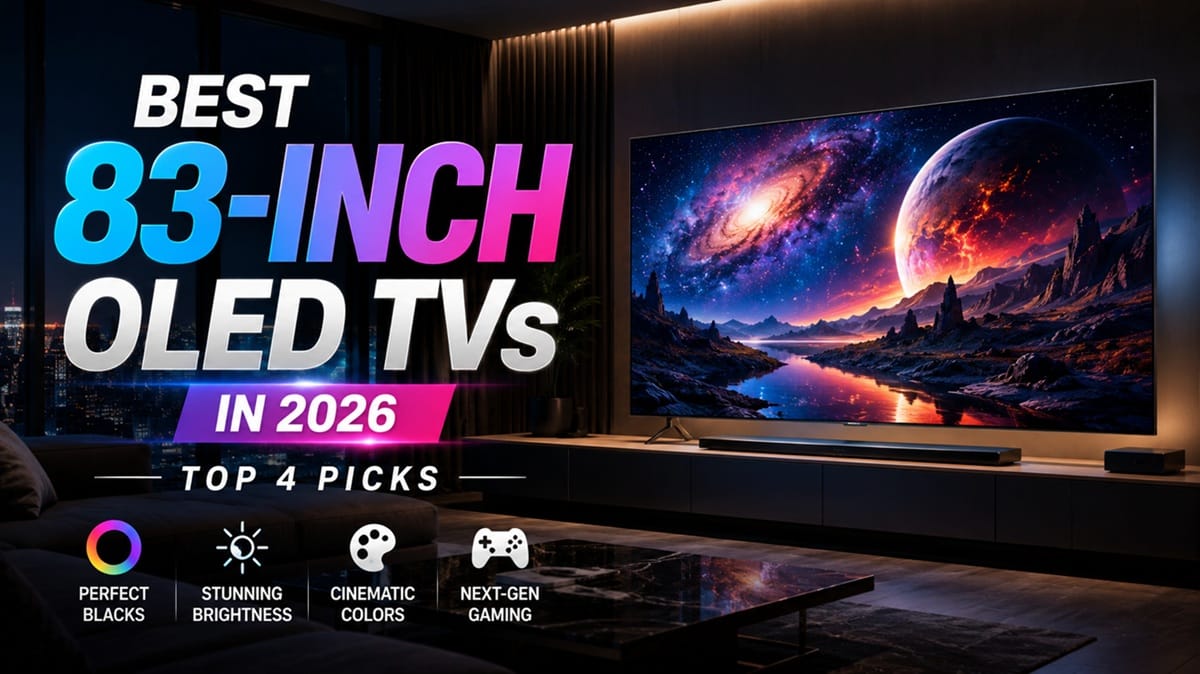
Best 83-Inch OLED TVs in 2026: Top Picks for the Biggest Impact
Last updated: June 2026 | 🕒 9 min read
Disclosure: As an Amazon Associate I earn from qualifying purchases. This article contains affiliate links — we may earn a small commission if you buy through them, at no extra cost to you.
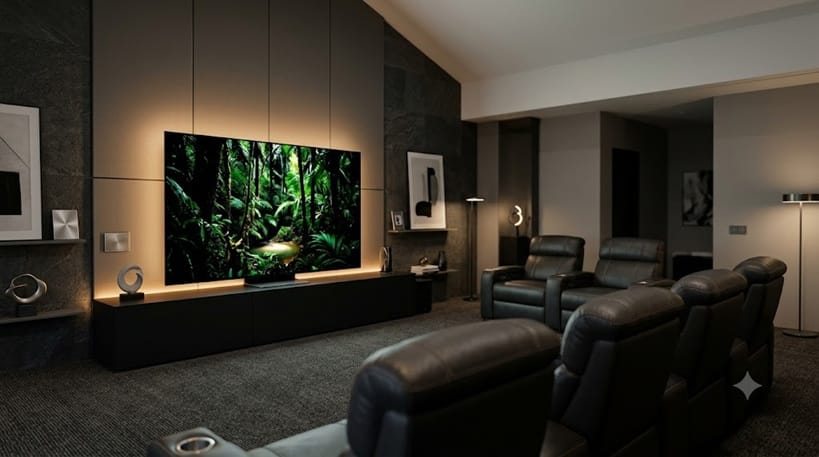
You’ve probably already measured the wall twice. An 83-inch screen sounds enormous on paper, but once you picture it actually mounted above the fireplace or filling out a dedicated theater wall, the question changes from “is this too big” to “which one is actually worth buying at this size.” That’s a different question than picking a 65-inch OLED, because at 83 inches, panel differences that don’t matter at smaller sizes suddenly do — and not every model in a lineup uses the same panel as its smaller siblings once you size up.
We compared the four 83-inch OLED TVs currently sold by LG and Samsung — Sony doesn’t make one at this size in 2026 — checking confirmed pricing, real specs, and gaming performance for each. Samsung’s S90H comes out as the best overall pick for most rooms, but if your budget is tighter, LG’s B6 gets you into 83 inches for meaningfully less.
Table of Contents
Best 83-Inch OLED TVs: Quick Comparison
| Pick | Model | Panel | Best For | Price |
|---|---|---|---|---|
| Best overall | Samsung 83″ S90H | WOLED | Best balance of price, gaming specs & RTINGS-verified picture quality | Amazon ↗ |
| Best budget | LG 83″ OLED B6 | WOLED | Most affordable way into 83-inch OLED | Amazon ↗ |
| Best panel upgrade | LG 83″ OLED evo C6 (C6H) | Tandem OLED | Best panel exclusive to LG’s 83-inch C-series | Amazon ↗ |
| Best for bright rooms | Samsung 83″ S95F | Tandem OLED | Brightest option for rooms that don’t go fully dark | Amazon ↗ |
↻ Prices change frequently — click through for current pricing.
✓ Scores reflect our independent assessment, not Amazon customer reviews.
Best Overall 83-Inch OLED TV: Samsung S90H
Samsung quietly made a significant change to the S90H for 2026: every size in the lineup, including this 83-inch model, dropped QD-OLED in favor of a standard WOLED-type panel. That's a real shift from last year's S90F, which mixed panel types depending on size. It doesn't make the S90H a worse TV — Samsung's official spec page still lists Glare Free coating, a 165Hz ceiling, and full VRR support — but it does mean the marketing language around "QD-OLED color" no longer applies here.
What pushed the S90H to the top of this list is the lab data behind it: RTINGS has already published a full review covering this exact 83-inch unit, not just a smaller sibling. For a TV this size and price, that's worth something — you're not relying on a smaller size's test results to guess how the panel performs at scale. Between the confirmed gaming features and the independent lab data, it's the safest "buy with confidence" pick on this list.
For a deeper walkthrough of how it actually performs day to day, our full Samsung 83S90H review covers real-world picture quality, gaming responsiveness, and room-fit considerations in more depth than a picks list can. And if even this price stretches the budget, our Samsung 83S85H review covers the cheaper way into the same 83-inch size — you give up the Glare Free coating and the 165Hz ceiling, but the core OLED contrast carries over.
Best Budget Pick: LG B6 83"
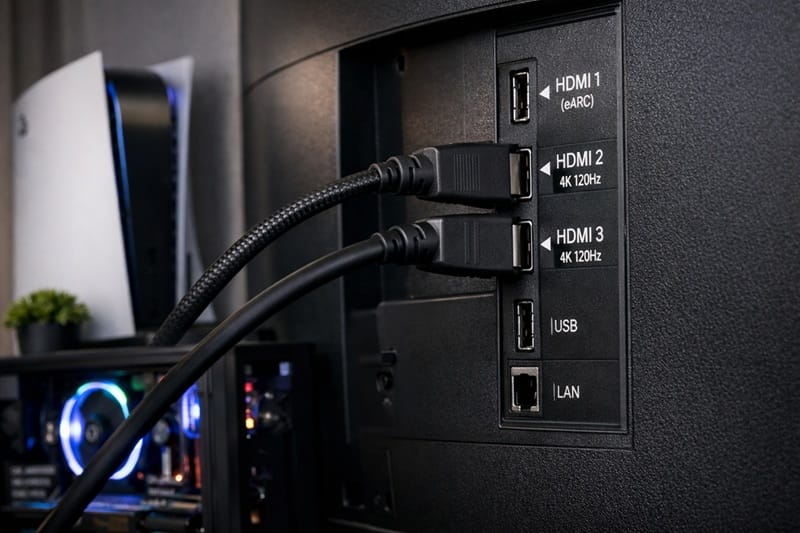
There's no published lab review of the 83-inch B6 yet — RTINGS and most major outlets have only tested the 65-inch version so far. Based on LG's official spec page and reviews of the smaller B6, this is a standard WOLED panel with the same Alpha 8 processor across every size, so we'd expect similar real-world performance, with the usual caveat that larger panels sometimes measure slightly different peak brightness.
What makes the B6 worth including here is simple math: it's the most affordable way to get an 83-inch OLED screen by a wide margin. You give up the higher refresh rate ceiling and the more advanced processor found on the C6H and S90H, but you still get real OLED black levels and Dolby Vision support — which, on a screen this size, is most of what actually matters for movie night.
Best Panel Upgrade: LG OLED evo C6 (C6H) 83"
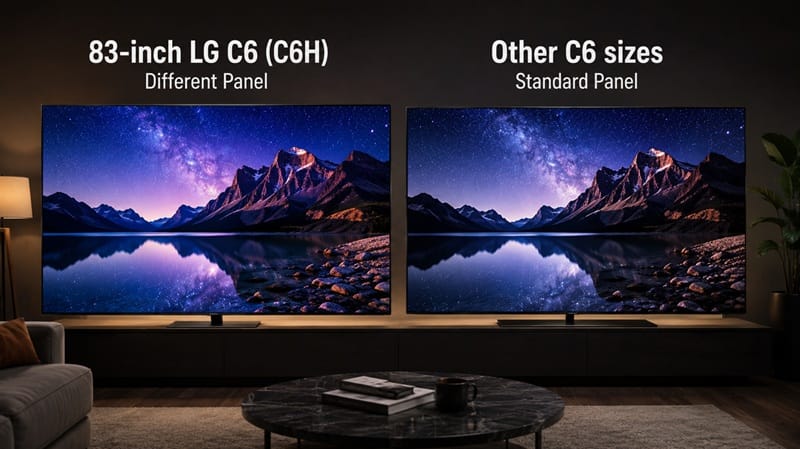
This is the model most shoppers overlook, and it's an easy mix-up to make: Amazon and several retailers list this exact unit as the OLED83C6HUP, not the standard OLED83C6PUA model name used on smaller C6 sizes. That's not a typo — LG builds the 77-inch and 83-inch C6 with an entirely different panel (Primary RGB Tandem 2.0, the same family used in the flagship G6) than the 65-inch and smaller C6 models, which use a standard WOLED panel. LG's own product page confirms the Hyper Radiant Color tech and Brightness Booster Pro that come with it.
Why there's no independent review yet
No outlet has published a dedicated test of this 77-inch-and-up Tandem panel yet — reviewers have explicitly said they're testing it separately from the standard C6 because performance won't be identical. If brightness and color volume matter more to you than having lab-verified numbers in hand today, this is the pick to watch; if you'd rather buy something already RTINGS-tested at this exact size, the S90H is the safer call.
If you're also weighing whether a large Mini LED set might serve you better than OLED at this size, our OLED vs Mini LED compared breakdown covers exactly that trade-off.
Best for Bright Rooms: Samsung S95F 83"
Here's a spec detail worth knowing before you buy: at 65 and 77 inches, the S95F uses Samsung's QD-OLED panel. At 83-inches, it switches to a WOLED-based 4-stack Tandem panel instead — confirmed directly on Samsung's own product page. It's the same naming, but not the same display tech, which matters if you've already seen a smaller S95F in a store and are assuming the 83-inch model looks identical.
Why the panel swap is a worthwhile trade
The Tandem panel construction is what lets Samsung push this large a screen this bright while keeping the second-generation Glare Free coating, and RTINGS' published S95F review explicitly covers this 83-inch model, confirming gaming response times and HDR performance independently rather than relying on smaller-size test data. If your room gets real daylight and you still want OLED contrast at this size, this is the pick that handles it best.
For a broader look at how OLED stacks up against QLED for living rooms with more ambient light, our full OLED vs QLED comparison walks through that decision in more detail.
What to Look for in an 83-Inch OLED TV
Viewing distance changes more than you'd expect
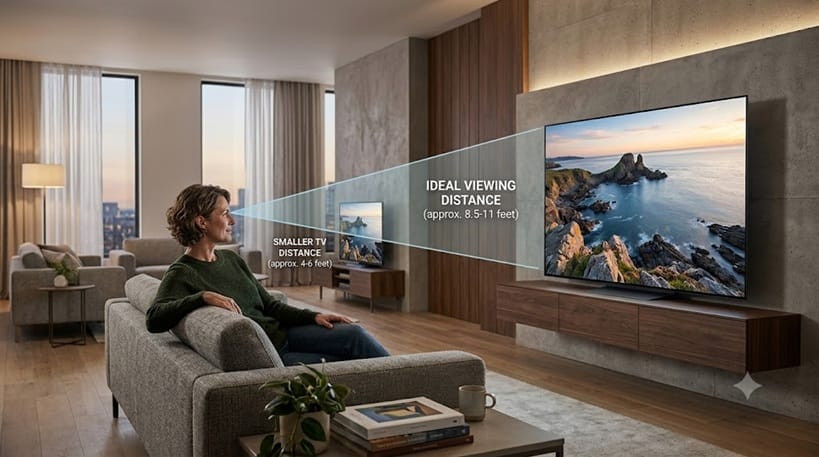
At 83 inches, the general 4K recommendation is to sit somewhere between 8.5 and 11 feet away to get a fully immersive picture without seeing individual pixels or feeling like you're craning your neck. If your seating is closer than that, a 77-inch model — or even 65-inch — may actually look better in practice, since you won't be forced to sit further back than your room allows.
Brightness and glare control matter more at scale
A bigger panel means a bigger reflective surface, so any window or overhead light becomes a bigger problem too. That's exactly why three of the four picks above lean on some version of an anti-glare coating — Glare Free, Glare Free 2.0, or LG's standard glossy finish on the B6. If your room isn't fully light-controlled, the coating matters as much as raw brightness specs.
The panel inside isn't always what the model name implies
This is the single biggest thing we'd want you to take away from this guide: at 83 inches, both the LG C6 and the Samsung S95F quietly switch to a different panel architecture than the same-named model at smaller sizes. Always check the specific size you're buying against the manufacturer's own page rather than assuming a smaller-size review applies directly.
Gaming specs hold up surprisingly well at this size
All four picks here support VRR and at least 120Hz, with three reaching up to 165Hz. That's a genuine surprise — large-format TVs have historically lagged behind smaller gaming-focused models on refresh rate, but 2026's 83-inch OLEDs don't make you choose between screen size and a smooth, responsive gaming experience.
Your real options are limited — and that's not a bad thing
Only LG and Samsung currently build OLED TVs at 83 inches; Sony doesn't offer this size. That narrows the decision considerably compared to 65-inch shopping, where you're picking from a dozen-plus models. Fewer choices means less research time, but it also means there's less room to "settle" — each of the four picks above earns its spot for a specific reason.
Is 83-Inches Right for Your Room?
Measure your actual seating distance before anything else. If you're sitting 8.5 feet or further from the wall, 83 inches will look proportionate and cinematic rather than overwhelming. If your room forces you closer than that — a smaller living room, an apartment, a desk-adjacent setup — you'll likely get a better day-to-day experience from our best 77-inch OLED TVs guide instead, where you give up very little picture quality for noticeably better fit.
Budget is the other half of the equation. The price jump from 77 to 83 inches is meaningfully steeper than the jump from 65 to 77, since far fewer models exist at this size and none of the major brands treat it as a mainstream size yet. If the picks above stretch past what you'd planned to spend, sizing down is rarely a downgrade in actual viewing experience — just in raw screen area.
How We Picked These TVs
We didn't rely on marketing spec sheets alone. For the Samsung S90H and S95F, RTINGS has already published full lab-tested reviews covering these exact 83-inch models, so we cross-checked gaming response times, brightness, and panel type against their measured data. LG's B6 and C6H at this size are new enough that no outlet — RTINGS included — has published dedicated 83-inch test results yet; reviewers have specifically said the 77/83-inch C6H will be tested separately from the standard C6 because it uses a different panel. For those two, we relied on LG's official specifications and used hedged, "based on the spec sheet" language anywhere a claim couldn't be backed by a same-size independent test.
Every price above was checked against the manufacturer's own listing and at least one major retailer at the time of publishing. We also double-checked model numbers directly against retailer listings, since LG's naming convention quietly changes at 83 inches — it ships as the C6H, not the standard C6 model name used at smaller sizes — and that kind of mismatch is easy to miss if you're comparing spec sheets quickly.
📍 Not sure 83 inches is the right call for your room or budget? See every size and price tier we recommend in our full best OLED TVs of 2026 roundup.
83-Inch OLED TVs FAQs
Which 83-inch OLED TV is best overall?
The Samsung S90H is our top overall pick. RTINGS has published a full review covering this exact 83-inch model, and it backs that up with a 165Hz refresh ceiling, full VRR support, and Glare Free coating, all for less than Samsung's own flagship S95F.
Is an 83-inch OLED TV worth the price jump over 77-inch?
It depends mostly on your seating distance and room size rather than budget alone. If you're sitting far enough back to take advantage of the extra screen area, the jump is worthwhile; if your viewing distance is closer to 77-inch territory, you'll likely get more value per dollar from a 77-inch model instead.
Do larger OLED TVs have a higher burn-in risk?
Screen size itself doesn't meaningfully increase burn-in risk — what matters is how you use the TV, not how big it is. Static content left on screen for extended periods (channel logos, game HUDs) is the real factor, and every model in this guide includes the same pixel-shifting and OLED care features found on smaller sizes from the same brand.
How does an 83-inch OLED compare to a similarly sized Mini LED TV?
OLED still wins on contrast, black levels, and viewing angles at this size, while Mini LED tends to win on peak brightness for very bright rooms. At 83 inches specifically, the gap narrows somewhat thanks to brightness-boosting panel tech like the Tandem designs used in two of our picks above.
Should I size down if 83 inches feels like too much?
If you're at all unsure, sizing down is the safer move. Our best 65-inch OLED TVs guide covers a much wider range of models at a size that fits a broader range of rooms without the same viewing-distance requirements.

iYaiii
Editor, GearPulse360
iYaiii is the editor and founder of GearPulse360, specializing in TV reviews and consumer electronics. He researches every recommendation before publishing.
✅ Based on spec analysis and LG's and Samsung's official data plus RTINGS — last verified June 2026