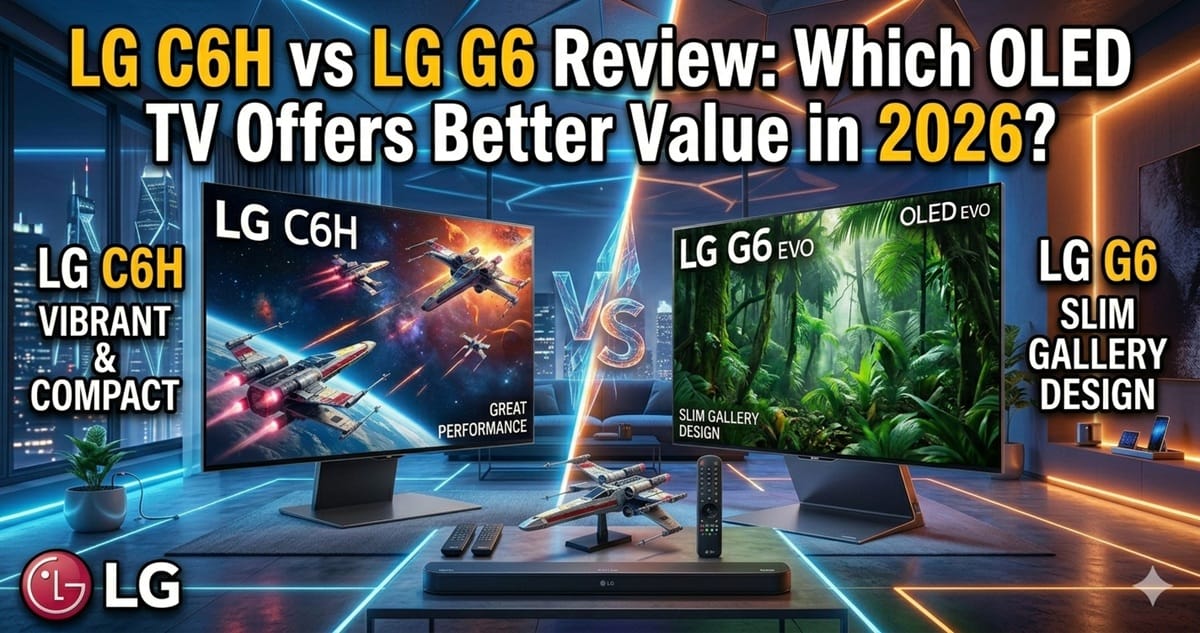
LG C6H vs LG G6 Review: Which OLED TV Offers Better Value in 2026?
Last updated: June 2026 | 🕒 9 min read
Disclosure: As an Amazon Associate I earn from qualifying purchases. This article contains affiliate links — we may earn a small commission if you buy through them, at no extra cost to you.
Here’s something most shoppers don’t realize when comparing these two TVs: the LG C6H and the LG G6 are both built on LG’s same 4-stack Primary RGB Tandem 2.0 panel, both branded “Hyper Radiant Color.” But they’re not tuned identically — LG ships the C6H with the Brightness Booster Pro tier, while the G6 gets the higher Brightness Booster Ultra tier, which translates into a real, measurable HDR brightness gap rather than just a calibration difference. So if the underlying panel hardware is shared, what exactly are you paying extra for with the G6?
That’s the real question this comparison answers. We’re looking at the 77-inch version of each TV, since that’s the only size where C6H and G6 go head-to-head on equal footing (C6H is only available in 77″ and 83″; G6 spans 55″ all the way to 97″). Round by round, we score design, gaming, HDR, smart features, audio, and value to land on a clear recommendation.
If you’re also curious how LG’s previous generation stacked up, our LG C5 vs G5 compared breaks down the same C-vs-G decision for 2025 models — useful context if you’re shopping last year’s leftover stock alongside these two.
Table of Contents
Product Overview: LG C6H vs LG G6 — What Are We Comparing?
Both TVs belong to LG’s 2026 OLED evo lineup and both run on the same next-generation panel technology — a genuinely unusual situation that makes this comparison less about picture quality and more about which premium features are actually worth paying for.
LG OLED77C6HUP (C6H)
The C6H designation exists specifically because LG put its 4-stack Primary RGB Tandem 2.0 panel into the 77″ and 83″ C6 models only — smaller C6 sizes use a standard W-OLED panel instead. The C6H carries LG’s “Hyper Radiant Color” branding, but at the Brightness Booster Pro tier (LG states up to roughly 3x brighter than the entry-level B6) rather than the higher tier reserved for the G6.
In effect, the C6H is LG’s way of offering most of its flagship-tier picture hardware at a step below G-series pricing. It ships with a conventional stand, runs the α11 AI Processor Gen3, and supports the same 165Hz/G-Sync/FreeSync gaming feature set as the G6. See LG’s official C6H product page for full specs, and our our full LG C6H review for a deeper look at long-term ownership.
LG OLED77G6WUA (G6)
The G6 is LG’s 2026 flagship and part of its new “Art TV” lineup alongside the Wallpaper TV and Gallery TV. It carries the same “Hyper Radiant Color” branding as the C6H, but at the higher Brightness Booster Ultra tier (LG states up to roughly 3.9x brighter than the entry-level B6) — the real source of its brightness edge over the C6H, detailed in Round 2 below. Its other headline feature is a flush-fit Gallery design built for wall mounting — there’s no stand included, and the panel sits nearly flat against the wall.
The G6 also gets LG’s 5-year panel warranty (a benefit reserved for the G and W series), access to the LG Gallery+ art-display subscription, and a more capable 4.2-channel built-in speaker system than the C6H. See LG’s official G6 product page for full specs, or our full LG G6 review for more on how it performs day to day.
Size note: The C6H is only sold in 77″ and 83″. If you want G6’s Gallery design in a smaller room, it’s available down to 55″ — something the C6H simply can’t offer.
Full Specs Comparison: LG C6H vs LG G6 (77″)
| Specification | LG OLED77C6HUP (C6H) | LG OLED77G6WUA (G6) |
|---|---|---|
| Screen Size | 77 inches | 77 inches |
| Panel Type | OLED — Primary RGB Tandem 2.0, Hyper Radiant Color (Brightness Booster Pro) | OLED — Primary RGB Tandem 2.0, Hyper Radiant Color (Brightness Booster Ultra) |
| Resolution | 4K UHD (3840×2160) | 4K UHD (3840×2160) |
| HDR Support | Dolby Vision, HDR10 | Dolby Vision, HDR10 |
| Processor | LG α11 AI Processor Gen3 | LG α11 AI Processor Gen3 |
| Smart TV OS | webOS 26 (Gemini + Copilot) | webOS 26 (Gemini + Copilot) |
| Max Refresh / VRR | Up to 165Hz, G-Sync, FreeSync Premium | Up to 165Hz, G-Sync, FreeSync Premium |
| Response Time | 0.1ms | 0.1ms |
| HDMI Ports | 4× HDMI 2.1 | 4× HDMI 2.1 |
| Built-in Speakers | 2.2-channel, down-firing | 4.2-channel |
| Design | Standard stand included | Flush-fit Gallery wall mount (no stand) |
| Panel Warranty | Standard LG limited warranty | 5-year panel warranty |
| Available Sizes | 77″, 83″ only | 55″, 65″, 77″, 83″, 97″ |
| Affiliate Link | Check Price | Not yet listed on Amazon — check back soon |
For most buyers: the LG C6H wins on value. It uses the same Hyper Radiant Color panel family as the G6, delivers the same gaming performance, and costs meaningfully less — you’re mainly trading away a brightness tier, a step down in built-in audio, the wall-mount design, and the longer warranty.
Buy the G6 if: you’re wall-mounting in a design-forward room, you want the 5-year panel warranty, or you need a size the C6H doesn’t offer (55″/65″/97″).
Check LG C6H PriceGaming is a major part of this decision for a lot of readers — if that’s your primary use case, our best OLED TVs for gaming roundup compares refresh rates and input lag across this year’s full lineup, not just these two models.
Round 1: Picture Quality & OLED Panel Performance
🤝 Near tie — same panel family, different brightness tier
This is the headline fact of the whole comparison: the C6H and G6 are both built on LG’s 4-stack Primary RGB Tandem 2.0 panel, both carrying the “Hyper Radiant Color” name. That shared architecture means both sets deliver the same core OLED strengths — true per-pixel blacks, wide color volume, and the instant pixel response that eliminates motion blur entirely.
Where they diverge is brightness tier: the C6H runs LG’s Brightness Booster Pro tuning, while the G6 gets the higher Brightness Booster Ultra tuning. That’s a real, hardware-level brightness difference rather than just processing or calibration — we break down exactly how much it matters in Round 2 below. For more background on how this generation of panel compares to other OLED types on the market, see our QD-OLED vs WOLED compared guide.
Round 1 verdict: near tie. The two share the same fundamental OLED strengths — the meaningful gap is in peak brightness, covered next.
Round 2: HDR Performance
🏆 Winner: LG G6 (confirmed, real gap)
Both TVs support Dolby Vision and HDR10 on the same Primary RGB Tandem 2.0 panel, but they run different Brightness Booster tiers — Pro on the C6H, Ultra on the G6 — and that shows up directly in lab testing. Independent lab measurements of the G6 put its peak HDR brightness at roughly 2,400–2,500 nits on a 10% window in calibrated picture modes, with full-screen sustained brightness jumping even more sharply versus the previous-generation G5. LG’s own marketing figure of “up to 20% brighter than G5” tracks reasonably closely with what independent labs have measured.
The C6H hadn’t received standalone independent lab testing for its exact peak-nit figure at the time of writing, but it runs the lower Brightness Booster Pro tier rather than Ultra, so expect it to land below the G6 on peak HDR highlights even though both share the same underlying panel. For the exact measured figures on your specific size, check RTINGS’ published reviews: RTINGS’ LG C6H review and RTINGS’ LG G6 review.
Round 2 verdict: G6, confirmed. This is the most concrete, measurable difference between the two TVs — not a marketing claim, a real brightness-tier gap.
Round 3: Gaming Performance
🤝 Tie
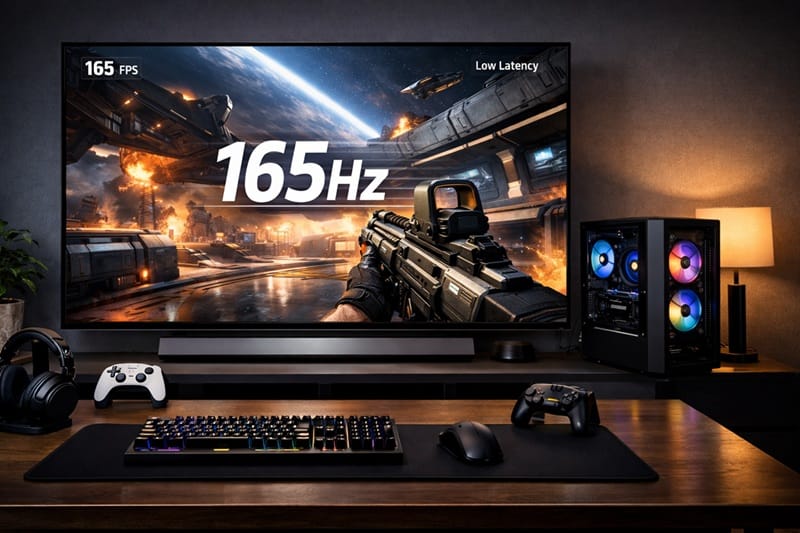
This round is straightforward: both TVs support up to 165Hz refresh, NVIDIA G-Sync compatibility, AMD FreeSync Premium, 0.1ms response time, and ALLM. Nothing in LG’s published specs suggests either model has a gaming advantage over the other — you’re getting identical gaming hardware whichever one you buy.
Round 3 verdict: tie. Gaming performance should not factor into your decision between these two. If you’re shopping specifically for a PC gaming display, our best OLED TVs for PC gaming roundup compares both of these against other desktop-focused picks.
Round 3 verdict: tie. Gaming performance should not factor into your decision between these two.
Round 4: Design, Build Quality & Aesthetics
🏆 Winner: LG G6 (clearly)
LG G6: Built to Disappear Into the Wall
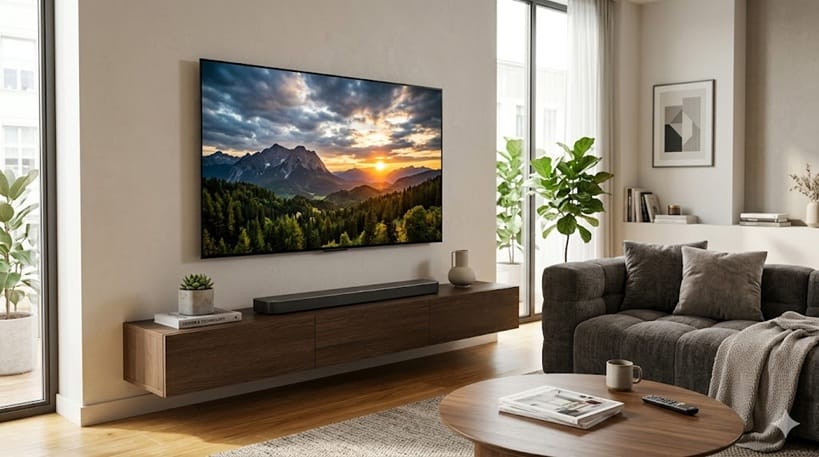
The G6’s flush-fit Gallery design is genuinely different from a conventional TV. It ships without a stand, designed from the ground up for wall mounting, and sits nearly flat against the wall once installed. Pair that with the LG Gallery+ subscription (included for a limited period with purchase) and the G6 doubles as a curated art display when you’re not watching content.
LG C6H: Conventional, Capable
The C6H ships with a standard stand and a conventional enclosure. It’s a handsome TV, but it doesn’t try to be a design statement — it’s built to be a TV first.
Round 4 verdict: G6 wins decisively for anyone who cares about wall-mount aesthetics or room integration. If you’re putting either TV on a stand or in an entertainment center, this advantage mostly disappears.
Round 5: Smart TV, Interface & AI Features
🤝 Tie — Both Run webOS 26
Both TVs ship with LG’s webOS 26, which now integrates Google Gemini and Microsoft Copilot for AI-assisted search, recommendations, and voice control. Since the software is identical across both models, there’s no interface advantage either way.
Round 5 verdict: tie — the software experience is identical, so it shouldn’t factor into your decision either way.
Round 6: Audio Performance
🏆 Winner: LG G6 (confirmed)
Both models support Dolby Atmos sound processing, but their built-in speaker hardware isn’t the same. The C6H ships with a 2.2-channel, down-firing speaker system, while the G6 steps up to a 4.2-channel array — a genuine, confirmed difference at the hardware level, not just a software EQ tweak. Both use LG’s AI Sound Pro processing with a virtual up-mix for a wider soundstage.
Round 6 verdict: G6, confirmed. If built-in audio quality is a deciding factor for you, the extra channels on the G6 are a real advantage — though most home theater setups will still benefit from a dedicated soundbar regardless of which TV you choose.
Round 7: Value for Money & Warranty
🏆 Winner: LG C6H (on value) — 🏆 Winner: LG G6 (on warranty)
Since both TVs share the same panel family, the value case strongly favors the C6H: you get closely related picture hardware and the same gaming performance for less money. The G6’s premium buys you a confirmed higher brightness tier, a more capable built-in speaker system, the Gallery wall-mount design, and LG’s 5-year panel warranty — a benefit that’s exclusive to the G and W series and not extended to the C6H.
That warranty gap is worth weighing seriously if you’re planning to keep the TV long-term: a 5-year panel warranty is a meaningful protection for an OLED purchase at this price point, and it’s one of the few G6 advantages that isn’t about aesthetics.
Round 7 verdict: C6H wins on pure value-per-dollar; G6 wins if long-term panel warranty coverage matters to you as much as price.
📊 Full Scorecard: LG C6H vs LG G6
| Category | Winner |
|---|---|
| Picture Quality (Panel) | 🤝 Near tie — shared panel family |
| HDR Brightness | G6 ✓ (confirmed) |
| Gaming Performance | 🤝 Tie |
| Design & Build | G6 ✓✓ |
| Smart TV & AI | 🤝 Tie |
| Built-in Audio | G6 ✓ (4.2ch vs 2.2ch) |
| Panel Warranty | G6 ✓ (5-year) |
| Value for Money | C6H ✓✓ |
Pros & Cons at a Glance
LG OLED77C6HUP (C6H)
✅ Pros: Same Hyper Radiant Color panel family as the G6 · Identical gaming performance · Lower cost for closely related picture hardware · Comes with a stand
❌ Cons: Lower Brightness Booster tier (real HDR brightness gap vs. G6) · Less capable 2.2-channel built-in speakers · No 5-year panel warranty · Conventional design, not a wall-mount statement piece · Only available in 77″/83″
LG OLED77G6WUA (G6)
✅ Pros: Flush-fit Gallery wall-mount design · 5-year panel warranty · Confirmed higher peak HDR brightness (Brightness Booster Ultra tier) · More capable 4.2-channel built-in speakers · Full size range from 55″ to 97″ · LG Gallery+ art-display subscription included
❌ Cons: Meaningful price premium over C6H for a closely related panel · No stand included
🛒 Who Should Buy Which TV?
Buy the LG C6H if you’re a value-conscious buyer who wants most of the flagship-tier OLED picture quality without paying for the top brightness tier or design extras, or a gamer who wants the same 165Hz/G-Sync/FreeSync experience as the G6 for less.
Buy the LG G6 if you’re planning to wall-mount in a design-forward space, want the confirmed brighter HDR highlights and stronger built-in sound, want the longer 5-year panel warranty, or need a size the C6H doesn’t offer. If you’d rather compare across LG’s full current lineup before deciding, our our LG OLED roundup ranks every model LG sells right now — or see how it stacks up against premium picks from other brands in our best premium OLED TVs of 2026.
Still not sure either of these is the right starting point? Our LG OLED buying guide walks through how to narrow down LG’s full 2026 lineup by room size, budget, and use case before you get to a head-to-head like this one.
Addressing the Biggest Buyer Objections
If they share the same panel, why does the G6 cost more?
The price difference reflects a genuinely higher Brightness Booster tier (Ultra vs. the C6H’s Pro tier, giving the G6 a confirmed HDR brightness edge), a more capable 4.2-channel built-in speaker system vs. the C6H’s 2.2-channel setup, the Gallery wall-mount design, the included LG Gallery+ subscription, and the 5-year panel warranty — not a different picture-producing panel architecture.
Is the C6H missing anything critical?
Not critically. For SDR picture quality, gaming performance, and smart features, the C6H delivers the same core experience as the G6. The real trade-offs are a lower peak-brightness tier, a less capable built-in speaker system, and the wall-mount design and extended warranty — not the underlying panel technology itself.
Does either TV support next-gen console gaming at full capability?
Yes — both support up to 165Hz with VRR, NVIDIA G-Sync compatibility, and AMD FreeSync Premium, well ahead of what current consoles can output, so neither TV is a bottleneck for console gaming.
Is the G6’s 5-year warranty worth the premium on its own?
For buyers planning to keep the TV long-term, a 5-year panel warranty on an OLED purchase at this price point is a genuine value-add — but it’s a personal risk-tolerance decision, separate from the confirmed picture and audio upgrades the G6 also brings.
🏆 Final Verdict: LG C6H vs LG G6 — Which Should You Buy?
The LG C6H wins for most buyers. Since it shares the G6’s underlying Hyper Radiant Color panel family and matches it on gaming performance, the C6H delivers most of the G6’s picture and performance for meaningfully less money — you’re trading a confirmed brightness-tier gap and a step down in built-in audio for a lower price.
If you want a single recommendation: the C6H is the smarter purchase for most people, since the price-to-performance gap is real but not dramatic. The G6 is the right call specifically for design-focused, wall-mounted setups, or for anyone who wants the brightest, loudest version of LG’s 2026 flagship picture without compromise.
📍 Still deciding between LG and other brands? See how these two stack up against the rest of this year’s flagships in our best OLED TVs of 2026 roundup.
❓ Frequently Asked Questions
How much brighter is the LG G6 than the C6H?
The G6 uses LG’s higher Brightness Booster Ultra tier, while the C6H uses the Brightness Booster Pro tier — both built on the same underlying panel. Independent lab testing puts the G6’s peak HDR brightness at roughly 2,400–2,500 nits on a 10% window, a real and confirmed step up rather than a marketing claim. Check RTINGS for the exact measured figure on your specific size.
Which has better built-in sound, the C6H or the G6?
The G6, confirmed. It uses a 4.2-channel built-in speaker system compared to the C6H’s 2.2-channel setup. Both use LG’s AI Sound Pro processing, but the G6’s extra channels give it a wider, more capable soundstage out of the box.
Can the LG C6H and LG G6 handle next-gen gaming?
Yes. Both support up to 165Hz with VRR, NVIDIA G-Sync compatibility, and AMD FreeSync Premium — identical gaming specs on both models.
Does the LG G6 come with a stand?
No. The G6 is designed for wall mounting and ships with a wall mount instead. If you need a tabletop setup, the C6H is the better fit.
Which is better for a dedicated home theater?
Both are excellent. The G6’s confirmed brightness and built-in audio edge help slightly in a brighter or larger room, but the C6H delivers nearly the same core OLED picture for less, and most dedicated home theaters add a separate soundbar or speaker system regardless.

iYaiii
Editor, GearPulse360
iYaiii is the editor and founder of GearPulse360, specializing in TV reviews and consumer electronics. He researches every recommendation before publishing.
✅ Based on spec analysis and LG’s official data plus RTINGS — last verified June 2026