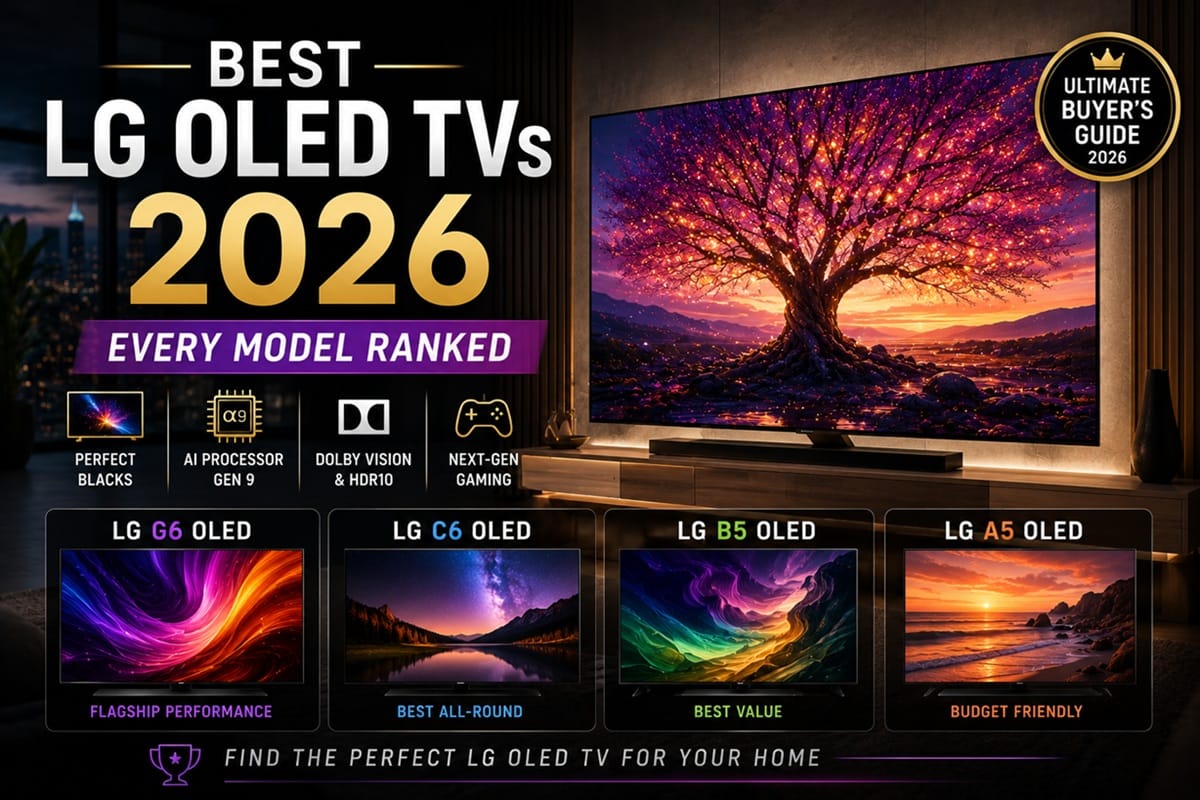
Best LG OLED TVs in 2026: B6, C6, C6H, G5 and G6 — Which One Is Right for You?
Disclosure: As an Amazon Associate I earn from qualifying purchases. This article contains affiliate links — we may earn a small commission if you buy through them, at no extra cost to you.
Last updated: June 2026
You’ve already done the hard part — you’ve decided on LG. But then you opened the product page and found five different OLED series staring back at you: B6, C6, C6H, G5, and G6. They all look similar in store photos, they all say OLED, and the spec sheets blur together fast. Which one is actually worth your money?
LG is unique in the TV market: it doesn’t just sell OLED TVs, it manufactures the panels that go inside most of them. That expertise runs through the entire lineup, though the differences between tiers are more nuanced than a simple good/better/best chart suggests — the jump from B6 to C6H matters a lot, while the jump from C6H to G5 matters less, but in the right room it matters exactly the right amount. In this guide, we rank every major LG OLED model for 2026, explain what actually changes between tiers, and tell you which one to buy based on your budget and how you watch.
If you want a head-to-head between two specific models, we’ve covered LG C6H vs LG G6 compared in a dedicated article.
Table of Contents
LG’s 2026 OLED lineup explained: B6, C6, C6H, G5 and G6
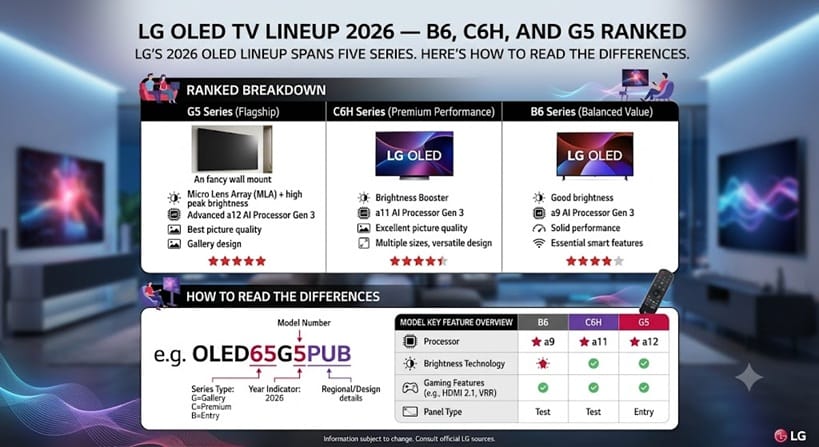
Before picking a model, it helps to understand how LG structures its lineup — because the naming conventions don’t explain the differences very well on their own. Think of it as a staircase: each step up brings a more advanced panel, a more powerful processor, and higher peak brightness.
Here’s how the tiers break down for 2026. You can also check LG’s official OLED lineup page for current size and availability details.
| Series | Panel Type | Processor | Sizes | Position |
|---|---|---|---|---|
| B6 | WOLED SE | α8 AI Gen3 | 55″, 65″, 77″ | Entry-level |
| C6 | WOLED evo | α11 AI Gen3 | 42″–65″ | Mid-range |
| C6H | RGB Tandem 2.0 | α11 AI Gen3 | 77″, 83″ | Mid-range (premium panel) |
| G5 | RGB Tandem (4-stack) | α11 AI Gen2 | 55″–97″ | Flagship (2025) |
| G6 | RGB Tandem 2.0 + Hyper Radiant | α11 AI Gen3 | 55″–97″ | Flagship (2026) |
One thing worth understanding before you compare prices: LG uses two different panel technologies in this lineup — and it matters more than the model number. The B6 and standard C6 use WOLED, which is good enough to make any dark scene look stunning. The C6H, G5, and G6 use RGB Tandem — a stacked panel design that roughly doubles peak brightness. In practice: a lightning strike in a film, a snow scene in daylight, or a football game on a Sunday afternoon all look noticeably different on an RGB Tandem panel when the sun is coming through your window. For a deeper technical breakdown, see our comparison of QD-OLED vs WOLED compared.
The practical takeaway: if you watch in a room that gets daylight or lamp light, panel technology is the most important spec on this page — more than size, more than the processor.
Best LG OLED TVs: Quick Comparison
| Pick | Model | Best For | Check Price |
|---|---|---|---|
| Best Overall | LG C6H (77″) | Most buyers — movies, gaming, everyday | Amazon |
| Best Value | LG B6 (65″) | Budget-conscious OLED buyers | Amazon |
| Best Premium | LG G5 (65″) | Bright rooms, wall mount, peak HDR | Amazon |
Prices checked at time of publishing. Amazon prices change frequently — click through for current pricing.
Star ratings and rankings above reflect our independent editorial assessment — they are not Amazon customer reviews.
Best overall LG OLED: LG C6H
LG did something unusual with the C6H this year: instead of just calling it a bigger C6, it gave it an entirely different panel. The 77″ and 83″ versions get the same Primary RGB Tandem 2.0 technology as the flagship G6 — the smaller C6 does not. It’s the first time LG has put two distinctly different panels inside the same series name, and it changes the buying calculus completely.
What that means in your living room: dramatically more brightness. The C6H pushes peak HDR output well beyond what any previous C-series could manage, which is what lets it hold its own when afternoon light hits the screen. Black levels remain reference-quality, as you’d expect from any LG OLED, and the combination of deep black and high highlights gives the C6H a contrast range that very few TVs at any price point can match.
Gaming is a strong suit too. You get four HDMI 2.1 ports running up to 165Hz, VRR, ALLM, G-Sync compatibility, FreeSync Premium, and Dolby Vision Game mode — whether you’re on PS5, Xbox Series X, or a high-end gaming PC, the C6H covers everything. See our full LG C6H review for a detailed breakdown of picture performance and real-world gaming tests.
The one constraint worth knowing: the C6H is only available in 77″ and 83″. If you need something smaller, the standard C6 is your next best option — it’s a solid TV in its own right, but its panel is less advanced.
Best value LG OLED: LG B6
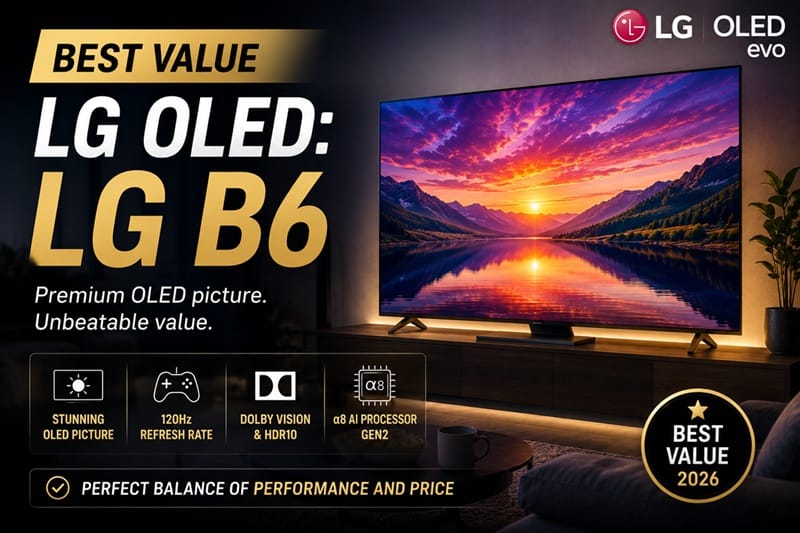
The B6 is the entry point into LG’s 2026 OLED range — and entry point here is not a polite way of saying “lesser.” You still get every core OLED strength: pixels that turn themselves fully off in dark scenes, wide viewing angles that hold up when guests spread across the room, and full Dolby Vision support. For anyone coming from an LCD or QLED, the B6 will feel like a genuine step change.
Where the B6 gives ground is primarily in bright rooms. The WOLED SE panel produces beautiful images but doesn’t push hard on peak HDR highlights the way the C6H and G5 can. That’s not a real issue if your main viewing space is a bedroom, a dim living room, or a dedicated home theater area. In those environments, the B6 looks stunning — the limitations are effectively invisible.
Gaming coverage is solid too. Four HDMI 2.1 ports, VRR, ALLM, and LG’s Game Optimizer mode — the ceiling is 4K/120Hz rather than 165Hz, but that still covers everything the PS5 and Xbox Series X can actually output. Casual and dedicated gamers alike will find little to complain about. For a full hands-on breakdown of real-world picture quality, gaming performance, and long-term reliability, see our LG OLED65B6GUA review.
Who is the B6 for?
The B6 makes the most sense if you want the OLED experience without committing to C-series or G-series pricing, and you know your viewing environment is reasonably controlled. It’s also the natural choice if size constraints put you in the 55″–65″ range — that’s where the B6 has the field mostly to itself at this price level.
One honest note: at launch, the price gap between the B6 and the B5 (2025) has been narrower than in past years. If the B5 is sitting at a real discount when you’re shopping — which tends to happen after a new generation drops — it’s worth a quick comparison. The B6 is the better TV, but the difference in everyday viewing is modest.
Put it in a dark room and the B6 holds its own against TVs that cost twice as much. That’s the pitch — and for a lot of buyers, it’s a convincing one.
Best premium LG OLED: LG G5
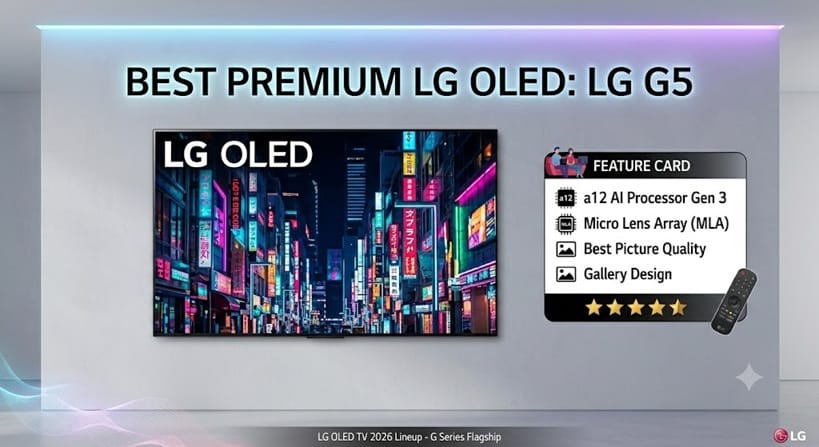
The G5 was LG’s flagship OLED for 2025, and it remains one of the most capable televisions you can buy heading into 2026, especially now that pricing has settled since launch. Its four-stack RGB Tandem OLED panel delivered a genuine brightness leap over its predecessor, with peak HDR output measured above 2,000 nits by independent testing labs. Reviewers at RTINGS.com confirmed the G5 as the brightest consumer OLED they had measured at the time — a distinction that carries real practical value in a room that sees any amount of ambient light.
The gallery-wall design is a genuine product difference, not a marketing claim. The G5 ships with a wall mount in the box and is engineered to sit flush against the wall with minimal gap. If aesthetics matter as much as performance, this is a different product category from the C6H — the trade-off is that no stand is included, so furniture placement isn’t really part of the plan.
Gaming credentials are complete: 4K at 165Hz, four HDMI 2.1 ports, G-Sync, FreeSync Premium, VRR, ALLM, and Dolby Vision Game mode. For a full breakdown of how it stacks up for gaming specifically, see our guide to the best OLED TVs for gaming.
LG C6H vs LG G5: which should you buy?
This is the question most buyers in the mid-to-upper LG range end up asking, and the honest answer comes down to one thing more than anything else: what size screen you need.
If you need a 65″ TV, the G5 is effectively your only option among these picks — the C6H doesn’t come in that size, and the standard C6 at 65″ uses a less advanced panel. The G5’s four-stack RGB Tandem design at 65″ is the best picture quality LG makes available at that size. If you’re shopping at 77″ or larger, the C6H is the stronger buy: same panel generation as the G6, lower price, available now.
On pure picture performance, the G5 is brighter in peak HDR output — the four-stack design pushes harder on highlights — but the gap is narrower in real mixed content than raw numbers suggest. For most everyday watching, both look exceptional; the G5 earns its premium most clearly in bright rooms, in large spaces where extra brightness helps the image hold impact, or in content with extreme HDR highlights.
Bottom line: if you’re buying a 77″ TV and don’t need the gallery-wall aesthetic, the C6H is the smarter purchase. If you need 65″ or you want the best LG makes regardless of price, the G5 is the answer — those are the only two scenarios where the choice really changes.
If you’re trying to save further and weighing the previous-generation C5 against the G5 instead, our LG C5 vs G5 comparison covers that pairing in more depth.
How to Choose the Right LG OLED for Your Situation
Three variables narrow the field quickly: your room brightness, the screen size you’re working with, and what you primarily watch.
Room brightness matters most
If your main viewing hours overlap with daylight or you keep lamps on, the C6H or G5 will serve you significantly better than the B6 or standard C6 — their RGB Tandem panels hold image punch in lit environments. In a dim or dark room, the brightness gap shrinks, and the B6 becomes a much more rational choice at its price.
Size narrows it further
The C6H is 77″ and 83″ only. The G5 spans 55″–97″. The B6 covers 55″–77″. If you’re set on 65″, the choice is effectively between the standard C6 and the G5, and at that size the G5’s panel advantage is at its most visible. For size-specific guidance, see our roundup of the best 65-inch OLED TVs.
Use case closes it out
For gaming, the C6H and G5 are the strongest options — both support 165Hz and the full suite of next-gen features. For movies and streaming, any LG OLED will be rewarding, but the C6H and G5 deliver a more cinematic HDR presentation on demanding content.
LG vs Samsung OLED: a quick note
LG and Samsung take fundamentally different approaches to OLED. LG uses WOLED in its B and C tiers and RGB Tandem panels in the C6H, G5, and G6. Samsung uses QD-OLED — a different architecture that adds a quantum dot layer over a blue OLED base, producing different color characteristics and very high brightness at the flagship level.
Neither approach is categorically better; both have real strengths depending on use case and budget. Our full LG OLED vs Samsung OLED compared covers picture performance, gaming, software, and value across the full lineups.
📍 Not set on LG yet? Compare top picks from LG, Samsung, and Sony side by side in our full 2026 roundup. See best OLED TVs of 2026
LG OLED TV FAQs
Which LG OLED TV is best overall in 2026?
For most buyers, the LG C6H is the answer — it brings the same advanced RGB Tandem 2.0 panel found in the flagship G6 to a mid-range price point, and its 77″ size suits the majority of living rooms. If budget is the primary concern, the B6 delivers genuine OLED quality at a more accessible price. If you’re setting up a bright room and want the absolute best LG can offer for daytime viewing, the G5 justifies its premium.
What’s the difference between the LG C6 and C6H?
The standard C6 (42″–65″) uses the same WOLED evo panel as the previous C5. The C6H (77″ and 83″ only) uses the newer Primary RGB Tandem 2.0 panel, which reaches significantly higher peak brightness and improved color performance. Both share the same processor (α11 AI Gen3) and the same gaming features, but the panel difference is substantial — in any room with ambient light, the C6H is a clearly better television, not just a larger version of the standard C6.
Do LG OLED TVs have burn-in issues?
Burn-in is possible on any OLED panel with prolonged static image exposure — channel logos, score bugs, and navigation bars are the most common culprits in practice. Under typical mixed-use conditions (movies, streaming, gaming), LG OLEDs have proven durable over years of real-world use, and LG includes an OLED Care suite with pixel refresh tools, screen shift, and logo luminance adjustment built in. Long-term testing at RTINGS.com found burn-in was rare under normal conditions but did occur with extended static content — worth knowing if you plan to leave news or sports tickers running for many hours every day.
Should I buy my LG OLED from Amazon, Costco, or Best Buy?
It depends more on return policy and support than on price, since pricing between major retailers tends to stay close. Costco and Best Buy differ meaningfully on return windows and in-store support for a set like the C6, and that difference can matter more than a few dollars off at checkout — our Costco vs Best Buy LG OLED comparison breaks down exactly where each one wins.
Is an LG OLED TV worth the price in 2026?
For the picture quality they deliver, yes — 2026 is probably the year to stop waiting if you’ve been putting it off. Panel prices have come down, brightness has gone up, and the B6 now starts at a price point that would have bought a mid-range QLED two years ago. The C6H offers flagship-grade panel technology at a mid-range series price, a rare value proposition in the premium TV segment, while the G5 commands a premium but earns it with class-leading brightness and a gallery-quality build.

iYaiii
Editor, GearPulse360
iYaiii is the editor and founder of GearPulse360, specializing in TV reviews and consumer electronics. He researches every recommendation before publishing.
✅ Based on LG’s official specs and RTINGS data — last verified August 2026