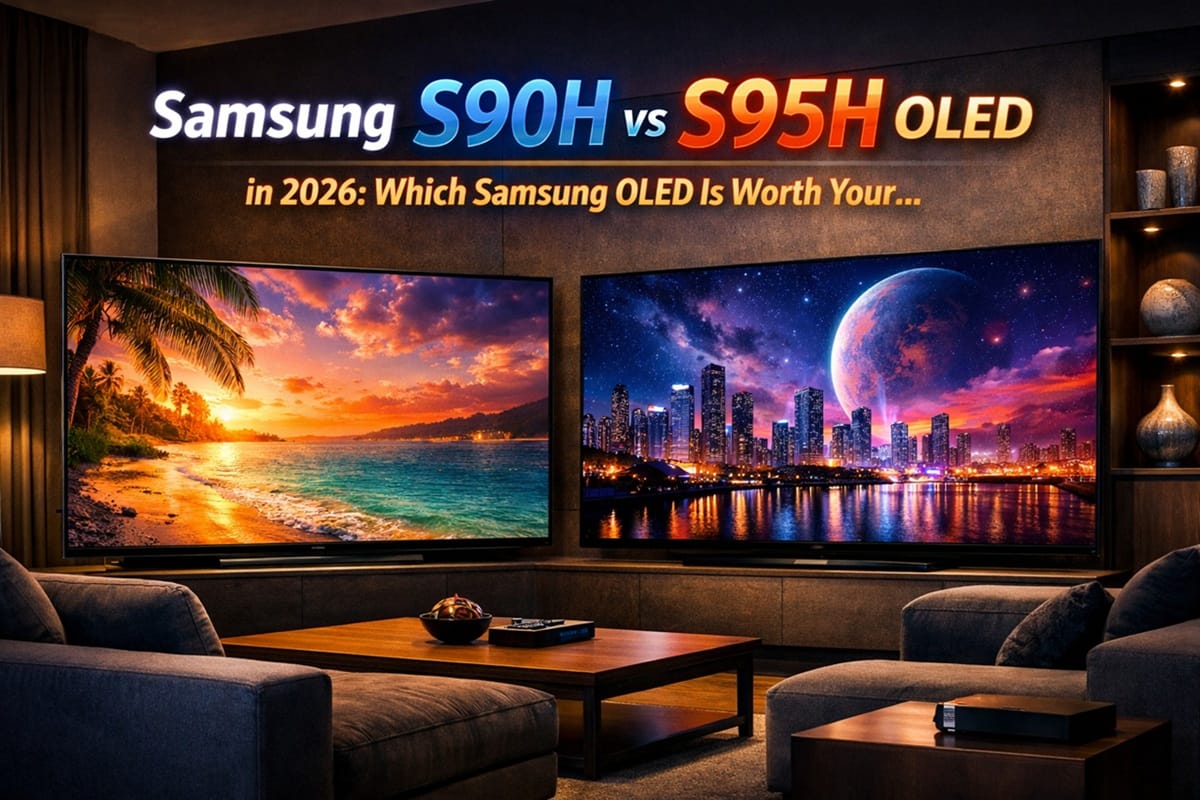
Samsung S90H vs S95H: Which Samsung OLED Should You Actually Buy in 2026?
Last updated: June 2026
Disclosure: As an Amazon Associate I earn from qualifying purchases. This article contains affiliate links — we may earn a small commission if you buy through them, at no extra cost to you.
You’ve narrowed it down to Samsung OLED. Now comes the harder question: S90H or S95H — and the price gap between them is bigger than the spec sheet makes it look. The answer isn’t simply “buy the more expensive one.”
For most buyers, the Samsung S90H vs S95H decision lands in favor of the S90H. It picks up the Glare Free coating that was previously reserved for flagship models, runs a full 165 Hz native refresh rate, and delivers excellent OLED picture quality in a traditional design that works on a TV stand or wall-mounted. The S95H is the better TV on paper — brighter, richer color volume, more premium build — but those advantages are meaningful only in specific situations.
In this comparison we’ll work through picture quality, brightness, gaming performance, design, and value so you can make a clean call. If you want the full Samsung lineup context first, our Samsung OLED roundup ranks all three 2026 models side by side. And if you’ve already landed on the S90H and just want size-specific detail, our full Samsung 48-inch S90H review covers hands-on testing for that model.
Table of Contents
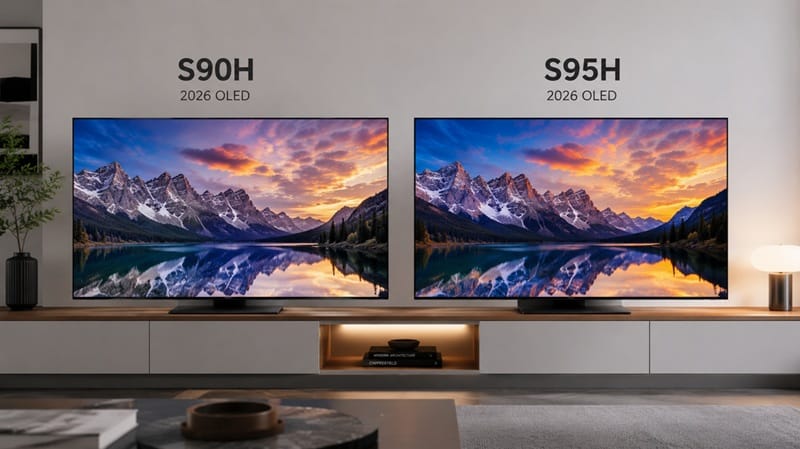
Samsung S90H vs S95H: Quick Verdict
How the S90H and S95H Actually Differ
What Is the Samsung S90H?
The S90H is Samsung’s mid-tier OLED for 2026, sitting between the entry-level S85H and the flagship S95H. The most significant change from last year’s S90F is the panel swap: the S90H moves from QD-OLED to a WOLED-based EX OLED panel (Samsung markets this as “EX OLED”; WOLED is the underlying panel technology supplied by LG Display). That’s the same class of panel used by LG across most of its lineup. Samsung pairs it with the NQ4 AI Gen3 processor, a native 165 Hz refresh rate, and — for the first time on a mid-tier Samsung OLED — the Glare Free coating.
It’s available in 42, 48, 55, 65, 77, and 83 inches, uses a traditional thin-bezel design, and is the better choice if your TV lives on a furniture stand rather than flush to a wall. For a deeper look at how panel types differ, our QD-OLED vs WOLED comparison covers the technical differences in full.
What Is the Samsung S95H?
The S95H is Samsung’s 2026 OLED flagship, and it retains QD-OLED — the quantum dot layer that pushes peak brightness and color volume higher than standard WOLED panels can reach. The headline additions this year are the FloatLayer design (a beveled metal frame that gives the TV a picture-frame look when wall-mounted) and Art Store support, making it the first OLED to bring Samsung’s artwork display feature from The Frame TV.
It’s available in 55, 65, 77, and 83 inches, supports the optional Wireless OneConnect Box for cable-free installation, and is priced meaningfully above the S90H. The S95H competes directly with the LG G6 at the OLED flagship level — a comparison you’ll find in our LG OLED vs Samsung OLED breakdown.
Curious which other Samsung OLED models actually use QD-OLED in 2026 versus WOLED? Our Samsung OLED buying guide breaks down the panel type, pricing tier, and core features across the full S85H, S90H, and S95H lineup.
The Core Difference in One Line
The Samsung S90H vs S95H isn’t just a tier comparison — it’s two different panel technologies. The S90H uses WOLED (excellent blacks, lower peak brightness), while the S95H uses QD-OLED (higher brightness, richer color volume). That panel gap is the entire story.
Picture Quality: QD-OLED Still Has an Edge
Both TVs deliver the core OLED promise: perfect per-pixel black levels, infinite contrast, and no blooming. In a dark room, the S90H looks outstanding — the kind of picture quality that would have been flagship-level just two years ago. The WOLED EX panel produces clean highlights, accurate colors, and zero haloing around bright objects.
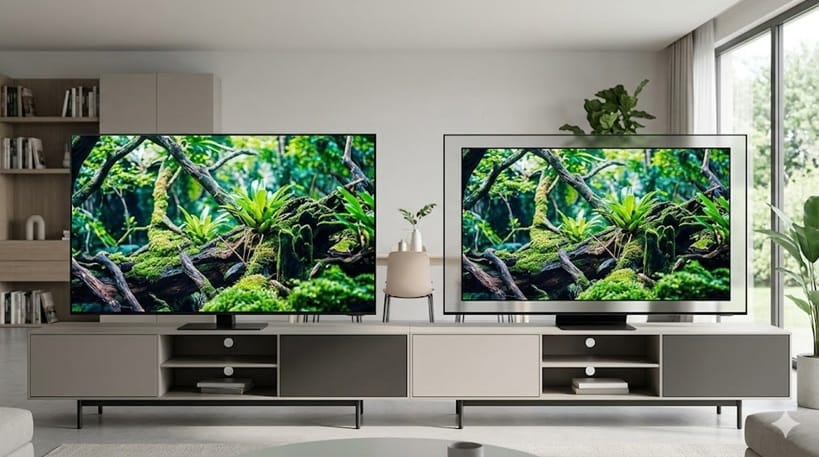
The S95H pulls ahead in two areas: peak brightness and color volume. QD-OLED’s quantum dot layer produces wider color gamut coverage and higher sustained brightness in small highlights — the kind of detail you notice in HDR content with bright specular highlights (a candle flame, a car headlight, sunlight on water). The S95H renders those moments with more intensity. RTINGS measures the S95H hitting around 1,400 nits on a 10% HDR window — roughly 25–30% brighter than the S90H in the same test. You feel that gap most in scenes with small, intense highlights against a dark background.
When the Difference Is Visible
In practice, you’ll notice the picture quality gap most clearly in HDR movie content in a moderately bright room. In a dark home theater setup or for casual streaming, the S90H holds its own extremely well. The S90H’s WOLED panel also has an advantage in some dark-scene gradations — a characteristic of WOLED panels that OLED enthusiasts appreciate for cinema content. If you’re watching Dune: Part Two or any HDR-mastered film with a wide dynamic range, the S95H’s extra headroom shows. For Netflix at night, you won’t notice — most casual viewers won’t, though viewers with trained eyes or a calibrated reference monitor may register the color volume difference.
Brightness and Glare: Both Get Glare Free, One Goes Brighter
This is where the S90H made the biggest leap over its predecessor. The S90F didn’t have Glare Free. The S90H does — and that coating makes a real difference in rooms with windows or ambient light sources. Glare Free screens scatter incoming light rather than creating mirror-like reflections, which means the TV stays watchable even when you can’t control the room lighting.
The S95H runs the enhanced version of Glare Free and gets meaningfully brighter in peak HDR output. Samsung’s QD-OLED panels have pushed OLED brightness further than WOLED-based competitors, and the S95H continues that trend. If your room is very bright — large south-facing windows, no blackout curtains — the S95H’s higher brightness gives you a noticeably better image at midday. For rooms where you have reasonable lighting control, the S90H’s Glare Free coating is enough. See our picks in the best OLED TVs for bright rooms guide for a broader comparison across brands.
Gaming Performance: Effectively Tied
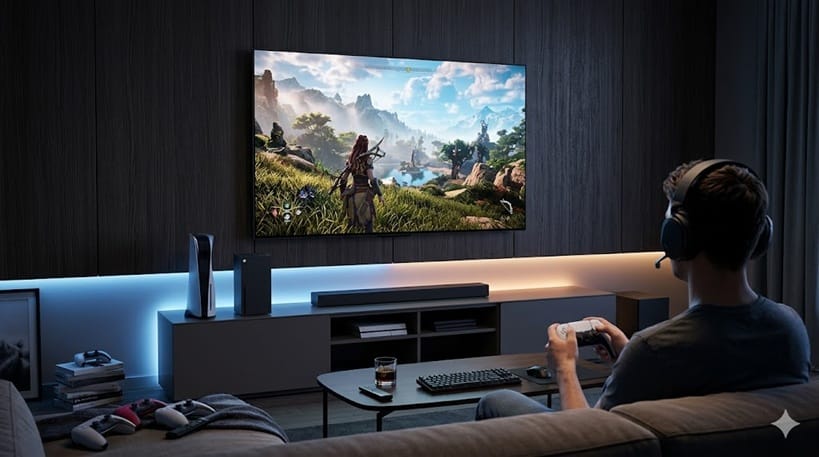
If gaming is your main reason to buy, the choice between them largely resolves itself: both TVs are exceptional and share nearly identical gaming specs. Both run a native 165 Hz refresh rate, support VRR (Variable Refresh Rate), ship with AMD FreeSync Premium Pro certification, and include Nvidia G-Sync Compatible support out of the box. Input lag is sub-2ms in Game Mode on both models — well below the threshold where it becomes perceptible during play.
Where the S95H Has a Theoretical Edge
The S95H’s higher peak brightness means HDR gaming scenes with very bright elements — explosions, sky lighting, in-game sun — can look slightly more dynamic. In competitive gaming where you’re running lower graphics settings for maximum frame rate, the difference is irrelevant. In cinematic single-player games where HDR fidelity matters, the S95H’s QD-OLED panel shows its advantage. But it’s incremental, not transformational.
For most gamers — including those with PS5, Xbox Series X, or high-end PC setups — the S90H delivers everything they need at a lower price. Our full best OLED TVs for gaming guide covers the broader competitive field if you want to see how both Samsung models rank against LG and Sony.
Design: The Biggest Practical Difference
Picture quality aside, design is where the Samsung S90H vs S95H comparison has the clearest winner depending on your setup. The S90H uses a minimal thin bezel — it’ll disappear into your living room whether you wall-mount it or place it on a TV stand. On a TV stand, that restraint works in its favor — nothing pulls your eye to the frame when the screen is off.
The S95H introduces the FloatLayer design: a beveled metal frame around the panel that gives it a picture-frame appearance, especially when wall-mounted. If you’re mounting flush to a wall and want the TV to display artwork or blend into the room as a decorative element, FloatLayer and Art Store make the S95H a compelling choice. If your TV sits on a cabinet or stand, the metal frame around the screen can look visually heavy from certain angles — not a flaw, but a matter of taste.
Wireless OneConnect — Only on the S95H
The S95H is compatible with Samsung’s optional Wireless OneConnect Box (sold separately), which lets you route all connections through a single thin cable to the TV panel instead of running HDMI and power cables directly to it. For a clean wall installation, this is a significant practical advantage. The S90H doesn’t support it.
Samsung S90H vs S95H by Use Case
Which Should You Buy?
For most buyers, the Samsung S90H is the right choice. It finally brings Glare Free to Samsung’s mid-tier OLED, runs the full 165 Hz gaming spec, and delivers genuine OLED picture quality — deep blacks, accurate color, and excellent contrast — in a clean traditional design. The WOLED panel is excellent. You’re not making a significant compromise going with the S90H over the S95H; you’re making a sensible one.
If you’re mounting your TV flush to the wall and the idea of a picture-frame TV that displays artwork when you’re not watching genuinely appeals to you, the S95H earns its premium. The FloatLayer design is well-executed, Art Store is a real feature for the right buyer, and QD-OLED’s brightness advantage is most meaningful in a bright, open living space where the TV is on during daylight hours.
One practical question worth asking yourself: will you actually use Art Store? If the honest answer is no, the S90H is your TV. For a broader view of where these two sit in the overall OLED market, see our guide to the best OLED TVs of 2026 and our best 65-inch OLED TVs roundup.
Already sold on a Samsung S-series but want to see how it stacks up against LG and Sony as brands first? See our full LG vs Samsung vs Sony OLED comparison for the three-way verdict.
Samsung S90H vs S95H: Common Questions
Is the Samsung S90H better than the S95H for movies?
In a dark room, the Samsung S90H vs S95H difference is smaller than the price gap suggests. The S90H’s WOLED panel handles dark-scene gradations and shadow detail very well, and for classic cinema viewing in a controlled environment, most people won’t miss the S95H’s extra brightness. The S95H pulls ahead noticeably for HDR content in bright rooms, where its higher QD-OLED peak output makes more of a visual difference.
Is the S95H worth the premium over the S90H?
For most buyers, no — the S90H covers 90% of the experience at a lower price. The picture quality upgrade is real but incremental: you’re paying for a meaningful step up in peak brightness and color volume, plus the FloatLayer design and Art Store. If those features genuinely fit your use case, the S95H justifies itself. If you just want the best OLED picture for movies and gaming on a stand, save the difference. RTINGS’s lab data for both models — S90H and S95H — shows the measured gap clearly.
Does the S90H have burn-in risk compared to the S95H?
Both TVs carry the same burn-in risk profile as any OLED TV — which is low for typical mixed-use viewing but worth understanding if you display static content for long periods. Neither the S90H’s WOLED panel nor the S95H’s QD-OLED panel has a meaningful advantage over the other in real-world burn-in resistance. Samsung includes the same pixel-management features on both models.
Will the S90H feel outdated quickly compared to the S95H?
No. The S90H runs Samsung’s current NQ4 AI Gen3 processor and Tizen smart platform, and its gaming spec — 165 Hz, VRR, HDMI 2.1 — matches what next-gen consoles and gaming PCs need for the foreseeable future. The panel technology difference (WOLED vs QD-OLED) won’t become more relevant over time; it’s a snapshot of where both panels are today, and the S90H’s WOLED is a current-generation panel, not a legacy one.
How does the S90H compare to LG’s OLED lineup?
The S90H competes most directly with the LG C6 — both use WOLED-based panels, both target the mid-to-upper OLED tier, and both deliver full gaming specs. LG’s advantage is Dolby Vision support, which Samsung doesn’t offer on any of its OLEDs (Samsung uses HDR10+ instead).

iYaiii
Editor, GearPulse360
iYaiii is the editor and founder of GearPulse360, specializing in TV reviews and consumer electronics. He tests and researches every recommendation before publishing.
✅ Based on spec analysis, RTINGS lab data, and hands-on review sources — last verified June 2026