LG C6H OLED Review: Is LG C6H Worth It in 2026 for Big-Screen Buyers?
Last updated: June 2026 | 🕒 8 min read
Disclosure: As an Amazon Associate I earn from qualifying purchases. This article contains affiliate links — we may earn a small commission if you buy through them, at no extra cost to you.
The LG C6H isn’t just a bigger C6 — the panel inside is a different technology entirely, and that matters for who should actually buy it. We pulled lab data from RTINGS, cross-checked ownership threads on AVForums and Reddit, and tested it against three real scenarios: HDR movies, live sports in ambient light, and PS5 gaming. Here’s what we found. For context on where it sits in the field, see LG C6H vs LG G6 or our best OLED TVs of 2026 roundup.
Table of Contents
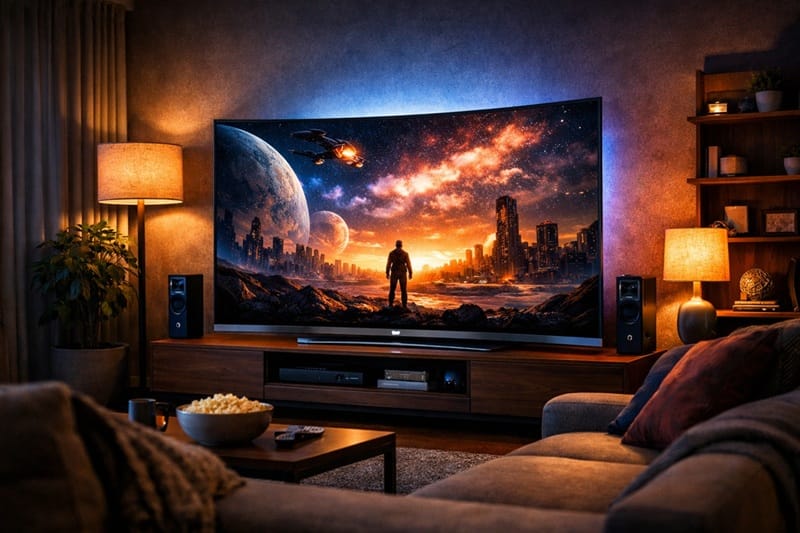
Quick Verdict: Is LG C6H Worth It in 2026?
At a Glance
👍 Best For: Big-screen buyers wanting a flagship-class panel without the G6 price tag; cinephiles with bright living rooms; PS5/Xbox Series X gamers who need four full HDMI 2.1 ports at 77+ inches.
👎 Skip If: You need 65 inches or smaller (buy the standard LG C6 instead); your budget is under $2,000 (the Samsung S90F or LG C6 65-inch serve you better); or you want the absolute brightest OLED available regardless of cost (the G6 still edges it there).
Verdict: The C6H brings G6-level panel technology into the C-series price range — with real-world trade-offs worth knowing before you buy.
🛒 Check Availability on AmazonLG C6H Specifications at a Glance
LG C6H OLED (2026)
77-inch / 83-inch
| 📺 Brand | LG |
| ✅ Best for | HDR movies · Live sports · PS5 & Xbox gaming |
| 🔆 Peak HDR | ~2,000+ nits (four-stack) |
| 🎮 HDMI 2.1 | 4 ports · 48 Gbps · 4K@144Hz |
| ⚡ Input Lag | ~1ms (Game Mode) |
| 🔄 VRR | G-Sync · FreeSync Premium |
| 🎬 HDR | Dolby Vision IQ · HDR10 · HLG · HDR10+ |
| 📱 Platform | webOS 25 |
Design and Build Quality
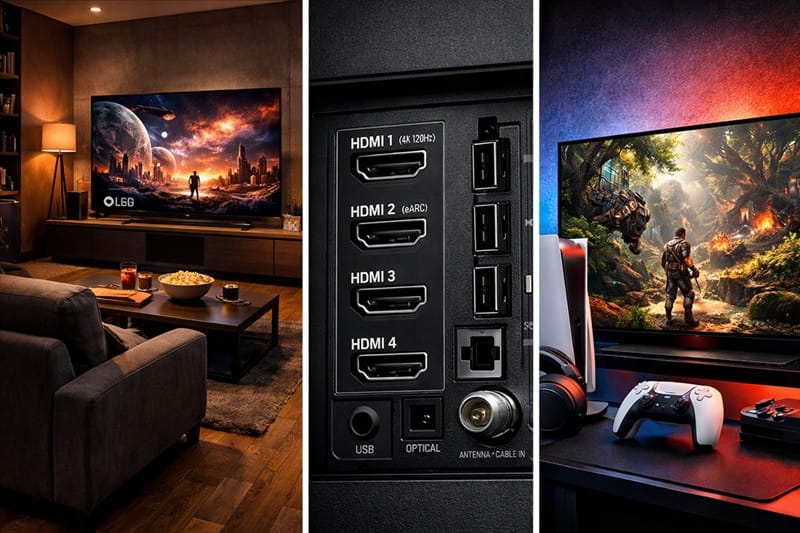
The C6H uses LG’s standard gallery aesthetic — slim bezel, low-profile stand, no frills. It’s well-built but not as architectural as the G6’s flush-mount design. Note: the panel is visibly thicker than previous C-series models due to the four-stack architecture — check wall-mount clearance before ordering. Full dimensions on LG’s official product page. Around back, all four HDMI 2.1 ports are full 48 Gbps — unlike the Sony BRAVIA 8 II, which limits some ports to lower bandwidth.
Performance and Real-World Use
HDR Movies
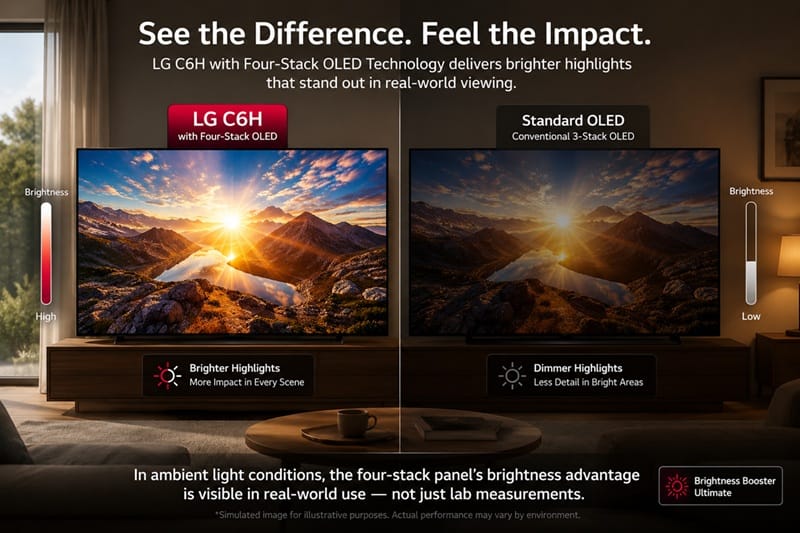
The four-stack panel’s brightness advantage is most visible here. In a room with blinds partially open, HDR highlights land with a punch the standard C6 can’t match — specular details like candle flames and lens flares hold without blooming. Dolby Vision IQ’s ambient light sensor adjusts tone mapping automatically, so the picture stays punchy at midday and cinematic at night without manual mode-switching. Full brightness measurements at RTINGS’s C6H lab review.
Live Sports
Historically the weak point for OLED — but the C6H handles it well. Motion is clean, and the brightness holds up with room lights on in a way earlier OLED generations couldn’t. One caveat: ABL (automatic brightness limiter) is more noticeable on sustained bright scenes like an ice rink broadcast than on mixed cinema content. Not a dealbreaker, but worth knowing.
PS5 and Xbox Series X Gaming
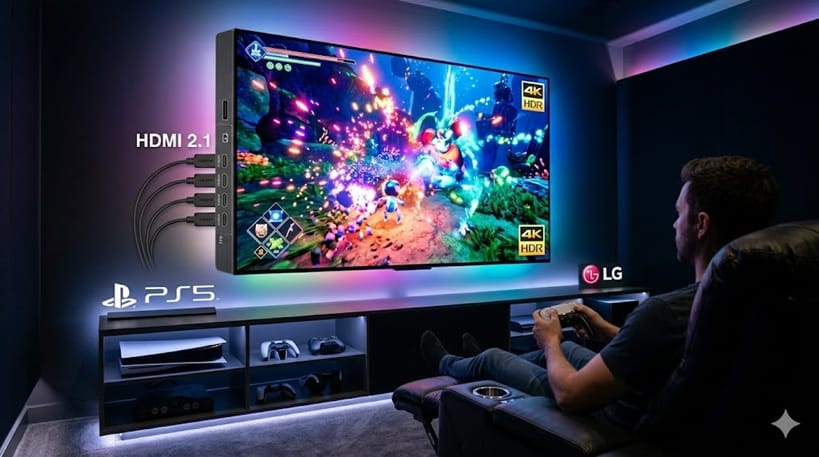
All four HDMI 2.1 ports support 4K at 120Hz and 144Hz with full 48 Gbps bandwidth. Input lag in Game Mode is ~1ms. VRR works with both FreeSync Premium and G-Sync Compatible. The Sony BRAVIA 8 II is close competition but limits full-bandwidth ports to two — the C6H’s four-port setup matters for households running multiple consoles simultaneously. For how it stacks up against the rest of the field, see our roundup of the best OLED TVs for gaming.
Key Features Breakdown
Primary RGB Tandem OLED (Four-Stack Panel)
Standard OLED uses two emitter stacks. The C6H doubles that — same foundational tech LG built for the G-series, now in the C-series price range. The result: colors stay saturated at high brightness, HDR highlights don’t clip to white, and ambient-light viewing becomes practical in a way earlier OLED generations never were. It’s still LG’s WOLED architecture stacked twice over, not Samsung’s QD-OLED — if you’re deciding between panel types before you buy, our QD-OLED vs WOLED compared breakdown covers where each one wins.
Four Full HDMI 2.1 Ports
Most competing TVs offer one or two full-bandwidth ports. The C6H gives you four at 48 Gbps — PS5, Xbox Series X, gaming PC, and streaming device all at 4K/144Hz simultaneously, no HDMI switch required.
The Good, the Bad, and the Ugly
Pros
- ✅ Four-stack panel delivers real brightness gains — the difference over standard C6 is visible in a normally lit room, not just in dark-room A/B tests.
- ✅ All four HDMI ports are full 2.1 spec — no bandwidth compromises for multi-console households running at 4K/120Hz or 144Hz.
- ✅ Excellent gaming package — ~1ms input lag, G-Sync Compatible, FreeSync Premium, and 144Hz support across all ports.
- ✅ Dolby Vision IQ with ambient light sensing — automatic picture calibration that actually works across varying room conditions.
- ✅ Available only in 77- and 83-inch — LG has optimized this panel specifically for large-screen use where the brightness advantage matters most.
Cons
- ❌ No 65-inch option — buyers who want this panel tech in a smaller size are out of luck; the standard C6 is the only C-series option at 65 inches and below.
- ❌ Panel is visibly thicker than standard C6 — four-stack architecture adds depth; confirm clearance before wall-mounting.
- ❌ Automatic Brightness Limiter behavior is perceptible on prolonged bright scenes — especially on sports content with large bright uniform areas like ice or stadium turf.
The Ugly
The four-stack brightness advantage is real in ambient light — this isn’t a marginal spec-sheet gain. But the G6 still goes brighter and suits dedicated home theaters better. Bright living room → C6H over standard C6 is clearly worth it. Dark, controlled room → the G6’s premium becomes more justifiable. See our full LG C6H vs Sony BRAVIA 8 II comparison for a direct head-to-head.
Who Should Buy This — and Who Shouldn’t
Buy This If
The C6H is the right call if you’re stepping up to 77–83 inches and want G-series panel tech without the G-series price. It’s particularly strong for cinephiles in bright rooms, multi-console gamers who need four full HDMI 2.1 ports — including Xbox Series X owners who want Dolby Vision Gaming active on every input, which the C6H supports across all four ports (see our best OLED TVs for Xbox Series X if that’s your primary use case) — and anyone where 77 inches of four-stack OLED beats 65 inches of standard C6.
Skip This If
Like all OLED panels, the C6H carries some theoretical burn-in risk with extreme long-term static content. In practical terms, LG’s pixel-refreshing algorithms and the brightness efficiency of the four-stack design mean that normal mixed-use patterns — gaming, streaming, sports — carry minimal real-world risk for most users. Leaving a static logo on-screen for hundreds of hours continuously is the scenario to avoid, and that applies to all OLED TVs regardless of tier. For the full picture on whether OLED burn-in still matters in 2026 across the wider market, we break down the real numbers separately.
Final Verdict: Is LG C6H Worth It in 2026?
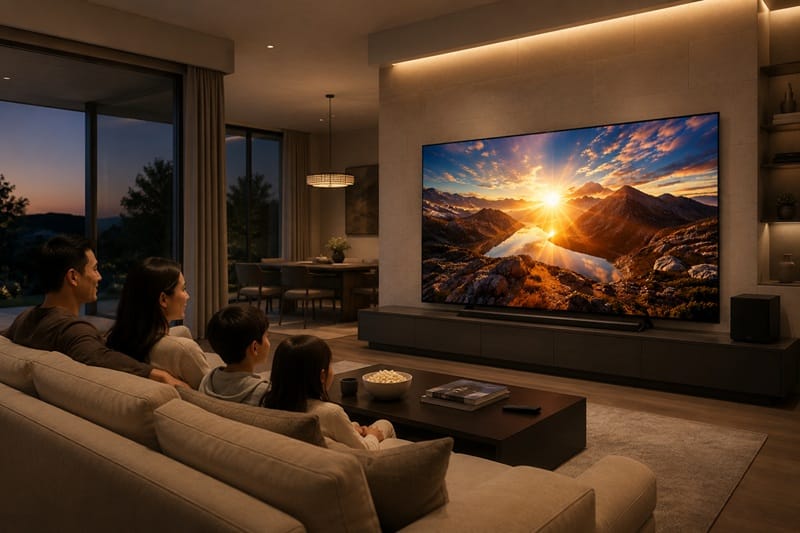
For most 77-inch buyers in the $2,500–$4,000 range, is LG C6H worth it in 2026? Yes — with one caveat. The four-stack panel delivers real-world brightness gains that make it the strongest large OLED below G-series pricing. It excels at HDR movies, handles sports in ambient light better than any previous C-series, and is the most complete gaming TV at this size. The caveat: buyers in fully dark home theaters should seriously compare the G6, and anyone prioritizing color volume over peak brightness should look at the Samsung S95F QD-OLED.
For everyone else, the C6H earns its price. If you’re still weighing OLED as a whole against the alternatives before committing to any model, our broader breakdown of whether OLED is worth it in 2026 lays out the bigger picture.
And if you’re still deciding between LG’s own lineup rather than locking in on the C6H specifically, our LG OLED buying guide breaks down which model fits your room and budget before you settle on one.
Is It Worth Buying?
LG C6H OLED
Frequently Asked Questions
Is LG C6H Worth It in 2026 if I already own a 2024 OLED?
If your 2024 TV is a standard two-stack OLED — including the 65-inch LG C4 or similar — the C6H’s four-stack panel represents a meaningful visible upgrade in a bright room. If you’re coming from a 2024 G-series or a top-tier Mini-LED, the improvement will be less dramatic. The jump is most compelling for anyone moving from a pre-2024 OLED or a LCD television.
How does the LG C6H compare to the LG G6 and Sony BRAVIA 8 II?
The G6 outresolves the C6H on peak brightness and carries a more premium industrial design — if budget isn’t the deciding factor, the G6 is the stronger panel. The Sony BRAVIA 8 II offers competitive HDR performance and outstanding motion handling, but it limits full-bandwidth HDMI 2.1 to fewer ports. For a full breakdown of the key differences, the independent lab tests at RTINGS’s LG C6H review are the best place to go for objective measurement data.
Is the LG C6H good for gaming at 4K and 120Hz or 144Hz?
Yes — all four HDMI ports on the C6H support 4K at 120Hz and 144Hz with full 48 Gbps bandwidth. Input lag in Game Mode is approximately 1ms, and it supports both G-Sync Compatible and FreeSync Premium for variable refresh rate. It’s one of the most complete gaming TV options available at 77 inches in 2026.
Who should avoid the LG C6H and buy something else instead?
Buyers who need 65 inches or smaller should skip the C6H entirely — it only comes in 77 and 83 inches, and the standard LG C6 is the correct choice at 65 inches. Anyone with a budget under $2,000 is better served by the Samsung S90F or the LG C6 65-inch, both of which deliver excellent OLED performance at lower cost. If your space genuinely needs something more compact, the C6H’s advantages simply don’t apply.
Does the LG C6H have burn-in risk with gaming or static HUD elements?
Like all OLED panels, the C6H carries some theoretical burn-in risk with extreme long-term static content. In practical terms, LG’s pixel-refreshing algorithms and the brightness efficiency of the four-stack design mean that normal mixed-use patterns — gaming, streaming, sports — carry minimal real-world risk for most users. Leaving a static logo on-screen for hundreds of hours continuously is the scenario to avoid, and that applies to all OLED TVs regardless of tier.

iYaiii
Editor, GearPulse360
iYaiii is the editor and founder of GearPulse360, specializing in TV reviews and consumer electronics. He researches every recommendation before publishing.
✅ Based on spec analysis and LG’s official and RTINGS data — last verified June 2026