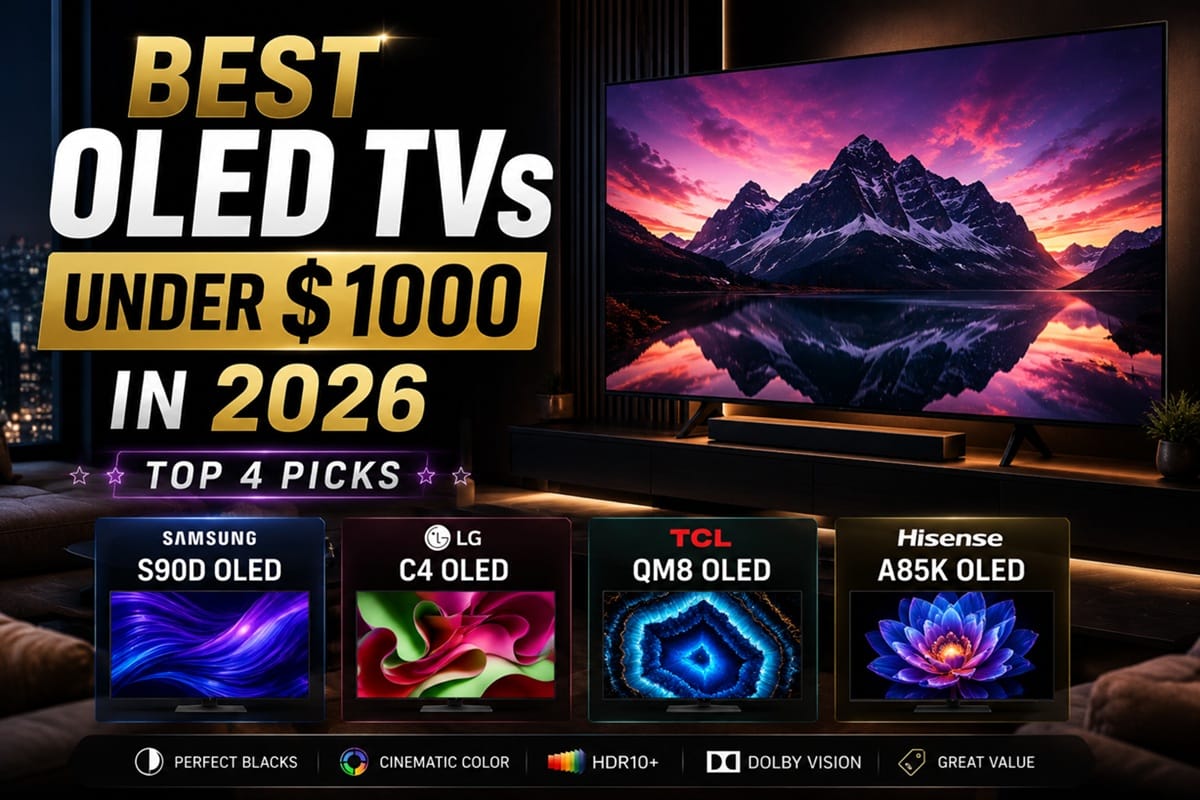
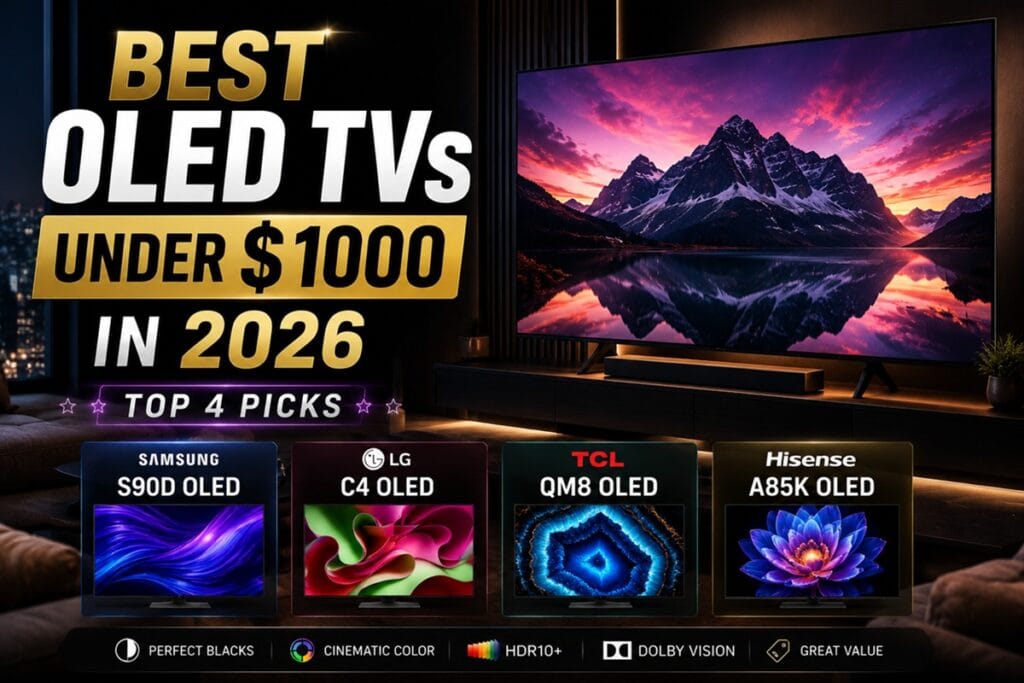
Best OLED TVs Under $1000 in 2026: Top 4 Picks at Every Size
Last updated: June 2026
Disclosure: As an Amazon Associate I earn from qualifying purchases. This article contains affiliate links — we may earn a small commission if you buy through them, at no extra cost to you.
A year ago, $1,000 barely bought you entry-level OLED. That’s changed. LG’s 2025 B5 and Samsung’s S84F have pushed the price floor down far enough that you can now get real OLED performance — perfect blacks, infinite contrast, full HDMI 2.1 — without touching the flagship tier. The catch is knowing which model fits your size and use case, because the wrong pick at this budget leaves real performance on the table. We’ve pulled together the four best OLED TVs under $1,000 from our best OLED TVs of 2026 roundup — ranked by picture quality, gaming specs, and value for money.
Our top pick is the LG B5 55″ — the most OLED you can buy for under $800, with four HDMI 2.1 ports, Dolby Vision, and LG’s proven WOLED panel. If gaming is your priority, step up to the LG C5 48″ for 144Hz and brighter HDR at just under $1,000. Need a bigger screen? The Samsung S84F 65″ delivers QD-OLED color across 65 inches for around $900. And if you want Samsung’s QD-OLED color in a compact body with full SmartThings integration, the Samsung S90F 48″ rounds out the list.
Already know OLED is right for you and just want the gaming deep-dive? See our best OLED TVs for gaming. Still weighing OLED against QLED at this price? Our full OLED vs QLED comparison covers the tradeoffs directly? Our picks for the best OLED TVs under $900 narrow the list to the models that clear that price most reliably.
Table of Contents
Quick Picks: All 4 at a Glance
| Pick | Model | Panel | Best For | Our Score |
|---|---|---|---|---|
| Best Overall | LG B5 55″ | WOLED | Movies, first-time OLED | ★★★★★ |
| Best for Gaming | LG C5 48″ | WOLED evo | PS5, Xbox, PC gaming | ★★★★★ |
| Best Large Screen | Samsung S84F 65″ | QD-OLED | Living room, sports, movies | ★★★★☆ |
| Best QD-OLED Compact | Samsung S90F 48″ | QD-OLED | Samsung ecosystem, compact rooms | ★★★★☆ |
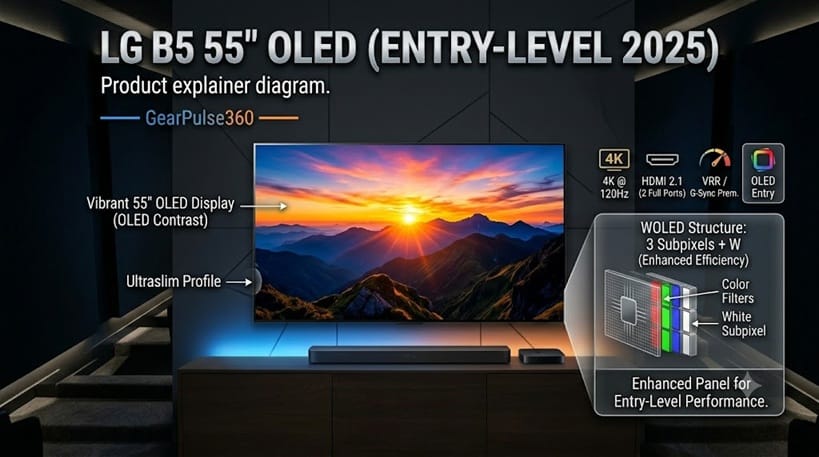
Best Overall: LG B5 55" OLED (2025)
LG OLED55B5PUA — 55" Class B5 Series OLED (2025)
The most OLED for the least money — perfect blacks, 120Hz, Dolby Vision at a price that finally makes sense.
★★★★★ Our Score
- Panel type: WOLED | Screen size: 55"
- Refresh rate: 120 Hz | HDMI 2.1: 4 ports (4K@120Hz)
- HDR formats: Dolby Vision, HDR10, HLG
- VRR / G-Sync / FreeSync: All supported
- Best for: Movies, casual gaming, first-time OLED buyers
Prices change frequently — click for current price.
The B5 is the answer to the question budget shoppers have been asking for three years: when does OLED stop being a luxury? At 55 inches, the B5 gives you the picture quality people spend twice as much chasing on QLED. The blacks are the kind of black where you genuinely can't tell if the TV is off. That's what you're paying for — and at under $800, it's finally at a price that makes sense.
What you're getting is LG's standard WOLED panel driven by the α8 AI Processor. It's not as bright as the C5 in HDR, and it tops out at 120Hz rather than 144Hz — but for movies and everyday TV watching, you won't feel the difference. Dolby Vision is fully supported, which matters if you watch a lot of Netflix or Apple TV+ content. Four HDMI 2.1 ports means every device you own plugs in at full bandwidth.
Who Should Buy the LG B5?
This is the right pick if you want the OLED experience without overthinking specs. VRR support covers casual PS5 or Xbox gaming comfortably at 120Hz. If you're upgrading from an LED or QLED TV and want to understand what the fuss is about — this is where to start. For a deeper look, the B5 holds its own against pricier competition in dark rooms, as covered in our best OLED TVs for movies guide.
Best for Gaming: LG C5 48" OLED (2025)
LG OLED48C5PUA — 48" Class C5 Series OLED evo (2025)
Step-up brightness and 144Hz on all four HDMI 2.1 ports — the pick if gaming matters.
★★★★★ Our Score
- Panel type: WOLED evo | Screen size: 48"
- Refresh rate: 144 Hz | HDMI 2.1: 4 ports (4K@144Hz)
- HDR formats: Dolby Vision, HDR10, HLG
- VRR / G-Sync / FreeSync: All supported
- Best for: PS5, Xbox Series X, PC gaming, desk setups
Prices change frequently — click for current price.
The C5 sits one rung above the B5, and the gap matters for gamers. Where the B5 tops out at 120Hz, the C5's OLED evo panel pushes 144Hz on all four HDMI 2.1 ports — every port runs at full 4K@144Hz bandwidth, which is unusual even at higher price points. The Alpha 9 Gen8 processor also improves brightness and HDR impact in mixed-light rooms.
Fast motion looks clean here — games don't smear, sports don't blur. That's OLED's natural advantage and the C5 doesn't waste it. At 48 inches it works as a primary TV in a smaller living space or as the best monitor-replacement setup you can build for under $1,000. Our best OLED TVs for PS5 guide covers how it performs with Sony's console in more detail.
B5 vs C5: When to Spend More
If gaming at 144Hz matters to you, or you watch a lot of HDR content in a room with some ambient light, the C5's added brightness makes the premium worthwhile. If you primarily watch TV and movies in a dark room and gaming is occasional, the B5 saves you money with no visible downside in what matters most.
Best Large Screen Value: Samsung S84F 65" OLED (2025)
Samsung QN65S84FAFXZA — 65" S84F 4K QD-OLED (2025)
A 65-inch QD-OLED under $1,000 — bigger screen, richer color, Samsung's Tizen ecosystem.
★★★★☆ Our Score
- Panel type: QD-OLED | Screen size: 65"
- Refresh rate: 144 Hz | HDMI 2.1: 4 ports
- HDR formats: HDR10+, HDR10, HLG (no Dolby Vision)
- VRR / G-Sync / FreeSync: All supported
- Best for: Big-screen movies, sports, living room viewing
Prices change frequently — click for current price.
The S84F is Samsung's most affordable OLED, and the 65-inch model sitting around $900 is the most compelling large-screen OLED value available right now. A 65-inch QD-OLED at this price genuinely didn't exist 18 months ago — it represents a real shift in what the sub-$1,000 tier offers. The QD-OLED panel delivers noticeably richer, more saturated colors than LG's WOLED panels, particularly in reds and greens. If color volume is your priority, QD-OLED has a visible edge.
The tradeoff is HDR format support. Samsung doesn't license Dolby Vision, so you get HDR10+ instead — equally capable in technical terms, but less widely supported on streaming services. If you watch a lot of Netflix or Apple TV+, this matters. If your content is primarily from Prime Video, Disney+, or physical media, HDR10+ covers you well.
The Case for Going Bigger at This Budget
At 65 inches the S84F gives you a genuinely cinematic size for a living room setup. The QD-OLED color and 144Hz refresh rate make it competitive against LG models costing several hundred dollars more. Its one real limitation is upscaling lower-quality content — Samsung's NQ4 AI Gen2 processor isn't quite as refined as LG's Alpha 9 here, though for 4K native content it's exceptional. If you can stretch the budget further for even more screen and brightness, our best OLED TVs under $2,000 picks cover the next tier up.
Best QD-OLED Compact: Samsung S90F 48" OLED (2025)
Samsung QN48S90FAFXZA — 48" S90F 4K QD-OLED (2025)
QD-OLED color in a 48-inch body — the pick for Samsung households and buyers who prefer vivid color over Dolby Vision.
★★★★☆ Our Score
- Panel type: QD-OLED | Screen size: 48"
- Refresh rate: 144 Hz | HDMI 2.1: 4 ports
- HDR formats: HDR10+, HDR10, HLG (no Dolby Vision)
- VRR / G-Sync / FreeSync: All supported
- Best for: Samsung ecosystem users, QD-OLED color preference, compact rooms
Prices change frequently — click for current price.
The S90F 48" is the pick for one specific buyer: someone already in the Samsung ecosystem who wants QD-OLED color without paying S95F money. If you have a Samsung Galaxy phone, a Frame TV in another room, or rely on SmartThings to automate your home setup, the S90F integrates in ways the LG C5 simply can't — app continuity across devices, SmartThings scenes, Bixby routines. That's a real-world advantage if the ecosystem already matters to you.
On raw picture quality, the S90F and LG C5 are close at 48 inches. The S90F's QD-OLED delivers more saturated color — reds and greens look richer than on WOLED. The C5 hits back with Dolby Vision support and slightly better processor refinement. If you're platform-agnostic and streaming is your main use, the C5 48" has a small edge. If you're a Samsung household, the S90F makes the integration seamless and the color difference tips the balance.
Also worth considering: LG B5 55" — if the S90F feels tight on screen size but you want to stay under $800, the B5's WOLED panel at 55 inches gives you Dolby Vision and a bigger picture for less.
How to Choose an Best OLED TVs Under $1000
WOLED vs QD-OLED: Which Panel Type Is Right for You?
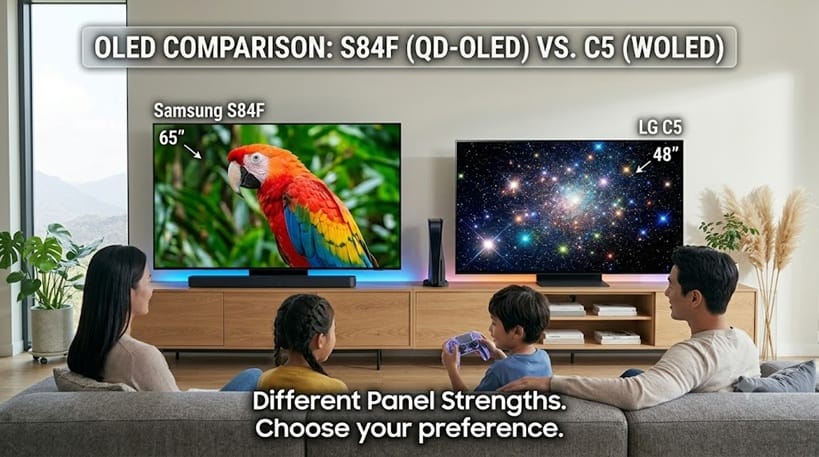
Both LG (B5, C5) and Samsung (S84F, S90F) use OLED technology at the base — infinite contrast, perfect blacks, and self-lit pixels are present across all four picks. The difference is in what sits on top. LG's WOLED panels add a white subpixel for brightness, then apply a color filter. Samsung's QD-OLED uses Quantum Dot material to convert blue OLED light into richer reds and greens, producing higher color volume without a filter layer.
In practice: QD-OLED color looks more vivid and saturated, especially in reds. WOLED handles Dolby Vision HDR grading better and tends to have more natural skin tones. Neither is objectively better — it depends on what content you watch and which HDR ecosystem your streaming services use. Our QD-OLED vs WOLED compared article covers this in technical depth if you want the full picture.
Refresh Rate: Does 120Hz vs 144Hz Matter at This Budget?
For everyday TV watching and streaming, 120Hz is the ceiling — no content is mastered above that. 144Hz only comes into play for PC gaming with a capable GPU pushing frame rates that high. For PS5 and Xbox Series X gaming, both consoles cap at 4K@120Hz, so you'll see no benefit from 144Hz on console. The main practical advantage of the C5 and Samsung models' 144Hz is future-proofing for PC gaming setups.
HDMI 2.1: How Many Ports Do You Actually Need?
All four picks include four HDMI 2.1 ports, which is excellent — most TVs in this range cut corners here. Where they differ is the maximum bandwidth. The B5 runs at 4K@120Hz across all four; the C5 and Samsung models step up to 4K@144Hz. If you have a gaming PC capable of 144Hz output, the C5 or Samsung picks give you the headroom. For console-only setups, the B5's 120Hz ceiling is never a limitation.
HDR Formats: Dolby Vision or HDR10+?
This is the most overlooked spec in the sub-$1,000 OLED category. LG TVs support Dolby Vision — the HDR format used by Netflix, Apple TV+, Disney+, and most major streaming services. Samsung TVs support HDR10+ instead — used primarily by Amazon Prime Video and Samsung's own content ecosystem. If you watch a lot of Netflix or Apple TV+, choose LG. If you primarily use Prime Video, HDR10+ covers you well. Both formats produce excellent results on an OLED panel — the execution difference is smaller than the format debate suggests.
SDR Brightness: The Real Limitation at This Price Tier
The honest caveat for sub-$1,000 OLED is brightness in SDR (standard dynamic range) content — everyday TV, cable channels, daytime viewing. Entry-level OLED panels like the B5 and S84F are dimmer than flagship models in SDR, which makes them less impressive in very bright living rooms. They perform best in rooms with controlled lighting. The C5 and S90F are noticeably brighter in SDR — worth the premium if your viewing environment has significant ambient light.
Is a $1,000 OLED Worth It vs a $1,000 QLED?
At equal prices, OLED wins in dark and mixed rooms — and it's not particularly close. A $1,000 QLED buys you a larger screen and more peak brightness, but the contrast ratio on any LED panel is a fraction of what OLED delivers. The black level difference is immediately visible: OLED pixels turn off completely in dark scenes, while LED panels produce a grey glow. For movies, gaming, and HDR content, OLED's infinite contrast produces a more cinematic image at the same price point.
The case for QLED at $1,000 is size and brightness. You can get a 75" QLED for what a 55" OLED costs, and in a very bright room the QLED's higher peak brightness may look more vivid. If you watch primarily in a sunlit living room and screen size is everything, the size-per-dollar math can favor QLED. For anything else — movies, gaming, dark-room TV — the OLED picture is the better choice at this budget. If Mini LED is also on your shortlist, our OLED vs Mini LED compared breaks down where the two technologies actually diverge.
💡 Budget stretching a little? If you can push to $1,500, the LG C5 55" and Samsung S90F 55" become available — adding meaningful brightness and screen size upgrades. Best OLED TVs Under $1,500 (coming soon) will cover those options in detail.
How We Picked These TVs
These picks are based on a combination of lab data from RTINGS.com, manufacturer spec sheets, and hands-on experience with LG and Samsung OLED panels across multiple model generations. We cross-referenced test scores across the key metrics that matter at this price tier: black levels, SDR and HDR brightness, input lag, color accuracy, and HDR format support. Price eligibility was verified against current Amazon listings in June 2026.
We don't recommend a TV simply because it's new or heavily marketed. The LG B5 earns its Best Overall position because it delivers the core OLED experience at a price that removes the main barrier for first-time buyers. The Samsung S84F earns its place because a 65-inch QD-OLED at this price genuinely didn't exist 18 months ago — it represents a real shift in what this tier offers.
This guide is reviewed and updated as prices shift and new models enter the market. If you're reading this more than three months after the June 2026 publish date, check for an updated version — OLED pricing at this tier moves quickly.
📍 Comparing across all budgets? Our full roundup covers the best OLED TVs at every price point and use case — from budget picks to flagship models.: See Best OLED TVs of 2026.
Best OLED TV Under $1,000 — FAQs
Which is the best OLED TV under $1,000 overall?
The LG B5 55" is our top pick for most buyers. It delivers the core OLED experience — perfect blacks, infinite contrast, Dolby Vision HDR, and four HDMI 2.1 ports — at a price that has consistently landed well under $800 in 2026. For buyers who want 144Hz gaming or slightly better brightness, the LG C5 48" is the upgrade worth considering. You can check current pricing for the LG B5 on Amazon.
Is a $1,000 OLED TV worth buying, or should I wait for prices to drop further?
2026 is a strong time to buy entry-level OLED. Prices at this tier have stabilized after two years of gradual decline, and there's no strong indication of a major drop in the next 12 months — if anything, tariff pressures have nudged some models slightly higher. According to RTINGS.com's LG B5 review, it performs at a level that was considered mid-range OLED just two generations ago. The current value is genuine.
Do OLED TVs burn in at this price tier?
Burn-in risk on these models is low for mixed normal viewing. The B5, C5, S84F, and S90F all include pixel shifting, logo dimming, and automatic panel refresh cycles that make burn-in unlikely under typical use. It remains a theoretical risk for extreme static-content use cases — displaying a news ticker or sports score bar for 10+ hours a day, every day. For the vast majority of households watching a mix of streaming, gaming, and live TV, burn-in is not a practical concern.
How does a $1,000 OLED compare to a $1,000 QLED?
In dark and mixed-light rooms, OLED wins on picture quality at equal prices — the infinite contrast ratio and perfect black levels produce a more cinematic image than any LED-based panel. QLED has an advantage in very bright rooms and on screen size per dollar.
What's the difference between the LG B5 and LG C5 at this budget?
The LG C5 uses LG's OLED evo panel, which is brighter in both SDR and HDR than the B5's standard WOLED panel. It also runs at 144Hz versus the B5's 120Hz cap. In practical terms: the C5 is the better choice if gaming or ambient-light viewing matters; the B5 is the right pick if you want maximum OLED picture quality for the minimum spend, particularly for dark-room movie watching.

iYaiii
Editor, GearPulse360
iYaiii is the editor and founder of GearPulse360, specializing in TV reviews and consumer electronics. He researches every recommendation before publishing.
✅ Based on spec analysis and LG's and Samsung's official data plus RTINGS — last verified June 2026