What Determines LG OLED Resale Value? A Plain-English Breakdown for Owners and Buyers
Last updated: July 2026
🕒 8 min read
Disclosure: GearPulse360 participates in the Amazon Associates Program. This particular article contains no affiliate links; other content on our site may.
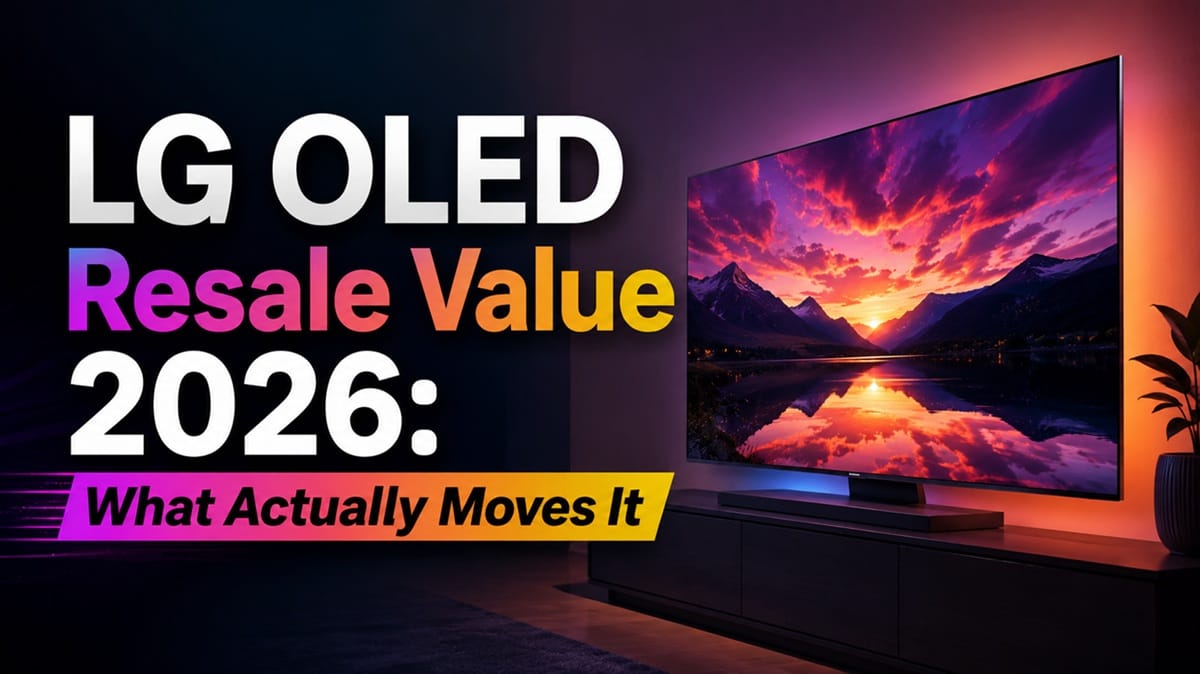
Sell an LG OLED two years after buying it, and the offer you get will hinge on a lot more than how clean the screen looks. LG OLED resale value moves on panel tier, warranty status, and how fast the next generation makes your set look dated — factors most sellers never think to check before listing.
If you’re weighing whether to sell now, hold, or trade toward a newer model, the confusion usually comes down to one thing: nobody separates “how old is it” from “what’s actually driving the number a buyer will pay.” Based on independent panel-testing data and LG’s own published warranty terms, those are two very different questions.
This guide breaks down the real factors behind LG OLED resale value — panel longevity, warranty transferability, and generation timing — and where your specific model likely lands. It also connects to a related question worth checking first: will OLED prices drop in 2026, since new-unit pricing directly shapes what buyers are willing to pay for a used one.
It’s worth separating LG OLED resale value from resale trends for LCD-based sets, too. A budget LED TV loses most of its worth almost immediately because there’s little brand or picture-quality differentiation to protect it. OLED behaves differently — the picture-quality gap between tiers is wide enough that buyers actively shop by series, not just by size and price, which is exactly why the factors below matter more than a simple “years owned” calculation.
Table of Contents
The Short Answer: What Determines LG OLED Resale Value
LG OLED resale value is set mainly by three things: which series tier the TV belongs to (B/C-series vs. G/M/Z-series), whether LG’s panel warranty transfers to a second owner (it doesn’t), and how many generations old the panel is compared to the current lineup. Age alone is a weak predictor — a three-year-old G-series can outsell a one-year-old B-series once buyers weigh in warranty coverage and picture-quality tier.
What Actually Drives LG OLED Depreciation
Panel Longevity and Buyer Confidence
Used-TV buyers hesitate on OLED mainly because of burn-in worry, and that hesitation directly compresses resale price. In RTINGS’ accelerated longevity test, which tracked around 100 TVs continuously from late 2022 through 2025, LG recorded just one complete failure across its entire 24-TV lineup in the study — a G2 OLED that developed dead subpixels near the end of the test — with its other issues limited to partial LED failures on LCD-based models, not OLED panels. Across the WOLED panel type specifically, the test recorded only two complete failures out of 17 units industry-wide and zero partial failures, the cleanest record of any panel category tracked.
The practical effect: sellers who can point to real reliability data, rather than just saying “it’s never had issues,” give a cautious buyer a concrete reason to pay closer to asking price instead of discounting for unknown risk. Our LG OLED long-term ownership data is a useful reference point here — it compiles real owner reports spanning thousands of hours of daily use, which is exactly the kind of evidence that reassures a hesitant buyer.
Model Tier and Generation Gap
Not every LG OLED depreciates at the same rate, and this is where LG OLED resale value splits sharply by tier. Entry-level B-series and mid-tier C-series TVs compete against a new, similarly priced model every single year, so their resale ceiling drops fast once a successor launches. G-series, M-series, and Z-series sets hold value better for two reasons: brighter panels that stay competitive longer, and — critically — the longer warranty coverage discussed below.
The gap compounds over time. A two-generation-old B-series is competing against heavily discounted current-year B-series stock at retail, which drags the used price down further. A two-generation-old G-series, by contrast, is still ahead of most B and C-series sets on brightness and processing, so it keeps a meaningfully higher floor.
Why This Matters More in 2026
Faster Release Cycles Compress Resale Windows
LG now refreshes its OLED lineup annually with meaningful picture-quality gains each cycle, not just cosmetic changes. That pace means a TV’s “current generation” status expires quickly — a set that was flagship-tier 18 months ago is already two generations behind, and buyers shopping used inventory notice that gap when comparing prices against new stock.
Faster iteration like this is a newer pressure on LG OLED resale value than it was five years ago, when generational gaps were smaller and a two- or three-year-old flagship still looked current. It’s good for buyers of new TVs, but it means anyone planning to resell should expect a shorter window before their model visibly falls behind.
Warranty Non-Transferability
This is the factor most sellers underestimate. According to LG’s official OLED Television Limited Warranty, coverage is valid only to the original purchaser of the unit. A used LG OLED — even one still technically inside its original warranty window — carries zero manufacturer coverage for its second owner. That single detail can matter more to a cautious buyer than a year or two of age difference, because it shifts all repair risk onto them from day one.
| FACTOR | VALUE | BASIS | LAST VERIFIED |
|---|---|---|---|
| Warranty length by series tier | Varies | 1 year standard on B/C-series; 5-year panel-only coverage on G/M/Z-series, per LG’s published warranty terms | July 2026 |
| Warranty transfers to a second owner | None | LG’s Limited Warranty is valid only to the original purchaser — used buyers get no manufacturer coverage regardless of the unit’s age | July 2026 |
| Complete failures in RTINGS’ 3-yr test (LG, all TV types) | 1 of 24 tested | Source: RTINGS accelerated longevity test (Nov 2022–Sep 2025); the single failure was an OLED model (G2) | July 2026 |
Bands reflect relative standing within the TV category, not guaranteed outcomes for any individual unit.

Holding onto an aging LG OLED versus buying new is really two separate math problems — one about what you’d recover selling, one about what a current-generation set actually costs to own. Our best OLED TVs of 2026 picks are the reference point for the second half of that comparison.
LG OLED Resale Value by Series Tier
How LG OLED Resale Value Compares Across the Lineup
A listing for a G-series set can realistically ask for a larger share of its original price than a B-series set of the same age, because the warranty and brightness gaps described above are things a used buyer can actually verify before paying rather than take on faith. In practice, the gap between tiers shows up clearly once you separate them out:
- B-series: Depreciates fastest — entry pricing new means little room left once a newer B-series or discounted C-series arrives.
- C-series: The most-produced tier, which keeps resale demand steady but also floods the used market, capping upside.
- G-series and up: Holds value longest, driven by the 5-year panel warranty and brighter panel tech that stays relevant across more generations.
Anyone deciding whether extended coverage is worth paying for on a current-generation set should read should you buy extended warranty for LG OLED — the same warranty-transfer gap that hurts resale value is the reason that decision matters in the first place.
What This Means for You in Practice
Who Should Pay Attention to This
If you own a B-series or C-series LG OLED that’s two or more years old, or you’re watching for the next generation’s launch, LG OLED resale value is actively working against you the longer you wait. Checking current asking prices against our LG OLED roundup before listing gives you a realistic ceiling rather than guessing based on what you originally paid.
Who Doesn’t Need to Worry
Owners of G-series, M-series, or Z-series sets with no plans to sell in the near term don’t need to track LG OLED resale value closely — the longer warranty window and slower depreciation curve mean the resale conversation can wait a few years without much downside.
FAQs: LG OLED Resale Value
Does LG OLED burn-in affect resale value?
Burn-in worry lowers what buyers are willing to offer even when a specific unit shows no visible issues, simply because they can’t verify usage history. If you’re unsure how real that risk is on a modern panel, does OLED burn-in still matter in 2026 covers what’s changed and what hasn’t.
How much value does an LG OLED TV lose per year?
There’s no fixed annual rate — it depends heavily on series tier and how close a new generation is to launching. In RTINGS’ three-year accelerated longevity test, LG recorded just one complete failure across 24 TVs tracked in the study, and the WOLED panel type posted zero partial failures industry-wide — a track record that gives buyers a concrete reason to trust an older unit rather than assume it’s due to fail. Actual resale pricing still comes down to condition, series tier, and how many generations old the model is.
Can I transfer my LG OLED warranty when I sell it?
No. LG’s limited warranty is valid only to the original purchaser, so a second owner buys the TV without any manufacturer coverage, regardless of how much time is left on the original warranty period.
Should I sell my LG OLED before a new generation launches?
If you’re on a B-series or C-series set, selling shortly before a new lineup launches usually protects LG OLED resale value better than waiting until after, since your model visibly becomes “last year’s” the moment the replacement is announced. G-series and higher owners have more flexibility given their longer warranty window and slower depreciation.
Will LG OLED resale values improve as the technology matures?
It’s reasonable to expect resale confidence to keep improving as more multi-year reliability data becomes public and burn-in concerns keep fading as a buying objection — but that’s a gradual trend, not something likely to shift dramatically within a single year.

iYaiii
Editor, GearPulse360
iYaiii is the editor and founder of GearPulse360, specializing in TV reviews and consumer electronics. He researches every recommendation before publishing.
✅ Based on spec analysis and LG’s official and RTINGS data — last verified July 2026