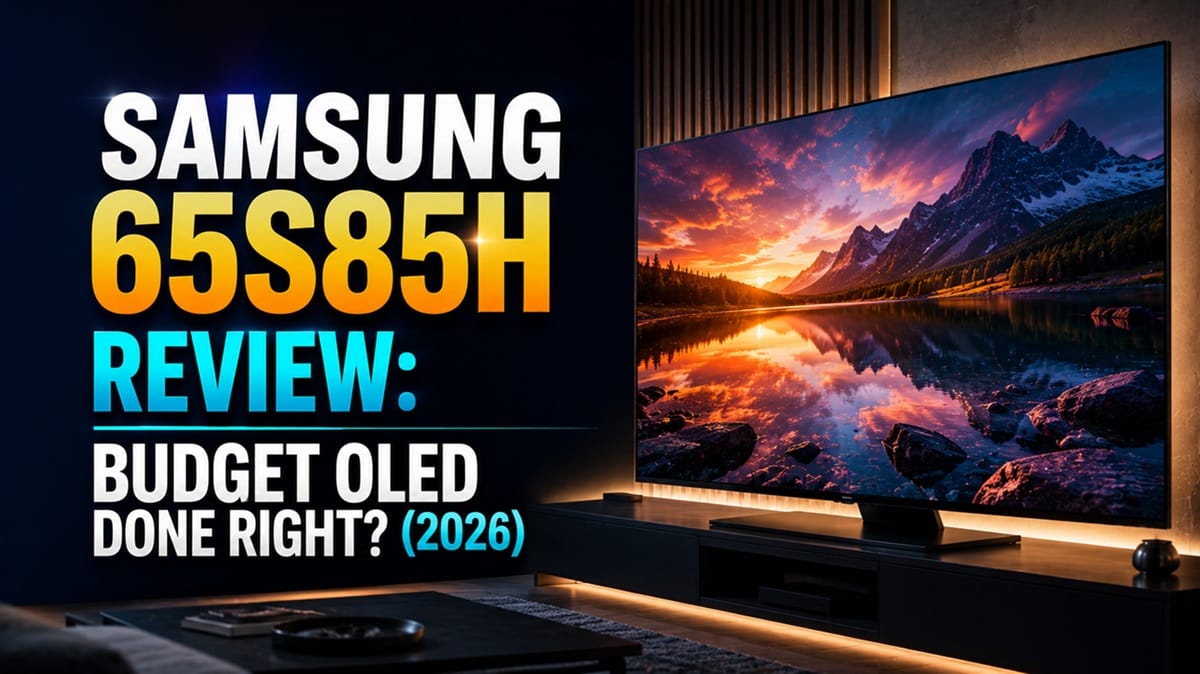
Samsung 65S85H Review: Is Samsung’s Cheapest 65-Inch OLED Worth Buying?
Last updated: July 2026
🕒 9 min read
Disclosure: As an Amazon Associate I earn from qualifying purchases. This article contains affiliate links — we may earn a small commission if you buy through them, at no extra cost to you.
Sixty-five inches is the size most people actually put in their living room — not the size you stretch to justify an entry-level panel, the way a 77-inch OLED sometimes is. That makes the Samsung 65S85H review question a little different from its bigger sibling: is Samsung’s cheapest OLED still a compelling buy once it’s sitting at the size shoppers compare against everything else on the shelf?
Every spec the S85H shares with the pricier S90H and S95H matters here, and so does every spec it doesn’t. Samsung’s official listings and cross-brand editorial context are what we’re sorting through below to pin down exactly where that line falls — and whether crossing it, at 65 inches specifically, is something you’d actually notice from the couch or only on a spec sheet. If you’re weighing this against Samsung’s own step-up models or a budget OLED from another brand, we’ll get into where each one pulls ahead. For a broader look at how this year’s field stacks up, our best OLED TVs of 2026 guide covers the full range of sizes and price tiers.
Here’s the short version: the S85H nails the fundamentals that actually matter for picture quality and hits the gaming spec sheet almost across the board — it’s what Samsung left out to hit this price that decides whether it’s the right call for your room.
Table of Contents
Quick Verdict
At a Glance
★★★★★ 7.2 / 10
At a Glance
Picture Quality
Gaming
Audio
Value
👍 Best For: Shoppers who want OLED contrast and a full gaming feature set at 65 inches without paying for Samsung’s Glare-Free coating or QD-color boost.
👎 Skip If: You watch in a bright room during the day or care more about built-in audio than picture quality.
One-Line Verdict: The Samsung 65S85H gets the OLED fundamentals and gaming checklist right, but its basic screen coating and speaker setup are exactly what you’d expect at this price.
🛒 Check Availability on AmazonProduct Specs at a Glance
Product Specs
Samsung 65S85H
WOLED (LG Display) · NQ4 AI Gen2 Processor · Tizen OS
| 🖥️ Panel Type | WOLED (LG Display) |
| 🎮 Gaming | 4K 120Hz, VRR, ALLM, 4x HDMI 2.1 |
| 🧠 Processor | NQ4 AI Gen2 |
| 🌈 HDR | HDR10+, HDR10, HLG (no Dolby Vision) |
| 🔊 Audio | Built-in 2-channel, Q-Symphony support |
| 📶 Smart Platform | Tizen OS 10, 7-year OS update pledge |
| 🖼️ Screen Coating | Standard glossy (no Glare-Free) |
Design & Build Quality
Materials & Finish
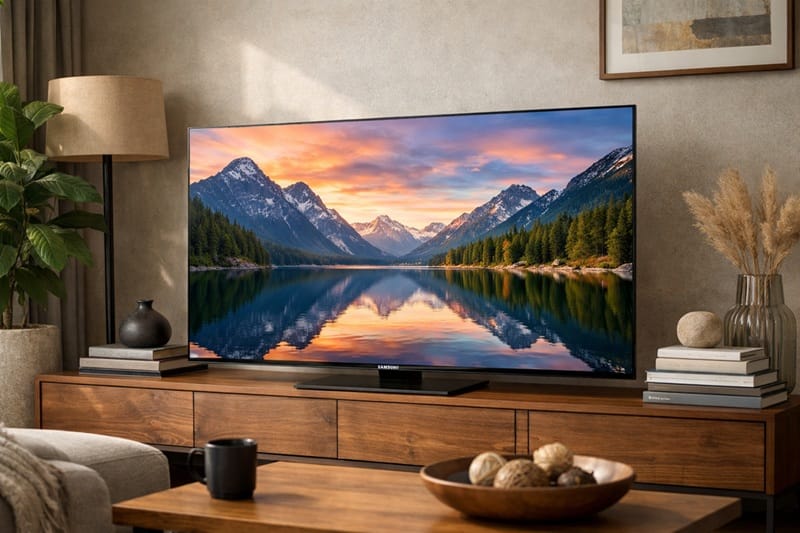
Samsung keeps the industrial design plain on the S85H — a slim panel on a basic center or dual-foot stand, without the picture-frame styling Samsung reserves for its flagship sets. The screen itself uses a standard glossy coating rather than the Glare-Free treatment on the S90H and S95H, which is one of the clearer ways Samsung signals where this model sits in the lineup. According to Samsung’s official product page, the 65S85H ships with the same NQ4 AI Gen2 processor and Vision AI feature set as the rest of the current lineup, just without the higher-tier screen treatment.
Ports & Connectivity
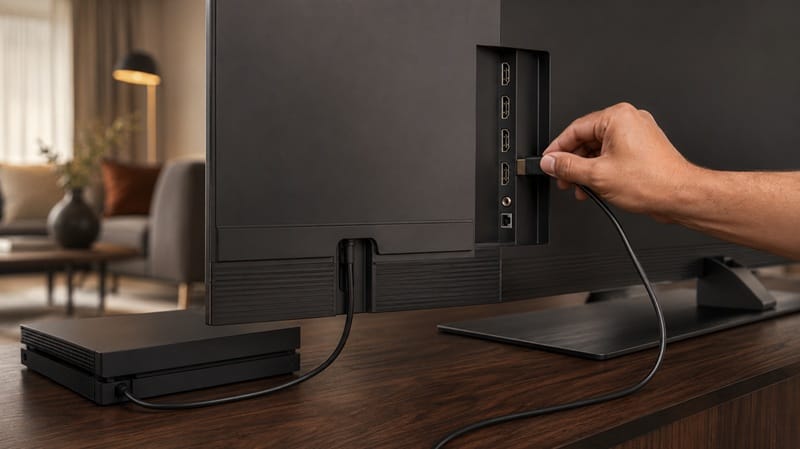
All four HDMI ports support 4K at 120Hz, and one carries HDMI eARC for a soundbar or AV receiver hookup — a generous port count for a model positioned as Samsung’s entry-level OLED. Add in Wi-Fi 6E and Bluetooth 5.3, and the setup experience doesn’t feel noticeably cut down compared to Samsung’s pricier panels.
Performance & Real-World Use
Movies and Dark-Room Viewing
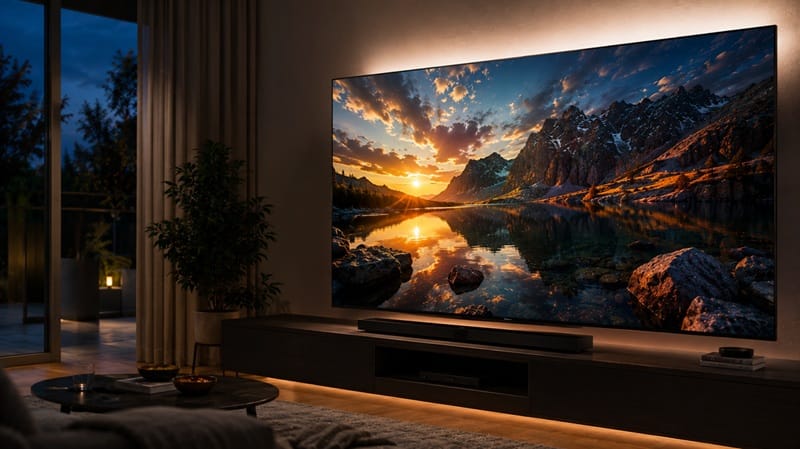
This is where the WOLED panel earns its keep. Based on published specifications and general OLED testing methodology outlined by RTINGS, self-emissive OLED panels produce per-pixel black levels that LED-backlit sets can’t match, regardless of tier — that fundamental advantage carries over to the 65S85H even without Samsung’s higher-end brightness or coating upgrades.
Gaming at 65 Inches
Every HDMI port on the 65S85H supports 4K at 120Hz with VRR and ALLM, so there’s no need to hunt for the “gaming port” the way some budget sets require. Samsung’s Premium Gaming Pack bundles in a Game Bar overlay for quickly checking frame rate and input latency mid-session, which matters more at 65 inches than it does on a smaller desk-bound panel where you’re sitting close enough to eyeball settings changes.
Bright-Room Viewing
The standard glossy coating is the tradeoff that shows up fastest in daily use. Without Glare-Free glass, direct light sources reflect more visibly off the screen than they would on the S90H or S95H — worth weighing carefully if your 65-inch set is going in a room with windows facing the screen rather than a dedicated dark viewing space. At 65 inches, that reflective surface also covers more area than it would on a smaller panel, so the effect is easier to notice from a normal couch distance than it is on a 48- or 55-inch version of the same TV.
Everyday Streaming and Upscaling
Most of what a living-room TV actually displays day to day isn’t native 4K HDR — it’s compressed streaming video, and sometimes still 1080p content from older sources. The NQ4 AI Gen2 processor handles upscaling duties here, and while it’s not Samsung’s newest silicon, it’s the same chip running across the rest of the current-generation lineup, so streaming picture quality doesn’t take a noticeable step down compared to the pricier S90H at this task specifically.
Key Features Breakdown
Tizen OS with a 7-Year Update Pledge
Samsung’s Tizen OS 10 runs the same interface across the whole 2026 lineup, and Samsung has committed to platform updates for up to seven years on this generation. For a budget-tier purchase, a seven-year commitment is worth noting on its own — it’s the same pledge Samsung is making across its pricier 2026 OLEDs, not a shortened version for the entry-level model.
SmartThings Hub Built In
The 65S85H doubles as a SmartThings hub, meaning it can control Matter, Zigbee, and SmartThings-compatible smart home devices without a separate bridge — a useful extra for anyone already inside Samsung’s smart home ecosystem, and not something every OLED at this price includes.
Q-Symphony and Object Tracking Sound Lite
Even though the built-in speakers are modest, the 65S85H supports Q-Symphony, which lets the TV’s speakers work alongside a compatible Samsung soundbar instead of switching over to the soundbar alone. Object Tracking Sound Lite adds a layer of virtual audio positioning on top of that. Neither feature fixes the weak built-in audio on its own, but they matter if a soundbar is already part of your setup or on your shopping list.
The Good, the Bad, and the Ugly
Pros
- ✅ Full 4K 120Hz gaming across every HDMI port — no compromise port to plan your setup around.
- ✅ True per-pixel OLED contrast — the core picture-quality advantage isn’t diluted at this tier.
- ✅ Seven-year OS update pledge — unusually long software support for a budget-tier OLED.
Cons
- ❌ No Glare-Free coating — reflections are more noticeable than on the S90H or S95H in bright rooms.
- ❌ Basic 2-channel built-in audio — plan on a soundbar if sound quality matters to you.
The Ugly
If your main concern going in was whether the “cheapest OLED” label means Samsung cut something that actually affects daily picture quality, the honest answer is: not really — what it cut is the screen coating and the color-volume ceiling that only shows up next to a brighter set in side-by-side comparisons. The Samsung 77S85H review we published covers the same tradeoff at a larger size, and the pattern holds here too: Samsung didn’t nerf the panel technology at this tier, it nerfed the coating and the brightness ceiling.
Who Should Buy This — and Who Shouldn’t
Buy This If
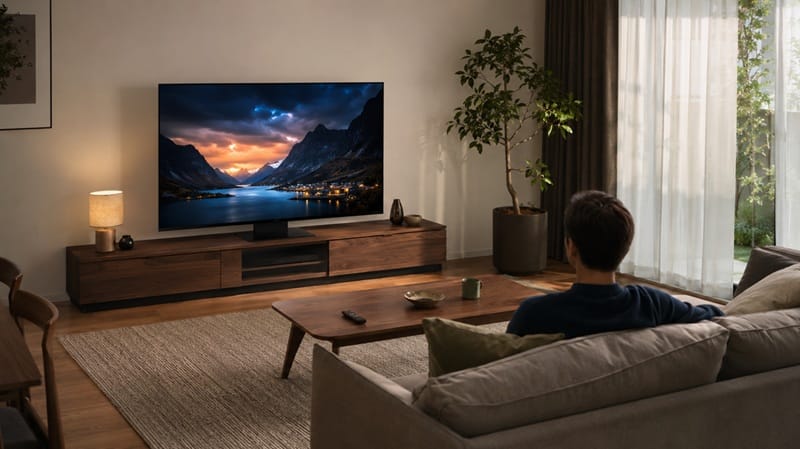
You want OLED contrast at the size most living rooms are actually built around, and you’re not fighting glare from windows all day. Think of the 65S85H like a well-equipped base-trim car: the core mechanicals — the engine, in this case the panel itself — match the pricier trims, it’s the paint and the stereo that get trimmed to hit the lower price. If your room is dim to moderately lit and gaming features matter to you, this one earns its price without much hedging.
65 inches happens to be the size most shoppers land on by default — but it’s worth confirming that against your actual room before you buy anything. We put the current options for this size, budget through flagship, side by side in our best 65-inch OLED TVs roundup.
Skip This If
Your room gets direct afternoon sun on the screen, or built-in audio quality actually factors into your decision rather than being an afterthought — the Samsung 65S90H’s Glare-Free coating and stronger speaker array earn their premium in exactly those two situations. Buyers who want a different brand’s take on the same budget-OLED formula should also look at the LG OLED65B6GUA, LG’s own entry-level 65-inch panel.
Final Verdict
Is the Samsung 65S85H Worth Buying?
For a dim-to-moderate living room where gaming and movie contrast matter more than fighting glare or built-in sound, the Samsung 65S85H review comes down in favor of the TV — it delivers the core OLED experience at the size most people actually buy, without charging for coating and brightness upgrades a lot of buyers won’t miss. If bright-room glare or audio quality are real priorities for your space, the step-up Samsung 65S90H is worth the difference; see how the tier above it compares in our Samsung OLED roundup. 🛒 Check Availability on Amazon
Frequently Asked Questions
Is the Samsung 65S85H a QD-OLED or WOLED panel?
It’s a WOLED panel manufactured by LG Display, not a QD-OLED panel from Samsung Display. This applies across every size in the S85H lineup, including the 65-inch model — only the S95H uses QD-OLED in Samsung’s 2026 range.
How does the Samsung 65S85H compare to the Samsung 65S90H?
Based on published specifications, the two share the same processor and panel technology tier, but the S90H adds Samsung’s Glare-Free anti-reflective coating and a higher peak-brightness ceiling. For general context on how 65-inch OLEDs are typically evaluated, RTINGS’ 65-inch TV rankings are a useful starting point, though a model-specific S85H test wasn’t available at the time of writing.
Does the Samsung 65S85H support Dolby Vision?
No. Samsung has standardized on HDR10+ Advanced across its entire 2026 lineup instead of licensing Dolby Vision, and that choice applies the same way to the flagship S95H as it does to the 65S85H — so it’s not a corner Samsung cut to hit this price, it’s just the HDR format Samsung backs company-wide.
Should I skip the Samsung 65S85H if I watch TV in a bright room?
If your room gets significant direct light on the screen during the day, the lack of Glare-Free coating is one of the more noticeable tradeoffs to factor in — the step-up Samsung 65S90H handles reflections noticeably better in that scenario.
Is the Samsung 65S85H a good TV for a first OLED purchase?
For most buyers moving from LED to OLED at a mainstream size, yes — it delivers the defining OLED contrast advantage without asking you to pay for features, like the Glare-Free coating, that matter mainly in specific room conditions.

iYaiii
Editor, GearPulse360
iYaiii is the editor and founder of GearPulse360, specializing in TV reviews and consumer electronics. He researches every recommendation before publishing.
✅ Based on spec analysis and Samsung’s official data — last verified July 2026