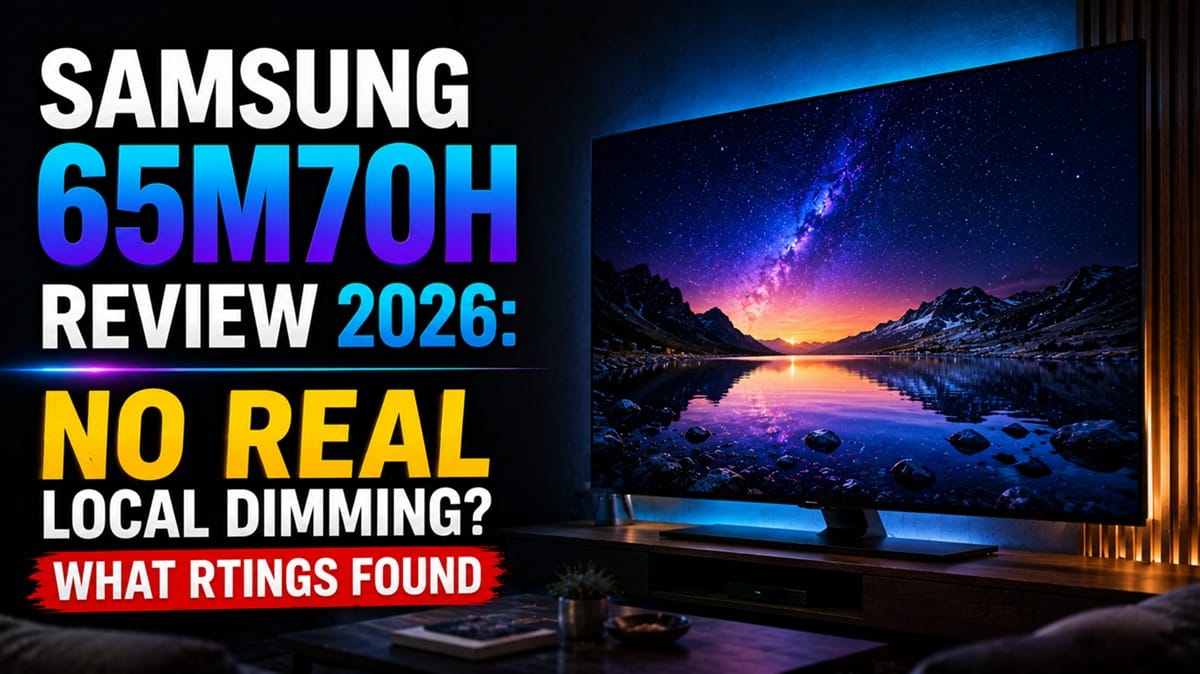
Samsung 65M70H Review: Does It Really Have Mini LED Local Dimming?
Last updated: July 2026
🕒 9 min read
Disclosure: As an Amazon Associate I earn from qualifying purchases. This article contains affiliate links — we may earn a small commission if you buy through them, at no extra cost to you.
Every Mini LED TV promises deeper blacks and brighter highlights than a standard LED set, but the Samsung 65M70H review runs into a real problem: according to RTINGS’ independent lab testing, the M70H doesn’t have a local dimming feature at all, despite the Mini LED name in its marketing. “Mini LED” here just means Samsung used smaller LEDs in the backlight — not that the panel can dim individual zones the way most Mini LED and Neo QLED sets do.
Below, we break down what that means for real-world picture quality, weighing it against Samsung’s own step-up options — the 144Hz M80H or the wider-viewing-angle QN70H. The short version: this is a budget TV priced and marketed like something with more local-dimming capability than it actually has. For a broader look at how this year’s field stacks up across brands and sizes, our best 4K TVs of 2026 roundup lines up the full range of price tiers.
Table of Contents
Quick Verdict
At a Glance
★★☆☆★ 4.8 / 10
At a Glance
Picture Quality
Gaming
Audio
Value
👍 Best For: Buyers who mainly watch in a dim room, care most about screen size and price, and won’t be comparing the picture side-by-side with a higher-tier TV.
👎 Skip If: You want the contrast and local-dimming performance the “Mini LED” name implies, watch in a bright room, or care about smooth motion and gaming responsiveness.
One-Line Verdict: The Samsung 65M70H is a budget TV with a Mini LED label but none of the local-dimming contrast that name usually promises — RTINGS’ own testing found several similarly priced competitors perform better.
🛒 Check Availability on AmazonSamsung 65M70H Specs at a Glance
Product Specs
Samsung 65M70H (UN65M70HAFXZA)
Mini LED VA-Panel LCD · Tizen OS · Vision AI Companion — 2026 model, not OLED
| 📺 Screen Size | 65-inch Class |
| 🔆 Backlight | Mini LED backlight — no local dimming (confirmed by RTINGS testing) |
| ⚡ Refresh Rate | 60Hz native (Motion Xcelerator + DLG interpolation) |
| 🌈 HDR Support | HDR10, HDR10+, HLG — no Dolby Vision |
| 🔌 HDMI Ports | 3× HDMI (1 with eARC) |
| 🎮 Gaming Features | VRR, ALLM, Gaming Hub, Cloud Gaming |
| 🔊 Audio | 20W 2.0-channel, Q-Symphony compatible |
How Long Will the Samsung 65M70H Last?
📅 Longevity Outlook: Samsung 65M70H (2026)
2026
Launch — the contrast and motion limitations RTINGS measured are present from day one, not a wear-in issue
2027–2028
Hardware doesn’t change after purchase — same picture-quality trade-offs persist, not something a software update fixes
2029–2031
Newer Mini LED tiers pull ahead on brightness and refresh rate; software still current per Samsung’s stated update window
2032+
Feature updates likely tapering — panel and HDMI inputs still usable
Timeline reflects our editorial estimate based on Samsung’s stated software-update commitment for its 2026 lineup. Actual support duration may vary and Samsung has not published a model-specific end date.
Design & Build Quality
Materials & Finish
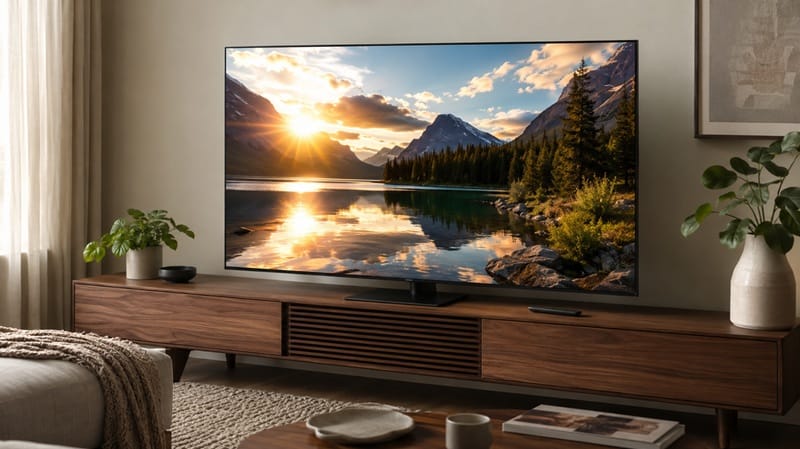
Based on manufacturer specifications, the 65M70H sticks to a slim-profile, matte-black design with thin bezels. RTINGS’ hands-on testing rates the build quality as mediocre — mostly plastic construction with a basic feel, consistent with the price point rather than a design flaw specific to this unit. It supports standard VESA wall mounting or a stand-based setup on a media console.
Ports & Connectivity
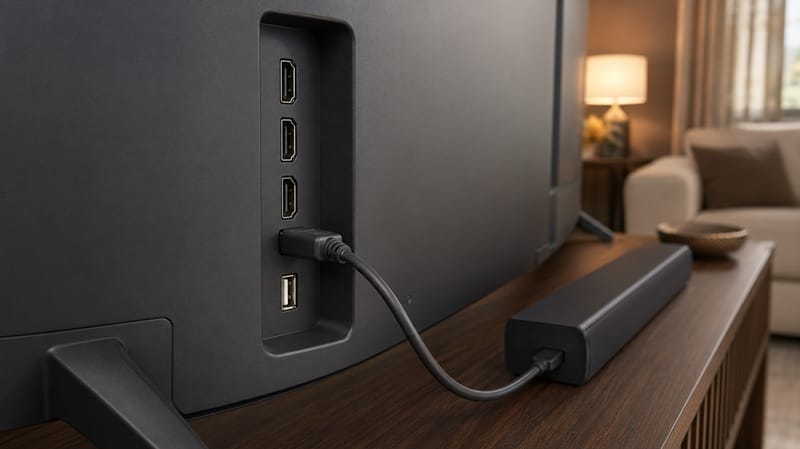
You get three HDMI ports, one with eARC for a soundbar or AV receiver, plus a single USB-A port. According to Samsung’s own product support answers, the 65M70H does not include an optical audio output — that’s reserved for the step-up QN70H and above, so anyone relying on an older sound system without HDMI ARC support should check compatibility first.
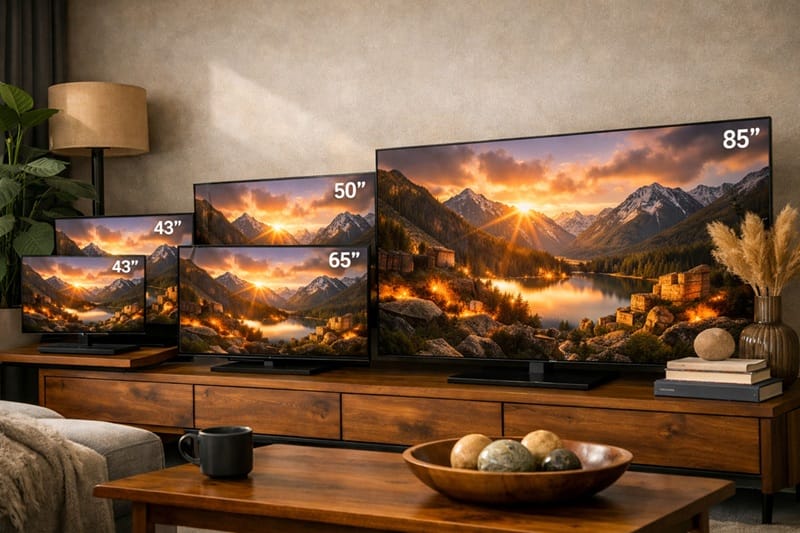
Wi-Fi 5 and Bluetooth 5.3 cover wireless connectivity, and this same connectivity set carries across the whole M70H size range, from the 43-inch entry point up through this 65-inch model. Samsung’s official listing for this 65-inch model lays out the full spec sheet if you want to confirm any of this directly.
Performance & Real-World Use
Everyday Streaming and Movies
This is where the Mini LED marketing runs into trouble. RTINGS’ lab testing found the M70H’s native panel contrast is actually good — but because there’s no local dimming to darken parts of the screen independently, that contrast never shows up in real content. Bright and dark areas of the same scene get compressed toward the middle, so the picture looks washed out rather than punchy, and dark scenes in particular lose the deep blacks the Mini LED name implies.
The upside of having no dimming zones at all is that there’s no distracting haloing around bright objects or subtitles on dark backgrounds — a problem some cheaper Mini LED sets do have. RTINGS also found HDR and SDR peak brightness both fall short, so the picture stays fairly flat even in bright scenes, and glare handling in a lit room is weak due to the glossy screen finish.
Sports and Fast Motion
RTINGS’ motion testing found the panel’s response time is slow, so fast panning shots — like following a ball across the field — look noticeably blurry. The included Motion Xcelerator + DLG interpolation feature is meant to help, but RTINGS found it performs poorly here: adding interpolation causes visible judder rather than smoother motion, and it can stop working entirely once the scene gets busy. Soccer Mode’s brightness and contrast adjustments for sports content are present, but they don’t fix the underlying motion softness.
The 60Hz native refresh rate is the ceiling regardless of processing — DLG is Samsung’s frame-interpolation technology, not a true higher-refresh panel, so it can’t manufacture motion clarity that isn’t there natively.
Gaming
RTINGS measured genuinely good input lag on the M70H, which is a real positive for casual play. VRR and ALLM are both supported, and the Gaming Hub gives you cloud gaming access without a console attached. But RTINGS also found the VRR range is narrow, too narrow to support Low Framerate Compensation, so it mostly helps only when your frame rate is already hovering close to 60fps. Combined with the blurry motion handling and a 60Hz ceiling, this isn’t built for competitive play — casual co-op sessions and story-driven single-player games are a comfortable fit; anyone chasing 120Hz+ console gaming should look at the M80H or a Neo QLED model instead.
Key Features Breakdown
Vision AI Companion and Tizen Smart Platform
Samsung’s Vision AI features — AI upscaling, voice control through Bixby, and personalized content recommendations — run on the same Tizen platform Samsung uses across its 2026 lineup. Samsung’s official Vision AI TV page confirms up to seven years of Tizen OS updates for TVs released in 2026, though Samsung hasn’t published a model-specific end date for the M70H. RTINGS did note the interface itself feels noticeably slower on the M70H than on higher-end Samsung models — the smart-platform feature list is full, but responsiveness takes a hit at this price tier.
Supreme Mini LED Dimming — What the Name Actually Means
“Supreme Mini LED Dimming” is Samsung’s marketing name for this feature, but RTINGS’ testing found the M70H doesn’t have a local dimming feature at all — it uses smaller LEDs in the backlight, which is where the “Mini LED” name comes from, but the panel can’t independently brighten or dim different zones of the screen. Samsung’s own product positioning describes its step-up Neo QLED tier as using zone-based local dimming, which — if accurate — would make the M70H a meaningfully different product from what “Mini LED” implies elsewhere in Samsung’s lineup.
The Good, the Bad, and the Ugly
Pros
- ✅ Good input lag — RTINGS measured genuinely responsive gaming performance, a real strength despite the 60Hz ceiling
- ✅ Six size options from 43 to 85 inches — the widest size range in Samsung’s current Mini LED lineup
- ✅ Full smart-platform feature set — Vision AI, Gaming Hub, and Tizen are present even at this price, if slower to respond than on higher-end models
- ✅ Excellent color accuracy after calibration — RTINGS found the panel calibrates cleanly in both SDR and HDR
Cons
- ❌ No local dimming despite the “Mini LED” name — RTINGS confirmed the panel can’t dim individual zones, so contrast doesn’t hold up the way the marketing implies
- ❌ Washed-out contrast and low brightness — good native panel contrast on paper doesn’t translate to real content without local dimming
- ❌ Blurry motion — slow response time and an interpolation feature RTINGS found actively makes judder worse in busy scenes
- ❌ Weak gray uniformity and glare handling — RTINGS found the sides of the screen run noticeably darker than the center in gray scenes (black uniformity itself tested fine), and the glossy finish doesn’t fight reflections well in a lit room
- ❌ 60Hz native refresh rate — a hard ceiling for anyone who games competitively or wants true high-refresh motion clarity
- ❌ No Dolby Vision — consistent with Samsung’s entire 2026 lineup, but still a gap next to competitors that support it
The Ugly
The mechanism is covered above — what’s worth sitting with is the practical effect. Someone shopping by size and price, seeing “Mini LED” on the box next to a Neo QLED model at a similar size, has a reasonable basis to expect closer performance between the two than what actually shows up on screen. RTINGS’ testing is what surfaces that gap; nothing in the M70H’s own marketing materials flags it.
None of this makes the M70H a defective unit — it performs exactly as its hardware allows. But the mismatch between the name and the measured result is worth knowing before you buy, not after.
Who Should Buy the Samsung 65M70H — and Who Shouldn’t
Buy This If
Within the M70H lineup, 65 inches lands in the middle of the size run rather than at either end. This TV makes the most sense for buyers who mainly watch in a dim room without much competing light, who want a bigger screen at a low price, and who won’t be directly comparing the picture against a higher-tier set. Its good input lag and full smart-platform feature set are real strengths if picture quality isn’t your top priority.
If you’ve already compared it against the larger Samsung 75M70H review we published and decided the smaller size still covers your use case, the same panel technology and feature set — including RTINGS’ no-local-dimming finding — carries over at this size too.
For the fuller context of where Samsung’s non-OLED lineup sits, our Samsung Crystal UHD buying guide covers the tier just below this one, if you’d rather compare more than one model side by side before deciding.
Skip This If
Skip it if you want the contrast and local-dimming performance the “Mini LED” name usually implies — RTINGS found this specific model doesn’t deliver that. Skip it too if you watch in a bright, sun-facing room, care about smooth motion for sports or gaming, need Dolby Vision, or want a competitive gaming setup — the M80H’s 144Hz panel and NQ4 AI Gen2 processor, or Samsung’s Neo QLED tier, are better fits for those priorities at a modest price step up. See our Samsung 55M80H vs Samsung 55QN70H compared for how those two specific step-ups actually stack up against each other.
RTINGS’ own testing also found several similarly priced non-Samsung competitors, including the TCL QM6K, outperform the M70H overall — worth cross-shopping before you commit.
Comparing this against Samsung’s own design-focused Frame lineup instead of a Neo QLED step-up? Our Samsung QN55LS03HE vs Samsung 55M70H comparison covers the 55-inch versions of both lines side by side, including where the M70H’s price advantage actually holds up against the art-TV design.
Final Verdict
Is the Samsung 65M70H Worth Buying?
For a mainstream living-room size, the Samsung 65M70H review comes down to a naming problem more than a hardware problem — the no-local-dimming finding covered above means the contrast and HDR punch a “Mini LED” label typically promises isn’t really here. That’s not automatically a dealbreaker if you mainly watch in a dim room and prioritize screen size and price above picture quality.
Against the pricier M80H or Neo QLED tier, that trade buys you a noticeably lower price; against genuinely local-dimming Mini LED competitors at a similar price, including the TCL QM6K that RTINGS tested alongside it, the M70H comes up short. For a broader sense of how Mini LED stacks up against OLED for the content you actually watch most, our OLED vs Mini LED for sports comparison walks through that trade-off in more depth. 🛒 Check Availability on Amazon
Frequently Asked Questions
Is the Samsung 65M70H a good TV for the price?
That depends on what you’re comparing it to. For casual, dim-room streaming where picture quality isn’t the top priority, the price and screen size can work well. But since RTINGS found it lacks local dimming entirely — see above — anyone expecting genuine Mini LED contrast for the price should know that several similarly priced competitors deliver more of it.
How does the Samsung 65M70H compare to Samsung’s Neo QLED TVs?
The gap is bigger than a typical tier difference. Neo QLED sits above the M70H in Samsung’s 2026 lineup and is built around zone-based local dimming, per Samsung’s own product positioning — a capability RTINGS confirmed the M70H simply doesn’t have (see above). So this isn’t “Neo QLED is somewhat better,” it’s a different category of contrast performance. The trade-off is price, so the comparison depends on how much local-dimming precision and HDR punch matter for your room and content.
Does the Samsung 65M70H support Dolby Vision?
No — like the rest of Samsung’s TV lineup, it skips Dolby Vision in favor of HDR10+, Samsung’s royalty-free HDR format. That’s consistent company-wide in 2026, not a corner cut specifically on this model.
Is the Samsung 65M70H good for gaming?
Input lag is a genuine strength — RTINGS measured it as good, which helps responsiveness. But the VRR range is narrow and motion handling is blurry due to a slow response time, so the experience is uneven. It covers the basics — VRR, ALLM, and Samsung’s Gaming Hub for cloud play — but the 60Hz native refresh rate means it’s built for casual and story-driven gaming rather than competitive, high-frame-rate play. Gamers who want 120Hz+ motion should look at the M80H instead.
Should I get the 65-inch M70H or size up to the 75-inch?
The panel technology, dimming behavior, and feature set are identical across the M70H range — the decision comes down to your room, not the TV. 65 inches suits a standard living room viewing distance without dominating the space; 75 inches makes more sense if your seating is further back or you specifically want the screen to be a bigger part of the room. Since nothing about picture quality or gaming performance changes between the two, our Samsung 75M70H review (linked above) covers the size-specific pricing and room-distance guidance if 75 inches is still on the table.

iYaiii
Editor, GearPulse360
iYaiii is the editor and founder of GearPulse360, specializing in TV reviews and consumer electronics. He researches every recommendation before publishing.
✅ Based on spec analysis and Samsung’s official data plus RTINGS — last verified July 2026