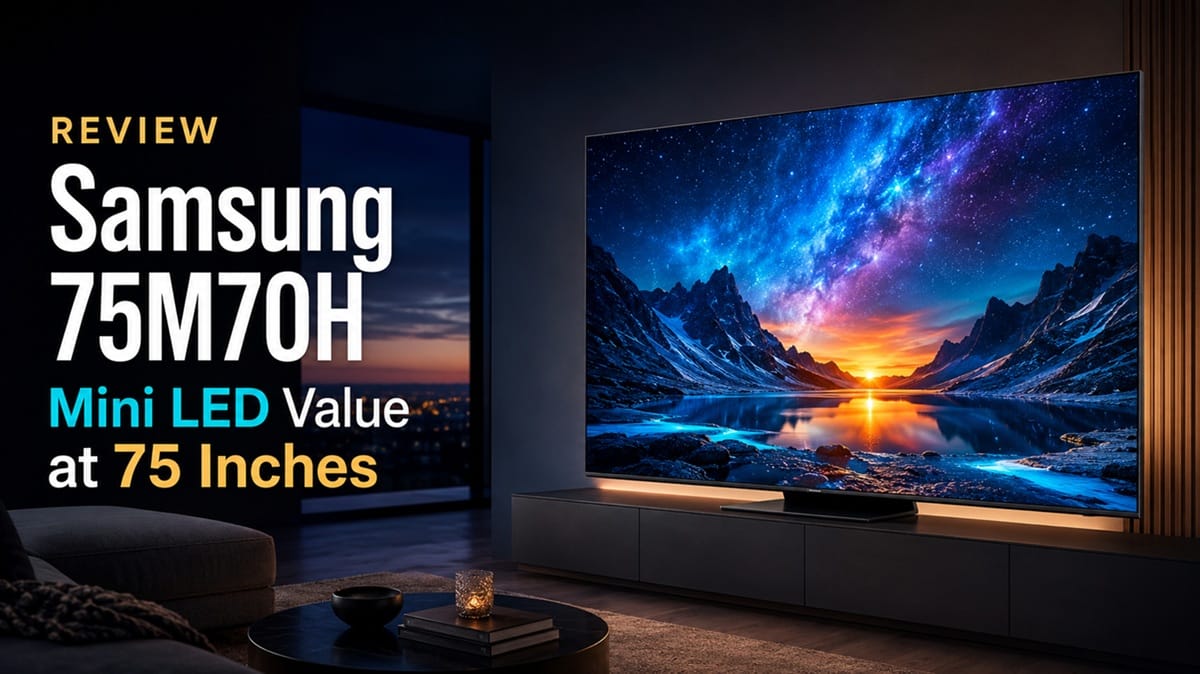
Samsung 75M70H Review 2026: Is Samsung’s Cheapest 75-Inch Mini LED Worth It?
Last updated: July 2026
🕒 9 min read
Disclosure: As an Amazon Associate I earn from qualifying purchases. This article contains affiliate links — we may earn a small commission if you buy through them, at no extra cost to you.
A 75-inch TV for well under Neo QLED money sounds like a catch — until you start asking what Samsung left out to hit that price. The Samsung 75M70H is the answer: a 2026 Mini LED set that sits below Samsung’s Neo QLED lineup, aimed at buyers who want a genuinely large screen with better contrast than a basic Crystal UHD panel, without stretching into 4-figure territory. In this Samsung 75M70H review, we’re looking at what that trade-off actually costs you in refresh rate, dimming precision, and gaming features, and comparing it honestly against Samsung’s own step-up option, the Samsung 55QN80H.
If you’re weighing this against other budget-Mini-LED picks, it’s also worth seeing where it lands in our best 4K TVs of 2026 roundup. Short version: this isn’t a Neo QLED in disguise, but for the right living room, it doesn’t need to be.
Table of Contents
Quick Verdict
At a Glance
★★★☆☆ 6.6 / 10
At a Glance
Picture Quality
Gaming
Audio
Value
👍 Best For: Budget-conscious buyers who want a large-screen living room TV with noticeably better contrast than basic LED, and who watch mostly casual content rather than competitive games.
👎 Skip If: You want VRR-heavy competitive gaming, Dolby Vision support, or the more uniform dimming a full-array panel provides.
One-Line Verdict: The Samsung 75M70H offers meaningfully better contrast than a standard Crystal UHD panel at a large screen size, but its 60Hz refresh rate and edge-lit dimming keep it a clear step below Samsung’s own Neo QLED tier.
🛒 Check Availability on AmazonSamsung 75M70H Specs at a Glance
Product Specs
Samsung 75M70H (UN75M70HAFXZA)
Mini LED VA panel · Mini LED Processor 4K · Tizen 10 OS
| 📺 Panel Type | Mini LED, edge-lit |
| 🔄 Refresh Rate | 60Hz native |
| 🌈 HDR Support | HDR10+ (no Dolby Vision) |
| 🔌 HDMI Ports | 3x HDMI 2.0 |
| 🎮 Gaming Features | VRR, Gaming Hub, Cloud Gaming |
| 🔊 Audio | Q-Symphony, OTS Lite |
| 🤖 Smart Platform | Tizen 10, Vision AI Companion |
Design & Build Quality
Materials & First Impression
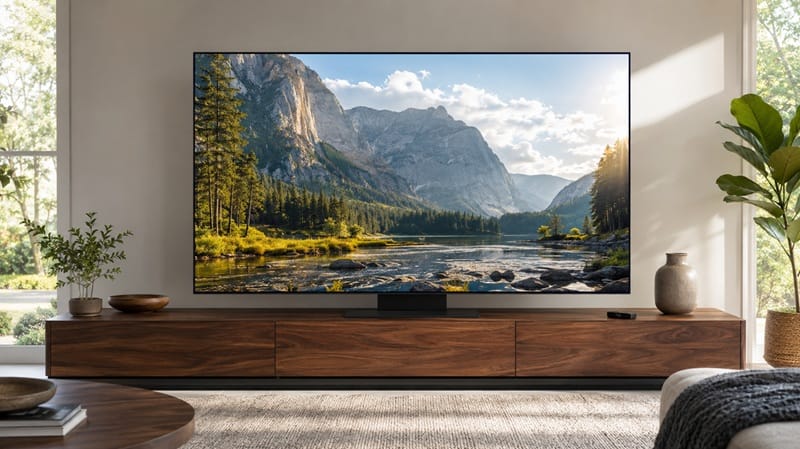
Based on manufacturer imagery and specifications, the 75M70H follows Samsung’s standard mid-range design language: a slim bezel, a low-profile stand, and a matte-finish rear panel rather than anything premium. There’s no metal trim here — this is a value-tier build, and Samsung isn’t pretending otherwise. According to Samsung’s own Mini LED TV pages, the M70H shares its core panel technology with the pricier M80H, just without the higher-end processor and motion hardware that come at the next tier up.
Ports & Connectivity
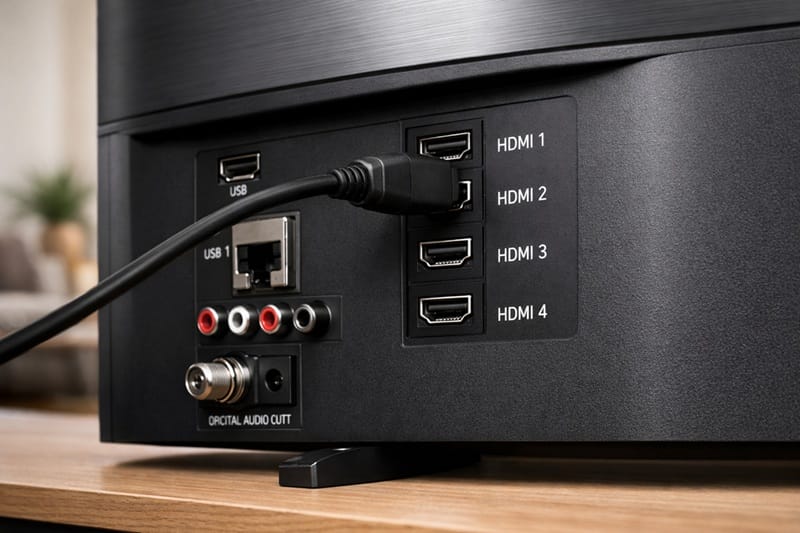
Connectivity is where the entry-level positioning shows most clearly. The 75M70H ships with three HDMI 2.0 ports — not HDMI 2.1 — plus a single USB-A port, Ethernet, and an RF input for antenna or cable. There’s no optical audio output, so anyone running an older soundbar without HDMI ARC will need an adapter. Wi-Fi 5 and Bluetooth 5.3 cover wireless needs, and Samsung’s SmartThings hub is built in for smart-home control, which is a nice inclusion at this price tier.
Performance & Real-World Use
Everyday Living Room Viewing
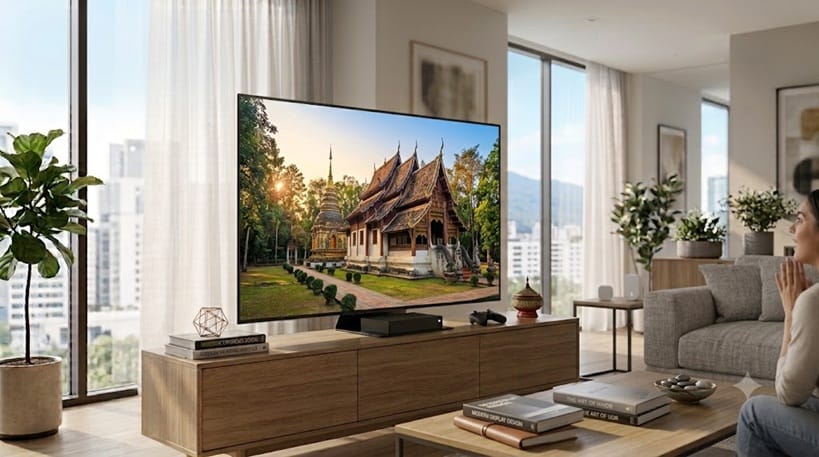
For a family room used mostly for streaming, sports, and general TV watching, the 75M70H’s Mini LED backlight should offer noticeably better contrast than a Crystal UHD or basic LED panel in the same size class. Samsung’s Pure Spectrum Color technology, detailed on the Samsung 75M70H product page, is built around a wide color volume claim, and Mini LED backlighting generally allows for deeper blacks and brighter highlights than a conventional edge-lit LED TV at this size.
Bright-Room Performance
Samsung 75M70H owners in daylight-heavy rooms should benefit from Mini LED’s higher peak brightness compared to entry LED panels, per Samsung’s published specs for the M70H series. That said, because this is an edge-lit implementation rather than a full-array design, dimming precision and uniformity are likely to trail Samsung’s Neo QLED models, which use significantly more local dimming zones.
In practical terms, that means bright scenes with small, isolated highlights — a streetlamp at night, a single lit window — are more likely to show blooming around the light source than they would on a full-array Neo QLED set, based on how edge-lit Mini LED panels typically behave relative to full-array designs.
Casual Sports & Movie Watching
This is where the 60Hz native panel matters most. Motion Xcelerator and DLG processing exist to smooth some judder in fast-moving content like sports broadcasts, but this is upscaled motion handling, not a true higher-refresh panel. Viewers who mostly watch movies and cable-style content shouldn’t notice much of a limitation; sports fans who care about crisp fast-motion clarity will feel the ceiling sooner.
Key Features Breakdown
Mini LED Processor 4K and Vision AI Companion
The M70H runs on Samsung’s Mini LED Processor 4K chip rather than the more capable NQ4 AI Gen2 Processor found in the step-up M80H and QN80H. In practice, that mostly affects upscaling refinement and scene-by-scene optimization rather than raw resolution — everything still outputs in native 4K, but older or lower-quality source material may look less polished than it would on a higher-tier Samsung set. Vision AI Companion is included regardless, giving on-screen AI search and recommendations across Samsung TV Plus content.
Q-Symphony and Object Tracking Sound Lite
Built-in audio uses Object Tracking Sound Lite paired with Q-Symphony compatibility, meaning the TV’s speakers can work alongside a compatible Samsung soundbar rather than being replaced by it. On their own, the TV’s speakers are unlikely to compete with even a modest external audio setup, so buyers planning to skip a soundbar should keep expectations modest here.
Tizen 10 and Software Longevity
The 75M70H runs Tizen 10, the same smart TV platform Samsung uses across its 2026 lineup, so app support and menu navigation should feel consistent with pricier Samsung sets. According to Samsung’s published support policy, the model is slated for software updates for up to seven years from launch, which is a meaningful longevity signal for a TV in this price tier — it suggests Samsung isn’t treating the M70H as a disposable entry-level product, even without the premium hardware of the M80H or Neo QLED lines.
The Good, the Bad, and the Ugly
Pros
- ✅ Genuine Mini LED contrast at 75 inches — a meaningful upgrade over Crystal UHD at a size where basic LED panels usually struggle with uniformity.
- ✅ Built-in SmartThings hub — useful if you’re already in the Samsung smart-home ecosystem.
- ✅ Reasonable connectivity for the price tier — VRR, Gaming Hub, and Cloud Gaming are present even without the premium gaming extras.
Cons
- ❌ No HDMI 2.1 — a real limitation for anyone hoping to run 4K/120 from a current-gen console.
- ❌ No Dolby Vision — HDR content is limited to HDR10 and HDR10+, which most but not all streaming platforms support.
The Ugly
The 60Hz native refresh rate is the number to sit with before buying. It’s fine for movies and cable news, but it’s a genuine ceiling for competitive gaming and fast sports content, and Samsung’s Motion Xcelerator + DLG processing softens rather than eliminates that limitation. If motion clarity or gaming performance is a priority, this isn’t the right Samsung Mini LED for that use case.
Who Should Buy This — and Who Shouldn’t
Buy This If
Think of the Samsung 75M70H the way you’d think of a starter home in a good neighborhood: it gets you real square footage and a meaningfully better foundation than the budget alternative next door, even if it’s missing the upgraded fixtures the pricier houses have. If you want a large-format screen for a living room where most of the viewing is streaming, sports on in the background, or family movie nights, and you’re not planning to pair it with a next-gen console for 120Hz gaming, the 75M70H’s Mini LED contrast is worth having over a same-size Crystal UHD set.
If 75 inches is more screen than your room actually needs, the same panel and feature set come in a smaller footprint too — our Samsung 65M70H review covers how the 65-inch version holds up. For a broader shortlist of Samsung sets at this size and budget, our Samsung Crystal UHD buying guide is a useful next stop if this one doesn’t quite fit.
It’s also worth understanding how this compares to Samsung’s higher panel tiers before deciding — OLED vs Mini LED compared breaks down where Mini LED panels like this one still fall short of self-emissive displays, which matters if deep, uniform blacks are a priority for you.
Skip This If
Skip the 75M70H if competitive gaming, HDMI 2.1 features, or Dolby Vision support matter to your setup — Samsung’s own 55QN80H is the more capable option within the same brand, and the TCL 65QM8L is worth a look if you’re open to a different manufacturer at a similar price point. If staying at 75 inches specifically is non-negotiable, TCL’s 75QM64L review covers a similarly sized Mini LED with a native 144Hz panel — a meaningful step up for gaming over the M70H’s 60Hz ceiling.
Final Verdict
Is the Samsung 75M70H Worth Buying?
Here’s the trade-off at the center of this Samsung 75M70H review: you’re getting meaningfully better contrast than a Crystal UHD panel at a large screen size, in exchange for a 60Hz refresh rate, edge-lit dimming, and no Dolby Vision. For casual living room viewing, that trade is easy to justify. For anyone eyeing serious gaming or wanting the most refined HDR performance Samsung offers, the step up to something like the Samsung 55QN80H or a deeper look at our full OLED vs QLED comparison is worth the extra research before you commit. 🛒 Check Availability on Amazon
Frequently Asked Questions
Is the Samsung 75M70H a good TV for the price?
Going by Samsung’s spec sheet for the model, the 75M70H offers meaningfully better contrast than a same-size Crystal UHD panel for well below Neo QLED pricing, which is the main reason to consider it. Where it falls short is refresh rate and HDR flexibility, so it’s a stronger fit for casual viewing than for gaming or serious HDR content.
How does the Samsung 75M70H compare to Samsung’s Neo QLED TVs?
According to RTINGS’ review of the M70H series, it sits below Samsung’s Neo QLED lineup, with a simpler processor, edge-lit rather than full-array Mini LED, and no Dolby Vision support.
Can I use the Samsung 75M70H for gaming?
It supports VRR, Gaming Hub, and Cloud Gaming, but its 60Hz native refresh rate and lack of HDMI 2.1 mean it’s better suited to casual gaming than competitive or next-gen console play at higher frame rates.
Who should avoid the Samsung 75M70H?
Buyers who prioritize Dolby Vision, HDMI 2.1, or high-refresh gaming should look at Samsung’s step-up Neo QLED models or a competing Mini LED set with a higher native refresh rate instead.
Is the Samsung 75M70H a reasonable long-term living room TV?
For casual, non-gaming households, the panel technology and Samsung’s software update commitment suggest reasonable longevity, though buyers should weigh the missing HDMI 2.1 ports against how they expect their next console or streaming device to evolve.

iYaiii
Editor, GearPulse360
iYaiii is the editor and founder of GearPulse360, specializing in TV reviews and consumer electronics. He researches every recommendation before publishing.
✅ Based on spec analysis and Samsung’s official and RTINGS data — last verified July 2026