
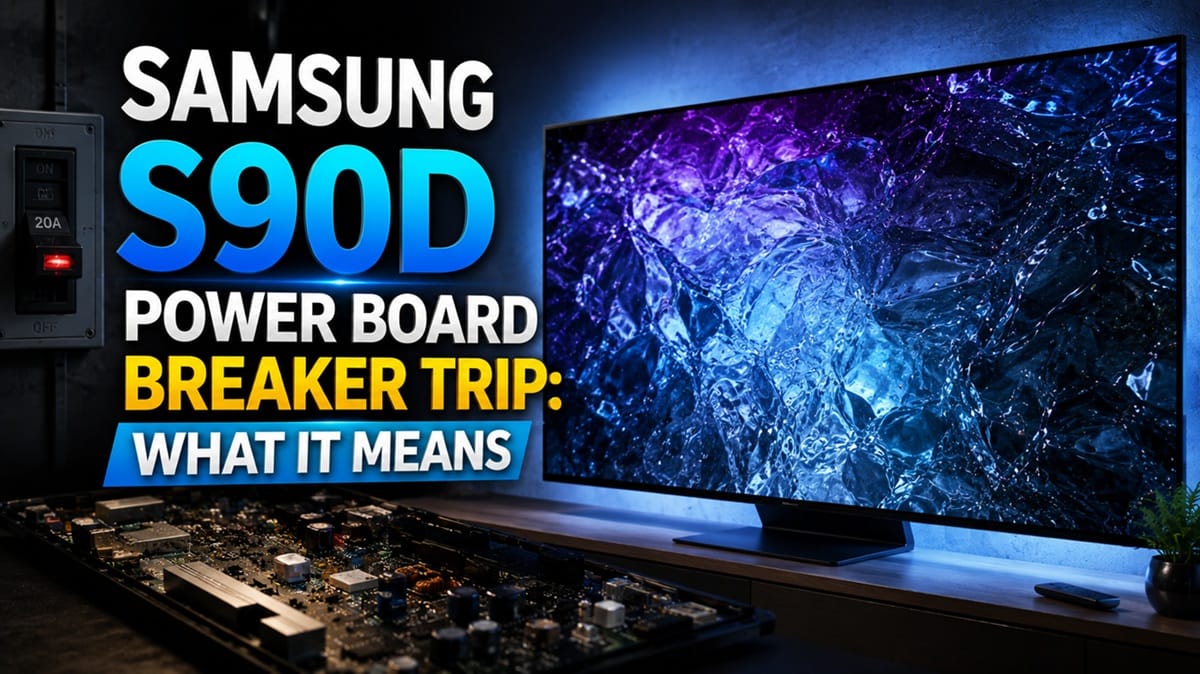
Why Does Your Samsung S90D Power Board Breaker Trip the Circuit Breaker?
Last updated: July 2026
🕒 8 min read
Disclosure: GearPulse360 participates in the Amazon Associates Program. This particular article contains no affiliate links; other content on our site may.
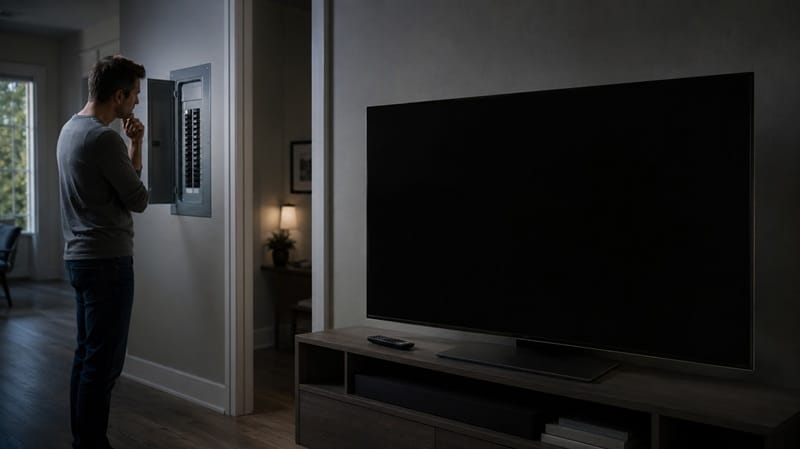
The picture cuts out, the room goes dark, and when you check the panel, one breaker has flipped again. If that’s happened more than once with your Samsung S90D, you’re dealing with one of the more disruptive electrical quirks a modern OLED TV can produce, and resetting the breaker over and over isn’t actually diagnosing anything.
Based on Samsung’s own troubleshooting guidance and independent panel data from RTINGS, a repeated breaker trip on a specific TV model points toward a component-level issue inside that TV, not necessarily a problem with your home’s electrical system. The two get confused constantly, and that confusion is exactly what keeps people stuck resetting a breaker that’s going to trip again in ten minutes.
This guide breaks down what’s actually happening with the Samsung S90D power board when it trips a breaker, how to tell whether the fault is in the TV or the outlet, and what Samsung’s official troubleshooting steps recommend before you call for service. If you’re not sure what QD-OLED is or how it differs from the OLED panels in other brands, that’s worth a quick read first since the panel and power architecture are related.
Table of Contents
The Short Answer
The most likely explanation for a Samsung S90D power board breaker trip is that the TV’s internal power supply board is drawing more current than the circuit is rated to carry safely, and the breaker is cutting power as a protective response. That’s how overcurrent protection works generally — neither Samsung nor RTINGS publishes a component-level failure breakdown for this specific board, so treat it as the standard technical explanation rather than a confirmed diagnosis. Either way, it is not automatically a sign of bad home wiring, and it’s not something to resolve by simply resetting the breaker on repeat.
What Causes a Samsung S90D Power Board Breaker Trip
Where the Power Board Sits in a QD-OLED TV
Every modern TV converts the AC power from your wall outlet into the specific DC voltages its panel, backlight driver, and main board need to run. On a QD-OLED set like the S90D, that conversion happens on a dedicated power supply board tucked inside the chassis. When a component on that board degrades or fails, it can start pulling more current than normal, and the breaker upstream reacts to that overcurrent by cutting the circuit.
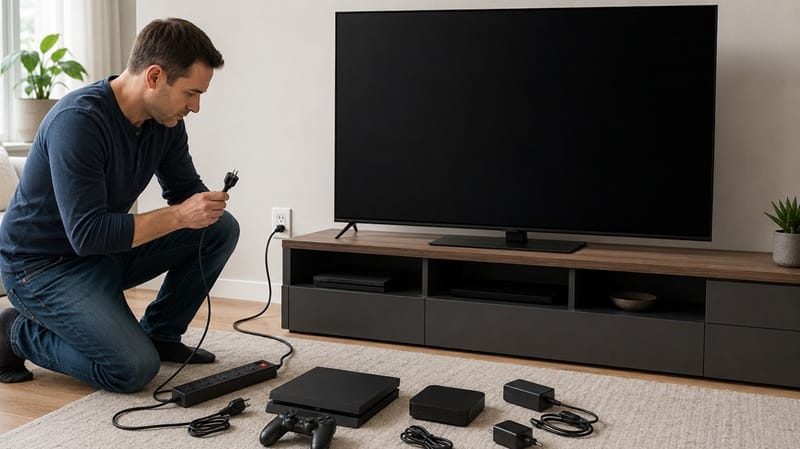
Samsung’s own troubleshooting guidance for TVs that won’t power on walks through the same underlying logic from the outlet side: unplug the TV, test on a confirmed working outlet without a surge protector, and watch how the standby light behaves. If the TV pulls power fine from a known-good outlet and the breaker still trips once the set is running, that points at the TV rather than the wall.
Overcurrent vs. a Wiring Problem
A circuit breaker trips when the current flowing through it exceeds its rating, whether that current is coming from an overloaded circuit (too many devices) or from a single device with an internal fault drawing more than it should. The way to tell these apart is isolation: move the TV to a different circuit, unplug everything else from the original outlet, and see whether the trip follows the TV or stays with the circuit. If the breaker only trips when the S90D is powered on, and nothing else on that circuit changes, the fault is almost certainly inside the TV.
How This Fits Into Samsung’s Broader OLED Reliability Picture
Weighing Reliability Against the Rest of the Purchase
A breaker-trip pattern tied to a specific TV’s internal hardware is the kind of reliability signal worth factoring into a purchase decision, not just something to troubleshoot after the fact. Picture quality and price are the obvious comparison points between premium OLED sets, but long-term reliability belongs in that same conversation — it’s the kind of tradeoff our are Samsung OLED TVs worth it breakdown looks at directly.
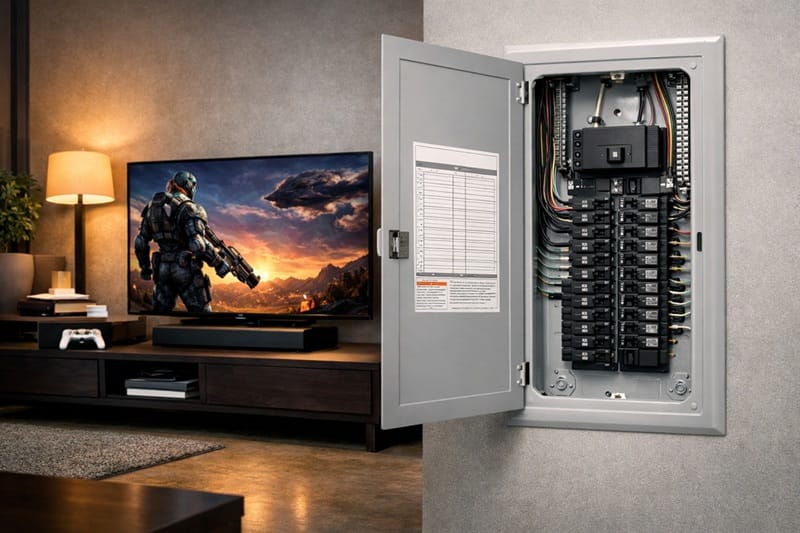
None of this means every Samsung OLED carries the same risk — panel generation, power-board revision, and even how the set is installed all factor in, which is exactly why our best OLED TVs of 2026 roundup weighs long-term reliability signals alongside picture quality rather than ranking purely on specs.
A breaker trip isn’t the only hardware quirk we’ve tracked on this model, either — some S90D units have also developed visible S90D banding in the panel itself. It’s a separate issue from the power board, but worth checking for independently if your set has already shown one fault.
Installation matters too, not just the internals. If the panel itself feels loose or unsteady on its stand or mount rather than the picture cutting out, that’s a different problem — our guide on Samsung TV screen falling off covers how to tell a mounting issue apart from a hardware fault.
Is a Breaker Trip a Fire Risk, or Just a Nuisance?
A breaker tripping is the safety mechanism working correctly. It exists specifically to cut power before an overcurrent condition turns into overheating or, in a worst case, a fire. That’s the reassuring part: the breaker doing its job means the danger was interrupted, not that a fire already started.
The part that isn’t reassuring is what happens if you keep resetting the breaker and powering the TV back on anyway. Each reset re-energizes a component that already showed a fault once. The troubleshooting steps outlined above end at the same point: if the standby light won’t behave normally after testing on a confirmed working outlet, the next step is contacting Samsung support rather than continuing to cycle the breaker.
What This Means for You in Practice
Who Should Pay Attention to This
If you own an S90D and have had a breaker trip more than once while the TV was on, this applies to you directly. It’s also worth reading if you’re actively shopping and comparing the S90D against other Samsung OLED tiers — our Samsung OLED roundup ranks the current lineup side by side, which is useful context before deciding which model to buy or which one to replace a faulty unit with.
Who Doesn’t Need to Worry
If your S90D has never tripped a breaker, this isn’t a maintenance task you need to perform preemptively. A power board fault, when it happens, tends to announce itself clearly through a breaker trip or a TV that won’t power back on — it isn’t a silent, gradually worsening issue that needs routine monitoring.
FAQs: Samsung S90D Power Board Breaker Trip
Why does my Samsung S90D trip the breaker?
The standard technical explanation is that the TV’s internal power supply board is drawing more current than the circuit is rated for, and the breaker cuts power as a protective response. Neither Samsung nor RTINGS has published a specific failure-mode breakdown for this board, so this is the general overcurrent-protection logic applied to the symptom rather than a confirmed root-cause diagnosis — but it’s a component-level fault inside the TV either way, not a normal part of how the set operates.
Is a tripped breaker automatically a sign of a wiring problem in my house?
No. A breaker trips whenever current exceeds its rating, whether the cause is an overloaded circuit or a single faulty device. Isolating the TV on its own circuit, away from other appliances, is the quickest way to tell whether the fault follows the TV or stays with the wiring.
Should I keep using the TV if the breaker keeps tripping?
It’s best not to. Repeatedly resetting the breaker and turning the TV back on re-energizes a component that has already shown a fault, and there’s no way to know from the outside whether the next trip will be the same minor event or something more serious. Testing on a confirmed working outlet once is reasonable diagnostic practice; doing it repeatedly is not.
Does the newer Samsung S90H have the same power board issue?
The S90H is a newer generation than the S90D, built on a different production run with its own component revisions, so a fault pattern tied to one generation’s power board doesn’t automatically carry over to the next. If you’re deciding between troubleshooting an existing S90D or stepping up to the newer model, our Samsung 48S90H review covers what’s changed.
What panel technology does the S90D use, and does that affect power draw?
The S90D uses Samsung’s QD-OLED panel technology, sitting just below the flagship S95D in Samsung’s 2024 lineup, per RTINGS’ review of the S90D. The power supply board is a physically separate component from the display panel, so panel type on its own doesn’t determine power-board reliability — it just confirms which generation and architecture the TV belongs to.

iYaiii
Editor, GearPulse360
iYaiii is the editor and founder of GearPulse360, specializing in TV reviews and consumer electronics. He researches every recommendation before publishing.
✅ Based on spec analysis and Samsung’s official and RTINGS data — last verified July 2026