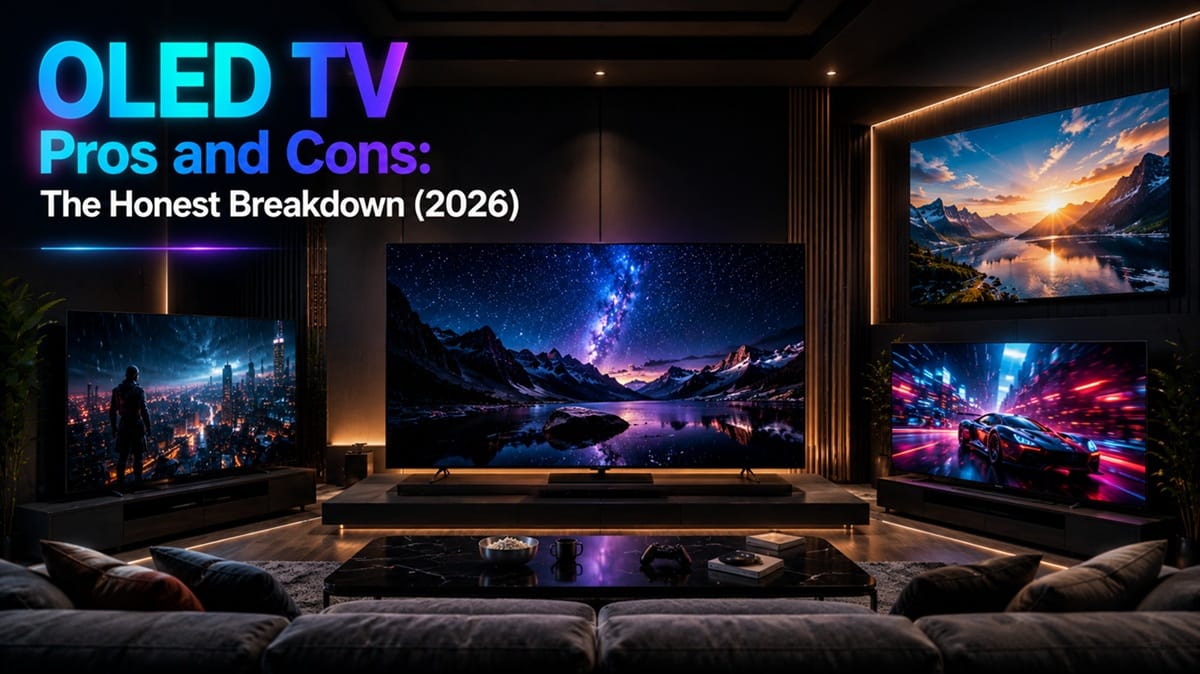
OLED TV Pros and Cons: Everything You Need to Know Before Buying
Last updated: June 2026
Disclosure: As an Amazon Associate I earn from qualifying purchases. This article contains affiliate links — we may earn a small commission if you buy through them, at no extra cost to you.
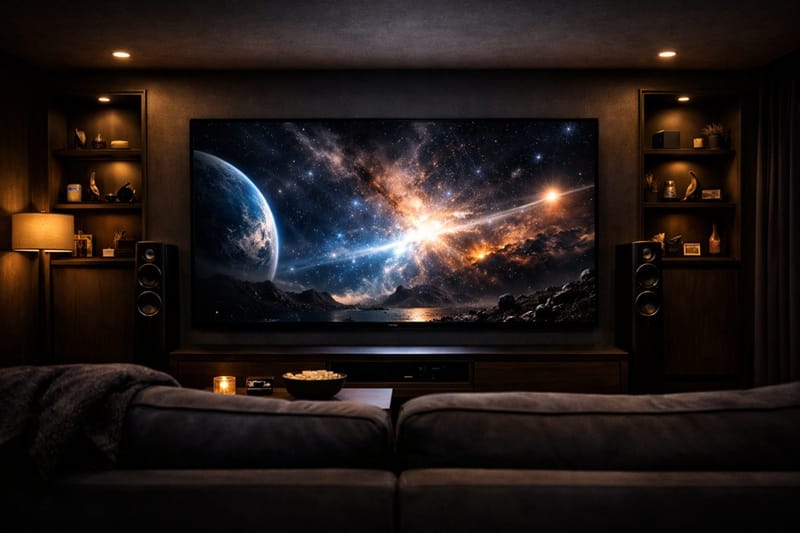
The first time you watch a truly dark scene on an OLED — a night chase, a candlelit dinner, the opening of a space film — you get it immediately. The blacks aren’t just dark. They’re off. Every pixel that should show nothing is simply not emitting light. It’s the kind of picture quality that makes everything else feel like a compromise.
But OLED isn’t perfect, and the reviewers who treat it as the obvious answer for everyone aren’t giving you the full picture. After testing multiple WOLED and QD-OLED panels across different viewing environments, we’ve seen where the technology excels — and where buyers end up disappointed because nobody warned them about the trade-offs.
This article covers the real OLED TV pros and cons: picture quality, burn-in risk, brightness ceiling, pricing, and the specific situations where a different panel type would serve you better. If you want to understand what OLED TV technology is at a deeper level, that guide covers the underlying mechanics. Here, we’re focused on what matters for the buying decision.
Table of Contents
⚡ Quick Answer
OLED TVs deliver the best picture quality available at the consumer level — perfect blacks, fast response, and wide viewing angles. The trade-offs are lower peak brightness than top-tier Mini LED sets, a burn-in risk under heavy static-content use, and a higher price relative to comparable LCD alternatives.
✅ Best for
Dark room viewing, movies, gaming, mixed-use home theaters
❌ Not ideal for
Bright living rooms, news channel marathons, tight budgets
💡 Key advantage
Pixel-level light control — true black and infinite contrast
⚠️ Key limitation
Peak brightness and burn-in risk under static content
The Pros: What OLED Actually Gets Right
Picture quality — and why the numbers don’t capture it
Contrast ratio is where OLED separates itself from every other panel type. Because each pixel generates its own light and can switch off completely, black is measured in thousandths of a nit rather than fractions. The result is an infinite contrast ratio — a spec that sounds like marketing but translates to something you notice every single viewing session.
Shadow detail in a dark film scene, star fields in space footage, the subtle gradations in a dimly lit room — all of these depend on how accurately your TV renders near-black tones. OLED handles this better than any LCD technology currently available, including the best Mini LED sets — and it shows up in every blind test, not just controlled lab conditions.
Color accuracy follows naturally from that contrast foundation. When your darkest darks are actually dark, everything in between — the midtones, the highlights, the subtle hues in a sunset — sits against the right reference point. Both WOLED and QD-OLED panels produce excellent color coverage, with QD-OLED offering a measurably wider color gamut that’s particularly noticeable in HDR content.
Viewing angles that hold up
Most LCD panels — even excellent Mini LED ones — shift color and lose contrast when you watch from an angle. It’s subtle at 15 degrees, pronounced at 30, and distracting at 45. OLED doesn’t have this problem. The picture quality at the edges of your sofa is essentially the same as directly in front of the screen. For anyone watching with a group, or in a wide room where the TV isn’t centered on every seat, this is a practical advantage rather than a theoretical one.
Response time and what it means for motion
OLED panels respond in fractions of a millisecond — well under 1ms in most tests. That speed eliminates the kind of trailing blur you see on slower LCD panels during fast camera pans or quick sports action. For gaming, it means cleaner motion during high-frame-rate titles and less smearing on fast-moving objects.
Combined with near-universal HDMI 2.1 support across current models, OLED is the panel type that gamers tend to gravitate toward — and for good reason. Low input lag, fast response, and accurate colors add up to a meaningful difference in competitive or immersive play.
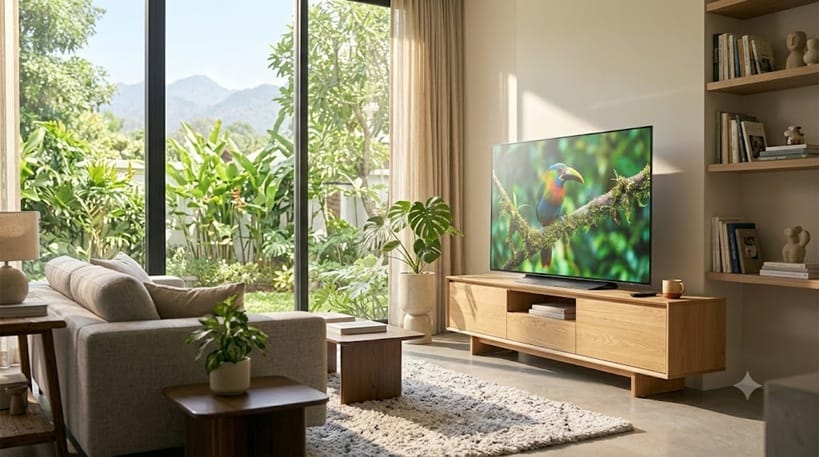
If you’re already close to a decision, our full roundup of the best OLED TVs in 2026 covers the top picks across every budget and use case.
The Cons: The Trade-Offs Worth Knowing
Brightness — the one area where OLED still falls short
Peak brightness is OLED’s clearest limitation. A high-end Mini LED set can sustain 1,500–2,000 nits across large portions of the screen. Most current OLEDs peak significantly lower on full-screen HDR content, and they manage their brightness automatically through what’s called Automatic Brightness Limiting — the panel dims at sustained high output to protect the organic material. It’s worth noting that LG’s 2025 OLED evo lineup has pushed peak output meaningfully higher than earlier generations, narrowing this gap — but the ceiling is still below what a top Mini LED can do on a bright window scene.
In a dark or moderately lit room, you’ll never notice this. The picture looks spectacular. But in a bright living room with afternoon sunlight coming through the windows, the gap between OLED and a premium QLED or Mini LED becomes real. The image can look washed out in ways that a brighter LCD simply wouldn’t. For more on this specific comparison, our full OLED vs QLED comparison goes through it in detail — and OLED vs Mini LED compared covers the bright-room scenario specifically.
This isn’t a reason to avoid OLED. But it is a reason to think honestly about your room. If most of your watching happens in the evening or in a room you can dim, this con barely applies. If your TV faces a window that stays bright all day, it matters.
Burn-in risk — what it is and how worried you should actually be
Burn-in is the most discussed OLED concern, and it deserves an honest treatment rather than either dismissal or alarm. It’s real. It’s also rarely a problem for most people.
It works like this: pixels that stay lit at the same brightness, in the same spot, for thousands of hours wear out faster than their neighbors. The classic culprits are news tickers, scoreboard overlays, and channel logos — the kind of thing a sports bar TV would display 12 hours a day. Eventually you can see a faint ghost of that image burned in, even when you’re watching something completely different.
Under torture-test conditions — which is how RTINGS runs its long-term tests, with a single static image playing up to 18 hours a day — burn-in does appear on OLED panels. But does OLED burn-in still matter in 2026 under real viewing conditions? The evidence says probably not for most households. RTINGS’ own conclusion, after running over 100 TVs for up to 18,000 hours, is that burn-in “isn’t really an issue under mixed usage” for panels from 2022 onward. At a typical three hours of viewing per day, reaching 18,000 hours would take over 16 years.
Where the risk is real: news channels running eight or more hours daily, competitive gaming with persistent HUD overlays, or using the TV as a permanent PC monitor. If any of those describes your situation, it’s worth reading our guide on how to prevent OLED burn-in before committing. For everyone else, modern pixel-shifting, logo dimming, and automatic compensation features have made this a manageable risk rather than a defining one.
Price premium — how significant is it really
OLED carries a price premium over equivalent-sized QLED and Mini LED sets, particularly at 65 inches and above. Entry-level OLED starts around $800–$900 at 55 inches and climbs quickly from there. A comparable-quality Mini LED from Samsung or TCL can undercut that meaningfully.
Whether the premium is justified depends on your priorities. If picture quality in a controlled viewing environment is the thing you care most about, OLED earns its price. If you’re compromising on size to afford OLED, that’s a trade-off worth reconsidering — a larger Mini LED in the same price bracket often produces a more satisfying overall experience than a smaller OLED. If budget is the constraint, see our picks for the best OLED TVs under $1,000.
Panel size limitations
OLED availability gets thinner as screen size increases. The sweet spot is 55–65 inches, where you’ll find the most model options at the most competitive prices. At 77 inches, the selection narrows and prices rise sharply. At 83 inches, you’re in premium territory with limited options. And below 48 inches, OLED choices become very restricted — most of the market at smaller sizes is still dominated by LCD.
QD-OLED vs WOLED: Do the Trade-Offs Differ?
Both types share the same core OLED pros and cons — self-emissive pixels, infinite contrast, fast response. The differences are at the margins. QD-OLED (used in Samsung and Sony’s higher-end models) produces a wider color gamut and measurably higher peak brightness than traditional WOLED. It’s the better choice for HDR performance and bright highlights.
WOLED (LG’s technology, used across its full lineup) has a longer track record, a broader range of panel sizes, and better performance at large screen dimensions. The color filter layer that gives QD-OLED its brightness advantage also slightly reduces peak black performance compared to the best WOLED panels in controlled conditions.
In practice, the picture gap between a well-calibrated WOLED and a QD-OLED is smaller than the spec sheets suggest. If your shortlist already has a model you like at the right price, buy that — don’t go hunting for a different panel type to optimize a difference you probably won’t notice on your own sofa.
For a deeper side-by-side breakdown, our QD-OLED vs WOLED compared guide covers the performance differences, size availability, and which panel type suits different budgets.
Who Should Buy an OLED TV — and Who Should Skip It
If you’re still on the fence about the value question specifically, our is OLED worth it in 2026 piece goes deeper on the premium-versus-performance calculation for different buyer types.
Ready to choose your OLED TV?
See our top-tested picks for every budget and use case — from budget OLED to flagship QD-OLED.
See Best OLED TVs 2026 → Best OLED TVs Under $1,000 →FAQs: OLED TV Pros and Cons
What are the main OLED TV pros and cons for the average buyer?
Most people come to this question after seeing OLED and QLED side by side at a store — where OLED looks incredible under store lighting, but they’re not sure if it holds up at home. The honest answer: OLED’s picture quality lead is real and consistent in controlled conditions, but the brightness advantage flips in a sunlit room. If your viewing setup skews toward evenings and darker environments, the pros win comfortably. If your TV is in a bright open-plan room, the gap closes significantly.
Is burn-in on OLED TVs still a real concern in 2026?
Under normal mixed-content viewing, burn-in is unlikely to be a problem. RTINGS’ multi-year longevity test — covering over 100 TVs running up to 18,000 hours — found that OLED panels from 2022 onward perform well under realistic conditions, and that burn-in under mixed usage “isn’t really an issue.” The risk is meaningful only for heavy static-content users: news channels running most of the day, persistent gaming HUDs, or TV-as-monitor setups.
Does OLED work well in a bright room?
It works, but it’s not where OLED performs best. Peak brightness on OLED sets is lower than what you’ll get from top-tier QLED or Mini LED panels, which matters when your room has significant ambient light. If daytime viewing in a sunlit room is a primary use case, a premium Mini LED set is the more sensible choice. If you watch mainly in the evening or can manage your room’s light, OLED holds up well.
How long does an OLED TV actually last?
Real-world longevity is better than OLED’s reputation suggests. RTINGS’ extended longevity testing, running panels for up to 18,000 hours, found no significant panel failure issues in WOLED or QD-OLED sets under mixed-content conditions — suggesting real-world durability is not the concern it once was. At a typical three hours of daily viewing, reaching even 10,000 hours of use would take over nine years. Panel degradation (gradual dimming over time) is normal across all display technologies, and modern OLED compensates with automatic pixel refresh cycles that run during standby.
Should I choose QD-OLED or WOLED?
Both deliver excellent results, and the difference matters less than the specific model you’re comparing. QD-OLED has the edge in peak brightness and color volume — useful for HDR highlights and brighter room conditions. WOLED has a wider size range and a longer track record for panel stability. The better question to ask yourself is which specific model fits your screen size, budget, and use case — not which OLED variant to chase.

iYaiii
Editor, GearPulse360
iYaiii is the editor and founder of GearPulse360, specializing in TV reviews and consumer electronics. He tests and researches every recommendation before publishing.