Hisense 75U7SG Review: Does a 75-Inch Mini-LED Still Deliver at This Size?
Last updated: July 2026
🕒 9 min read
Disclosure: As an Amazon Associate I earn from qualifying purchases. This article contains affiliate links — we may earn a small commission if you buy through them, at no extra cost to you.
A Mini-LED spec sheet lists one number for peak brightness and one number for local-dimming zones, as if those figures held steady no matter which size you buy. They don’t. Hisense’s U7SG lineup runs from 55 inches all the way to 116 inches, and the panel behind each size is tuned differently to hit a brightness target and a price point for that specific screen.
That’s the real question behind this Hisense 75U7SG review: does the mid-range Mini-LED performance that impressed independent testers on the 65-inch model actually carry over once the same panel design stretches to 75 inches, or does something get diluted along the way?
Based on Hisense’s own published specifications for the 75-inch model, cross-referenced against RTINGS’ independent lab testing of the 65-inch U7SG, this review breaks down what changes — and what doesn’t — once the panel scales up. Short answer on the 75U7SG: the brightness and gaming specs hold up well for a mid-range set, with one size-specific caveat worth knowing before you buy.
Weighing this against the rest of the current TV market? Our best 4K TVs of 2026 roundup breaks down where this generation’s other Mini-LED and QLED sets land on the same trade-offs.
Table of Contents
Quick Verdict
At a Glance
★★★★☆ 8.4 / 10
At a Glance
Picture Quality
Gaming
Audio
Value
👍 Best For: Buyers who want a large-screen, bright-room-capable Mini-LED TV with strong gaming specs at a mid-range price.
👎 Skip If: You mainly watch in a dark room and want the deepest possible black levels and contrast over raw brightness and size.
One-Line Verdict: A bright, fast-refreshing 75-inch Mini-LED with dimming performance that’s solid rather than flagship-grade.
🛒 Check Availability on AmazonProduct Specs at a Glance
Product Specs
Hisense 75U7SG
VA Mini-LED (Hi-QLED Mini-LED Pro) · Local Dimming · Google TV
| 💡 Peak Brightness | Up to 3,000 nits (rated, scales by size) |
| 🎮 Refresh Rate | 165Hz native · 330Hz Game Booster |
| 🌓 Backlight | Hi-QLED Mini-LED Pro, local dimming |
| 📺 HDR Support | Dolby Vision, HDR10+, HDR10, HLG |
| 🔊 Audio | 60W 2.1.2-channel, Dolby Atmos |
| 🕹️ Gaming Features | AMD FreeSync Premium Pro, ALLM |
| 📱 Smart Platform | Google TV |
| 🖥️ Screen Finish | Anti-reflection, anti-glare coating |
Design & Build Quality
Materials & Finish
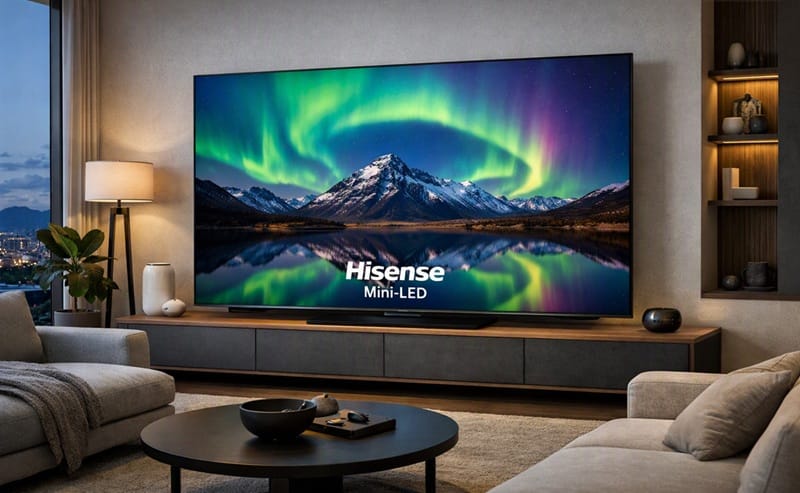
At 75 inches, the 75U7SG carries the same unibody design language Hisense has used across the rest of the U7SG range — a slim metal-toned bezel and a flat-panel profile that reads more premium than the price tag suggests.
Hisense’s own product materials for the 2026 lineup describe the anti-reflection, glare-free coating as a feature it’s pushing down from higher-tier sets into the U7SG for the first time. That matters more at this screen size than on a smaller TV, since a bigger panel captures more ambient light from windows and room lighting.
According to Hisense’s own 2026 lineup announcement, the U7SG series was built with large-format viewing — sports, in particular — as a core use case, and the design choices track with that: a wide stand footprint for stability at 75 inches, and a finish intended to hold up in brighter, more heavily trafficked rooms rather than a dedicated home theater.
Ports & Connectivity
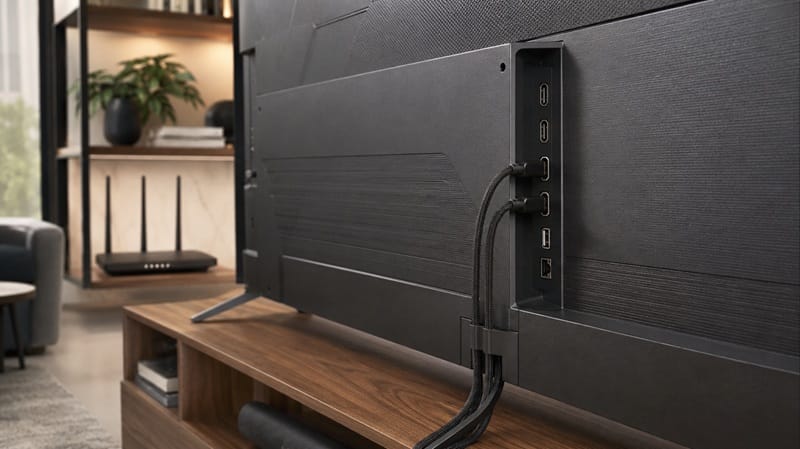
The 75U7SG ships with HDMI 2.1 inputs sufficient for a next-gen console and a soundbar simultaneously, along with 802.11ax Wi-Fi 6E for wireless streaming and an Ethernet jack for a wired connection. It also includes an ATSC 3.0 tuner, which is worth knowing if you still rely on over-the-air broadcast signals rather than a streaming-only setup.
Performance & Real-World Use
Hisense 75U7SG Brightness and Local Dimming at This Size
This is where the size-scaling question actually gets answered — partially. Hisense rates the U7SG family for up to 3,000 nits of peak brightness and as many as 3,000 local-dimming zones. Reviewers covering the 65-inch model have noted these figures typically shift by screen size across a Mini-LED lineup, which is standard for how backlight arrays scale on larger panels.
Based on Hisense’s published specifications for the 75-inch model, the 75U7SG is marketed within that same “up to 3,000 nits” ceiling. But the exact brightness and zone count specific to the 75-inch panel — as opposed to the 65-inch unit RTINGS actually tested — isn’t broken out on Hisense’s public product page and hasn’t been independently lab-verified.
What that means in practice: expect strong, punchy highlights and a genuine HDR pop in a room with some ambient light, which is the U7SG’s whole reason for existing. What it doesn’t mean is flagship-tier blooming control around small bright objects on a dark background — Hisense’s own U8QG, one step up, gets a materially higher brightness ceiling and denser dimming for exactly that reason.
Sports and Bright-Room Viewing
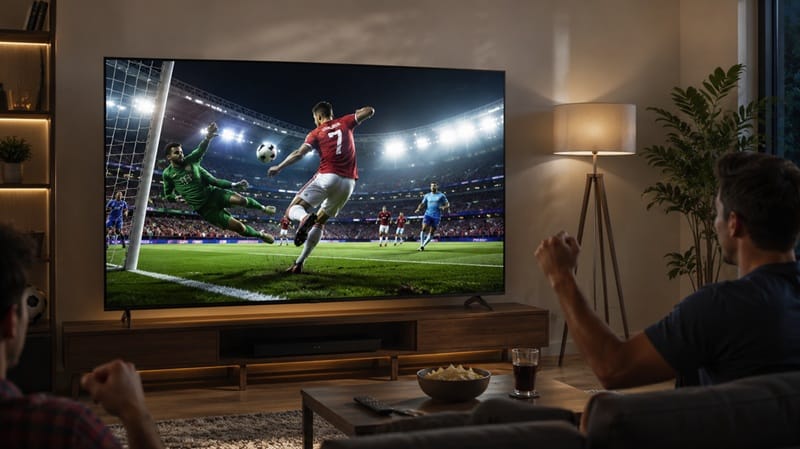
Hisense has been explicit that the U7SG series was designed around large-scale sports viewing, and at 75 inches that’s the scenario where this TV makes the most sense. The anti-reflection coating and high peak brightness combine to keep a sunlit afternoon game watchable without the washed-out look that cheaper LCD panels get in the same conditions.
Gaming Performance
The native 165Hz refresh rate, extendable to 330Hz through Hisense’s Game Booster mode at lower resolutions, puts the 75U7SG ahead of most TVs in its price tier on paper. Combined with AMD FreeSync Premium Pro and ALLM, it’s built to keep pace with a current-gen console or a mid-range gaming PC rather than just checking a spec-sheet box.
Key Features Breakdown
Hi-View AI Engine Pro
The U7SG runs the same Hi-View AI Engine Pro processor as Hisense’s step-up U8QG, according to the brand’s own 2026 lineup materials. That’s notable mainly because it’s a shared-hardware decision, not a marketing label — Hisense didn’t cut the processing chip to hit the U7SG’s lower price, even though it did cut peak brightness and dimming-zone count relative to the U8QG.
Neither RTINGS nor Hisense has published a direct upscaling or scene-adaptive contrast comparison between the two chips at this size, so treat “same processor” as a hardware fact rather than a guarantee of identical picture processing.
Built-In Audio
The 75U7SG ships with a 60W, 2.1.2-channel speaker system tuned with Devialet and Dolby Atmos support, confirmed directly against Hisense’s manufacturer spec sheet for this exact size rather than carried over from a smaller model. That’s a lot of built-in audio hardware for the price. It won’t satisfy anyone who takes sound seriously enough to already own a dedicated setup, but for background sports or everyday viewing, it’s enough to skip a soundbar purchase entirely.
The Good, the Bad, and the Ugly
Pros
- ✅ Strong peak brightness for the price — up to 3,000 nits keeps HDR content watchable in bright rooms, which matters even more at 75 inches.
- ✅ Gaming specs well above its tier — native 165Hz, FreeSync Premium Pro, and ALLM outperform most TVs at this price point.
- ✅ Capable built-in audio — 60W Dolby Atmos sound that can realistically replace a soundbar for casual use.
Cons
- ❌ Dimming-zone density isn’t confirmed at this size — Hisense’s zone counts vary by screen size, and only the 65-inch unit has independent lab data behind it.
- ❌ No Fire TV option under this exact model — the U7SG runs Google TV only; Hisense’s Fire TV equivalent ships under the separate U7SF name.
The Ugly
Nobody has independently lab-tested the 75-inch U7SG. RTINGS’ published U7SG review is built entirely around the 65-inch unit, and Hisense doesn’t publish a size-by-size breakdown of exact nits or zone count on its product pages — so “up to 3,000 nits” is a series-wide marketing ceiling, not a number this specific size has been measured against.
That’s not a reason to assume the 75-inch model underperforms; it’s a reason to treat this review’s picture-quality section as spec-based rather than lab-confirmed, and to check RTINGS’ review pipeline before buying if independently verified numbers at 75 inches matter to your decision.
Who Should Buy This — and Who Shouldn’t
Buy This If
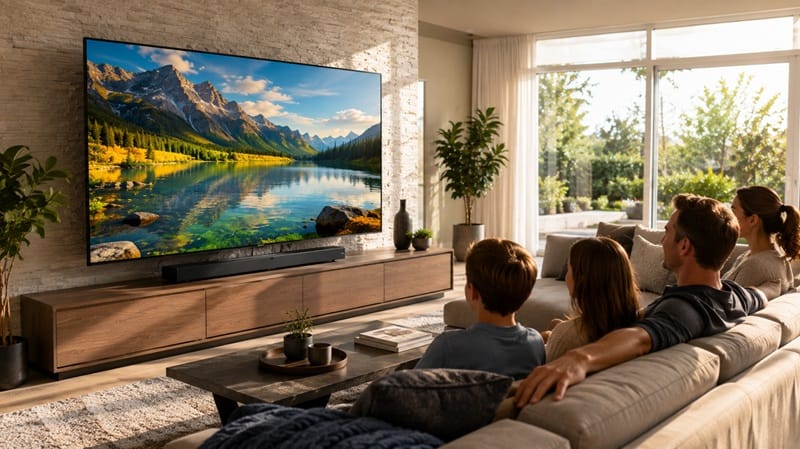
The Hisense 75U7SG fits a shared living room where the TV runs sports on Sunday, a movie on Friday, and a console the rest of the week — a large screen bought for everyday use, not a dedicated dark-room setup. It trades OLED’s deeper black levels the way an all-season tire trades outright dry-pavement grip: what you give up in one specific condition, you get back in consistency across more of the situations you’ll actually use it in — a sunlit afternoon game, a bright kitchen-adjacent living room, a fast-moving console title.
If that trade-off works for your room, this model lines up well against the wider field in our OLED vs Mini LED compared breakdown.
Still deciding between brands at this price point? Our Samsung Crystal UHD buying guide covers the other side of the mid-range field.
Skip This If
If your main use case is dark-room movie watching and you care most about deep, uniform black levels and per-pixel contrast control, the 75U7SG’s LCD-based Mini-LED design is working against you — an OLED panel, or Hisense’s own step-up U8QG for a brighter Mini-LED alternative, is the better fit for that specific priority.
Final Verdict
Is It Worth Buying?
This Hisense 75U7SG review lands on a clear trade: strong brightness, fast gaming specs, and capable built-in audio at a mid-range price, against dimming performance that reads as solid rather than confirmed flagship-grade at 75 inches specifically.
Compared to Hisense’s own U8QG, you’re giving up peak brightness and dimming-zone density for a meaningfully lower price — a fair exchange for most living-room buyers who don’t need the brightest set on the market.
That extra brightness ceiling on the U8QG isn’t free of trade-offs, either — independent testing has traced its Dolby Vision picture problems to Dynamic Tone Mapping pushing highlights past what the mastering data actually calls for. The 75U7SG’s more restrained peak brightness ends up tracking closer to the source in real-world viewing.
If you’re deciding between sizes in the same series, our Hisense 65U7SG review covers the independently lab-tested version of this panel design at a smaller screen size. 🛒 Check Availability on Amazon
Frequently Asked Questions
Is the Hisense 75U7SG a good TV for the price?
Yes, for a mid-range Mini-LED at this size — it offers a high rated peak brightness, a native 165Hz refresh rate, and Dolby Atmos audio at a price well below Hisense’s flagship U8QG, making it a strong option for shared living-room use.
Has RTINGS tested the Hisense 75U7SG specifically?
Not the 75-inch size directly. RTINGS’ U7SG review is based on independent lab testing of the 65-inch unit, and Hisense doesn’t publish separate brightness or dimming-zone specs per size, so the 75-inch model’s exact lab-measured performance hasn’t been independently confirmed yet.
Is the 75U7SG good for gaming?
Yes — a native 165Hz refresh rate (extendable to 330Hz at lower resolutions via Game Booster), AMD FreeSync Premium Pro, and ALLM make it a strong gaming display for the price, whether you’re on a current-gen console or a gaming PC.
Who should avoid the Hisense 75U7SG?
Buyers focused primarily on dark-room movie watching who want the deepest black levels and most precise contrast control should look at an OLED panel instead, since Mini-LED — even a well-implemented one like this — can’t fully match OLED’s per-pixel light control.
Does the Hisense 75U7SG support Dolby Vision?
Yes, along with HDR10+, HDR10, and HLG, giving it broad HDR format coverage across most major streaming services.

iYaiii
Editor, GearPulse360
iYaiii is the editor and founder of GearPulse360, specializing in TV reviews and consumer electronics. He researches every recommendation before publishing.
✅ Based on spec analysis and Hisense’s official and RTINGS data — last verified July 2026