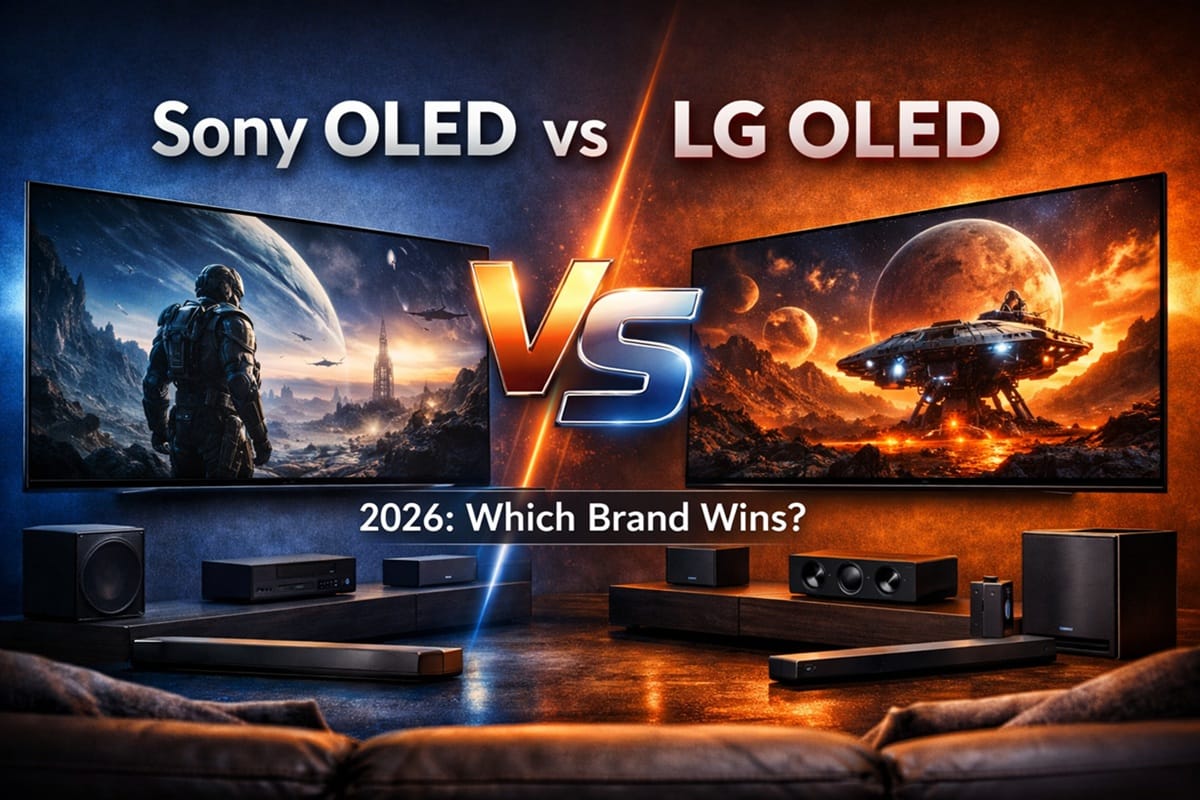
Sony OLED vs LG OLED in 2026: Which Brand Actually Has the Better Picture?
Last updated: June 2026
Disclosure: As an Amazon Associate I earn from qualifying purchases. This article contains affiliate links — we may earn a small commission if you buy through them, at no extra cost to you.
Sony and LG are the two names most serious TV buyers end up choosing between — and they’re closer in quality than most people expect. That’s exactly what makes this comparison hard, and why getting it wrong comes down to personal priorities, not specs on a box.
LG wins for most buyers in 2026. The C6H delivers outstanding picture quality, a smoother gaming experience, and better value at its price point. But Sony’s BRAVIA 8 II is not far behind — and for movie-focused viewers who want the most natural, film-accurate image processing on the market, Sony genuinely earns its premium. (We go deeper on just these two specific models in our LG C6H vs Sony BRAVIA 8 II compared breakdown, if you want the full head-to-head.)
The panel technology behind each brand — LG’s Tandem WOLED vs Sony’s QD-OLED — explains most of the differences you’ll actually see on screen. Understanding how those two panel types compare makes the rest of this easier to follow.
Table of Contents
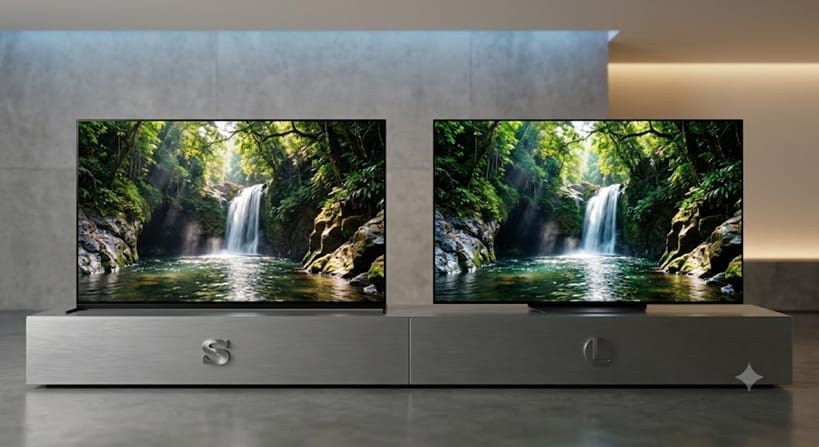
Sony OLED vs LG OLED: Quick Verdict
Want to see how these models rank across sizes and budgets? See our best OLED TVs for movies and best OLED TVs for gaming picks.
Panel Technology: WOLED vs QD-OLED
How LG’s WOLED Works
LG manufactures its own panels and uses a White OLED (WOLED) structure — essentially a white emitter layer with a color filter on top. The C6H takes this a step further with a Tandem WOLED stack, layering two emitter stacks to nearly double brightness output compared to previous generations. The result is a panel that can hit over 1,500 nits in real-world HDR highlights while keeping the absolute black levels OLED is known for.
One knock on WOLED has historically been color purity — the white subpixel can dilute saturation slightly at high brightness. LG has narrowed this gap significantly with the C6H, and in practice you’d only notice it comparing a saturated red gradient at peak brightness — not something that shows up in everyday viewing.
How Sony’s QD-OLED Works
Sony’s BRAVIA 8 II uses a QD-OLED panel — a blue OLED emitter combined with quantum dot color conversion. Because there’s no white subpixel, QD-OLED produces inherently purer, more saturated color, especially in the red and green spectrum. The trade-off is that peak brightness is slightly lower than LG’s Tandem WOLED in real-world scenes, and the glossy panel coating can be more prone to glare in bright rooms.
Sony doesn’t manufacture its panels — it sources QD-OLED from Samsung Display. What Sony brings is its Cognitive Processor XR, which shapes how the raw panel output is processed, tuned, and upscaled. That’s where a lot of Sony’s picture identity comes from.
Picture Quality: Closer Than You’d Think
The honest answer is that measured contrast and black levels are essentially identical — both panels hit true zero black. Where they split is brightness ceiling vs. color purity, and that trade-off shapes everything else in this section.
LG’s C6H has the edge in raw brightness. The Tandem WOLED stack pushes peak HDR highlights harder, which matters in scenes with bright sunlight, specular reflections, or HDR-graded content with extreme contrast. Measured peak luminance sits around 1,500–1,600 nits in a 10% window — noticeably brighter than Sony’s QD-OLED in the same test.
Where Sony Pulls Ahead
Sony counters with better color volume at moderate brightness levels. QD-OLED’s quantum dot layer produces a wider color gamut coverage — particularly strong in the DCI-P3 and Rec. 2020 color spaces used by streaming services and Blu-ray. Skin tones, in particular, look slightly more natural and three-dimensional on Sony’s processing. The Cognitive Processor XR’s “XR Triluminos Pro” system is genuinely good at object-level brightness mapping — it knows the difference between a face and a background, and adjusts accordingly.
For a dark living room with carefully calibrated settings, Sony produces a slightly more film-like image. For a bright room or mixed content viewing, LG’s higher brightness ceiling wins out.
Gaming Performance: LG Wins Clearly
This category isn’t particularly close. LG built the C6H with gaming firmly in mind — it ships with four HDMI 2.1 ports, a 165 Hz native refresh rate, and input lag that drops to around 1ms in Game Mode. It supports VRR, AMD FreeSync Premium, and NVIDIA G-Sync Compatible out of the box. For anyone with a PS5, Xbox Series X, or a high-end gaming PC, these specs matter.
Sony’s BRAVIA 8 II supports 120 Hz and has HDMI 2.1, but only on two ports. Input lag in Game Mode is typically measured at around 8–9ms — well within acceptable range for casual gaming, but noticeably behind LG’s near-instantaneous response. It doesn’t support G-Sync Compatible either, which limits flexibility for PC gamers.
The gap between 1ms and 8–9ms input lag sounds small on paper — in a fast-paced shooter or fighting game, it’s the difference between reacting and guessing. Sony’s casual gaming experience is perfectly adequate, but for anyone who plays competitively or just hates perceivable lag, the C6H is the obvious call. Independent measurements from RTINGS.com confirm both TVs’ input lag figures — LG’s advantage here is among the largest of any OLED comparison in this tier. For deeper picks by console, see our best OLED TVs for gaming guide.
Smart TV Experience: Two Different Philosophies
LG webOS 25
LG’s webOS is fast, well-organized, and widely supported. The home screen loads quickly, app availability is comprehensive, and the quick-settings panel is genuinely useful without being buried. LG also offers ThinQ AI for voice control and HomeKit compatibility. For most users, it just works without requiring much configuration.
Sony Google TV
Sony runs Google TV, which brings a wider app ecosystem and tight integration with Google services — YouTube, Google Assistant, Chromecast built-in. If you’re deep in the Google ecosystem, this is a real advantage. The downside is that Google TV can feel busier than webOS, and Sony’s implementation sometimes loads more slowly on first boot. The interface prioritizes content recommendations heavily, which some users appreciate and others find cluttered.
If you use an iPhone and AirPlay matters to you, webOS handles it more cleanly than Google TV. If your household runs on Google — Android phones, Nest speakers, Google Photos — Sony’s integration is noticeably tighter. Either way, how you use your TV day-to-day matters as much as the panel — something we get into more in our Sony OLED vs LG OLED comparison.
Sony OLED vs LG OLED by Use Case
Which Should You Buy?
For most buyers, the LG C6H is the smarter pick. It delivers picture quality that’s genuinely competitive with Sony at a lower price point, it handles gaming better than any Sony OLED at this tier, and webOS remains one of the most polished smart TV interfaces available. If you’re not specifically chasing film-accuracy or living in the Sony ecosystem, LG gives you more TV for the money.
Sony’s BRAVIA 8 II makes a stronger case the moment movies become your primary use case. The Cognitive Processor XR’s approach to scene analysis and motion handling produces something you can feel rather than measure — most obvious on 24fps film with natural lighting and complex skin tones. We cover every aspect of that experience in our full Sony BRAVIA 8 II review. If that matters to you and the premium is within budget, Sony is worth it.
Still comparing across the full market? For a deeper look at LG’s full lineup, see our LG OLED roundup — and if Sony is more your speed, our Sony OLED roundup covers the brand’s full range. Samsung is the other major name in this conversation — if you’re weighing Sony against Samsung’s QD-OLED lineup specifically, our Sony OLED vs Samsung OLED compared breakdown covers that matchup directly.
📍 See our top OLED picks for 2026 We’ve ranked the best models by budget, use case, and size — across LG, Sony, and Samsung. best OLED TVs of 2026 — ranked by budget, use case, and size.📍
Sony OLED vs LG OLED: Common Questions
Is Sony OLED better than LG OLED for movies?
Yes — and it’s not particularly subtle on well-graded content. The Cognitive Processor XR’s motion handling on 24fps film material produces a cleaner, more natural cadence than LG’s Alpha 9 AI Processor on standard settings. Sony also supports Dolby Vision, Netflix Adaptive Calibrated Mode, and a dedicated Cinema Pro picture mode that’s calibrated closer to studio reference than anything LG offers out of the box. For streaming blockbusters and Blu-ray, the difference is real. For sports and everyday TV, it largely disappears.
Is the Sony BRAVIA 8 II worth the premium over the LG C6H?
For most buyers, no — the C6H delivers around 95% of the BRAVIA 8 II’s picture quality at a meaningfully lower price. The gap shows up most on carefully graded film content in a dark room; in a bright living room watching mixed content, it’s hard to justify on picture alone. Where the premium becomes defensible is if movies are your primary use case and you’re not gaming. Independent lab data — including RTINGS.com — shows both TVs scoring closely on measured performance, with Sony’s edge appearing in subjective viewing tests rather than objective benchmarks.
Does Sony OLED have better burn-in protection than LG OLED?
Both brands include automatic pixel refresh cycles and screen shift features to manage burn-in risk. LG’s implementation is slightly more aggressive by default, running a refresh cycle more frequently. Sony relies more on manual activation. In practice, neither TV is likely to develop burn-in under normal mixed-content viewing — the risk is primarily for static commercial displays or heavy news viewing with persistent channel logos. If burn-in is a concern, both brands handle it adequately with proper settings. For a full breakdown of how burn-in risk works in 2026, see does OLED burn-in still matter in 2026.
Will Sony close the gaming gap with LG OLED in future models?
Sony has been improving gaming specs steadily, and the gap has narrowed compared to a few years ago. But LG’s hardware advantage — particularly the 165 Hz refresh rate and four HDMI 2.1 ports on the C6H — represents a meaningful lead that Sony hasn’t matched yet at equivalent price points. It’s worth checking updated models as both brands refresh annually. Our LG OLED vs Samsung OLED comparison also covers how the C6H holds up against its closest rival.
Which brand has better long-term software support — Sony or LG?
Sony’s Google TV platform benefits from Google’s broader update infrastructure, which tends to mean longer app support and more consistent security patches. LG’s webOS is updated annually alongside new TV models, but older TVs do see OS version limits over time. If software longevity is important — and it increasingly is as TVs last 7–10 years — Sony’s Google TV platform has a slight structural advantage here.

iYaiii
Editor, GearPulse360
iYaiii is the editor and founder of GearPulse360, specializing in TV reviews and consumer electronics. He tests and researches every recommendation before publishing.
✅ Based on spec analysis and LG official – Sony official and RTINGS data — last verified June 2026