Best OLED TVs for Sports in 2026: Fast Motion, Great Picture, Real Talk on Burn-In
Disclosure: As an Amazon Associate I earn from qualifying purchases. This article contains affiliate links — we may earn a small commission if you buy through them, at no extra cost to you.
Sports fans have a complicated relationship with OLED TVs. The picture is stunning — infinite contrast on a night game, motion that makes a 4K broadcast actually look like 4K — but two questions always come up: won’t fast action blur on OLED? And won’t the ESPN bug burn into the screen? Those are fair questions, and we’ll give you honest answers to both.
The short version: modern OLED is excellent for sports. Response times are near-instant, 120Hz is now standard across every pick below, and burn-in protection has improved significantly in 2026. It’s not a zero-risk purchase, but with sensible habits it’s a risk most sports fans can live with.
Below are our four picks for the best OLED TV for sports in 2026 — chosen specifically for motion clarity, reflection handling, and burn-in protection, not just general picture quality.
Table of Contents
Best OLED TVs for Sports: Quick Comparison
Ranked for motion clarity, glare handling, and burn-in protection · Updated June 2026
↻ Prices change frequently — click through for current pricing.
✓ Rankings reflect our independent editorial assessment — not Amazon customer reviews.
Is OLED Actually Good for Sports?
This is the question most guides avoid answering directly. The answer is yes — with one honest caveat. OLED’s self-emissive pixels switch on and off far faster than any LCD backlight can, which means response times in the sub-millisecond range. A ball crossing the screen doesn’t drag a ghost behind it the way it does on a slow panel. The infinite contrast ratio also means night games and indoor arenas look cinematic rather than muddy.
The Case for OLED in Sports
The motion advantage is real. Every TV below runs at native 120Hz, meaning 120 individual frames per second of live broadcast — more than enough to track fast play without judder. OLED’s near-zero response time works alongside that refresh rate to eliminate the trailing blur that LCD panels can still produce on fast lateral pans. Watch a hockey puck or a serve in a Grand Slam final on a good OLED and you’ll immediately see the difference.
Contrast matters too. Sports content has extreme dynamic range — bright stadium lighting versus deep shadows in the stands, white jerseys against a dark pitch. OLED’s per-pixel dimming handles that without the halo glow that Mini LED can produce around bright objects on a dark background. The color accuracy on modern QD-OLED panels is also noticeably stronger than WOLED for saturated kit colors and grass greens.
The Honest Trade-Offs
Two things work against OLED for sports. First, peak brightness. QD-OLED panels like the S95F and S90H below have closed the gap significantly — the S95F reaches very high peak HDR brightness — among the highest measured in the OLED category in independent lab testing — but a flagship Mini LED TV in a sunlit room will still outshine them on full-screen content. If your living room gets direct afternoon sun and you can’t draw a blind, this matters more than any spec on paper.
Second, burn-in. Sports channel logos are exactly the kind of static, high-contrast image that OLED panels are most sensitive to. It’s a legitimate concern and we address it directly in the burn-in section below. The short answer: modern OLED protection features have improved considerably, and most sports fans who don’t watch the same channel for 10+ hours a day have nothing to worry about. If you’re still weighing OLED against QLED or Mini LED on this specific point, our OLED vs Mini LED comparison covers the trade-off in detail.
Best Overall OLED TV for Sports: Samsung S95F OLED
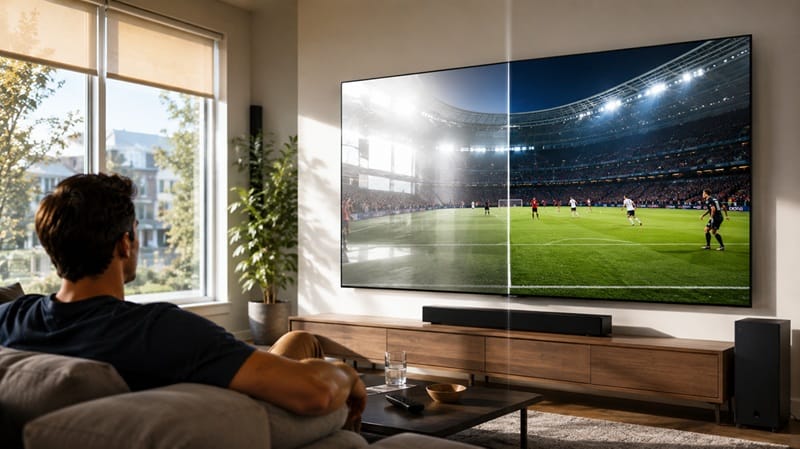
The S95F earns the top spot because it solves the biggest weakness OLED has traditionally had for sports: bright rooms. Samsung’s OLED Glare Free 2.0 matte coating doesn’t just reduce reflections — it effectively eliminates the mirror-like glare that makes glossy OLED panels almost unwatchable during afternoon games. You get OLED’s contrast and motion in a package that works whether the blinds are up or down.
The QD-OLED panel brings brightness well above what WOLED achieves on the same content type. Saturated colors — kit reds, grass greens, court blues — look noticeably more vivid than on WOLED rivals, which matters more during sports than most other content types. Motion is handled by Samsung’s Motion Xcelerator at 144Hz, and in practice the picture during fast pans is clean without needing to push motion smoothing to levels that introduce the soap-opera effect.
Why It Wins for Sports
The combination of matte screen, QD-OLED brightness, and 144Hz handling puts it ahead of every other OLED specifically for sports viewers who don’t want to manage their room lighting around game time. Samsung’s burn-in protection suite — Auto Brightness Limiter, Pixel Shift, and Logo Luminance Dimming — runs continuously in the background without any manual setup. It’s the OLED equivalent of buying the best rain jacket: you pay a premium, but you stop worrying about the weather.
What to Watch Out For
The S95F doesn’t support Dolby Vision, which matters more for movies than for sports broadcast. HDR10+ is Samsung’s preferred format and coverage on sports streaming platforms is solid, but if you switch between a lot of content types it’s worth noting. Audio is also the weakest part of the package at this price — you’ll want a soundbar for stadium-quality sound to match the picture.
Best Budget OLED TV for Sports: Samsung S85H OLED
The S85H is Samsung’s entry-point OLED for 2026, and for most sports fans it’s the most honest recommendation in the lineup. At the entry point of the OLED price range, it still costs more than a comparable QLED — but the motion performance gap justifies the step up for dedicated sports fans. It uses a WOLED panel — the same fundamental technology in LG’s lineup — rather than Samsung Display’s QD-OLED, which is why it sits below the S90H and S95F on brightness. What it gives you is real OLED motion performance, four HDMI 2.1 ports, 120Hz refresh, and Samsung’s smart platform, at a meaningfully lower price than its siblings.
For a sports fan in a moderately lit room who primarily watches evening games, the S85H covers everything that actually matters. Response time is as fast as any OLED panel. Motion during live play is clean and natural without heavy-handed processing. The NQ4 AI Gen2 processor applies real-time scene analysis, which in practice means skin tones during broadcast sports look accurate rather than oversaturated the way some budget TVs push them.
Where It Delivers
120Hz is enough for every major sports broadcast and streaming format available in 2026. You don’t need 144Hz or 165Hz for sports — those extra frames only become relevant in PC gaming contexts. The S85H’s four HDMI 2.1 ports also mean you can connect a streaming box, console, soundbar, and antenna without reaching for an adaptor.
Compromises at This Price
Peak brightness is the clearest step down from the S90H and S95F. In a bright room during a daytime match, you’ll notice it. Samsung’s glare-free coating is also not present on the S85H — it has a semi-glossy screen that performs well in dim to moderate light but struggles in direct sun. If your viewing environment is bright, spend up to the S90H. If you watch mostly evenings or in a room you control, the S85H is a harder decision than it looks — it delivers everything that actually matters for sports at a price that doesn’t require a conversation with your partner.
Best OLED TV for Sports in Bright Rooms: Samsung S90H OLED
If your watching environment is the deciding factor — meaning you watch afternoon games with sunlight coming through the windows — the S90H is the pick to consider before jumping straight to the S95F. It’s a QD-OLED panel, which gives it significantly more peak brightness than the S85H’s WOLED without the cost of the flagship. The difference between QD-OLED and WOLED is most visible on high-brightness content: the saturated colors of kit, the bright blue sky above a cricket ground, the white ice of an NHL arena.
The S90H also runs at a native 165Hz, the highest refresh rate in this roundup. For sports broadcast at 60fps that headroom doesn’t change what you see, but if the same TV gets used for PC gaming or console titles that support high frame rates, that flexibility is real value. If you want to understand exactly what the panel difference means in practice before committing, our QD-OLED vs WOLED comparison covers the technical side in full.
Panel Type and What It Means for Sports
QD-OLED uses quantum dots on top of a blue OLED layer to produce color, which gives Samsung’s panels a measurably wider color gamut than WOLED’s white-subpixel approach. In practice, this means sports content — particularly grass and turf sports where color accuracy is obvious — looks more accurate and more vivid at the same time. Green is actually green, not slightly lime or slightly olive the way older OLED panels sometimes rendered it.
Brightness in mixed-light rooms is also where QD-OLED earns its price premium over WOLED. The S90H can sustain higher brightness across more of the screen simultaneously than the S85H, which matters for full-field shots where the action fills the whole panel rather than a small HDR highlight in the corner.
Best Large-Screen OLED for Sports: LG G6 OLED
Size matters for sports in a way it doesn’t for most other content. A 65″ TV is fine for a movie you’re focused on from ten feet away; a 65″ TV during a full-field football broadcast with 22 players visible simultaneously can feel like you’re watching through a porthole. If your room allows for 77″ or 83″, the LG G6 is where we’d direct you for the best OLED sports experience at that scale.
The G6 uses LG’s WOLED panel with Micro Lens Array (MLA) technology, which redirects more of the panel’s light forward rather than scattering it sideways. The result is meaningfully higher peak brightness than standard WOLED — closer to QD-OLED territory — combined with Dolby Vision support that neither Samsung OLED offers. For sports fans who also use the same screen for movies, the G6 handles the full content range better than any single pick in this guide.
Size and Viewing Distance for Sports
A 77″ TV at 4K resolution looks sharp at distances from around 8 feet. Most sports fans naturally sit closer to their TV than they do for a movie, and at 10–12 feet a 77″ OLED fills your field of view in a way that a 65″ simply doesn’t. The pitch of a football field, the full sweep of a cycling peloton, the court and all its players during a basketball game — you see it differently when the screen is truly large. If you’re considering a 77″ or larger, our guide to the best 77-inch OLED TVs covers the full size category in detail.
LG’s Burn-In Protection on the G6
LG calls their burn-in protection suite OLED Care, and on the G6 it runs continuously. Logo Luminance Dimming automatically detects static bright elements — exactly the kind of channel bug that sports fans worry about — and reduces their brightness relative to the surrounding image without visibly affecting the content you’re watching. Combined with automatic pixel refresh cycles that run when the screen goes to standby, the G6 is one of the better-protected OLED panels you can buy if burn-in is your primary concern. For the best OLED TVs for gaming, the G6 makes that list too — its low input lag and 144Hz performance are competitive with dedicated gaming-first picks.
If you’re still deciding between OLED and a high-end Mini LED for sports, the core trade-off comes down to brightness versus contrast — OLED wins on per-pixel precision and motion, Mini LED wins on sustained peak brightness in bright rooms. Our OLED vs Mini LED comparison covers both sides of that argument in full.
Real Talk: OLED Burn-In and Sports Channel Logos
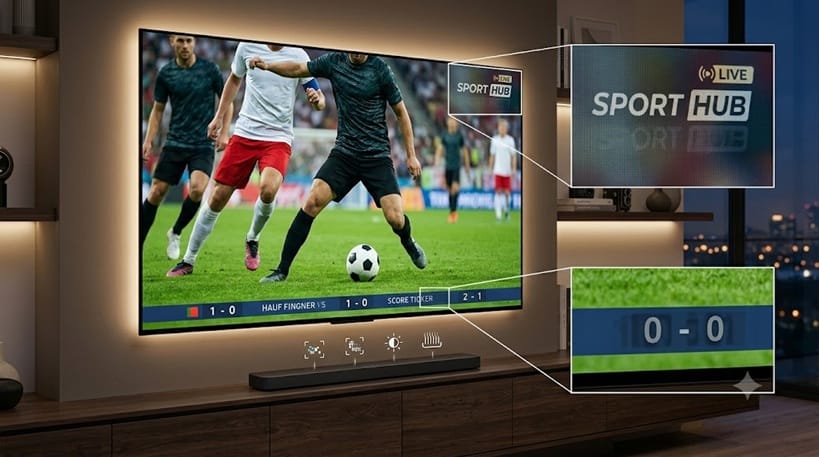
The concern is specific: sports channels display a static logo — the ESPN bug, a network badge, a score ticker — in the same corner of the screen for hours at a time. OLED pixels wear unevenly when parts of the image are much brighter or more static than others over long periods. In theory, that’s a recipe for burn-in.
How Serious Is the Risk in 2026?
Lower than most people fear — but not zero. RTINGS.com has run extensive long-term burn-in testing on OLED panels over several years, including content specifically designed to simulate typical viewing habits including sports and news. Their findings show that viewers who watch varied content — sports alongside streaming, movies, and general TV — rarely encounter visible burn-in within typical ownership windows of 5–7 years. The risk rises significantly if you watch the same channel for 8–10+ hours a day, seven days a week, without ever varying your source.
Most sports fans don’t watch that way. Games end, you switch to something else. You sleep. The panel refreshes. If you’re someone who leaves ESPN running as background noise all day regardless of whether you’re watching, that’s a higher-risk pattern and worth acknowledging honestly. For a full breakdown of where the risk actually sits in 2026, see our guide on whether OLED burn-in still matters in 2026.
Built-In Protections on 2026 OLED TVs
Every TV in this guide ships with multiple layers of protection that weren’t available on older OLED panels:
- Logo Luminance Dimming: Automatically detects static bright regions and reduces their luminance relative to the content around them. Channel bugs become less bright, reducing the differential wear on those pixels.
- Pixel Shift: Micro-moves the entire image by a pixel or two at intervals, so no single pixel is always displaying the same element.
- Automatic Pixel Refresh: Runs a compensation cycle when the screen powers off after extended use. On LG panels this is labeled OLED Care; on Samsung it runs silently in the background.
- Screen Saver Activation: Activates after periods of static content to break up any fixed image pattern.
For a detailed breakdown of how these risks have changed and what the current data shows, RTINGS.com’s long-term OLED burn-in longevity test — which ran for nearly three years across 100 TVs — is the most credible source available. It’s worth reading before making a final decision.
Practical Tips to Minimize Risk
- Keep brightness at or below 50–60% for everyday sports viewing. Burn-in accelerates at peak brightness.
- Use the TV’s built-in Screen Saver and ensure it’s set to activate automatically.
- Don’t leave a static sports menu or a paused game frame on-screen for extended periods.
- Vary your input sources throughout the week — the more mixed your content, the better the panel self-corrects.
What to Look for in an OLED TV for Sports
Motion Clarity: What the Specs Actually Mean
Refresh rate and response time are the two specs that matter most for sports motion, and they mean different things. Refresh rate — 120Hz, 144Hz, 165Hz — tells you how many times per second the panel updates. Broadcast sports top out at 60fps, so the practical question isn’t whether 144Hz looks better than 120Hz on a live match. It’s whether your panel can display 120 frames per second without introducing blur between them — and that’s where response time comes in.
Response time is more nuanced. OLED panels measure in fractions of a millisecond — typically 0.1ms to 0.2ms — compared to even a fast LCD at 1–5ms. That difference is visible during fast lateral pans: OLED pixels are already off before the trailing edge of a moving object clears the pixel, eliminating the blur trail. This is why OLED’s motion advantage over LCD is most obvious on sports specifically, not on slower-paced movie content.
Brightness: How Much Do You Really Need?
Sports content in HDR doesn’t push the extreme peak brightness numbers that a cinema-mastered movie does. A football broadcast doesn’t have scene highlights exceeding 1,000 nits in the way a Marvel film might. Where brightness matters for sports is sustained, full-screen brightness — the ability to keep the entire frame bright during a daytime outdoor event without the panel dimming aggressively to protect itself.
QD-OLED panels (S95F, S90H) maintain higher sustained brightness than WOLED (S85H, G6 without MLA) for this reason. The G6’s MLA technology partly closes that gap on WOLED. If your room is bright, lean toward QD-OLED. For rooms you control, any OLED panel in this guide is strong.
Panel Type: QD-OLED vs WOLED for Sports
The panel type debate is meaningful for sports fans in a way it isn’t for all use cases. QD-OLED’s quantum dot layer produces wider color volume and higher peak brightness — both visible advantages during brightly lit outdoor sports. WOLED with MLA (like the LG G6) matches or approaches QD-OLED brightness while offering advantages in off-axis viewing angles, which matters for wider seating arrangements. For a deeper dive on the technical differences, our QD-OLED vs WOLED comparison covers everything in detail.
Size and Room Setup
Sports reward larger screens more than almost any other content type. The generally recommended viewing distance for 4K — roughly 1.5x the screen diagonal — places a 65″ TV at around 8 feet, and a 77″ at around 10 feet. Most living rooms and dedicated sports rooms will accommodate 77″ comfortably. For movies and general TV, the jump from 65″ to 77″ can feel excessive; for sports, it’s where the experience actually shifts. If you want to explore the full picture across OLED sizes and use cases, our guide to the best OLED TVs for movies shows how the same picks perform for a different use case.
Anti-Glare and Reflection Handling
Sports often happen during the day — games, matches, and races scheduled for weekend afternoons when your living room might be at its brightest. Anti-glare coating quality varies significantly between models. The S95F’s OLED Glare Free 2.0 is the most capable matte treatment on any OLED currently available. The S90H and S85H have semi-gloss screens that perform well in dim to moderate ambient light but can produce reflections in bright conditions. If bright-room performance is your main concern, the S95F is the unambiguous choice; the S90H is a strong compromise. For the full picture on OLED in bright environments, see our picks for the best OLED TVs for bright rooms.
How We Picked These TVs
Our picks are based on a combination of published lab data from independent testing sites — primarily RTINGS.com’s motion handling and burn-in longevity results — along with hands-on assessment of each panel type’s real-world performance during live sports content. We weighed motion clarity, anti-glare handling, burn-in protection features, and brightness sustainability in both dark and mixed-light environments.
We updated this guide in June 2026 to reflect the full 2026 Samsung OLED lineup (S85H, S90H, S95F) and LG’s G6 release. Models are chosen for how well they address the specific requirements of sports viewing, not just general OLED performance rankings. A TV that scores highly overall but lacks matte coating or adequate burn-in protection will rank lower here than a slightly less bright model that handles both concerns well.
We don’t accept payment from manufacturers for placement. Affiliate links are disclosed above and help support the site at no cost to you.
Who Should Buy an OLED TV for Sports?
Buy This If…
You watch sports primarily in the evenings, or in a room where you have some control over ambient light — even just drawing a blind during a daytime match. You want the cleanest possible motion on fast-moving content: hockey, tennis, Formula 1, basketball. And you want one screen that handles streaming and movies alongside sports, without keeping a second TV in the room.
You’re also in the right place if gaming shares the same screen. OLED’s sub-millisecond response time is as relevant for a console as it is for a Premier League match, and every pick here handles both without compromise.
Skip This If…
Your viewing room has large south-facing windows and you can’t or won’t manage them during games. In that environment, a high-brightness QLED or Mini LED TV will sustain more visible picture quality during peak daytime brightness. Similarly, if you leave the same sports channel running continuously as background noise for 8+ hours a day, the burn-in risk increases meaningfully regardless of the protection features built into these panels. In either case, something like a Samsung QN90F or equivalent Mini LED flagship handles that use pattern better. Our OLED vs Mini LED comparison will help you decide if you’re still on the fence.
Comparing across every use case and budget? Our full roundup covers the best OLED TVs at every price point — movies, gaming, sports, and more. See Best OLED TVs 2026 →
OLED TV for Sports: Frequently Asked Questions
What is the best OLED TV for sports in 2026?
The Samsung S95F OLED is our top pick for sports in 2026. Its QD-OLED panel delivers the combination of high brightness, fast 144Hz motion, and Samsung’s OLED Glare Free 2.0 matte coating — making it the strongest performer across different room conditions, including during daytime matches. For a broader look at how RTINGS ranks sports TVs overall, their sports TV guide is a useful reference alongside ours.
Is OLED better than QLED for watching sports?
For most sports viewing environments, yes. OLED’s near-instant response time produces cleaner motion during fast play than QLED, and infinite contrast handles the extreme light-to-dark range of stadium content better. The exception is very bright rooms — a flagship QLED or Mini LED TV sustains higher full-screen brightness in direct sunlight. If your sports room gets strong direct sun and you can’t control it, a top-tier Mini LED like the Samsung QN90F may outperform an OLED during daytime matches. See our OLED vs QLED comparison for the full trade-off breakdown.
Will sports channel logos burn into my OLED TV?
It’s a real risk but a manageable one for most viewers. Static elements like channel bugs, score tickers, and network logos can cause uneven pixel wear over time — but modern OLED protection features (Logo Luminance Dimming, Pixel Shift, auto pixel refresh) significantly reduce that risk. Viewers who watch varied content and don’t leave the same channel running continuously for 8+ hours a day are unlikely to encounter visible burn-in within a typical 5–7 year ownership period. For the most detailed independent data on this, RTINGS.com’s multi-year burn-in longevity test is the most comprehensive study available. We also have a full breakdown of whether OLED burn-in still matters in 2026 if you want a more detailed answer before buying.
Do I need 4K for sports?
Broadcast sports are increasingly available in 4K — particularly on streaming platforms like Apple TV+, Amazon Prime Video Sports, and some cable packages. Where 4K matters most for sports is the combination of resolution and refresh rate: a 4K 120Hz OLED panel handling a high-frame-rate stream produces noticeably sharper motion than even a good 1080p set. Every pick in this guide is 4K native, and all support 120Hz or higher for content that takes advantage of it.
How big an OLED TV should I get for sports?
Bigger than you think you need. Sports content rewards screen size more than almost any other content type — the ability to track the full pitch, court, or track simultaneously changes the experience fundamentally. At a viewing distance of 10 feet, 77″ is a more immersive sports screen than 65″, and 4K resolution means it stays sharp at that size. If your room fits 77″, that’s where we’d start rather than finish. Our guide to the best 77-inch OLED TVs covers the full size-tier in detail.

iYaiii
Editor, GearPulse360
iYaiii is the editor and founder of GearPulse360, specializing in TV reviews and consumer electronics. He researches every recommendation before publishing.
✅ Based on spec analysis and Samsung official – LG’s official data plus RTINGS — last verified June 2026