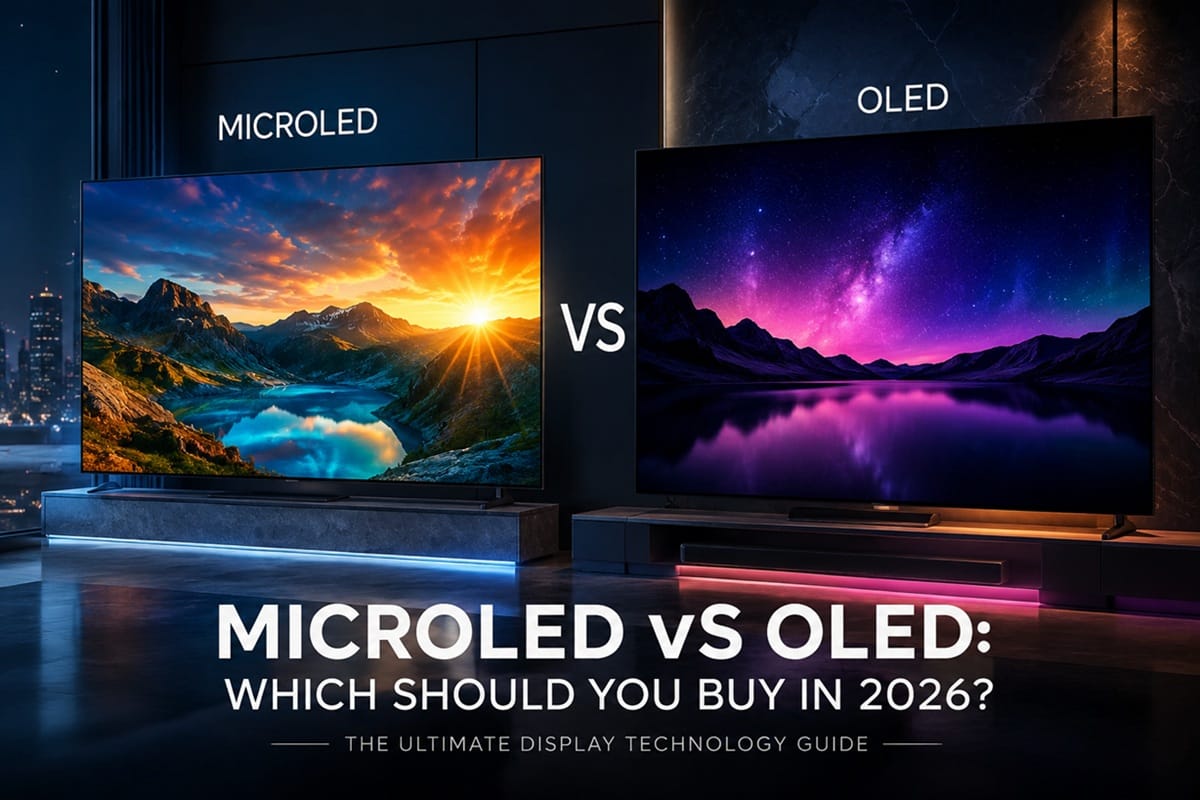
MicroLED vs OLED: Which Should You Buy in 2026?
Last updated: July 2026
🕒 10 min read
Disclosure: As an Amazon Associate I earn from qualifying purchases. This article contains affiliate links — we may earn a small commission if you buy through them, at no extra cost to you.
If you’ve seen “MicroLED” mentioned in CES coverage or a flagship TV review and started wondering whether your next OLED purchase is about to be outdated, you’re not alone. The headlines make MicroLED sound like the technology that finally beats OLED at its own game.
Here’s the short version: for almost every buyer reading this, OLED still wins the MicroLED vs OLED question in 2026 — not because MicroLED is worse on paper, but because true MicroLED isn’t something you can realistically buy for a normal home.
This comparison covers true, self-emissive MicroLED — not the “Mini LED” backlit LCD TVs some brands market with similar-sounding names. If you’re actually deciding between OLED and Mini LED, our OLED vs Mini LED comparison is the more relevant read.
Table of Contents
OLED — because it’s actually a TV you can buy
True MicroLED delivers a technically superior picture in a lab, but it’s sold as a modular, professionally installed display starting around 89 inches, priced for luxury home theaters and commercial spaces. OLED gives you comparable perfect-black contrast at a size and price that fits an actual living room. The exception is buyers with a six-figure-plus home theater budget who want a fully custom, bezel-less video wall — for them, MicroLED is worth exploring.
How They Compare
Picture Quality — OLED
Picture Quality — MicroLED
Brightness — OLED
Brightness — MicroLED
Gaming — OLED
Gaming — MicroLED
Value — OLED
Value — MicroLED
Ready to act on that verdict? See our picks for best OLED TVs under $2,000 →.
Since MicroLED isn’t a realistic purchase for most homes, the actual decision is which OLED to buy. Here’s how 2026’s two most relevant flagships stack up:
How MicroLED and OLED Actually Differ
What Is MicroLED?
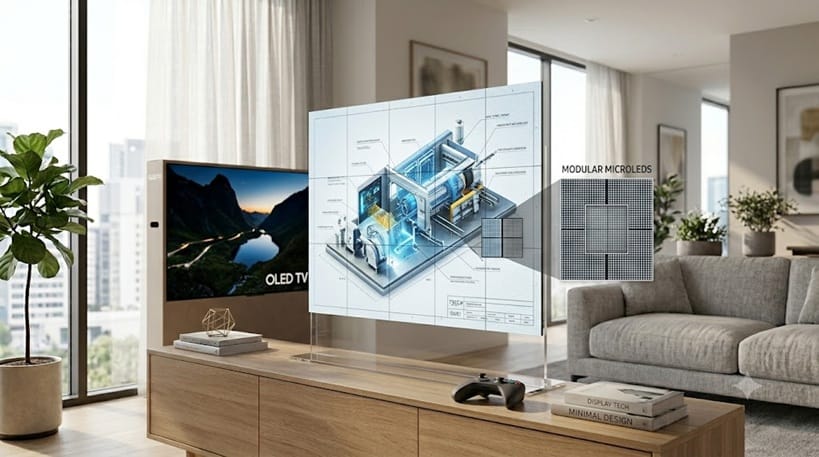
MicroLED uses millions of microscopic inorganic LEDs — one per sub-pixel — that emit their own light directly, with no backlight and no organic compounds involved. Based on Samsung’s published specifications, its consumer MicroLED lineup starts at 89 inches and is built from modular panels that get professionally assembled and calibrated on-site, more like installing a home theater screen than unboxing a TV.
It’s worth flagging a naming trap here: Samsung’s 2026 “Micro RGB” TVs (the R95H and R85H series) are not the same technology as true MicroLED, despite the similar name. Micro RGB is a Mini-LED-backlit LCD panel that uses independently controlled red, green, and blue LEDs for the backlight — the picture itself still passes through an LCD layer, unlike MicroLED’s self-emissive pixels. Micro RGB TVs are sold as normal, boxed consumer TVs on Amazon; true MicroLED is not.
What Is OLED?
OLED is also self-emissive — each pixel is an organic compound that produces its own light and switches off completely for true black — but it ships as a standard, wall-mountable TV in familiar sizes, from 42 inches up to 97 inches, with a single retail price tag and no installation crew required. For a deeper breakdown of how OLED panel types differ from each other, see our guide to OLED panel types.
The Key Structural Difference
MicroLED is assembled from tiled modules, which is what makes custom, bezel-less, any-size installations possible. OLED is manufactured and shipped as one finished panel. That single difference explains almost everything else in this comparison — including why one shows up in “best TV” buying guides and the other doesn’t.
Picture Quality and Contrast: Who Wins?
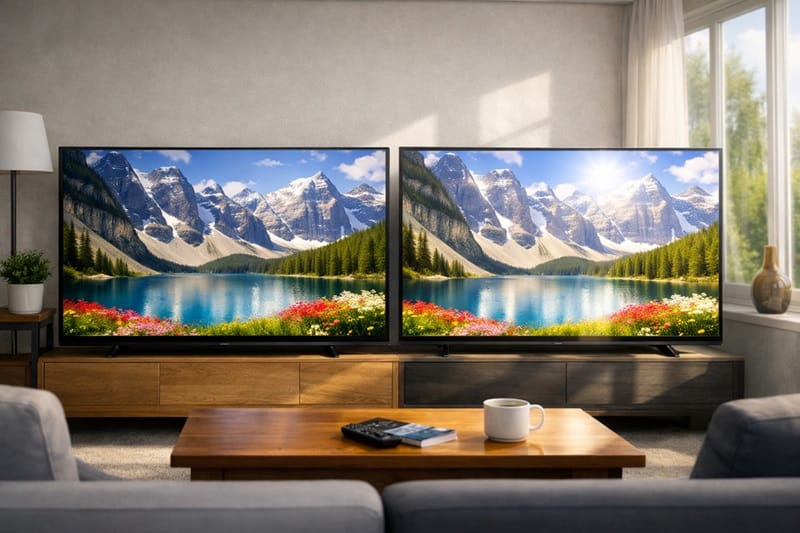
Both technologies hit true black, pixel by pixel, because both are self-emissive — there’s no backlight bleeding into dark scenes on either one. On paper, MicroLED has a slight edge: no organic layer means no theoretical limit on per-pixel brightness, and Samsung markets its MicroLED sets around “true-to-life imagery” with wide color coverage.
In practice, that edge is hard to see at normal home viewing distances. OLED’s per-pixel dimming already delivers reference-level contrast, and Samsung markets its flagship 2026 QD-OLED at peak brightness claims approaching 3,000 nits in HDR — numbers that make the theoretical MicroLED advantage mostly academic for a living room.
Pixel pitch matters here too. MicroLED’s picture sharpness scales with screen size and viewing distance — a 100-inch-plus MicroLED wall viewed from across a large room resolves detail beautifully, but the same panel at close range can reveal visible spacing between LED clusters on lower-density configurations. OLED’s fixed, factory-set pixel density means a 65-inch panel looks equally sharp whether you’re on a couch six feet away or standing right in front of it.
Brightness: Who Wins?
MicroLED’s inorganic LEDs can be driven harder without the long-term risk that organic OLED material faces at extreme brightness, so large-format MicroLED installs can sustain very high output across the whole screen. Consumer OLED closes most of that gap for typical content, though — modern flagship OLEDs already handle small, bright highlights (explosions, sun glare, HDR peaks) extremely well.
Gaming Performance: Who Wins?
This dimension isn’t close. OLED TVs built for gaming in 2026 routinely offer native 144Hz–165Hz panels, four full-bandwidth HDMI 2.1 ports, VRR, and near-instant response times — features console and PC gamers rely on. Based on manufacturer specifications and independent testing data from RTINGS, current OLED flagships post some of the fastest response times of any consumer display.
MicroLED installs are engineered for content playback and signage, not competitive gaming — documented refresh rate, VRR, and low-latency gaming features are largely absent from consumer MicroLED product pages. If gaming matters to you at all, OLED is the clear pick regardless of budget.
Price and Real-World Availability: The MicroLED vs OLED Gap That Actually Matters
This is the dimension that actually decides the MicroLED vs OLED debate for most people. Based on published pricing coverage from 2026, entry MicroLED configurations sit in the tens of thousands of dollars once professional installation is included, while flagship OLED TVs remain in a mainstream, single-receipt price range. Unless budget genuinely isn’t a factor, that gap settles the decision on its own.
Screen Size and Installation Flexibility: Who Wins?
Here MicroLED has a real, defensible advantage. Its modular tile design means a display can theoretically be built to almost any size or shape, with no visible bezels — something no boxed OLED panel can replicate. For a dedicated, no-budget-limit home theater room built around one custom video wall, that flexibility is the whole appeal.
For everyone else, OLED’s fixed sizes already cover the range that fits a real living room — up to 97 inches — without a custom installation project.
Burn-In and Longevity: Who Wins?
Both technologies carry some risk from static content over years of heavy use, since both rely on individually driven emissive elements. Inorganic LEDs in MicroLED are generally expected to have a longer theoretical lifespan than OLED’s organic compounds, though long-term consumer usage data for MicroLED barely exists yet since it’s still such a new, low-volume product category.
OLED, by contrast, has years of real-world consumer usage behind it, along with manufacturer panel warranties that reflect that track record. For a typical household, OLED’s proven history currently outweighs MicroLED’s theoretical advantage.
Power draw is another practical factor buyers rarely consider upfront. A large-format MicroLED installation running at high brightness across a bezel-less wall consumes meaningfully more electricity than a single 65-inch OLED panel — worth factoring in if you’re pricing out a dedicated home theater build rather than a straightforward TV replacement.
Which Should You Buy?
For most buyers, OLED is the obvious answer — not a close call. You get comparable perfect-black contrast, genuinely excellent gaming features, and sizes that fit a normal home, all at a price you can pay in one transaction.
If your priority is a completely custom, bezel-less video wall and budget genuinely isn’t a constraint, true MicroLED is worth researching directly with a certified installer — this isn’t a buy-it-yourself category.
If your priority is simply “the brightest, most color-accurate TV I can actually own,” a flagship 2026 OLED gets you there without waiting on a technology that isn’t retail-ready for normal households.
📍 Ready to see which OLED actually fits your room and budget? Our full roundup ranks every 2026 flagship by picture, gaming, and value — check out our OLED TV roundup.
MicroLED vs OLED: Common Questions
MicroLED vs OLED: which one actually wins for home use?
OLED wins for practically every home buyer in 2026. True MicroLED is sold as a modular, professionally installed display starting around 89 inches, aimed at luxury and commercial installs rather than a typical household purchase.
Is MicroLED worth the premium over OLED?
Only if you’re already planning a dedicated, high-budget home theater build where a fully custom, bezel-less video wall is the goal. For a standard living room upgrade, the price gap between the two categories is too large to justify on picture quality alone.
Does MicroLED have burn-in risk like OLED?
Both use individually driven emissive elements and carry some theoretical risk from years of static content. MicroLED’s inorganic LEDs are generally expected to last longer than OLED’s organic material, but there isn’t enough real-world consumer data yet to say how that plays out over a decade of normal use.
Also consider: if long-term durability at a lower price point matters more to you than flagship specs, the LG B6 OLED is a budget-friendly way to get proven panel technology with a full manufacturer warranty.
Will MicroLED close the gap with OLED for regular buyers?
Does Samsung’s “Micro RGB” TV count as MicroLED?
This isn’t an isolated naming quirk, either — Samsung’s Mini LED branding gets stretched elsewhere in the lineup too. Our Samsung QN55LS03H vs Samsung 55M70H comparison covers a budget “Mini LED” model that, per RTINGS testing, has no local dimming zones at all.

iYaiii
Editor, GearPulse360
iYaiii is the editor and founder of GearPulse360, specializing in TV reviews and consumer electronics. He researches every recommendation before publishing.
✅ Based on spec analysis and LG’s and Samsung’s official data plus RTINGS — last verified July 2026