Best OLED TVs for Streaming in 2026: Ranked by App Support, HDR, and Sound
Last updated: June 2026 / 🕒 9 min read
Disclosure: As an Amazon Associate I earn from qualifying purchases. This article contains affiliate links — we may earn a small commission if you buy through them, at no extra cost to you.
Streaming services keep adding 4K HDR titles, but not every OLED TV does them justice — some can’t decode Dolby Vision, others bury Netflix and Apple TV+ behind a clunky smart-TV menu, and a few sound thin enough that you’ll want a soundbar just to watch a sitcom.
We picked four OLED TVs across price tiers based on what actually matters for streaming: smart-platform app support, HDR format compatibility, and built-in sound quality — not just panel brightness. For a broader look at every OLED use case, our full roundup covers sizes and budgets beyond this guide. LG’s C5 tops our list for its deep webOS app library and balanced picture, though Samsung’s S95F pulls ahead in daytime brightness if your room gets a lot of natural light.
Table of Contents
Best OLED TVs for Streaming in 2026: Quick Comparison
| Pick | Model | Panel | Best For | Price |
|---|---|---|---|---|
| Best overall | LG C5 (65″) | WOLED | All-around streaming, deepest app library | Amazon ↗ |
| Brightest picture | Samsung S95F (65″) | QD-OLED | Bright rooms and daytime streaming | Amazon ↗ |
| Best audio | Sony Bravia 8 II (65″) | QD-OLED | Built-in sound without a soundbar | Amazon ↗ |
| Best budget | LG B6 (65″) | WOLED | Budget-friendly streaming setups | Amazon ↗ |
↻ Prices change frequently — click through for current pricing.
✓ Scores reflect our independent assessment, not Amazon customer reviews.
Best Overall OLED TV for Streaming: LG C5
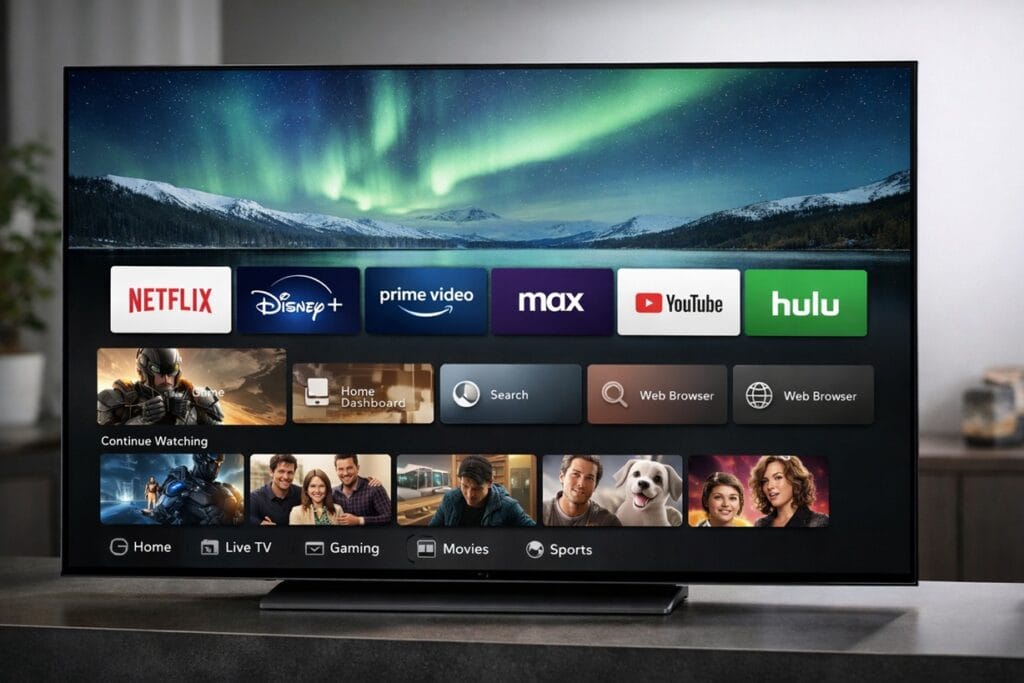
For a TV that's mainly going to live on Netflix, Disney+, and Apple TV+, the app platform matters as much as the panel. LG's webOS gives the C5 fast app launches, a dedicated row for each major streaming service, and AI-driven picture/sound presets that adjust automatically per app. Per LG's official specifications and RTINGS' independent review, the C5 runs an Alpha 9 AI Processor Gen8.
It supports full Dolby Vision and Dolby Atmos passthrough, so HDR and surround content from Netflix or Apple TV+ arrives the way the studio intended. It won't out-glow Samsung's brighter panel in a sun-flooded living room, but for a typical evening streaming session, it's the most well-rounded pick here.
Brightest Pick for Daytime Streaming: Samsung S95F
The S95F is the brightest TV on this list, and that matters more for streaming than it sounds — if your living room has big windows, even a great OLED can look washed out during the day. Samsung's Glare Free screen and NQ4 AI Gen3 upscaling keep lower-bitrate streams looking cleaner than they would on a glossier panel.
The trade-off, according to Samsung's own spec sheet, is that the S95F skips Dolby Vision entirely in favor of HDR10+. Most major streaming apps support both formats, so you won't lose access to HDR content — you'll just get Samsung's own tone-mapping instead of the studio-graded Dolby Vision pass that Netflix and Apple TV+ ship by default. We didn't find a model-specific RTINGS review for this exact S95F configuration at publish time, so the claims above are based on Samsung's official specifications rather than independent lab testing.
Best for Built-In Sound: Sony Bravia 8 II
Sony built the Bravia 8 II around Google TV, which means the widest third-party app catalog of any pick here, plus Sony Pictures Core baked directly into the platform. According to RTINGS' review, its Acoustic Surface Audio+ system vibrates the panel itself to produce sound, which is genuinely the most noticeable upgrade for streaming-only setups that don't already have a soundbar.
Per Sony's specifications page, the panel also includes Studio Calibrated picture modes developed alongside major streaming services, aimed at matching what the colorist intended rather than a generic "Vivid" preset. It costs about the same as the Samsung S95F, so the decision mostly comes down to whether sound or peak brightness matters more in your room.
Best Budget OLED TV for Streaming: LG B6
The big thing to know about the B6 is what it doesn't cut: based on LG's official specifications, it runs the same webOS 2026 smart platform as the flagship G6, with the same app catalog and the same Dolby Vision and Dolby Atmos support. For a TV whose main job is streaming rather than gaming or bright-room movie nights, that's the part that actually matters.
What you give up is brightness headroom — Samsung's QD-OLED panels are generally built to handle glare better than entry-level WOLED sets — and as a brand-new 2026 release, independent lab data on the B6's real-world brightness and reflectivity is still limited. If budget is the deciding factor and streaming is most of what you watch, it's a reasonable place to start.
Still deciding between OLED and QLED before you even get to a specific pick? Our full OLED vs QLED comparison breaks down the difference in plain terms.
What to Look for in an OLED TV for Streaming
Smart TV Platform and App Library
This is the single biggest differentiator for a TV that's mainly used to stream. LG's webOS, Samsung's Tizen, and Sony/Google TV all carry the major apps — Netflix, Disney+, Apple TV+, Prime Video — but they differ in how fast apps launch, how much the home screen pushes ads, and how deep third-party app support goes. Google TV currently has the widest catalog of niche and regional apps.
A deep app library doesn't automatically cover your local stations, either — free ad-supported apps carry some local affiliates but not all of them in every market. If that's part of what you're weighing, our guide on local channels without cable breaks down where antenna reception still beats an app-only setup.
Dolby Vision vs. HDR10+ for Streaming Apps
Most major streaming services ship content in both Dolby Vision and HDR10+, so you're rarely locked out of HDR entirely on either format. The practical difference is that Dolby Vision carries scene-by-scene metadata mastered by the studio, while HDR10+ uses a similar dynamic approach but is graded by fewer platforms by default — it's a smaller gap than panel brightness, but worth knowing before you rule a TV out.
Built-In Sound Quality
If a soundbar isn't in your budget, built-in audio quality becomes a real factor. Most OLED TVs ship with thin 2.0-channel speakers that struggle with dialogue clarity, which is exactly the gap Sony's screen-vibrating Acoustic Surface Audio+ is designed to close.
Brightness for Different Room Lighting
OLED handles dark scenes better than any other display technology, but daytime brightness in a sunlit room is where it can fall behind. If your living room gets a lot of natural light, it's worth comparing OLED directly against the alternative — our OLED vs Mini LED comparison covers how the two technologies handle glare and ambient light.
Ports and Connectivity Across Brands
If you're running a soundbar, a streaming box, and a console off the same TV, HDMI 2.1 port count is worth checking before you buy — not every "HDMI 2.1" port on every TV actually runs full 48Gbps bandwidth. LG's C6H, for example, ships with four full-bandwidth HDMI 2.1 ports, while Sony's BRAVIA 8 II limits full-bandwidth HDMI 2.1 to fewer of its inputs. eARC support (for lossless audio to a soundbar or receiver) is standard across current LG, Samsung, and Sony OLED lineups, but which specific port carries it varies by model, so it's worth checking the manual rather than assuming. Wi-Fi 6 is now standard on current-generation sets from all three brands, which helps with buffering on 4K streams in a crowded household network.
Is OLED Actually Good for Streaming?
The honest concern people raise is burn-in — streaming interfaces often keep static elements like channel logos, mini-EPG bars, or paused-screen overlays on-screen for long stretches. Modern OLED panels include pixel-shifting and screen-saver features specifically to offset this, and normal day-to-day streaming use, with regular variety in what's on screen, isn't the scenario that causes real-world burn-in.
If movies are more of your focus than day-to-day streaming variety, our guide to the best OLED TVs for movies digs into home-theater-specific picks instead.
How We Picked These OLED TVs
We started from LG, Samsung, and Sony's current 2026 OLED lineups and narrowed to models with strong smart-platform reputations and confirmed HDR/audio specs, based on manufacturer specifications and RTINGS' independent testing data where a review exists.
Models without a model-specific RTINGS review yet — like the brand-new LG B6 and the exact S95F configuration above — are noted plainly rather than assigned a performance claim we can't back up. We re-check pricing and availability periodically and will update picks as 2026 lineups shift.
📍 Not sure streaming is your only priority? See every OLED TV we recommend across sizes, budgets, and use cases in our full 2026 OLED TV guide.
Best OLED TVs for Streaming: FAQs
Which OLED TV for streaming is the best overall pick?
The LG C5 is our top overall pick for streaming, thanks to its deep webOS app library and full Dolby Vision/Atmos support. It's the most well-rounded choice if you're not chasing maximum daytime brightness.
Do you need an expensive flagship OLED just to stream Netflix and Disney+?
No — budget models like the LG B6 already run the same smart-TV platform and HDR formats as flagship models. You're paying more on higher-end TVs for brightness, color volume, and gaming features, not for basic app support.
Does leaving streaming apps open all the time cause OLED burn-in?
Normal streaming use with regular content variety is not the scenario that causes real-world burn-in on modern OLED panels. For a deeper look at what actually does cause it, see our guide on whether OLED burn-in still matters in 2026.
Is QD-OLED or WOLED better for streaming content specifically?
Neither panel type changes which streaming apps or HDR formats a TV supports — that's determined by the smart platform and processor, not the panel. QD-OLED tends to run brighter and more colorful; WOLED (like LG's panels) tends to have broader Dolby Vision support across its lineup.
Does Wi-Fi or refresh rate matter more for streaming picture quality?
Wi-Fi speed and your streaming service's bitrate matter far more than refresh rate for streaming-specific picture quality. Refresh rate (120Hz, 144Hz, etc.) mainly affects gaming and motion smoothness, not how clean a Netflix or Apple TV+ stream looks.

iYaiii
Editor, GearPulse360
iYaiii is the editor and founder of GearPulse360, specializing in TV reviews and consumer electronics. He researches every recommendation before publishing.
✅ Based on spec analysis and LG's, Samsung's, and Sony's official data plus RTINGS — last verified June 2026