Samsung 55M80H vs Samsung 55QN80H: Does “Mini LED” Mean What You Think?
Last updated: August 2026
🕒 9 min read
Disclosure: As an Amazon Associate I earn from qualifying purchases. This article contains affiliate links — we may earn a small commission if you buy through them, at no extra cost to you.
Both of these TVs are marketed as Mini LED, both run at 144Hz, and both sit in Samsung’s 2026 lineup at 55 inches. On the spec sheet, the 55M80H looks like a budget shortcut to the same gaming performance as the pricier 55QN80H. Based on independent testing data, the lab results tell a different story.
The 55QN80H is our pick for most buyers. The reason isn’t brightness or color — it’s that the 55QN80H has a working local dimming backlight, and the 55M80H doesn’t, despite both carrying the Mini LED name.
That one hardware difference decides most of what follows: contrast, HDR punch, and how each TV holds up once the room goes dark. If you’re deciding between Samsung’s Neo QLED step-up and its entry-level M-series, here’s where they diverge — and where the 55M80H still makes sense. For a wider view of where these two sit against the rest of Samsung’s 2026 4K lineup, our Samsung 55M80H vs Samsung 55QN70H comparison covers a similar tier gap with a different set of trade-offs.
Table of Contents
Ready to act on that verdict? See our picks for our Samsung Crystal UHD buying guide.
How the 55M80H and 55QN80H Actually Differ
What Is the Samsung 55M80H?
The M80H is Samsung’s entry-level 2026 TV, sitting above the M70H. It’s part of a new M-series that pairs U-series-level picture hardware with the gaming feature set from Samsung’s higher-end QLED lineup. It carries “Mini LED” branding, but based on independent testing data, it ships with no local dimming zones at all — the backlight operates as a single, non-adjustable unit.
What Is the Samsung 55QN80H?
The QN80H is one tier up, Samsung’s highest Neo QLED model below its new RGB Mini LED lineup. It replaces last year’s QN80F and uses the same NQ4 AI Gen2 processor as the M80H, but its backlight is split into independently controlled zones, giving it the local dimming the M80H’s marketing implies but doesn’t deliver.
The Naming Problem
Samsung labels both TVs as using Mini LED backlighting, but that term on its own doesn’t guarantee full-array local dimming (FALD) — a small diode count without independently controlled zones can still be marketed as Mini LED. That’s what’s happening with the M80H: the diodes are small, but they’re not zoned, so the contrast benefit most people associate with Mini LED isn’t there.
The color data backs up that the gap is about the backlight, not the panel: independent testing puts the 55M80H’s total color volume at roughly 86.8% of DCI-P3 and 61.5% of BT.2020, within a point or two of the 55QN80H’s 87.9% and 60.3%. Color reproduction was never really the differentiator between these two — the backlight architecture is.
Local Dimming & Contrast: The Real Difference
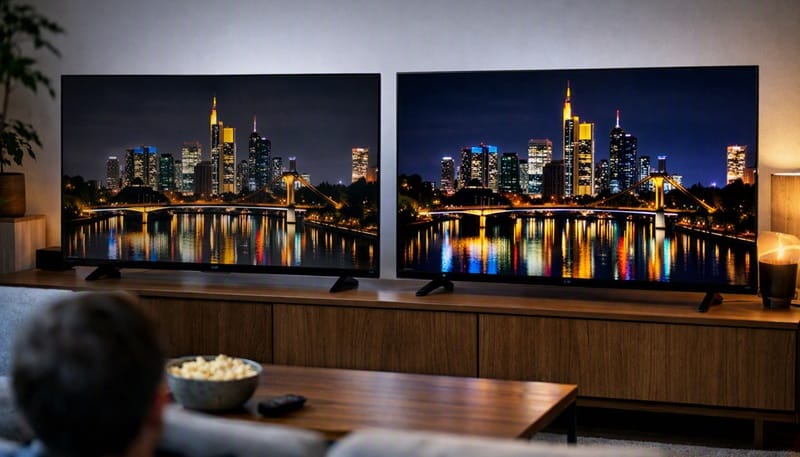
Local dimming lets a TV brighten and dim different backlight zones independently, so bright highlights and dark scenes can coexist on screen without one washing out the other. It’s the single hardware feature that separates these two TVs, and it drives most of the gap that follows.
The 55QN80H’s Zoned Backlight
The 55QN80H has that feature. Based on independent testing data, its zone precision is decent, with some haloing around very bright objects but well-controlled light spread around on-screen text like subtitles. Its native panel contrast is solid on its own, and local dimming stacks on top of that for deep, uniform blacks.
The 55M80H’s Single-Zone Limitation
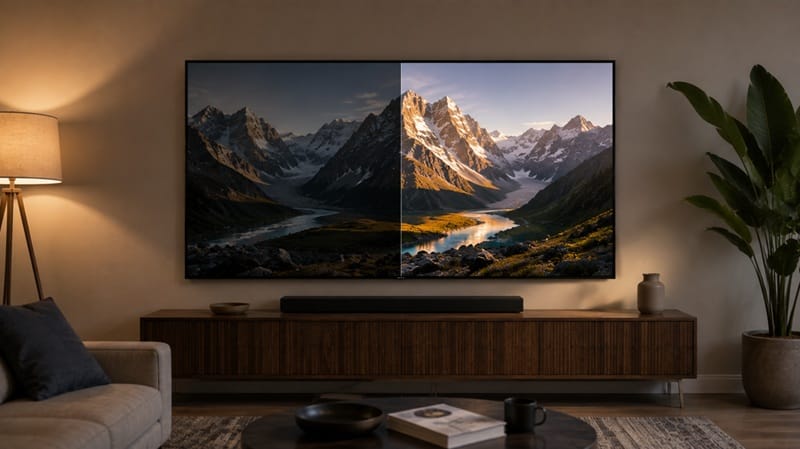
The 55M80H has no local dimming to fall back on. Its native panel contrast is close to the QN80H’s on paper, but without zoned dimming, blacks are raised across the whole screen instead of staying dark where the scene calls for it. In a dim room, this is the gap you’ll notice within the first few minutes.
HDR & SDR Brightness
Brightness compounds the contrast gap rather than offsetting it. According to RTINGS, the 55QN80H’s HDR brightness runs around 487 cd/m² in hallway-light scenes and 541 cd/m² on smaller highlights like a lit skyscraper window — enough for explosions and lens flares to actually stand out against the rest of the frame. RTINGS describes the 55M80H’s HDR brightness as not bright enough to deliver an impactful HDR experience at all, with small highlights failing to stand out and most content looking flat by comparison.
In SDR, the 55QN80H has strong peak brightness that handles daytime glare comfortably. The 55M80H’s SDR brightness is more modest — it can manage moderate glare but isn’t the right pick for a consistently sun-drenched room. Neither screen coating does much to cut the intensity of direct reflections, since both TVs use a glossy finish.
Gaming Performance: 144Hz, VRR & Motion Clarity
On paper, these TVs look like gaming twins. Both run a native 144Hz refresh rate, both support HDMI Forum VRR alongside FreeSync and G-Sync Compatible, and both can push resolution down to 1080p for an even higher 240Hz mode. Input lag is excellent on both sets, so competitive responsiveness isn’t a real reason to pick one over the other.
Motion clarity is where they split. Based on RTINGS’ lab testing on the 55M80H, its motion handling at maximum refresh rate is far blurrier than the QN80H’s — the QN80H isn’t flawless there either, but it holds up better in fast-moving content by a clear margin. If input lag is your only priority, the kind of setup where every millisecond counts in a competitive shooter, the M80H won’t hold you back. If clean motion matters too, the QN80H is the more complete gaming TV.
Price & Value
The 55M80H’s lower price makes sense for one specific buyer: someone watching mostly in a moderately-lit room, who doesn’t lean on HDR content, and wants Samsung’s 144Hz gaming feature set without paying for a working backlight. Outside that use case, the savings come directly at the expense of contrast — not a marketing footnote, but the TV’s single biggest performance gap.
The 55QN80H costs more because its backlight is doing more work: independently controlled dimming zones, a higher HDR brightness ceiling, and blacks that hold their own once the room lights go down. For dark-room viewing or regular HDR content, that’s what the price difference is paying for.
55M80H vs 55QN80H by Use Case
| Use Case | Winner | Why |
|---|---|---|
| Dark room movie nights | 55QN80H | Local dimming keeps blacks dark instead of gray |
| Bright living room, daytime TV | 55QN80H | Higher peak brightness handles glare more comfortably |
| Competitive gaming, input lag priority | Tie | Both TVs post excellent, near-identical input lag |
| Fast-paced console or PC gaming, motion clarity | 55QN80H | Noticeably less motion blur at max refresh rate |
| Tight budget, moderate-lit room only | 55M80H | Same core gaming features at a lower price |
Which Should You Buy?
For most buyers, the 55QN80H is worth the step up. Local dimming isn’t a minor feature on a TV — it’s the difference between a picture that looks intentional in a dark room and one that looks washed out. Both TVs already carry the same gaming-grade 144Hz panel and processor, so the extra cost is going toward a backlight that actually does its job, not toward features you’d pay for either way.
If your priority is matching Samsung’s gaming feature set at the lowest price, and you’re not watching in a dark room or leaning on HDR, the 55M80H covers that use case — just go in knowing the hardware isn’t built for real contrast, no matter what the Mini LED label suggests.
Also consider: Samsung 55QN70H — a true Neo QLED step below the QN80H that still includes local dimming, for buyers who want real contrast at a lower price than the QN80H.
Want the full performance picture straight from the source? Our Samsung 55QN80H review goes deeper on the QN80H specifically for readers who’ve already ruled out the M80H.
📍 These aren’t the only two Samsung Mini LED options worth a look. Our best 4K TVs of 2026 roundup sorts the current lineup by budget and panel type if neither model here is quite the fit.
Samsung 55M80H vs Samsung 55QN80H: Common Questions
Is the Samsung 55QN80H better than the 55M80H for watching movies at night?
Yes. The 55QN80H local dimming keeps blacks dark in low-light scenes, while the 55M80H lack of zoned dimming leaves dark areas looking gray and washed out. For a dedicated dark-room movie setup, the gap is significant enough to notice immediately.
Is the 55QN80H worth paying more for over the 55M80H?
For most buyers, yes. Based on RTINGS’ testing of the 55QN80H, the extra cost buys working local dimming, HDR brightness in the 490–540 cd/m² range versus HDR that RTINGS flagged as too dim to feel impactful on the 55M80H, and cleaner motion at max refresh — not just a bigger number on the box. If you rarely watch in a dark room and don’t care about HDR, that gap narrows, but it doesn’t close entirely.
Does the Samsung 55M80H actually have Mini LED local dimming?
No. Despite carrying Mini LED branding, independent testing found the 55M80H has no local dimming zones — its backlight operates as a single unit. The diodes may be physically smaller, but that alone doesn’t deliver the contrast benefit most buyers expect from the Mini LED name.
Will Samsung’s Mini LED naming get any clearer for shoppers going forward?
Probably not on its own. Mini LED describes diode size, not zone count, and that gap between the two is a labeling choice Samsung controls — nothing about it is likely to resolve itself as next year’s lineup arrives. Until the naming changes, the only reliable check is looking up a model’s actual zone count and local dimming behavior in independent testing before assuming the label guarantees contrast performance.
Why does Samsung market the 55M80H as “Mini LED” without local dimming?
Samsung uses Mini LED to describe the physical size of the diodes in the backlight, not whether those diodes are grouped into independently controlled zones — the two aren’t the same thing, even though most shoppers assume they are. That gap is exactly why checking independent test data on zone count and local dimming, rather than the name on the box, matters for a purchase like this one.

iYaiii
Editor, GearPulse360
iYaiii is the editor and founder of GearPulse360, specializing in TV reviews and consumer electronics. He researches every recommendation before publishing, cross-checking manufacturer specs against RTINGS lab data.
✅ Based on Samsung spec analysis and RTINGS data — last verified August 2026