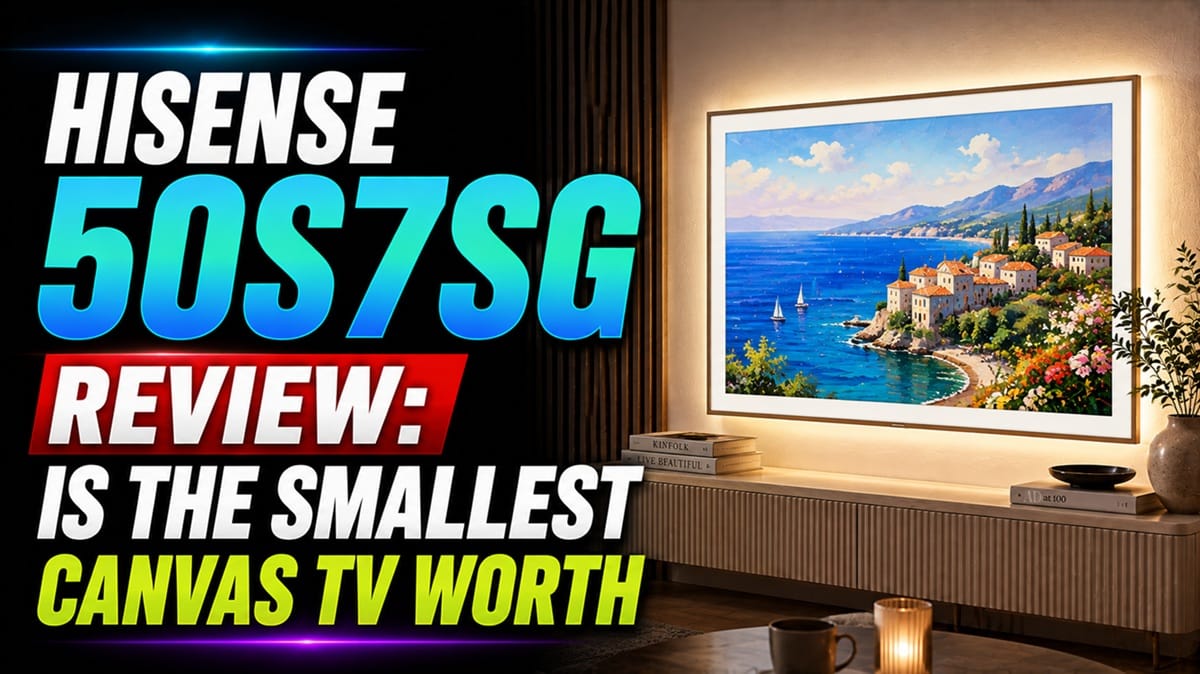
Hisense 50S7SG Review: Is the Smallest CanvasTV Worth It in 2026?
Last updated: August 2026
🕒 9 min read
Disclosure: As an Amazon Associate I earn from qualifying purchases. This article contains affiliate links — we may earn a small commission if you buy through them, at no extra cost to you.
Hisense already sells a 50-inch QLED built around picture quality for close to the same money. The 50S7SG isn’t that TV — it’s the smallest, newest size in the CanvasTV lineup, built around Art Mode and a swappable frame instead, and this Hisense 50S7SG review checks what RTINGS’ lab testing says you actually give up in exchange.
RTINGS bought and tested the 65-inch S7SG and states its findings carry over to every size in the line, including this 50-inch model, so the performance picture below isn’t pieced together from a spec sheet — it’s measured.
What that measurement shows is a TV built almost entirely around its Art Mode, with Hisense’s own budget-performance sets — like the U7SG Mini-LED line and the larger 85S7SG — sitting in a different tier for anything beyond casual daytime viewing.
Buyers weighing this against other budget and mid-tier sets releasing this year can start with our best 4K TVs of 2026 roundup, which breaks down how design-forward sets like this one compare with no-frills budget QLEDs at a similar size. The specific numbers behind that trade-off — and exactly where it falls apart — are below.
Table of Contents
Quick Verdict
At a Glance
★★★★★ 6.0 / 10
At a Glance
Picture Quality
Gaming
Design
Value
👍 Best For: Buyers who want the CanvasTV look — swappable frames, Art Mode, a flush wall mount — at the smallest, most affordable size in the line.
👎 Skip If: You care more about contrast, dark-room movie nights, or gaming than you do about how the TV looks when it’s turned off.
One-Line Verdict: The 50S7SG nails Hisense’s CanvasTV design at its smallest size, but the panel behind that design is a clear step below what Hisense already sells for similar money.
🛒 Check Availability on AmazonHisense 50S7SG Specs at a Glance
Product Specs
Hisense 50S7SG
Direct-Lit QLED (VA) · CanvasTV Art Mode · Google TV
| 🖥️ Panel | VA / Direct-Lit QLED, No Local Dimming |
| 🎮 Refresh Rate | 144Hz Native, Full VRR Suite |
| 🌈 HDR Formats | Dolby Vision, HDR10+, HLG |
| 📶 Smart Platform | Google TV |
| 🔌 HDMI 2.1 | 2 of 4 Ports |
| 🖼️ Design | CanvasTV Art Mode + 3 Swappable Frames |
| ✨ Screen Finish | Hi-Matte Anti-Glare Coating |
Design & Build Quality
Materials & Finish
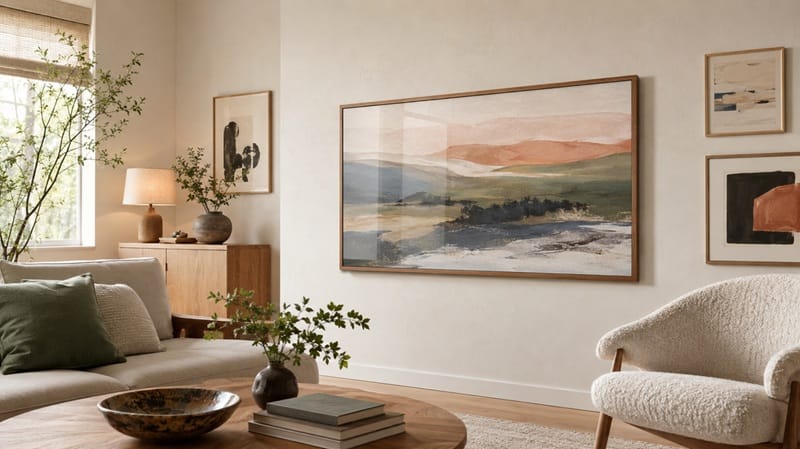
RTINGS’ testing rates the build quality a genuine strength — the wood-finish frame included in the box feels more premium than what you’d get on Hisense’s non-CanvasTV budget sets, which skip a decorative frame entirely, and the TV mounts nearly flush against the wall through Hisense’s UltraSlim wall mount.
According to Hisense’s own CanvasTV introduction, the whole point of the line is to read as a framed piece of art rather than a piece of electronics, and at 50 inches that illusion is easier to sell in a smaller room than it is on the 85-inch version.
The 50S7SG ships with a teak-finish frame; white and walnut versions sell separately if that doesn’t match your decor. Everything behind the frame is plastic, which is unremarkable but stays out of sight once the TV is mounted or standing on its feet.
Ports & Connectivity
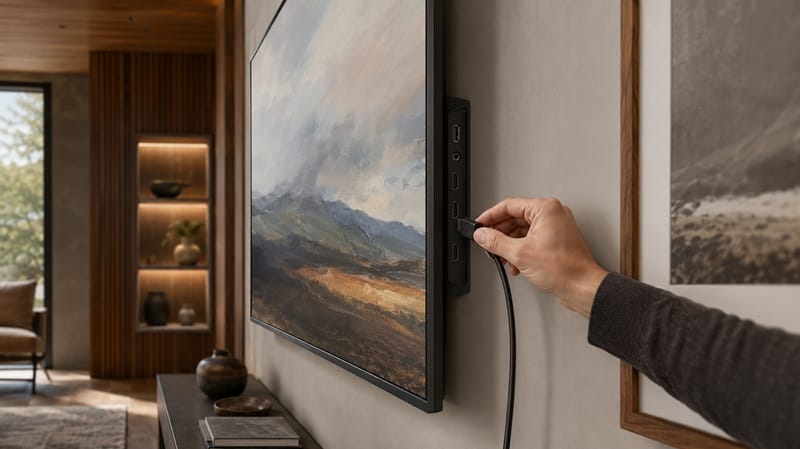
Most of the inputs sit toward the side of the panel, which keeps them reachable even with the TV mounted flush against the wall. Cable-management clips on the back help route wiring, though only two of the four HDMI ports carry full HDMI 2.1 bandwidth — the other two top out at HDMI 2.0, and the eARC connection lives on one of the lower-bandwidth ports.
Performance & Real-World Use
Everyday Streaming & Bright-Room Viewing
Daytime viewing is where this panel’s strengths actually line up with its marketing. Per the Hisense 50S7SG product page, the Hi-Matte coating pairs with an AI RGB light sensor that adjusts brightness and color temperature to the room.
RTINGS’ reflection testing found the matte finish does an excellent job cutting direct glare — bright windows and lamps barely register on screen. SDR peak brightness is good enough to push through that glare comfortably.
RTINGS also measured 86.4% DCI-P3 color coverage in SDR, which holds up in midtones but narrows in the brightest and darkest parts of the image — decent color for casual streaming, not reference-level.
Movie Nights & Dark-Room Viewing
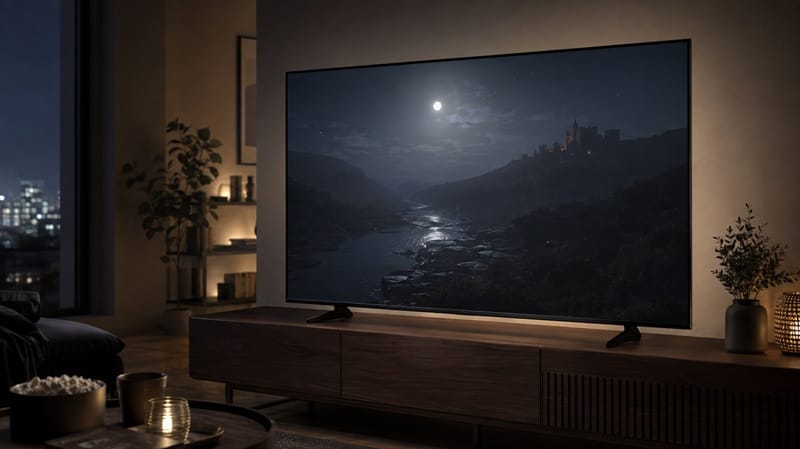
This is where the CanvasTV concept runs into the panel underneath it. RTINGS measured poor native contrast with no local dimming to compensate, so blacks read as gray rather than black even in a dark room, and dark scenes come across flat instead of punchy.
With HDR tone mapping enabled, RTINGS recorded peak brightness around 530 cd/m² for bright highlights and roughly 264 cd/m² for darker HDR scenes — numbers that support daytime content well but don’t do much for shadow detail once the lights go down.
Gaming
The spec sheet promises a lot here — 144Hz native refresh, HDMI Forum VRR, FreeSync, and G-Sync Compatible all supported with excellent input lag. RTINGS’ actual motion testing tells a different story: response time is poor at every refresh rate tested, and motion at the full 144Hz mode is described as very blurry. More on exactly how that breaks down below.
Key Features Breakdown
Art Mode & the CanvasTV Frame System
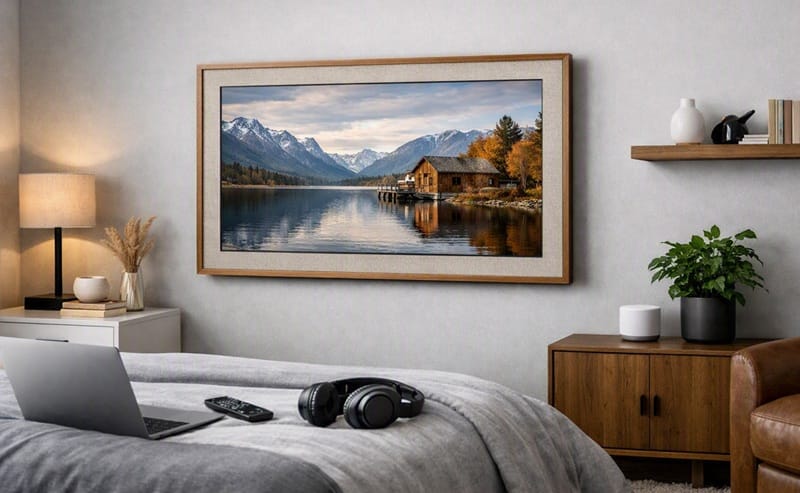
Art Mode is the real product here. A built-in motion sensor turns the display on with curated or personal artwork when someone walks into the room, and powers it back down when the room’s empty — Hisense says this keeps energy use in check, and RTINGS measured roughly 85W of consumption while Art Mode is active.
You can upload your own photos over USB or a QR-code phone link instead of relying only on Hisense’s built-in artwork selection.
144Hz Game Mode Pro & the VRR Suite
The console side of this is thoroughly covered: Auto Low Latency Mode, full VRR with Low Framerate Compensation for when frame rates drop, and 4K at up to 120Hz confirmed working on both the PS5 and Xbox Series X|S. RTINGS also found one hard ceiling worth knowing about — VRR stops working above 144Hz entirely, so a PC pushed to 1080p at 288Hz will show visible tearing instead of the smoother motion that refresh rate is supposed to deliver.
The Good, the Bad, and the Ugly
Pros
- ✅ Excellent glare control — the Hi-Matte coating nearly eliminates direct reflections, based on RTINGS testing.
- ✅ Premium-feeling build for the price — the included teak-finish frame and near-flush wall mount go further than most sets at this size.
- ✅ Complete gaming input suite — HDMI Forum VRR, FreeSync, G-Sync Compatible, and excellent measured input lag all check out.
Cons
- ❌ No local dimming — contrast stays flat in dark scenes with nothing to compensate for it.
- ❌ Split HDMI bandwidth — only 2 of 4 ports handle full HDMI 2.1, and eARC sits on one of the slower ones.
The Ugly
RTINGS tested motion at all three of the panel’s refresh rates, and the pattern doesn’t change: bad at the full 144Hz ceiling, still poor at 120Hz, and outright terrible at 60Hz — dropping the refresh rate doesn’t fix the underlying response time. Fast-moving objects show visible color and edge artifacts trailing behind them at every setting.
That’s hard to square with a TV that puts “144Hz Game Mode Pro” on the spec sheet as a headline feature. The mode exists and the VRR handshake works, but the panel itself can’t keep pace with what the marketing implies.
Who Should Buy This — and Who Shouldn’t
Buy This If
The 50S7SG makes the most sense for someone who thinks about a TV the way they’d think about buying a piece of furniture — it needs to look right in the room as much as it needs to perform well once it’s on. If that’s the priority, the larger Hisense 85S7SG review covers the same design formula scaled up, in case a bigger wall is on the table later.
It’s also a reasonable pick for anyone who mostly watches TV during the day, in a room with real ambient light, where the matte coating and decent SDR brightness do the most good. Buyers still comparing budget options before committing can check our Samsung Crystal UHD buying guide for how Samsung’s no-frills sets compare on price and picture quality at a similar size.
Skip This If
Anyone who watches movies in a dark room, plays fast-paced games at 144Hz, or just wants the best picture quality Hisense sells at this price should look elsewhere in Hisense’s own lineup — the Mini-LED U7SG series delivers meaningfully better contrast and motion handling for buyers who don’t need the art-mode frame.
Final Verdict
Is the Hisense 50S7SG Worth Buying?
RTINGS classifies the CanvasTV 2026 as a mixed-usage TV, and that label holds up at 50 inches specifically: strong for daytime viewing and Art Mode, weak once the room goes dark or the frame rate climbs. Going smaller didn’t cost this model anything RTINGS could measure — Hisense didn’t cut corners on the frame to hit this size, but it didn’t improve the panel underneath it either.
If picture quality and motion handling matter more to you than the frame, the Hisense 55U7SG review covers a Mini-LED alternative from the same brand that outperforms the 50S7SG in nearly every measured category except design. 🛒 Check Availability on Amazon
Frequently Asked Questions
Is the Hisense 50S7SG a good TV for the price?
It’s a stronger buy for the design than for the panel. RTINGS’ CanvasTV 2026 testing classifies it as a mixed-usage set — solid for daytime viewing, weak on contrast and motion — so it earns its price mainly on how it looks, not on what it does once the lights go down.
How does the 50S7SG compare to Hisense’s own U7SG series?
RTINGS’ side-by-side testing found the U7SG delivers significantly better contrast, full-array local dimming, higher peak brightness, and noticeably smoother motion for gaming than the CanvasTV line. The trade-off is that the U7SG doesn’t come with swappable frames or Art Mode.
Is the Hisense 50S7SG good for gaming?
The input suite is complete — full VRR, ALLM, and excellent measured input lag — but RTINGS found the panel’s actual response time poor at every refresh rate, with visibly blurry motion at 144Hz. Casual gaming is fine; fast-paced competitive titles are not this panel’s strength.
Who should avoid the Hisense 50S7SG?
Anyone prioritizing dark-room picture quality, high-motion gaming, or general HDR performance over design should look at a Mini-LED set instead — within Hisense’s own lineup, that’s the U7SG.
Does Art Mode drain power or fill the screen with ads?
RTINGS measured roughly 85W of power draw while Art Mode is active, which is modest for a TV-sized display running continuously. The broader Google TV interface does carry ads that can’t be fully disabled, though Hisense’s Basic TV mode strips most smart features in exchange for an ad-free experience.

iYaiii
Editor, GearPulse360
iYaiii is the editor and founder of GearPulse360, specializing in TV reviews and consumer electronics. He researches every recommendation before publishing.
✅ Based on spec analysis and Hisense’s official and RTINGS data — last verified August 2026