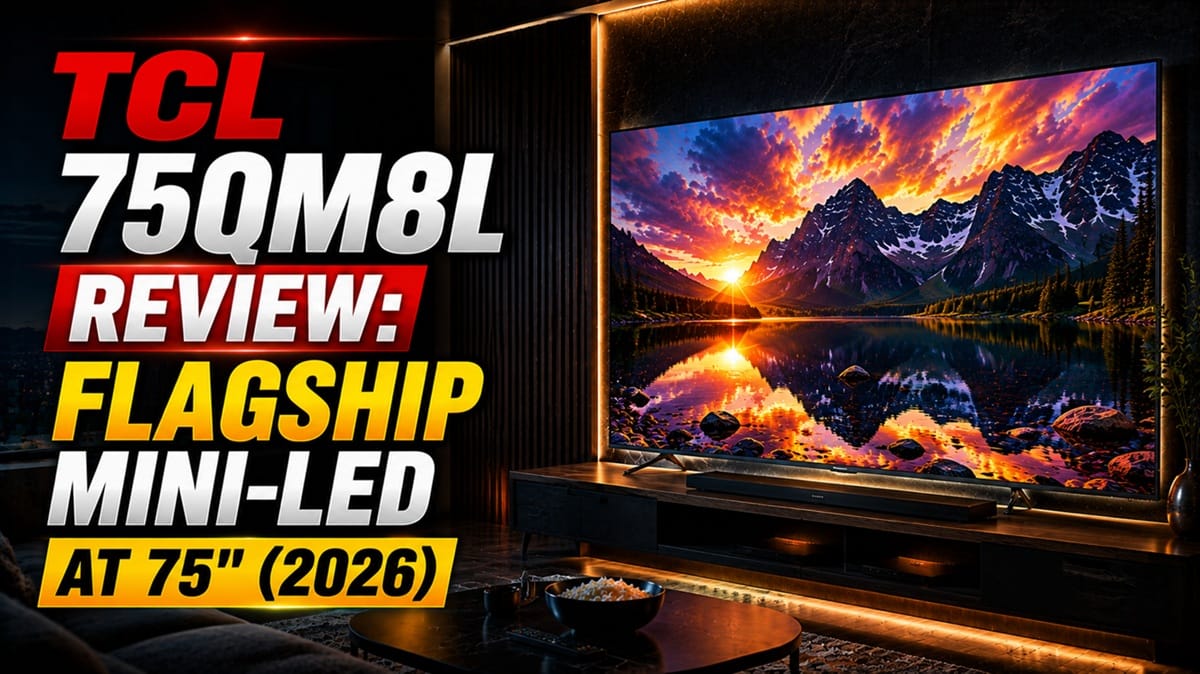
TCL 75QM8L Review: Flagship Mini-LED at the Size Most Living Rooms Actually Fit
Last updated: August 2026
🕒 9 min read
Disclosure: As an Amazon Associate I earn from qualifying purchases. This article contains affiliate links — we may earn a small commission if you buy through them, at no extra cost to you.
Most TV-size guides land on one number for a standard living room, and it isn’t the size most flagship reviews get written about. TCL sells the QM8L in four sizes.
This TCL 75QM8L review covers the one that matches typical seating distance — bigger than the 65-inch model most coverage defaults to, without the wall space a 98-inch panel demands.
Based on independent testing data and TCL’s own published specifications, this review checks whether that mid-size QM8L gives up anything against its siblings, and where TCL’s flagship Mini-LED formula still comes up short against OLED.
Buyers still sorting out screen size before anything else can start with our best 4K TVs of 2026 roundup, which breaks down sizes and panel types side by side. The spec sheet on this one changes more than the headline number suggests.
Table of Contents
TCL 75QM8L Quick Verdict
At a Glance
★★★★★ 8.4 / 10
At a Glance
Picture Quality
Gaming
Audio
Value
👍 Best For: Buyers whose room and seating distance call for 75 inches rather than 65 or 98, who want flagship-level brightness and contrast for movies, sports, and console or PC gaming.
👎 Skip If: You sit close enough for off-angle seats to matter, or HDR color accuracy out of the box is a higher priority than raw brightness.
One-Line Verdict: The TCL 75QM8L brings flagship Mini-LED brightness and contrast to a mainstream living-room size, with HDR color accuracy as the one real trade-off.
🛒 Check Availability on AmazonProduct Specs at a Glance
Product Specs
TCL 75QM8L
SQD-Mini LED (VA/WHVA 2.0) · Halo Control local dimming · Google TV
| 🔆 Peak Brightness | Up to 6,000 nits (series max) |
| 🎛️ Local Dimming Zones | Up to 4,000 (series max) |
| 🖥️ Panel Type | VA, WHVA 2.0 wide-angle layer |
| 🔁 Refresh Rate | 144Hz native, Game Accelerator 288 |
| 🎮 Gaming | 4x HDMI 2.1, VRR, ALLM |
| 🌈 HDR Formats | Dolby Vision, HDR10+, HDR10, HLG |
| 📺 Smart Platform | Google TV, Google Gemini |
Design & Build Quality
Materials & Finish
The 75QM8L carries the same design language as the rest of the 2026 QM8L line: thin bezels on all four sides and a center pedestal stand that leaves room for a soundbar without blocking the screen.
Based on TCL’s published spec sheet for the QM8L series, the stand offers a high and low mounting position, and the back panel uses the same textured finish as TCL’s step-up X11L model.
Build quality holds up at this size. RTINGS’ inspection of the unit found no visible flex around the panel edges and no quality-control issues out of the box, with a plastic chassis that reads as more solid than the price suggests.
That detail matters more at 75 inches, where a thin panel can look cheaper simply because there’s more of it to see.
Ports & Connectivity
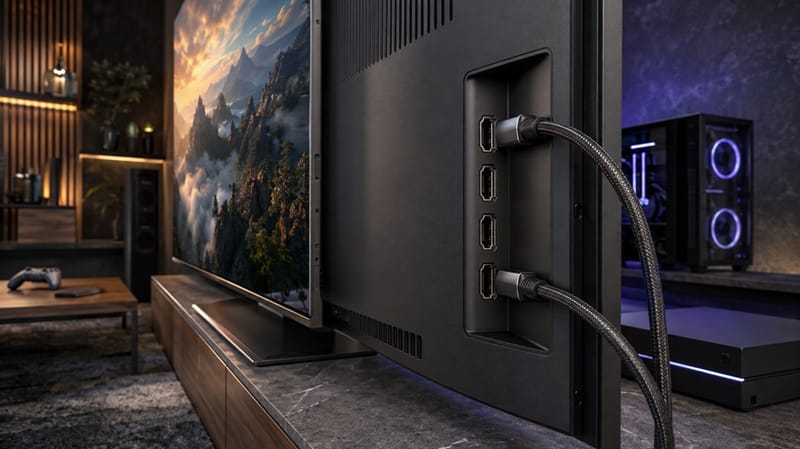
All four HDMI inputs support full HDMI 2.1 bandwidth, so 4K 144Hz and VRR aren’t limited to a single “gaming” port the way they are on some competing sets.
RTINGS notes the ports sit in a recessed cutout on the back with dedicated cable guides — tidy for cable routing, but harder to reach once the TV is mounted flush against a wall.
Performance & Real-World Use
Movies & Dark Room Viewing
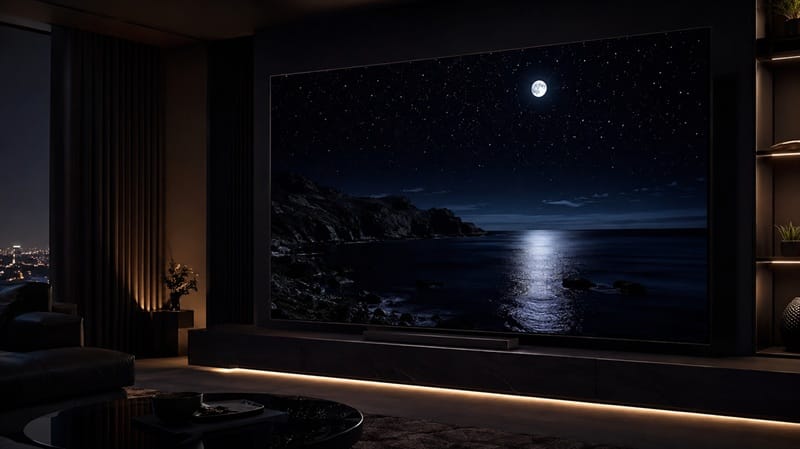
Contrast and black levels are the strongest part of this TV’s picture. Based on TCL’s own 75QM8L product page and independent testing data, the set delivers excellent contrast and near-perfect black uniformity.
RTINGS’ zone-transition testing found the backlight system precise enough to control oddly shaped bright objects like subtitles without a noticeable halo around them.
Fast-moving bright objects transition between zones cleanly too, per that same testing, with only a slight flicker effect as they cross zone boundaries — not the smeared halo trail that gives cheaper Mini-LED sets away.
Zone count shifts by size within the line, and the marketing figure alone doesn’t capture that. RTINGS’ own size-comparison data lists the 75-inch model at roughly 2,584 dimming zones and an advertised peak brightness around 5,500 nits.
That’s short of the 98-inch model’s 4,032 zones and the series’ full 6,000-nit ceiling, but well ahead of the 65-inch model most reviews default to.
Bright Room & Daytime Viewing
Brightness is the 75QM8L’s clearest strength. RTINGS measured the QM8L as bright enough to comfortably overcome glare in a well-lit room, with small highlight details capable of pushing well past 5,000 nits in short bursts.
RTINGS rates direct reflection handling as only average, though — TCL’s glossy finish reduces reflection intensity somewhat, but bright windows and lamps remain clearly visible rather than diffused away.
Gaming
Console and PC gamers get a fully stocked feature set here: all three major VRR standards, Auto Low Latency Mode, and input lag RTINGS describes as excellent once Game Master mode is active.
The one caveat is motion clarity at the TV’s own 144Hz ceiling. RTINGS’ clarity testing found it slow enough at maximum refresh rate that fast panning still shows real motion blur.
That means the high refresh number reads better on a spec sheet than it plays in the fastest-paced titles.
Key Features Breakdown
Halo Control Local Dimming
TCL’s Halo Control system is the reason this TV can push both high brightness and deep, uniform blacks without the obvious blooming that plagues cheaper Mini-LED sets.
RTINGS’ zone-precision testing found scattered bright highlights against a dark background — subtitles, a candle in a dark room — stay controlled instead of surrounded by a gray halo.
Super Quantum Dot Color
The SQD color layer is what lets the 75QM8L hit wide color coverage without the color-crosstalk issue RTINGS found on some RGB Mini-LED competitors, where whites can pick up an unwanted tint depending on the scene.
The trade-off, covered below, is that punchy color volume doesn’t automatically mean accurate color out of the box.
The Good, the Bad, and the Ugly
Pros
- ✅ Bright enough to beat glare in any room — daytime sports and bright-room streaming both stay watchable without dimming the lights.
- ✅ Deep, uniform blacks — Halo Control keeps dark scenes clean instead of blotchy, even with bright highlights scattered across the frame.
- ✅ Complete gaming feature set — 4 HDMI 2.1 ports, full VRR support, and excellent input lag in Game Master mode.
Cons
- ❌ Only average direct reflection handling — the glossy finish tones down bright reflections slightly but doesn’t diffuse them the way a true anti-glare coating would.
- ❌ Picture washes out quickly off-angle — this is a VA panel at heart, so color and contrast drop noticeably once you’re seated well to the side.
The Ugly
HDR color accuracy is the real weak point here. RTINGS’ pre-calibration testing measured sub-par HDR accuracy out of the box, and a full calibration doesn’t fully close the gap.
Color and luminance errors stay visible across the spectrum, driven mainly by how aggressively the TV maps brightness rather than by hue errors alone. Buyers prioritizing reference-grade HDR color over raw brightness should treat this as a real limitation, not a spec-sheet footnote.
Who Should Buy This — and Who Shouldn’t
Buy This If
The 75QM8L makes the most sense for buyers who’ve already worked out that 75 inches, not 65 or 98, is the size their room and seating distance call for.
Choosing a TV size ideally works the way choosing a couch does — not the biggest one that technically fits through the door, but the one sized to the room you sit in every day.
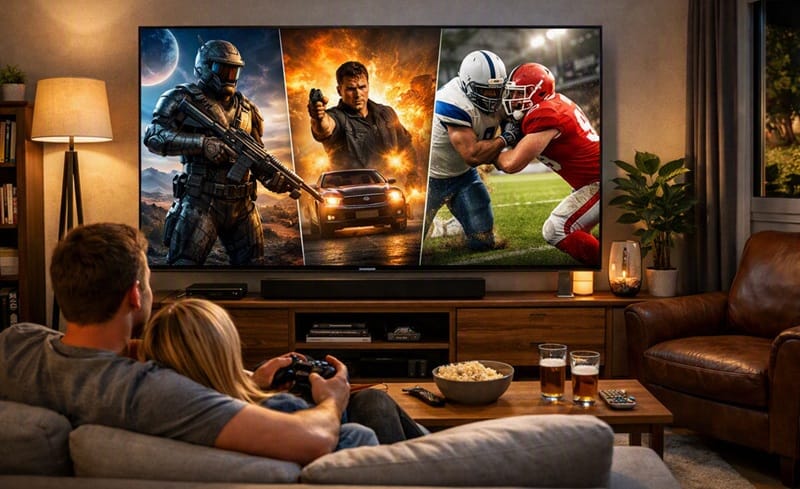
For that buyer, this TV delivers flagship-level brightness and contrast without stepping up to TCL’s true flagship X11L. It also suits anyone splitting their viewing between movies, live sports, and gaming, since none of those uses forces a real trade-off elsewhere in the lineup.
Buyers still comparing Mini-LED against OLED at this size should read our OLED vs Mini LED compared breakdown before deciding, since the trade-offs shift depending on room lighting and seating angle.
For buyers still torn on which size within TCL’s own flagship line makes sense, our TCL 98QM8L review covers how the formula changes at the largest size TCL offers.
Skip This If
Skip the 75QM8L if your seating includes wide side angles. This is a VA panel, and its viewing cone is narrower than an OLED or QD-OLED set’s — a wide couch facing a 75-inch screen will make that limitation obvious fast.
Skip it too if HDR color accuracy out of the box matters more to you than brightness. Hisense’s U8QG measures meaningfully more accurate in HDR according to RTINGS’ side-by-side testing.
That makes the U8QG the better pick for dedicated home theater use, even though the two TVs are close everywhere else.
Skip the 75QM8L too if flagship-tier pricing is the real sticking point rather than any one feature. TCL’s own TCL 75F7D review looks at a much cheaper 75-inch model from the same brand, once the Mini-LED backlight, 4,000-zone dimming, and 144Hz panel are all taken off the spec sheet.
Final Verdict
Is the TCL 75QM8L Worth Buying?
This TCL 75QM8L review comes down to a simple trade: flagship-level brightness, contrast, and gaming features at a size most living rooms are actually built around, in exchange for HDR color accuracy that never fully catches up even after calibration.
Against the similarly priced Hisense U8QG, the two trade wins depending on priority — the U8QG for HDR accuracy and home theater use, the 75QM8L for overall brightness and more uniform dark-scene control.
For buyers still deciding between Mini-LED and OLED at this size, our OLED vs Mini LED for sports comparison is a useful next read, especially for anyone splitting time between movies and live sports on the same TV. 🛒 Check Availability on Amazon
Frequently Asked Questions
Is this TCL 75QM8L review based on the 75-inch model specifically?
Not directly. RTINGS’ QM8L review purchased and tested the 65-inch model, and states its core findings extend to the 75-, 85-, and 98-inch versions since all four share the same panel design, processor, and feature set.
Zone count and advertised peak brightness still scale up with size, though. RTINGS’ own size-comparison data puts the 75-inch model at roughly 2,584 zones and around 5,500 nits, against the 65-inch model’s 2,040 zones.
The Spec Card above lists the series-wide ceiling (up to 4,000 zones, 6,000 nits) instead, since that figure belongs to the largest size in the line, not this one — the 75-inch numbers here are the ones that actually apply to this review.
TCL 75QM8L vs Hisense U8QG — which should you buy?
Based on RTINGS’ side-by-side testing, the two are close enough that there’s no clear overall winner. The 75QM8L controls its dimming zones more precisely for a more uniform dark-scene image.
The U8QG, meanwhile, is noticeably more accurate in HDR and shows less banding, making it the better pick specifically for dedicated home theater viewing.
Is the TCL 75QM8L good for gaming?
Yes, for most gaming. It supports all three major VRR formats, Auto Low Latency Mode, and four full-bandwidth HDMI 2.1 ports, with excellent input lag in Game Master mode.
The one exception is motion clarity in the fastest-paced titles — response time is slow enough at the TV’s peak refresh rate that visible blur remains during quick panning.
Who should avoid the TCL 75QM8L?
Buyers with wide seating angles relative to the screen — this VA panel’s narrow viewing cone shows up fastest for side seats — and anyone prioritizing accurate HDR color reproduction over raw brightness. The Hisense U8QG or a QD-OLED model are both stronger fits for that specific priority.
Does the TCL 75QM8L need a soundbar?
Not strictly, but it’s a reasonable upgrade. Based on RTINGS’ testing, the built-in Bang & Olufsen-tuned speakers deliver a well-balanced, clear sound profile at normal volume with more bass than most TVs manage on their own.
There’s noticeable thumping at maximum volume, though — a budget soundbar would clean that up for movie-heavy use.

iYaiii
Editor, GearPulse360
iYaiii is the editor and founder of GearPulse360, specializing in TV reviews and consumer electronics. He researches every recommendation before publishing.
✅ Based on spec analysis and TCL’s official and RTINGS data — last verified August 2026