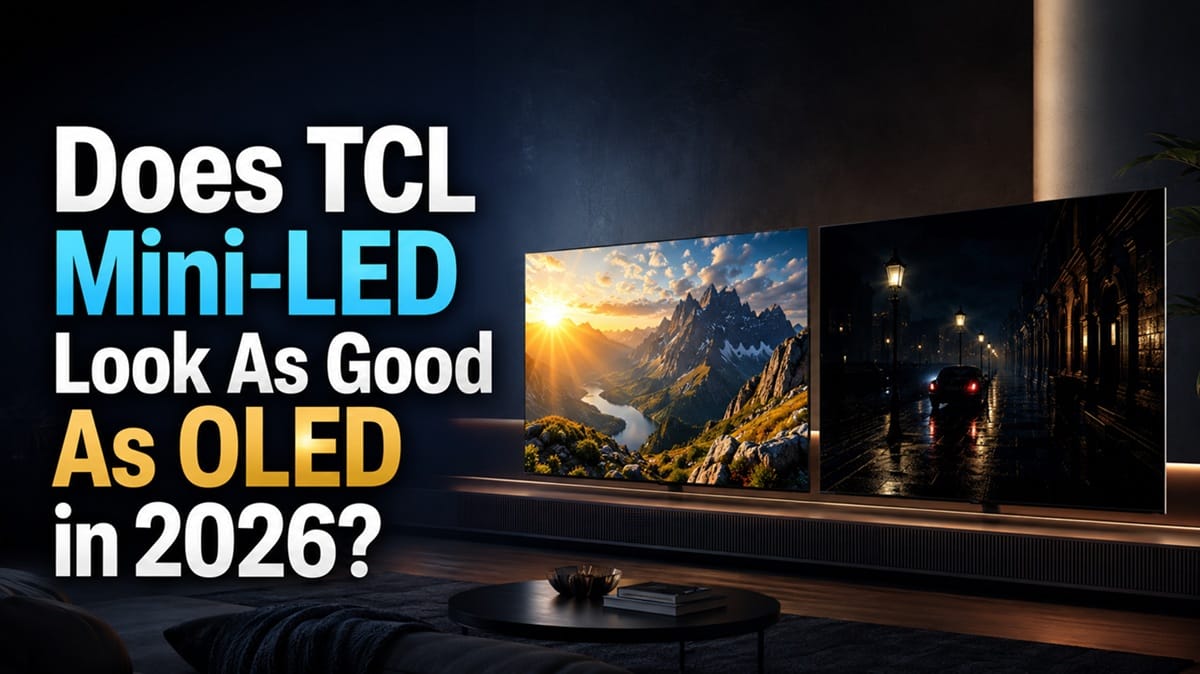
Does TCL Mini-LED Look As Good As OLED? Here’s Where It Wins and Where It Still Doesn’t
Last updated: July 2026
🕒 8 min read
Disclosure: GearPulse360 participates in the Amazon Associates Program. This particular article contains no affiliate links; other content on our site may.
A TCL Mini-LED spec sheet reads a lot like a flagship OLED’s these days — deep blacks, Dolby Vision, thousands of dimming zones, peak brightness numbers that sound almost made up. Put the two TVs next to each other playing the same content, though, and the differences show up fast, just not always where you’d expect.
Does TCL Mini-LED look as good as OLED? The answer splits by category. A few of the metrics below show TCL closing in fast; a few others are still decided by how each panel is physically built, and haven’t moved much in years.
The comparisons that follow use lab-tested contrast, black uniformity, and motion data instead of spec-sheet numbers. If you want the software side of the picture too, our breakdown of TCL QM8K motion blur covers a related complaint that shows up in exactly the scenario where Mini-LED still trails.
Table of Contents
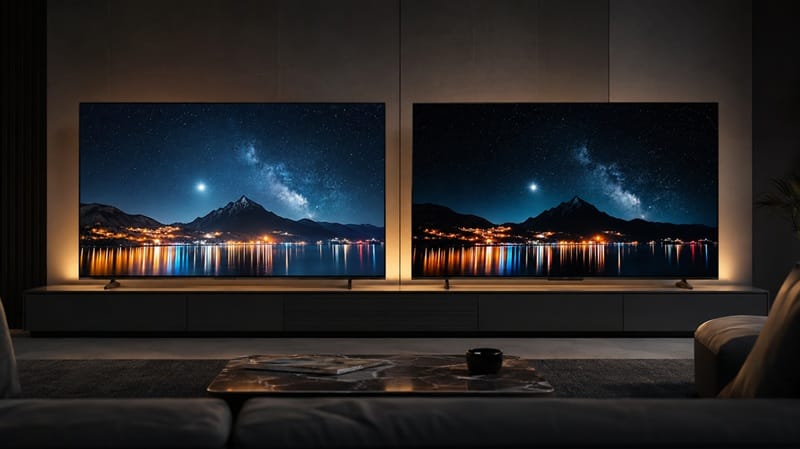
The Short Answer: Does TCL Mini-LED Look As Good As OLED?
Not quite, but it’s closer than it used to be. TCL’s current Mini-LED lineup has caught up on peak brightness and made real gains in black uniformity and dimming precision, but OLED still wins outright on contrast, motion clarity, and viewing angle. Whether that gap matters to you depends heavily on your room and how you watch.
Panel performance is only one piece of ownership, though. Day-to-day software stability is a separate question from picture quality, and it’s worth knowing about on its own terms — we’ve covered a specific TCL Google TV freezing or stuck in a reboot loop issue separately for anyone who’s run into it or wants to know what to watch for.
What Actually Separates a TCL Mini-LED From an OLED
How TCL’s Mini-LED Panel Produces Its Picture
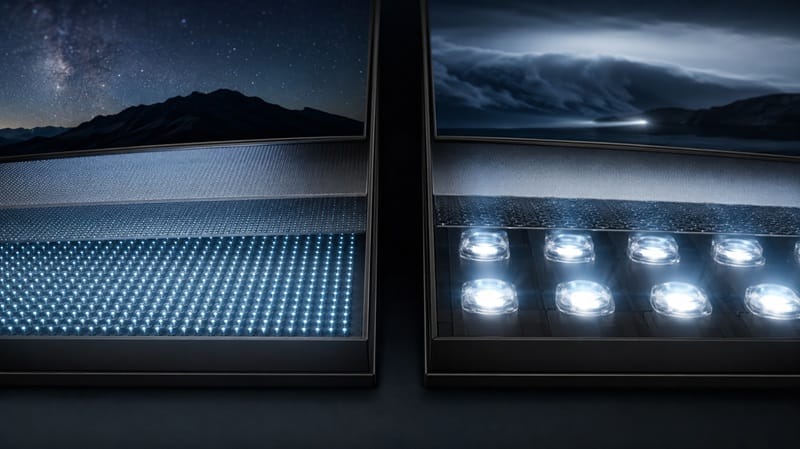
TCL’s higher-end Mini-LED sets, including the QM8L, use a backlight made of individually dimmable LED zones — 2,040 of them on the 65-inch model, scaling up to 4,032 on the 98-inch, per RTINGS’ size breakdown — sitting behind an LCD panel, paired with what TCL calls Super Quantum Dot (SQD) color filtering. The panel controls brightness in zones rather than per pixel, which is the root of most of the differences below.
How OLED Produces Its Picture Differently
OLED skips the backlight entirely. Every pixel emits its own light and can be switched fully off, which is why OLED starts from a structural advantage in anything involving small, precise areas of brightness next to true black — subtitles, credits, starfields, and similar content.
Where TCL Mini-LED Has Actually Closed the Gap
Everything below focuses on TCL’s step-up Mini-LED tier, where zone counts and SQD color filtering are strongest. Budget TCL sets trade some of that hardware away to hit a lower price, and the differences aren’t limited to backlight zones — HDMI port specs shift too, which our TCL budget TV picture quality and HDMI features breakdown covers on its own.
Brightness
Brightness is where the category gap is most decisive. RTINGS measured the 65-inch QM8L exceeding 6,000 nits on a 5% HDR window during its published testing of the model, putting it ahead of rival Mini-LED sets like the Sony BRAVIA 7 II and the Hisense UR9SG in that same review. Across the roughly 45 Mini-LED and OLED models RTINGS has tested under its current methodology, Mini-LED holds a clear average lead on brightness score, and the gap widens further on full-screen, 100% HDR content — the kind a bright sports broadcast produces.
Black Uniformity and Local Dimming Precision
Local dimming precision has moved further than raw brightness has. RTINGS’ QM8L review describes the TV’s zone control as handling oddly shaped bright objects, like subtitles, with very little haloing, and rates its black uniformity as excellent — close to zero variation with local dimming on, and still clean with no distracting flashlighting when dimming is switched off. That’s a step up from earlier TCL Mini-LED generations, even though it’s still zone-based rather than per-pixel control.
Color Volume Without the RGB Trade-Off
TCL’s SQD approach also sidesteps a flaw some newer RGB Mini-LED designs carry: color cross-talk in complex, saturated scenes. RTINGS’ review notes the QM8L’s HDR color volume lands close to the Hisense UR8SG, an RGB Mini-LED model, without the crosstalk that TV shows.
For the full picture across every test category, not just the ones TCL is closing in on, our OLED vs Mini LED compared guide breaks each one down individually.
And if brightness and black levels aren’t the only things on your list, our best 4K TVs of 2026 roundup groups current picks by panel type and price range, so you’re weighing TCL against the right competitors rather than judging it in isolation.
Where OLED Still Wins, and By How Much
The gains above share a common thread: brightness, zone count, and color filtering are engineering problems that scale with R&D budget, which is exactly the kind of gap a company the size of TCL can keep closing year over year. The three categories below don’t work that way — they trace back to backlit LCD versus self-emissive pixels, a difference no amount of zone-count investment fully erases.
Contrast is the clearest example. RTINGS’ side-by-side of a Sony BRAVIA 9 Mini-LED and an LG G5 OLED measured the Mini-LED’s contrast at roughly 293,000:1, against effectively infinite contrast on the OLED — and even at that ratio, the darkest parts of the Mini-LED’s image carried a faint bluish glow the OLED didn’t produce. Motion clarity tells a similar story: response-time testing consistently shows OLED transitioning between shades almost instantly, while the TCL QM8L’s own review notes high motion blur at higher refresh rates, since even a well-tuned Mini-LED panel is still slower than any OLED currently on the market.
Viewing angle is where the difference is most obvious in a real living room. RTINGS’ testing puts the QM8L’s viewing angle performance in mediocre territory — off-axis viewing brings noticeable color washout, with the blue channel losing accuracy fastest, a known LCD limitation that panel tweaks like TCL’s WHVA reduce but don’t eliminate. OLED panels, especially QD-OLED variants, hold color accuracy much further off-axis, which matters most if you sit off-center or have a wide couch.
Does TCL Mini-LED Look As Good As OLED For You?
Buy TCL Mini-LED If…
You watch mostly in a bright or mixed-light room, want the largest screen for your budget, or care more about sports and daytime viewing than reference-level dark-room accuracy. Our TCL 75QM64L review covers what that trade-off looks like at a specific size and price point.
Consider OLED Instead If…
Your room is dark most of the time you watch, you sit off-center on a wide couch, or fast panning and camera motion bother you more than most viewers. None of that makes Mini-LED a worse TV outright — it just means the categories where OLED wins happen to matter most for how you watch.
FAQs: TCL Mini-LED vs OLED
Does TCL Mini-LED look as good as OLED for movies and dark scenes?
Not quite. In a dark room, OLED still produces deeper, more uniform blacks with none of the faint halo effect that even a well-tuned Mini-LED shows around bright highlights, according to RTINGS’ side-by-side testing of Mini-LED against OLED. OLED remains the stronger choice for a dedicated home theater setup, even though TCL’s newest Mini-LED models get closer than earlier generations did.
Does more dimming zones mean a TCL TV automatically matches OLED contrast?
No. Zone count correlates loosely with better black-level performance, but the relationship is noisy — the processing behind each zone matters more than the raw number. A TV with fewer, well-controlled zones can outperform one with more zones and weaker algorithms.
Will TCL’s Mini-LED picture quality vary much between screen sizes?
Slightly. Larger TCL Mini-LED models generally add more dimming zones and a bit more peak brightness as the screen size increases, but the underlying panel technology and picture character stay consistent across the lineup rather than changing dramatically size to size.
How does this comparison change for fast motion and sports?
Motion is one of the areas where the gap stays widest. Our dedicated breakdown of OLED vs Mini LED for sports goes deeper into response time and motion blur specifically, which matters more for live sports and fast-paced games than for slower content.
Will future TCL Mini-LED TVs eventually match OLED completely?
They’ll likely keep narrowing the numbers on brightness, zone count, and uniformity — those are engineering and cost problems, and TCL has shown steady year-over-year progress on exactly those fronts. Contrast and motion clarity are a different story: they come down to backlit LCD versus self-emissive pixels, and that gap won’t close without TCL moving to a different panel technology altogether.

iYaiii
Editor, GearPulse360
iYaiii is the editor and founder of GearPulse360, specializing in TV reviews and consumer electronics. He researches every recommendation before publishing.
✅ Based on TCL’s official specifications and RTINGS data — last verified July 2026