TV Warranty vs. Lifespan: Why Your Coverage Window Closes Long Before the TV Does
Last updated: August 2026
🕒 8 min read
Disclosure: GearPulse360 is a participant in the Amazon Associates Program. This article does not contain product recommendations or affiliate links — it’s intended for general educational purposes.
Your TV dies in year four. You go looking for the receipt, half-hoping the warranty still applies, and then you remember: it expired three years ago. That gap between “still working fine” and “still covered” catches a lot of TV owners off guard, and it’s not a coincidence or a sign something was wrong with your set.
If you’re searching for tv warranty vs lifespan, you’re probably staring down a repair bill outside the coverage window, or you’re about to buy a TV and want to know whether the standard warranty is actually enough. Based on manufacturer warranty documentation and independent longevity testing, the short version is this: warranty length and expected lifespan are two different numbers set for two different reasons, and manufacturers were never promising the two would match.
The rest of this piece stays narrow on purpose: why that gap exists, what a standard warranty actually covers, and how to tell if your situation calls for extended coverage. We’ve separately covered how long OLED TVs last in full — what’s below isn’t that; it’s just the warranty clock, and why it stops ticking so much earlier than the TV does.
Table of Contents
The Short Answer: TV Warranty vs. Lifespan
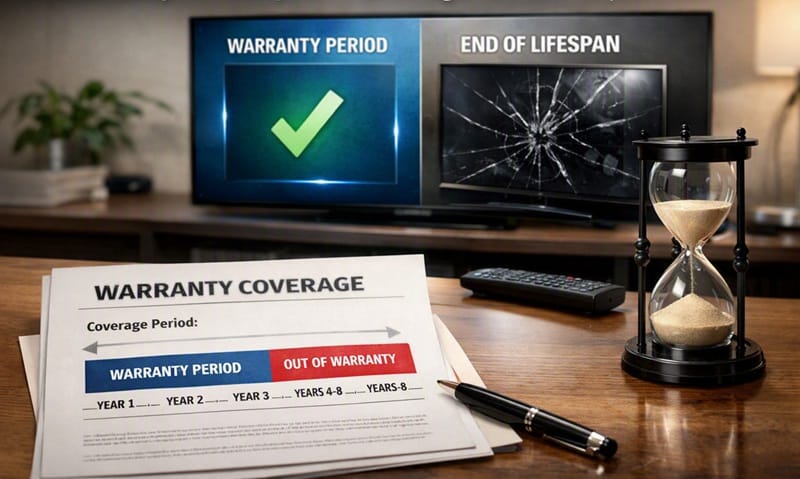
A standard TV warranty typically covers one year of parts and labor. A modern TV’s realistic usable life runs well beyond that — commonly seven to ten-plus years under normal household use, per independent longevity testing. The warranty period is a business decision tied to early-failure risk and cost, not an estimate of how long the TV is built to last.
What a TV Warranty Actually Covers
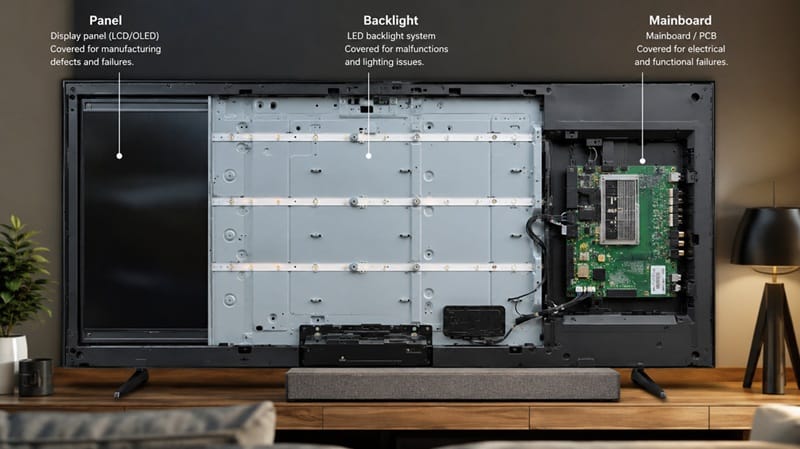
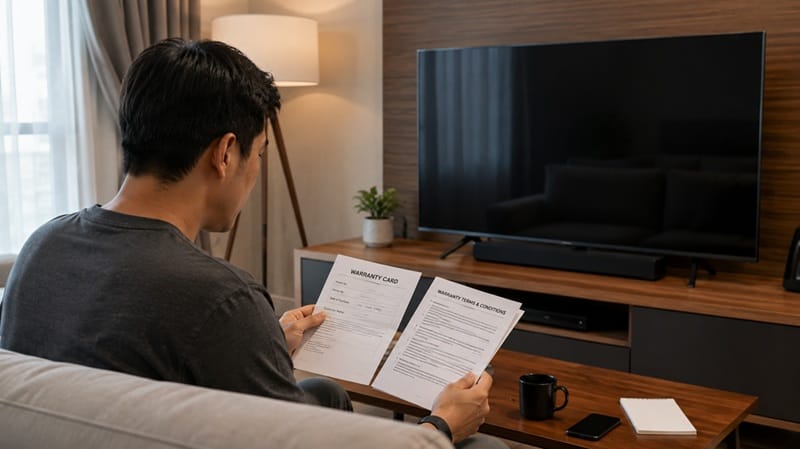
Most manufacturers structure the standard warranty around a single number: one year from the date of purchase, covering defects in materials or workmanship under normal use. LG’s official warranty terms, for example, spell out parts and labor coverage for that first year, with replaced components covered for the remainder of the original period or a short extension, whichever is longer.
Why One Year Is the Default
Electronics tend to follow what’s known as a “bathtub curve” of failures — a short spike of early defects right after manufacturing, then a long stretch of low failure rates, then a rise again as components age. A one-year window is built to catch that early spike: the manufacturing defects, DOA units, and infant-mortality failures that show up fast. It isn’t designed to track the TV all the way to the end of its usable life.
What Falls Outside Standard Coverage
Physical damage, power surges, and issues tied to the environment the TV sits in are typically excluded from the start, regardless of how much time is left on the warranty. Most standard warranties are also non-transferable per manufacturer specifications, applying only to the original purchaser — which matters if you’re buying secondhand.
Why the Gap Between Warranty and Lifespan Exists
The disconnect isn’t an accident of paperwork. Warranty length gets set by risk and claims cost; lifespan gets set by component durability and testing. They’re calculated by different people for different reasons, which is exactly why they land on such different numbers.
Warranty Length Is a Risk Calculation
A warranty period is priced around the statistical likelihood of an early failure, not the full expected life of the product. Extending it costs the manufacturer money in claims and service overhead, so the window tends to sit just past the point where most manufacturing defects would already have surfaced. It’s a bit like a car’s bumper-to-bumper coverage: short by design, because it’s meant to catch build issues, not carry the vehicle for its whole working life.
Lifespan Is a Testing and Component Question
Independent longevity testing measures something the warranty card never touches: how long the hardware actually holds up under real use. RTINGS runs an ongoing accelerated durability program built specifically to track how current TVs age under extended, continuous operation — the kind of question a one-year warranty period was never designed to answer. That testing exists precisely because component durability and warranty length are set by two entirely different processes. If a return window and a warranty claim ever end up overlapping on the same purchase, our piece on the warranty claim return window covers how those two timelines actually interact.
That longevity data is also worth factoring in if you haven’t bought yet. Our best OLED TVs of 2026 roundup weighs reliability track record alongside picture quality, not specs alone.
Does a Longer Warranty Mean a Longer Lifespan?
Not necessarily, and this is the misconception that surfaces most often when shoppers compare two models with different warranty lengths side by side. A brand offering a longer standard warranty isn’t automatically making a stronger claim about how long the panel will physically last. It may simply be absorbing more risk, competing on a specific feature, or covering a component, like an OLED panel, that has a known, narrower failure profile it wants to insure against.
The reverse is also true: a shorter one-year warranty doesn’t mean the manufacturer expects early failure. Warranty length correlates more closely with company policy and component insurance strategy than with actual expected product lifespan, based on a review of manufacturer documentation across brands.
What This Means for You in Practice
Who Should Pay Attention to This
If you’re weighing an extended warranty at checkout, this gap is exactly what that decision comes down to — you’re paying to cover years the standard warranty simply doesn’t reach, not to fix a defect the manufacturer is hiding. If you’re on the fence about that add-on, our breakdown of whether extended warranty coverage is worth it walks through when it tends to pay off and when it doesn’t.
Who Doesn’t Need to Worry
If your TV is still inside its first year and functioning normally, there’s nothing here that should change how you use it. The bathtub-curve pattern means the highest-risk window for defects is also the one you’re already covered for — the gap only becomes relevant once that first year has passed.
FAQs: TV Warranty vs Lifespan
Why is my TV warranty so much shorter than how long the TV actually lasts?
The tv warranty vs lifespan gap exists because warranty length is priced around early manufacturing defects, not the TV’s full working life. RTINGS’ accelerated longevity testing program is built specifically to track how long a TV’s components hold up over extended use — a question the one-year warranty period was never designed to answer.
Does a 1-year warranty mean my TV is only built to last a year?
No. A one-year warranty reflects the window manufacturers use to catch early defects, not an estimate of the product’s total lifespan. Manufacturer specifications and independent testing both point the same direction: most TVs are engineered to run far longer than the warranty period suggests.
What should I do once my TV’s warranty expires?
Once the standard coverage ends, repairs typically become the owner’s responsibility unless you’ve purchased extended coverage. It’s worth keeping the original purchase receipt and registering the product with the manufacturer, since some out-of-warranty service programs still require proof of purchase for diagnostic pricing.
Is it worth buying extended warranty to close the coverage gap?
It depends on how risk-averse you are and how the plan is priced relative to likely repair costs — the earlier section above on who should pay attention to this walks through when that decision tends to make financial sense.
What would it actually take for warranties to match TV lifespan?
The warranty period would have to stop being priced as a risk-and-claims calculation and start being priced as a lifespan guarantee — a fundamentally different cost model that shifts liability onto the manufacturer for years instead of months. Nothing in current warranty structures or servicing economics points toward that shift, since the two numbers are set by different departments answering different questions in the first place.

iYaiii
Editor, GearPulse360
iYaiii is the editor and founder of GearPulse360, specializing in TV reviews and consumer electronics. He researches every recommendation before publishing.
✅ Based on spec analysis and LG’s official and RTINGS data — last verified August 2026