Hisense 85S7SG Review: Is Hisense’s CanvasTV Worth It at 85 Inches?
Last updated: July 2026
🕒 9 min read
Disclosure: As an Amazon Associate I earn from qualifying purchases. This article contains affiliate links — we may earn a small commission if you buy through them, at no extra cost to you.
A television that spends most of its life pretending not to be one is a strange thing to judge by the usual checklist of contrast, brightness, and motion clarity. The Hisense 85S7SG is built around exactly that contradiction.
It’s the 85-inch entry in Hisense’s CanvasTV lineup, a gallery-style TV built to hang flush against a wall and display artwork when nobody’s watching a movie — Hisense’s answer to Samsung’s The Frame, scaled up to a size most “art TVs” don’t even offer.
If you’re reading this Hisense 85S7SG review, you’re probably weighing that design promise against a real question: does an 85-inch TV built around looking like a picture frame actually perform like a TV once the art mode turns off?
RTINGS has now lab-tested the CanvasTV 2026 lineup — the 85S7SG shares its panel and electronics with the 50-, 55-, 65-, and 75-inch versions — and the results are more mixed than Hisense’s marketing photos suggest. Our verdict below leans on that lab data alongside Hisense’s own published specifications, since our editorial team hasn’t had an 85-inch unit in for hands-on time.
Before diving into specifics, it’s worth sizing this up against the wider field — our best 4K TVs of 2026 roundup covers where design-first sets like this one land next to performance-focused Mini-LED and OLED options.
Table of Contents

Quick Verdict
At a Glance
★★★☆☆ 6.0 / 10
At a Glance
Picture Quality
Gaming
Design
Value
👍 Best For: Buyers who want an 85-inch centerpiece that doubles as wall art and mostly gets used for daytime, casual viewing.
👎 Skip If: You want strong dark-room contrast, competitive gaming motion clarity, or the best possible HDR performance at this size.
One-Line Verdict: The design execution is excellent; the picture underneath it is only okay.
🛒 Check Availability on AmazonProduct Specs at a Glance
Product Specs
Hisense 85S7SG (CanvasTV)
QLED LCD (VA panel) · No Local Dimming · Google TV
| 📺 Panel type | LCD / VA, Quantum Dot |
| 💡 Backlight | Direct LED, no local dimming |
| 🎮 Native refresh rate | 144Hz, VRR + ALLM |
| 🎨 HDR formats | Dolby Vision, HDR10, HDR10+, HLG |
| 🖼️ Screen finish | Matte, anti-reflective |
| 📡 HDMI 2.1 | 2 of 4 ports |
Design & Build Quality
The Frame Is the Point
Hisense’s whole pitch with the CanvasTV series is that the 85S7SG shouldn’t look like a TV at all once it’s on the wall. It ships with a teak-finish frame that snaps around the edge of the panel, and Hisense also sells white and walnut alternatives separately if the included finish doesn’t match your room.
According to Hisense’s official product page, the frame and an UltraSlim wall mount are both included in the box, which isn’t a given at this size from every design-focused TV.
RTINGS’ build-quality assessment backs up the design-first framing: it rated the wooden frame as feeling more premium than the one included with Samsung’s own Frame Pro. The rest of the chassis is plastic, which is typical for this category, but the frame itself is the piece buyers are actually paying for.
Wall Mount and Cable Management
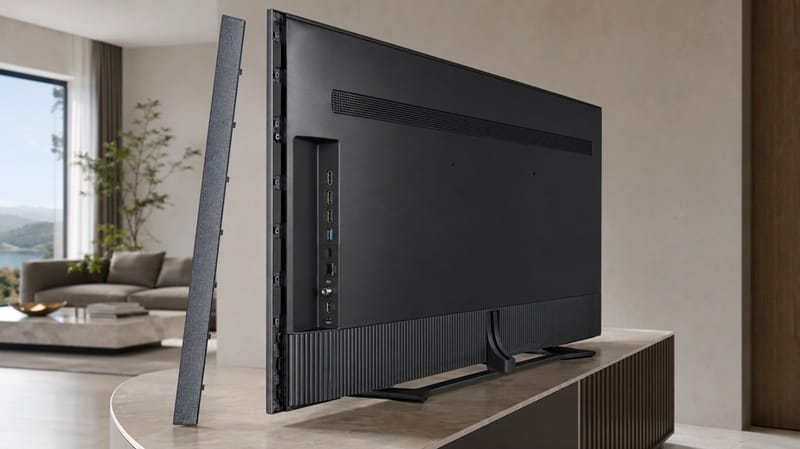
The included UltraSlim wall mount is designed to sit the 85S7SG flush against the wall with minimal gap — Hisense’s marketing calls this “zero gap,” and RTINGS confirms most of the rear inputs are positioned toward the side and edge of the panel rather than the center, specifically so they stay reachable once the set is mounted flat.
There are cable-routing clips on the back to keep power and HDMI runs tidy, a small detail that matters more on a TV meant to be looked at when it’s off.
Hisense 85S7SG Performance & Real-World Use
Picture Quality: Where the 85S7SG Wins
This is where the 85S7SG earns its keep. According to RTINGS’ lab testing, the matte anti-reflective coating does an excellent job cutting direct reflections, and SDR peak brightness is good enough to overcome glare in a sunlit living room.
Ambient light also has very little effect on perceived black level or color saturation — the kind of result that matters most for a TV that spends its daylight hours competing with windows.
Dark Rooms and HDR Contrast
The picture falls off once the lights go down. RTINGS measured poor native contrast with no local dimming to compensate, so dark scenes carry a visible gray cast instead of deep black. HDR brightness is described as okay rather than impressive — bright enough for average scenes, but small specular highlights don’t stand out, and most HDR content reads flatter than it should.
Color and Motion
Color is where the panel does best: RTINGS found decent SDR and HDR color volume with good DCI-P3 coverage, and — after an admittedly aggressive calibration — fantastic HDR color accuracy. Motion is the weak link. Response time testing came back poor at every refresh rate RTINGS tried, including the panel’s native 144Hz, which shows up as visibly blurry motion during fast scenes and games.
Key Features Breakdown
Art Mode and Google TV
The CanvasTV art mode is functional but fairly basic next to what Samsung offers on The Frame: there’s no paid artwork marketplace or subscription tier, just a limited library of free curated pieces plus the ability to upload your own photos over USB or a QR-code phone link. A built-in motion sensor turns the display on and off automatically so it isn’t showing artwork to an empty room.
The smart platform runs Google TV, though RTINGS notes it ships on version 12 — older than the version 14 most competitors have already moved to in 2026. The interface carries the usual ads unless you opt into Hisense’s stripped-down Basic TV mode.
Gaming Features on Paper vs. in Practice
Spec-for-spec, the gaming feature set reads well: 144Hz native refresh, AMD FreeSync Premium, HDMI Forum VRR, G-Sync compatibility, ALLM, and full 4K/120Hz support on both PS5 and Xbox Series X|S. Input lag is excellent per RTINGS’ measurements.
The catch: slow response time undercuts most of that on-paper appeal — motion stays blurry in Game Mode even at the max refresh rate. Hisense’s own U7SG, with full-array local dimming and a much faster panel, is the better gaming and movie TV whenever design isn’t the priority.
The Good, the Bad, and the Ugly
Pros
- ✅ Excellent glare rejection — RTINGS rated the matte coating’s reflection handling as excellent; bright lights and windows are barely visible on screen.
- ✅ Swappable, wall-ready frame — teak included, white and walnut sold separately, plus a wall mount built for a flush install without extra hardware.
- ✅ Console-ready connectivity — VRR, ALLM, and low input lag on both PS5 and Xbox Series X|S, even if motion clarity doesn’t back it up.
Cons
- ❌ No local dimming — contrast and dark-scene detail are the weakest parts of the picture, based on RTINGS’ lab measurements.
- ❌ Slow response time — motion blur shows up at every refresh rate tested, including native 144Hz.
- ❌ Older Google TV build — version 12 lags behind the version most 2026 competitors ship with.
The Ugly
On paper, the gaming spec sheet matches what Hisense puts on its dedicated gaming TVs. RTINGS’ motion testing tells a different story: blurry, uneven transitions at every refresh rate it tried, 144Hz included. If competitive gaming or fast-motion sports sits anywhere near your primary use case at 85 inches, this is where the CanvasTV concept breaks down.
Who Should Buy This — and Who Shouldn’t
Buy This If
The 85S7SG earns its price when the CanvasTV concept — not picture-quality specs — is what’s pulling you toward it. It’s closer to buying a large piece of furniture that happens to play video than a performance TV that happens to look nice, and that trade works best if daytime viewing in a bright, decorated living room is your main use case and you’d actually use art mode when the TV’s off.
Worth comparing it against Samsung’s take on the same idea before deciding — our Samsung QN65LS03H review covers the Frame Pro’s added local dimming and brighter panel, which come at a noticeably higher price than the Hisense.
If you want the wall-art concept at a smaller footprint, our LG 55LX7B review is worth a look too, since LG’s Gallery TV takes a similar approach with a newer smart platform.
Skip This If
Skip the 85S7SG if dark-room movie nights, competitive gaming, or sports with fast motion are a big part of how you’ll actually use an 85-inch screen. Samsung’s Frame Pro is the stronger pick if you want the art-TV format without giving up as much picture performance, even at a higher price.
Final Verdict
Is the Hisense 85S7SG Worth Buying?
The Hisense 85S7SG delivers exactly what it promises on the design side — a large, wall-flush TV that reads as art when it’s not in use — and RTINGS’ own comparison data backs that up against Samsung’s Frame 2026.
What it doesn’t deliver is a picture that holds up once you switch from art mode to an actual dark-room movie or a fast-paced game — that trade-off is built into the CanvasTV format itself, not specific to this size. RTINGS confirms this 2026 model replaces the original Hisense CanvasTV 2024, so this generation’s core trade-offs — strong daytime looks, weak dark-room and motion performance — are a known characteristic of the line rather than a one-off.
Anyone deciding between design and performance at 85 inches should also weigh it against the wider field — our best OLED TVs for bright rooms picks cover sets that handle daylight nearly as well without giving up contrast after dark. 🛒 Check Availability on Amazon
Frequently Asked Questions
Is the Hisense 85S7SG good for everyday TV watching?
For daytime viewing in a bright room, yes — that’s where this Hisense 85S7SG review found it performs best, based on RTINGS’ lab testing of the CanvasTV 2026 lineup. For dark-room movie nights or fast-motion content, the lack of local dimming and the slow response time become noticeable.
How does the Hisense 85S7SG compare to Samsung’s Frame TV?
RTINGS found the base Samsung Frame 2026 and the Hisense CanvasTV 2026 closely matched, with the Hisense slightly brighter for daytime use. Samsung’s Frame Pro pulls ahead with more brightness, better out-of-box accuracy, and basic local dimming, at a higher price.
Is the Hisense 85S7SG any good for gaming?
It supports 144Hz, VRR, ALLM, and has excellent input lag, but RTINGS measured slow response time and blurry motion at every refresh rate — so it’s better suited to casual gaming than fast-paced or competitive titles.
Who should skip the Hisense 85S7SG?
Buyers who primarily watch movies in a dark room, or who want strong motion clarity for gaming and sports, should look elsewhere — the lack of local dimming and the slow panel response show up directly in both situations.
Does the Hisense 85S7SG support Dolby Vision, and does that matter without local dimming?
Yes — it supports Dolby Vision alongside HDR10, HDR10+, and HLG. Dolby Vision’s dynamic metadata still helps with tone-mapping and scene-by-scene brightness decisions, but it can’t add contrast a non-dimming backlight doesn’t have — HDR content will look correct in color and brightness targeting, just not as deep in dark scenes as a local-dimming panel.

iYaiii
Editor, GearPulse360
iYaiii is the editor and founder of GearPulse360, specializing in TV reviews and consumer electronics. He researches every recommendation before publishing.
✅ Based on Hisense’s official specifications and RTINGS test data — last verified July 2026