Samsung 85QN80H Review 2026: Does Neo QLED Brightness Hold Up at 85 Inches?
Last updated: July 2026
🕒 9 min read
Disclosure: As an Amazon Associate I earn from qualifying purchases. This article contains affiliate links — we may earn a small commission if you buy through them, at no extra cost to you.
A TV panel’s flaws get harder to hide at 85 inches than at 55. This Samsung 85QN80H review looks at what changes when Samsung’s Neo QLED backlighting and processing get stretched across nearly double the screen area of the smaller sizes in the lineup. Against alternatives like the TCL 85QM8L or Hisense 85U6SF Pro, the QN80H leans on Samsung’s processing and smart platform rather than raw spec-sheet numbers. If you’re weighing the wider field of large-screen options, our best 4K TVs of 2026 roundup lines up this year’s top picks by size and budget. Below is what held up at 85 inches, and what didn’t.
Table of Contents
Quick Verdict
At a Glance
★★★★★ 8 / 10
At a Glance
Picture Quality
Gaming
Audio
Value
👍 Best For: Buyers who want a large-screen, bright-room-capable TV without paying OLED prices.
👎 Skip If: You’re prioritizing dark-room contrast, wide-seating viewing angles, or true edge-to-edge black uniformity.
One-Line Verdict: A capable, bright 85-inch Neo QLED — just don’t expect flagship-level dimming precision at this size.
🛒 Check Availability on AmazonProduct Specs at a Glance
Product Specs
Samsung 85QN80H
Neo QLED · Mini LED Full Array Local Dimming · Tizen 2026
| 📺 Panel Type | VA LCD, Mini LED Full Array |
| ⚡ Refresh Rate | 144Hz native |
| 🧠 Processor | NQ4 AI Gen2 |
| 🎮 Gaming | FreeSync Premium Pro, G-Sync Compatible |
| 🌈 HDR Support | HDR10, HDR10+, HLG (no Dolby Vision) |
| 🔌 HDMI 2.1 Ports | 4, full 48Gbps bandwidth |
| 📐 VESA Mount | 600 x 400 |
Design & Build Quality
Materials & Finish
Samsung keeps the same design language across the QN80H lineup regardless of size: thin bezels on three sides, a slightly thicker bottom edge, and a mostly-plastic build that still feels solid. The panel runs on Samsung’s Neo QLED Mini LED platform, the same backlight architecture Samsung uses across its 2026 Neo QLED range.
RTINGS’ testing of the same design on the 65-inch model found the feet stable in the wide position but prone to wobble in the narrow one. At 85 inches and up, that narrow-position instability is worth planning around before you settle on a media console width.
Ports & Connectivity
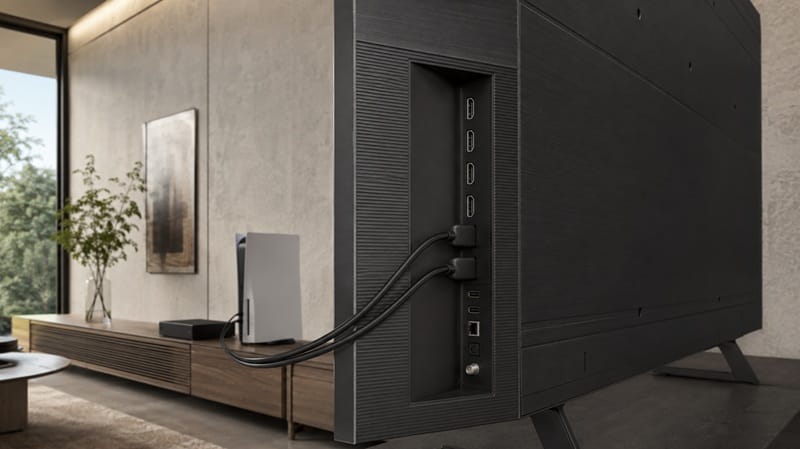
All four HDMI ports run at the full HDMI 2.1 bandwidth of 48Gbps, so it doesn’t matter which port you plug a next-gen console or AV receiver into — none of them are compromised the way “one good HDMI port” configurations can be on cheaper sets. The inputs sit in a recessed cutout on the back, which keeps cables tidy but can be awkward to reach if you’re wall-mounting the TV close to the surface.
Performance & Real-World Use
Bright Rooms & Sports
According to Samsung’s official 85-inch product specifications, the QN80H is built around Quantum Mini LED Full Array backlighting paired with the NQ4 AI Gen2 Processor. RTINGS’ lab testing on the same panel design recorded great peak brightness in SDR — enough to overcome glare in most living rooms. HDR brightness is more middling: real HDR scenes look bright and punchy overall, but small specular highlights like sun glints or explosions don’t stand out as dramatically as they do on brighter competing sets.
Movie Nights & Dark Rooms
Contrast holds up better than you might expect from a mid-range Mini LED. RTINGS’ lab data shows great black uniformity with no noticeable flashlighting, and decent zone precision — though there’s some haloing visible around very bright objects against dark backgrounds, a common tradeoff with full-array local dimming at this price tier. That haloing is reasonable to expect to be more visible as panel size increases, since there’s more screen area for the eye to scan — though this is an editorial inference, not something RTINGS specifically measured at 85 inches (their unit was the 65-inch model).
Large-Screen Specific Considerations
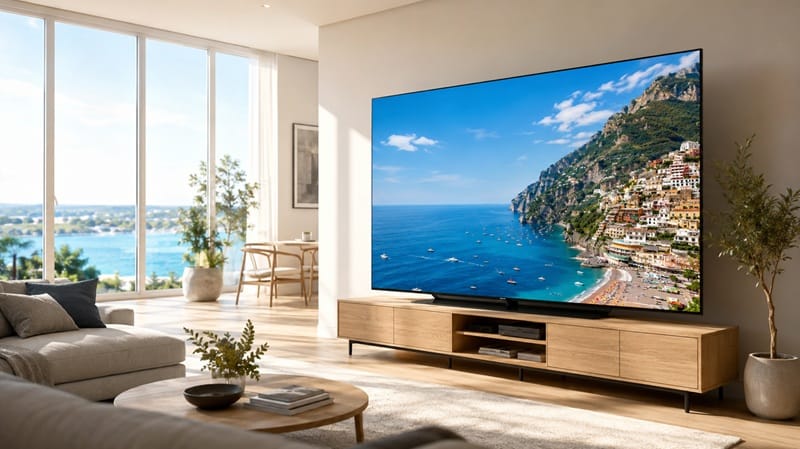
One detail unique to the 85-inch (and 100-inch) QN80H is Samsung’s Supersize Picture Enhancer, an additional processing mode built specifically for large panels to clean up lower-quality sources — cable broadcasts, older streaming bitrates, and similar content that would otherwise look softer when blown up to this size. It’s not available on the 55-, 65-, or 75-inch models, so it’s a genuine size-specific advantage rather than marketing filler.
Key Features Breakdown
144Hz Gaming with Full VRR Support
The QN80H supports FreeSync Premium Pro and G-Sync Compatible alongside HDMI Forum VRR, and RTINGS measured excellent, consistently low input lag across every supported resolution in Game Mode. Low Framerate Compensation is also supported, which keeps VRR working smoothly even if your frame rate drops well below the panel’s native refresh window. The tradeoff shows up in fast motion: at the panel’s max 144Hz refresh rate, motion clarity is only mediocre, with blur that’s more noticeable in darker scenes than bright ones.
Seven Years of Software Support
Samsung backs the QN80H’s Tizen platform with a promised seven years of firmware updates, which matters more on a TV this size — an 85-inch panel isn’t something most households replace on a two- or three-year cycle. The interface does carry ads that can’t be fully disabled, which is standard across nearly every current smart TV platform, not a QN80H-specific compromise.
The Good, the Bad, and the Ugly
Pros
- ✅ Strong SDR and HDR brightness — handles bright, sun-facing rooms without the image washing out.
- ✅ Excellent gaming responsiveness — low input lag, full VRR support, and a complete HDMI 2.1 port set.
- ✅ Supersize Picture Enhancer at 85″ — a size-specific processing boost that smaller QN80H models don’t get.
Cons
- ❌ Mediocre viewing angle — colors and black levels shift noticeably once you move off-center, a bigger deal on an 85-inch panel meant for wide seating.
- ❌ Glossy screen coating — direct reflections aren’t dimmed much, so window and lamp glare stays fairly visible.
The Ugly
The honest limitation here is local dimming precision. RTINGS’ motion testing found the QN80H’s zone transitions can’t fully keep up with fast-moving bright objects, and haloing around highlights is noticeable enough that viewers coming from OLED or a higher-tier Mini LED set will likely spot it in dark, high-contrast scenes. A bigger panel makes that kind of inconsistency easier to notice — a reasonable expectation based on screen size alone, though not something independently verified at 85 inches specifically. It’s not a dealbreaker for a bright-room TV, but it’s the tradeoff you’re accepting for the price.
Who Should Buy This — and Who Shouldn’t
Buy This If
The 85QN80H fits best in a room that gets real daylight, for buyers who watch more sports and daytime content than dedicated movie nights. Think of it less as a scaled-up premium TV and more like a big, bright window — it’s built to stay watchable when the sun’s out, not to disappear into inky blacks after dark.
If you’ve already been considering Samsung’s Neo QLED lineup at a smaller size, it’s worth comparing notes against our Samsung 55QN80H review — the core panel behavior carries over, but the tradeoffs (viewing angle, haloing) become more noticeable as the screen grows.
Buyers on a tighter budget who still want a big Samsung screen without stepping up to Neo QLED pricing may also want to check our Samsung Crystal UHD buying guide before deciding how much brightness and gaming performance is actually worth paying for.
Skip This If
If your room stays dim most of the time, or you regularly seat people well off to the sides of the screen, the QN80H’s weaker viewing angle and haloing will bother you more than they would in a bright, front-facing setup. The TCL 85QM8L is worth a look instead — TCL specs it with up to 4,000 local dimming zones, a meaningfully different approach to contrast control that’s worth comparing directly before you commit at this size.
Final Verdict
Is It Worth Buying?
The Samsung 85QN80H review question comes down to room conditions and seating more than spec-sheet comparisons. It delivers strong brightness, responsive gaming, and a size-specific processing boost that smaller QN80H models don’t get — but the local dimming precision and viewing angle that were acceptable compromises at 55 inches become more visible once you’re looking at 85. Compared honestly against the TCL 85QM8L, the Samsung leans on smart-platform polish and brightness consistency rather than outright contrast performance. If you’re still weighing panel types at this size, our full OLED vs QLED comparison breaks down where each technology actually wins. 🛒 Check Availability on Amazon
Frequently Asked Questions
Is the Samsung 85QN80H review verdict different from smaller QN80H sizes?
The core panel behavior is the same across sizes, since Samsung uses the same backlight and processing platform throughout the QN80H lineup. What changes at 85 inches is how noticeable certain tradeoffs become — viewing angle and dimming-zone haloing are both more visible on a larger screen, simply because there’s more panel for your eyes to scan.
How does the 85QN80H compare to RTINGS’ test results?
RTINGS bought and tested the 65-inch QN80H directly and states that most of its results carry over to the 55-, 75-, 85-, and 100-inch versions, since they share the same panel technology and processing. According to RTINGS’ independent testing, the QN80H performs well in mixed-use scenarios but underperforms brighter, better-dimmed competitors like the TCL QM8K at a similar price.
Is the 85QN80H good for gaming on a PS5 or Xbox Series X?
Yes — based on manufacturer specifications and independent testing data, it supports 4K at 120Hz, Auto Low Latency Mode, VRR, and HDR on both consoles, along with a 144Hz native panel refresh rate for PC gaming. Input lag is consistently low across every tested resolution.
Who should avoid the 85QN80H?
Buyers who mostly watch in a dark, dedicated home theater room, or who need consistent picture quality from wide seating angles, are better served by a higher-tier Mini LED set or an OLED panel instead — the QN80H’s dimming precision and viewing angle are both built around bright-room use, not theater-style viewing.
Does the 85QN80H support Dolby Vision?
It doesn’t. Samsung dropped Dolby Vision licensing across its entire 2026 lineup in favor of HDR10+, the royalty-free HDR format it develops in-house, and the 85QN80H follows that same company-wide policy — it isn’t a cut made specifically for this model or size.

iYaiii
Editor, GearPulse360
iYaiii is the editor and founder of GearPulse360, specializing in TV reviews and consumer electronics. He researches every recommendation before publishing.
✅ Based on Samsung’s official specifications and RTINGS data — last verified July 2026