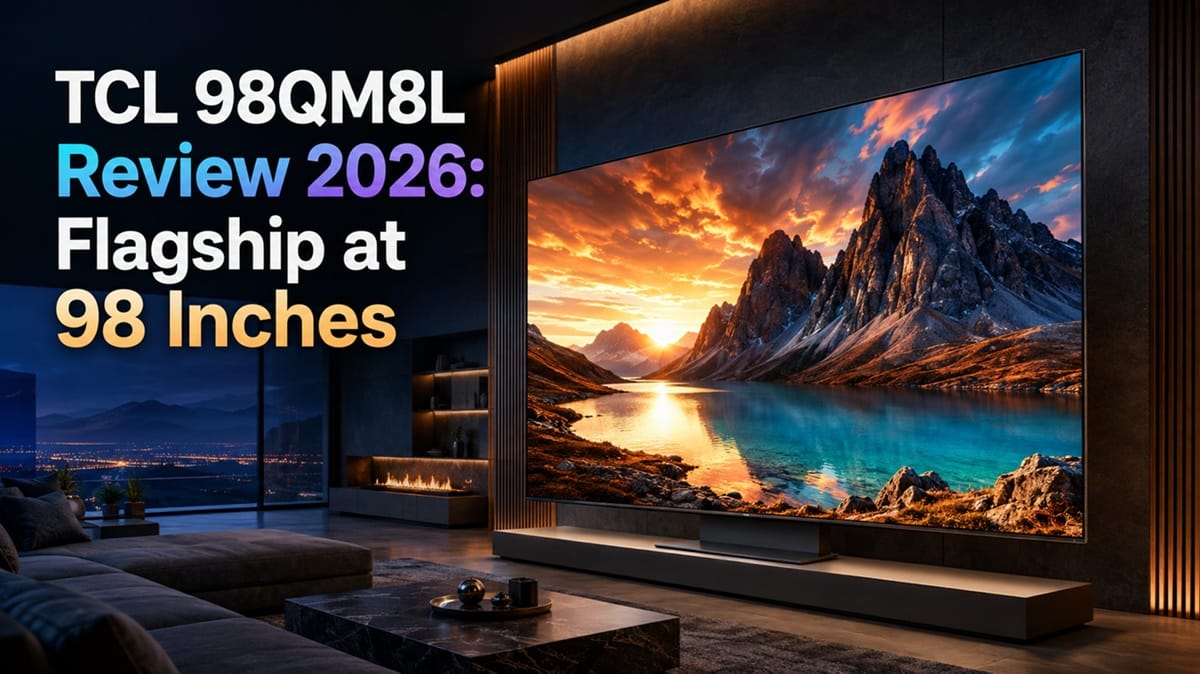
TCL 98QM8L Review 2026: Does TCL’s Flagship Formula Scale to 98 Inches?
Last updated: August 2026
🕒 8 min read
Disclosure: As an Amazon Associate I earn from qualifying purchases. This article contains affiliate links — we may earn a small commission if you buy through them, at no extra cost to you.
Most flagship Mini-LED lineups stop growing at 85 inches and hand anything larger to lower-tier panels. TCL didn’t: the 98QM8L carries the same Halo Control local dimming and Super Quantum Dot (SQD) color that built the 65-inch QM8L’s reputation, scaled up to a screen nearly eight feet wide. This TCL 98QM8L review checks whether that combination holds together at the largest size in the line, based on TCL’s official specifications and RTINGS’ published testing of the QM8L lineup.
A 98-inch panel is a different manufacturing problem than the 65-inch set most reviewers actually test, with far more dimming zones to coordinate and more backlight to keep uniform edge to edge. This review breaks down what changes at that scale, what TCL confirms stays the same, and where the size actually shifts the viewing experience. Anyone still weighing panel types and price brackets before committing to a screen this size can check our best 4K TVs of 2026 roundup first.
Direct competition at this size is limited. Samsung’s 100QN80H is the closest true flagship-tier alternative near 100 inches, with LG’s 100QNED84BU and Hisense’s 100U7SG covering the mid-flagship tier just below it. Most other brands cap their top Mini-LED tier at 85 inches and drop to lower-tier panels above that — which is the gap the 98QM8L is built to fill.
Table of Contents
Quick Verdict
At a Glance
★★★★★ 8.5 / 10
At a Glance
Picture Quality
Gaming
Audio
Value
👍 Best For: Large, mostly front-facing rooms that want flagship-level brightness and contrast at a size few competitors reach.
👎 Skip If: You watch from an angle rather than dead-center, or reference-accurate HDR color matters more to you than raw brightness and contrast.
One-Line Verdict: The 98QM8L runs the same flagship Mini-LED formula as the smaller QM8L sizes — HDR accuracy and viewing angle weaknesses included — just at a scale almost nothing else on the market matches.
🛒 Check Availability on AmazonTCL 98QM8L Review: Specs at a Glance
Product Specs
TCL 98QM8L
SQD-Mini LED, VA · Halo Control Local Dimming · Google TV
| 📺 Screen Size | 98″ |
| 🖥️ Panel Type | SQD-Mini LED, VA |
| ⚡ Refresh Rate | 144Hz native |
| 💡 Dimming Zones | Up to 4,000 |
| 🔌 HDMI 2.1 | 4 ports, full bandwidth |
| ☀️ Peak Brightness | Up to 6,000 nits |
| 📡 Smart Platform | Google TV 14 |
| 🔊 Audio | Bang & Olufsen tuned |
Design & Build Quality
Materials & Finish
TCL’s QM8L series page describes the line’s FullView metal bezel-less design and WHVA 2.0 Ultra Panel structure, both of which carry through to the 98-inch model. RTINGS’ hands-on assessment of the 65-inch unit rated overall build quality as excellent, citing a premium-feeling plastic construction with no obvious quality control issues on their review sample.
Ports & Connectivity
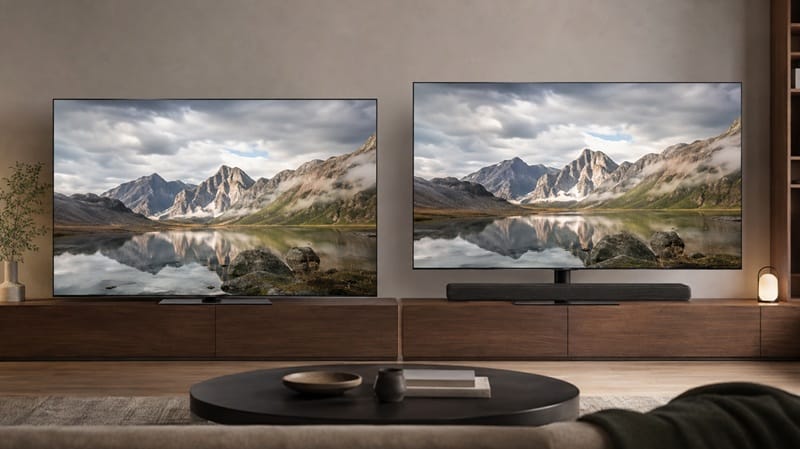
The pedestal stand ships with two mounting heights, which leaves clearance for a soundbar without blocking the bottom of the picture, a detail that counts for more on a screen this large, where the stand has to support significantly more panel weight. RTINGS also noted that the rear inputs sit recessed into a cutout, which can make them harder to reach if the TV is mounted flush against a wall.
Performance & Real-World Use
Brightness & HDR
RTINGS bought and tested the 65-inch QM8L directly and states its results extend across the 75-, 85-, and 98-inch versions of the same panel design, with dimming zone count and peak brightness scaling up at each larger size.
TCL’s own 98QM8L product page lists up to 4,000 discrete dimming zones and up to 6,000 nits of peak brightness for this size; RTINGS’ own size comparison table gives a more precise figure, 4,032 zones.
Based on RTINGS’ measurements of the 65-inch unit, the QM8L line overcomes glare easily in a sunlit room and carries that brightness advantage into HDR content, pushing well past 1,000 nits on real scenes. HDR color accuracy is the clearer weak point: RTINGS describes the QM8L’s out-of-the-box HDR accuracy as disappointing, with noticeable mapping and luminance errors, and found that a full calibration only partially closes the gap. That trade-off comes from the panel and processing pipeline, so it carries over to the 98-inch model unchanged.
Contrast & Local Dimming
Local dimming performance is where the QM8L consistently earns praise. RTINGS rated its contrast and black uniformity as excellent, describing near-perfect consistency across the screen with local dimming enabled and only minor variation with it off. Zone transitions were also described as clean, with minimal visible haloing around bright, oddly shaped objects like on-screen text or subtitles.
RTINGS’ own comparison notes give useful context on how the QM8L line stacks up within TCL’s catalog. Against the step-down QM7L, the QM8L measured brighter in both SDR and HDR, with more vivid color and deeper blacks.
Against its own predecessor, the QM8K, the QM8L brought better color volume and full HDMI 2.1 bandwidth on all four ports, though RTINGS found it came with slightly worse native contrast and noticeably weaker HDR accuracy, even after calibration.
Motion & Gaming
On the gaming side, the 98QM8L carries the full feature set TCL built the QM8L line around: a 144Hz native panel, four HDMI 2.1 ports at full bandwidth, and support for AMD FreeSync, HDMI Forum VRR, and G-Sync Compatible mode. RTINGS measured excellent input lag in Game Master mode and confirmed full compatibility with PS5 and Xbox Series X, including 4K at 120Hz and Auto Low Latency Mode.
Motion clarity doesn’t match the rest of the performance picture. RTINGS found response time inconsistent, especially coming out of dark shades, and measured very high motion blur at the panel’s maximum 144Hz refresh rate, a limitation that carries over unchanged at 98 inches.
PC gamers should also note a specific VRR quirk: it doesn’t work correctly with NVIDIA GPUs locked to a 60Hz signal, though the issue disappears once the connection runs at 120Hz or higher.
Key Features Breakdown
Halo Control Local Dimming at 98 Inches
Halo Control is TCL’s local dimming system, and at 98 inches it’s coordinating roughly 4,032 individually controlled zones, according to RTINGS’ size comparison table. What that means in practice, per RTINGS’ testing of the same architecture on the 65-inch unit, is fewer visible halos around bright objects on a dark background, which matters more as the screen grows since a larger panel has more physical distance for a poorly controlled backlight to bloom across.
Full-Bandwidth HDMI 2.1 Across All Four Ports
All four HDMI inputs support the full HDMI 2.1 bandwidth, per RTINGS’ port testing, not just one or two ports the way some competing sets handle it. In practice, that means a console, a PC, and a soundbar can all stay connected at full 4K 120Hz+VRR capability simultaneously, without having to move cables around depending on what’s running that night.
The Good, the Bad, and the Ugly
Pros
- ✅ Overcomes glare easily — high peak brightness holds up in SDR and HDR alike, per RTINGS’ testing
- ✅ Deep, uniform blacks — RTINGS rated contrast and black uniformity as excellent with local dimming on
- ✅ Excellent input lag — full VRR support and low latency in Game Master mode, confirmed on PS5 and Xbox Series X
Cons
- ❌ Below-average HDR color accuracy — noticeable mapping and luminance errors that a full calibration only partially fixes
- ❌ High motion blur at max refresh — RTINGS measured very high blur at 144Hz, more noticeable in fast panning shots or twitch gaming
The Ugly
The real question with any 98-inch TV is whether the panel holds together at that scale, and on brightness and contrast, RTINGS’ data says yes: those strengths scale up cleanly from the 65-inch unit.
What doesn’t improve is viewing angle. RTINGS rated it mediocre on the 65-inch model, with color washing out and blues dropping off quickly off-center, and that weakness doesn’t shrink just because the screen grew — if anything, a wider screen puts more seats at an angle where it’s noticeable. Anyone planning wide seating rather than a single dead-center couch should weigh that before buying at this size.
Who Should Buy This — and Who Shouldn’t
Buy This If
You have a large, dedicated room — a home theater, a great room, or a living room with enough distance to a wall-sized screen — and you want a TV built primarily for movies and sports, not a color-accurate reference monitor. Think of the 98QM8L less like a bigger television and more like a small home-theater projector screen that happens to run circuits instead of a bulb: brightness and contrast are the whole point, not fine color grading. If you’re still deciding between panel types at this scale, our OLED vs Mini LED compared guide lays out where each technology tends to win.
TCL’s own 65-inch model in the same series, covered in our TCL 65QM8L review, is worth a look too if 98 inches turns out to be more screen than your room actually needs.
Skip This If
You mainly watch from an angle rather than dead-center, or reference-accurate HDR color matters more to you than raw brightness and contrast. If precise off-angle color is the priority, Samsung’s 100QN80H is a flagship-tier alternative near this size worth comparing specs on, though we haven’t published a full review of it yet.
TCL 98QM8L Review: Final Verdict
Is the TCL 98QM8L Worth Buying?
This TCL 98QM8L review doesn’t find a lineup that reinvents what made the QM8L work at 65 inches; it carries the same formula to a larger screen. Based on RTINGS’ testing and TCL’s published specifications, brightness, contrast, and local dimming performance hold up cleanly at the largest size in the series, and the gaming feature set stays flagship-level, while HDR accuracy and viewing angle remain the same trade-offs as the smaller sizes.
For a large, mostly front-facing room, it’s one of the few 98-to-100-inch sets running genuine flagship Mini-LED hardware rather than a panel built down for the larger screen; shoppers who prioritize reference-grade color over scale should compare it against Samsung’s 100QN80H instead. Anyone weighing it against alternative panel types for fast-paced content can also check our OLED vs Mini LED for sports breakdown. 🛒 Check Availability on Amazon
Frequently Asked Questions
Is the TCL 98QM8L a good TV in 2026?
This TCL 98QM8L review finds it holds up well for large-room use, based on RTINGS’ testing of the QM8L lineup and TCL’s own published specifications, with strong contrast, brightness, and gaming features. Its main limitations, below-average HDR accuracy and a narrow viewing angle, are consistent across every size in the series rather than something new at 98 inches.
How does the 98QM8L compare to Samsung’s 100QN80H?
Both are Mini-LED flagships near 100 inches, but per RTINGS’ QM8L review, TCL’s local dimming and contrast performance stand out, while Samsung’s Neo QLED processing is generally regarded as more color-accurate out of the box. Shoppers prioritizing raw brightness and contrast tend to favor the TCL; those wanting more accurate color tend to favor the Samsung.
Is the TCL 98QM8L good for gaming at this size?
Based on RTINGS’ testing, it supports 4K at 120Hz on both PS5 and Xbox Series X with Auto Low Latency Mode, full VRR, and excellent input lag in Game Master mode. Motion blur at the panel’s maximum 144Hz refresh rate runs high, so competitive twitch-shooter players may notice it more than casual gamers will.
Who should avoid the TCL 98QM8L?
Anyone without a large, mostly front-facing room to put it in, and anyone who cares more about reference-accurate HDR color than brightness and contrast. The viewing angle is one of the QM8L line’s more consistent weak points across every size RTINGS has tested, so wide, off-center seating is a real drawback here, not a minor one.
Is the RTINGS review based on the 98-inch model specifically?
Not directly. RTINGS purchased and tested the 65-inch QM8L, and states its findings extend to the 75-, 85-, and 98-inch versions, since all four share the same panel design, processor, and feature set, with zone count and brightness scaling by size.

iYaiii
Editor, GearPulse360
iYaiii is the editor and founder of GearPulse360, specializing in TV reviews and consumer electronics. He researches every recommendation before publishing.
✅ Based on TCL’s official specifications and RTINGS data — last verified August 2026