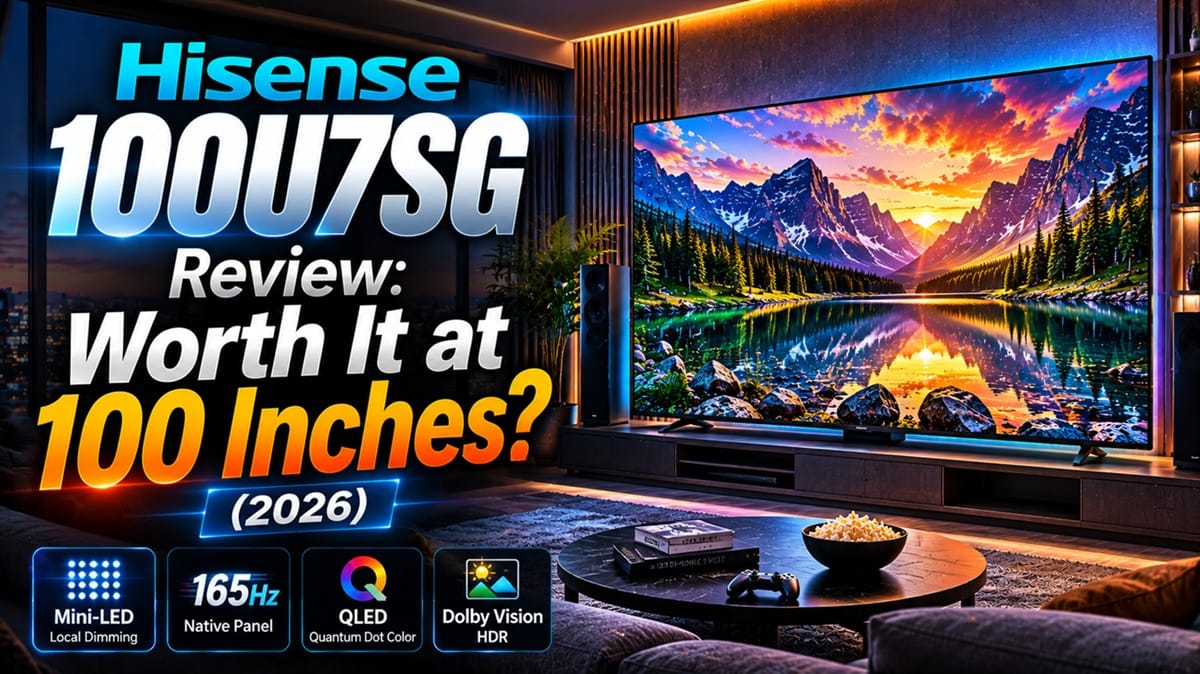
Hisense 100U7SG Review: Is the Step-Up Mini-LED Worth It at 100 Inches?
Last updated: August 2026
🕒 9 min read
Disclosure: As an Amazon Associate I earn from qualifying purchases. This article contains affiliate links — we may earn a small commission if you buy through them, at no extra cost to you.
This Hisense 100U7SG review starts with a simple tier question. Buy a Hisense TV at 100 inches and you’re choosing between two very different price points under the same Hisense badge — the entry-level E7 series and the pricier, faster U7SG sitting one tier up.
The extra cost buys a denser backlight and a much stronger gaming spec sheet. But at this specific screen size, one feature that defines the smaller U7SG models doesn’t carry over.
Most buyers shopping at 100 inches are already comparing Hisense’s own tiers rather than cross-shopping brands — the 100E7SF undercuts this set on price, and the 100U6SF Pro splits the difference.
Hisense’s official specifications and RTINGS’ independent testing of the U7SG series both point the same direction: the 100U7SG earns its higher price through denser local dimming and a stronger gaming spec sheet.
Buyers weighing Hisense against other brands at this size instead can check our best 4K TVs of 2026 roundup for how Hisense stacks up against other brands at this size.
Table of Contents
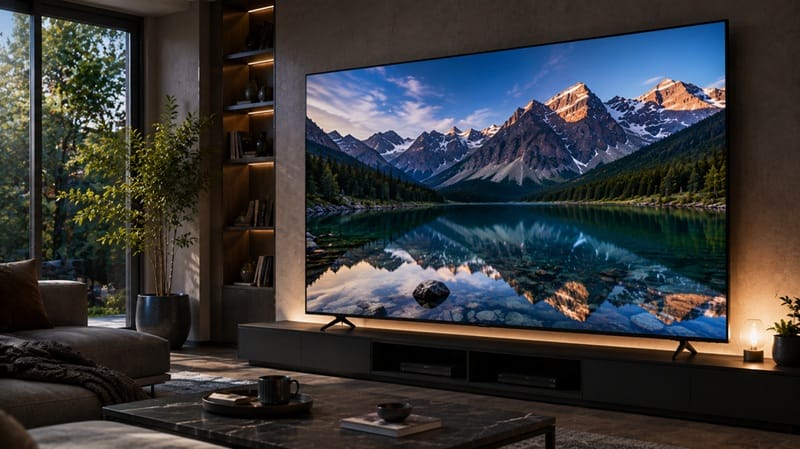
Quick Verdict
At a Glance
★★★★★ 7.6 / 10
At a Glance
Picture Quality
Gaming
Audio
Value
👍 Best For: Buyers who want the biggest Mini-LED screen Hisense sells below flagship RGB pricing, and who prioritize gaming performance and HDR brightness over glare control.
👎 Skip If: Your room gets strong direct light and glare control matters more to you than backlight performance.
One-Line Verdict: A noticeably stronger backlight and gaming spec sheet than Hisense’s cheaper 100-inch sets, undercut by one screen-coating change most buyers won’t see coming.
🛒 Check Availability on AmazonProduct Specs at a Glance
Product Specs
Hisense 100U7SG
Mini-LED QLED · Hi-QLED MiniLED Pro · Google TV
| 📺 Screen Size | 100 inches |
| ⚡ Native Refresh Rate | 165Hz |
| 💡 Local Dimming Zones | 2,304 |
| 🎨 HDR Formats | Dolby Vision, HDR10+, HDR10, HLG |
| 🖥️ Screen Finish | Glossy (100″/116″ only) |
| 🎮 Gaming | VRR, ALLM, 4x HDMI 2.1 |
| 📱 Smart Platform | Google TV |
Hisense 100U7SG Design & Build Quality
Materials & Finish
Hisense carries the same slim unibody design across the whole U7SG line, and based on Hisense’s official product page, the 100U7SG is built around the same Hi-QLED Mini-LED Pro platform as the rest of the series.
RTINGS’ testing of the 65-inch model found a higher-quality plastic build than the outgoing U75QG, with a grid-textured back panel that looks more expensive than the price tag suggests.
The one build detail that changes at this size is the screen coating. Hisense ships matte, anti-reflective glass on the 55-, 65-, 75-, and 85-inch U7SG models, but RTINGS’ size-and-variant breakdown lists the 100- and 116-inch panels as glossy instead.
RTINGS considered the difference significant enough to update its review in July 2026 specifically to document it. It’s a bigger deal than a spec-sheet footnote, and it’s worth its own section below.
Ports & Connectivity
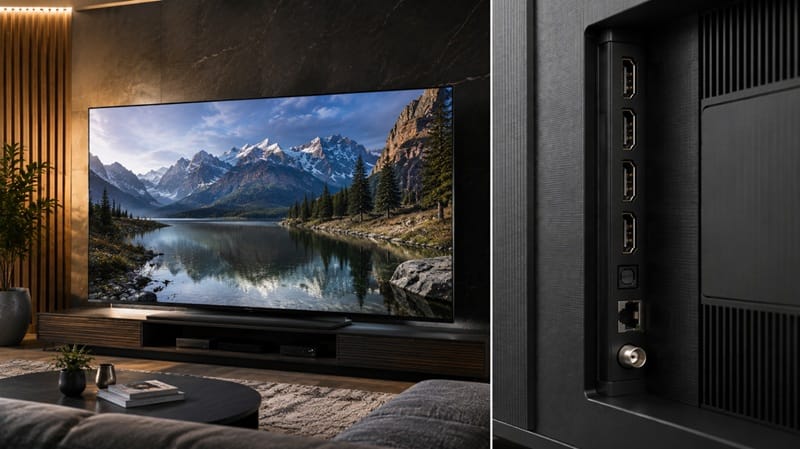
All four HDMI inputs are rated for full HDMI 2.1 bandwidth, which is a real step up from budget Mini-LED sets that only wire one or two ports for high-refresh signals.
There’s also an ATSC 3.0 tuner for over-the-air 4K, plus the usual eARC, USB, and optical audio connections, with cable routing built into the stand’s feet to keep a screen this large from looking cluttered.
Performance & Real-World Use
Brightness and Contrast in a Large Room
RTINGS measured fantastic peak brightness in SDR — enough to punch through glare in a sunlit room — plus excellent HDR brightness that makes highlights stand out clearly.
According to Hisense’s own 2026 lineup overview, the U7 series is rated for up to 3,000 nits of peak brightness, and that ceiling holds at 100 inches rather than dropping at the largest size.
Contrast is where the 100U7SG stands out most: RTINGS found deep, uniform blacks, and — despite costing less — the U7SG actually produced deeper blacks in testing than Hisense’s own pricier UR8SG, largely thanks to a local-dimming system that keeps haloing under control.
Gaming Performance
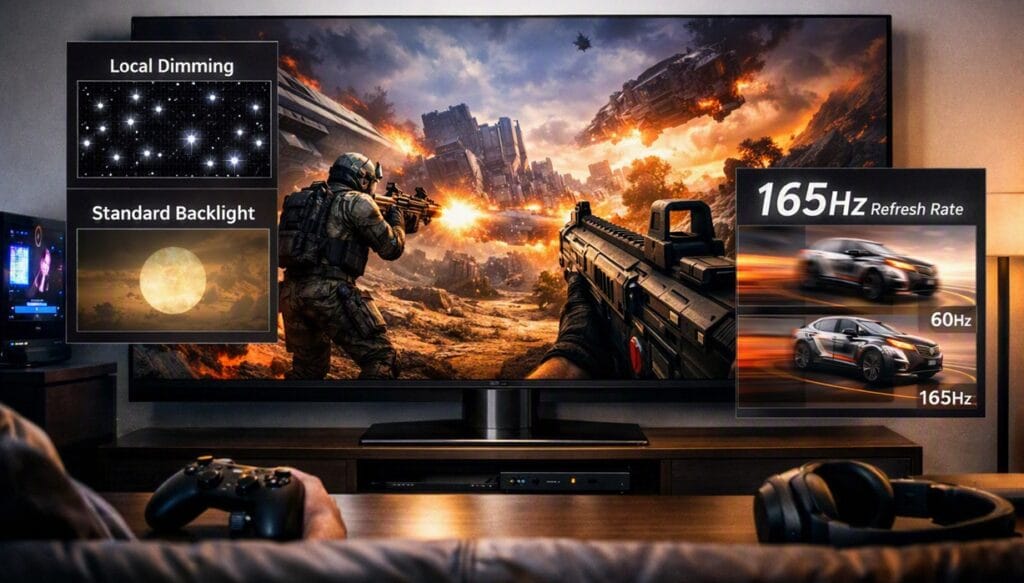
Gaming is where the spec sheet does the most work. RTINGS measured incredibly low input lag and confirmed full compatibility with both PS5 and Xbox Series X, including 4K at 120Hz, HDR, and Auto Low Latency Mode.
Variable refresh rate support spans an unusually wide range thanks to the 165Hz ceiling — the one exception is that VRR won’t engage if the source itself is capped at 60Hz.
Motion and Sports Viewing
Response time is where the 165Hz spec oversells the experience. RTINGS’ pursuit-photo testing showed the panel starts a color transition quickly but takes too long to finish it, leaving visible trailing blur behind fast on-screen motion.
That blur is worst in the darker end of the brightness range, where RTINGS also measured the most overshoot — so the refresh-rate and input-lag numbers looking strong on paper don’t guarantee clean motion in every scene.
Interpolation-based motion smoothing helps reduce judder in slower 24fps content, but it doesn’t touch the underlying response-time limitation once the action speeds up.
Key Features Breakdown
Hi-QLED Mini-LED Pro Backlight
The 100-inch panel packs 2,304 local-dimming zones, which works out to roughly the same zone density per square inch as the 65-inch model RTINGS tested (1.85 square inches per zone versus 1.88) — a detail that matters because Mini-LED performance often gets thinner as screen size grows and zone count doesn’t keep pace.
RTINGS’ color testing on the 65-inch unit also measured strong SDR coverage, at roughly 93% of the DCI-P3 gamut on average.
Hisense scaled both the zone count and the panel quality with the screen, so the dimming precision and color performance buyers read about at smaller sizes should carry over rather than thin out at 100 inches.
165Hz Game Mode Ultra
Native 165Hz at 4K is still an uncommon spec at this screen size, and it’s paired with AMD FreeSync Premium Pro and a dedicated Game Bar for adjusting settings without leaving the game. For anyone building a large-screen gaming setup, that combination matters more day-to-day than the peak-brightness number most marketing copy leads with.
The Good, the Bad, and the Ugly
Pros
- ✅ Excellent HDR and SDR brightness — plenty of headroom to stay watchable in a sunlit room, based on RTINGS’ testing of the U7SG series
- ✅ Deep, uniform blacks — strong native contrast plus effective local dimming that RTINGS found outperforms Hisense’s own pricier UR8SG on black level
- ✅ A well-rounded gaming spec sheet — 165Hz native, four full-bandwidth HDMI 2.1 ports, and very low input lag on both major consoles
Cons
- ❌ Slow-finishing response time — RTINGS measured a fast first response but a sluggish full transition, which shows up as visible blur once motion speeds up
- ❌ Narrow viewing angle — color and contrast fade quickly off-axis, which matters more on a screen this wide with multiple people seated across it
The Ugly
The biggest gap between marketing and reality here is the screen coating. Every other size in the U7SG lineup — 55, 65, 75, and 85 inches — ships with the matte, anti-reflective glass that RTINGS credited with excellent glare handling, including the Hisense 65U7SG. The 100-inch model doesn’t get it.
RTINGS’ differences-between-sizes table lists the 100- and 116-inch panels as glossy instead, and it’s not a minor asterisk — anyone shopping the U7SG lineup by size alone is likely assuming the coating is the same across the board.
If your room has direct light hitting the screen, budget for curtains or a seating change; the coating alone won’t handle it the way it does on the smaller U7SG models.
Who Should Buy This — and Who Shouldn’t
Buy This If
The 100U7SG makes the most sense for buyers who’ve already decided on a 100-inch Hisense and are choosing between tiers rather than cross-shopping brands. Stepping up from the Hisense 100E7SF buys a meaningfully denser dimming grid, a much higher native refresh rate, and a fuller gaming feature set.
It’s a bit like comparing two paint swatches under store lighting versus seeing them on an actual wall — the extra dimming zones and higher refresh rate barely register as numbers on a spec sheet, but they’re obvious the moment dark HDR scenes are actually playing across a screen this size.
If you’re still comparing options across brands rather than just within Hisense’s own lineup, our Samsung Crystal UHD buying guide is a useful reference point for how a different brand’s mid-range tier structures its own upgrades.
Skip This If
Skip the 100U7SG if reflection control in a bright room is non-negotiable — the missing anti-glare coating at this size is a real limitation. It’s worth cross-shopping other 100-inch options, like the Samsung 100QN80H, which markets anti-reflective screen treatment as a standard feature at this size, rather than assuming any 100-inch Mini-LED handles glare the same way.
Budget-focused buyers who don’t game competitively and can live with a plainer QLED backlight may also be better served by the cheaper 100U6SF Pro instead.
Final Verdict
Is It Worth Buying?
The 100U7SG earns its place over Hisense’s cheaper 100-inch sets on the strength of its backlight and gaming performance — not on the screen coating, which is the one spec that doesn’t scale up with the size.
For buyers who’ve settled on a 100-inch Hisense and value picture quality and responsiveness over glare control, that trade is worth making. Buyers still deciding between the E7SF, U6SF Pro, and U7SG purely on price should check the Hisense 100U6SF Pro first. 🛒 Check Availability on Amazon
Frequently Asked Questions
Is the Hisense 100U7SG worth buying in 2026?
Yes, if you’re choosing between Hisense’s own 100-inch tiers — the extra cost over the 100E7SF buys a denser local-dimming grid and a much more complete gaming spec sheet.
The trade-off is the screen coating: unlike the smaller U7SG sizes, the 100-inch panel is glossy rather than matte, so factor your room’s lighting into the decision before assuming it’ll handle glare the same way.
How does the Hisense 100U7SG compare to the Hisense U8QG?
Based on RTINGS’ testing, the step-up U8QG is brighter on paper, but most content can’t actually use that extra headroom. The U7SG tracked brightness more accurately and handled reflections better in RTINGS’ testing, which makes it the smarter buy for most households despite sitting a tier below on paper.
Is the Hisense 100U7SG good for sports and fast-motion content?
Sports and fast gaming are where the gap between the spec sheet and RTINGS’ actual motion testing shows up the most — the refresh rate and input lag are strong, but full-speed scenes still show trailing blur once the action gets fast.
If competitive shooters or fast-break sports are the main use case, weigh that motion trade-off against sets RTINGS rates specifically higher for motion clarity.
Who should avoid the Hisense 100U7SG?
Buyers with a very bright room where direct light hits the screen should think twice, since the 100-inch model loses the matte anti-glare coating that the smaller U7SG sizes carry. Anyone prioritizing wide-angle viewing for a big shared seating area may also find the viewing-angle drop-off more noticeable at this screen size.
Does the Hisense 100U7SG have the same matte anti-glare screen as the smaller sizes?
No — and it’s a common point of confusion, since Hisense markets the U7SG as a single lineup without flagging the coating change on the 100-inch product page itself.
If you’re buying based on the smaller sizes’ reputation for handling glare, plan for light control — blackout curtains, or seating away from windows — rather than expecting the coating alone to do that work at 100 inches.

iYaiii
Editor, GearPulse360
iYaiii is the editor and founder of GearPulse360, specializing in TV reviews and consumer electronics. He researches every recommendation before publishing.
✅ Based on spec analysis and Hisense’s official and RTINGS data — last verified August 2026.