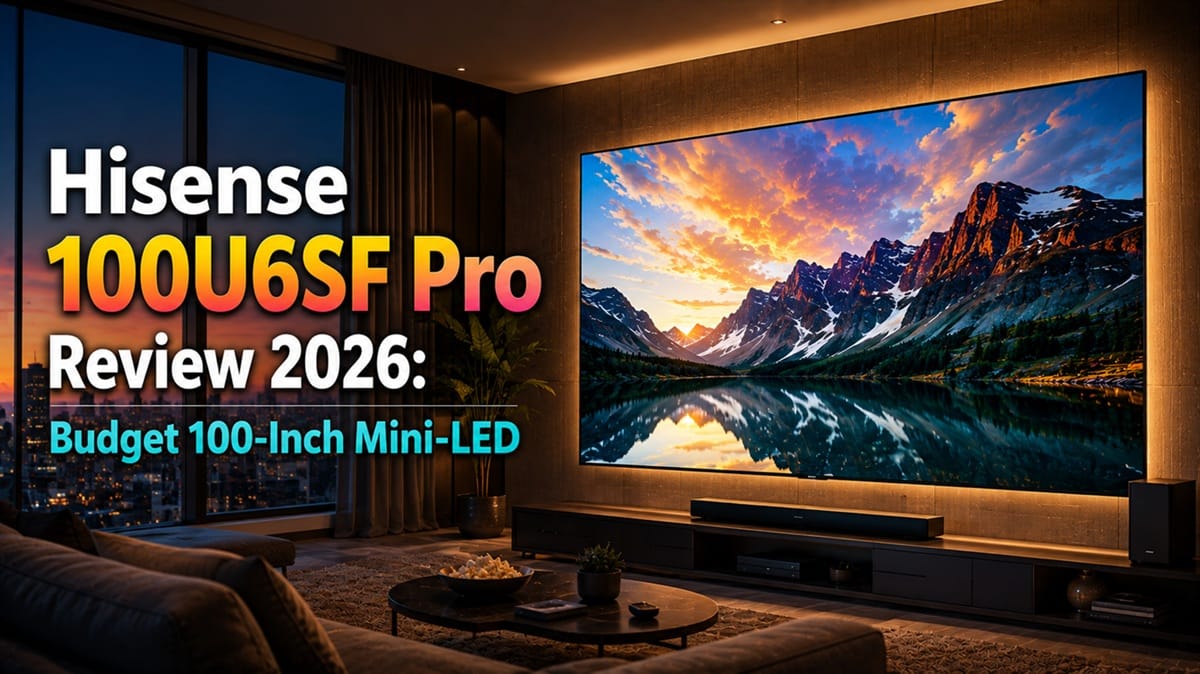
Hisense 100U6SF Pro Review: Is Hisense’s Budget 100-Inch Mini-LED Worth It?
Last updated: August 2026
🕒 9 min read
Disclosure: As an Amazon Associate I earn from qualifying purchases. This article contains affiliate links — we may earn a small commission if you buy through them, at no extra cost to you.
Going bigger usually means paying flagship prices. The Hisense 100U6SF Pro breaks that pattern by cutting features rather than screen size — this Hisense 100U6SF Pro review looks at exactly what got cut, and whether the trade is worth it.
People land on this page for one of two reasons — either 100 inches finally feels affordable enough to consider, or they’ve already priced out Hisense’s own step-up models and want to know what the cheaper option gives up. Based on Hisense’s official spec sheet, the 100U6SF Pro sits below the mid-flagship 100E7SF and the Hisense 100U7SG in the same 2026 lineup, and the two step-up models both lead with higher peak-brightness claims that the 100U6SF Pro’s own product page doesn’t make.
Buyers comparing sizes and budgets in Hisense’s own catalog, or weighing Mini-LED against OLED at this price point, aren’t wrong to hesitate — a 100-inch panel asks more of a Budget-tier backlight than a 55-inch one does. For a wider view of where this model sits against the rest of 2026’s field, our best 4K TVs of 2026 roundup breaks down the competing picks by size and price. That gap between the 100U6SF Pro and its pricier siblings is what the sections below check, panel by panel — starting with the backlight it’s built around.
Table of Contents
Quick Verdict
At a Glance
★★★☆★ 7 / 10
At a Glance
Picture Quality
Gaming
Audio
Value
👍 Best For: Buyers who want the biggest screen a budget allows and value a 144Hz gaming panel over flagship brightness.
👎 Skip If: You watch mostly in a bright room and want maximum HDR punch, or you want the most local-dimming zones Hisense offers at this size.
One-Line Verdict: The most affordable way into a 100-inch Mini-LED screen in Hisense’s 2026 lineup — if you’re fine trading some brightness and dimming precision for pure size.
🛒 Check Availability on AmazonProduct Specs at a Glance
Product Specs
Hisense 100U6SF Pro
Mini-LED (Hi-QLED) · Full Array Local Dimming · Fire TV
| 📺 Screen Size | 100 inches |
| 🎮 Refresh Rate | Native 144Hz |
| 💡 Backlight | Mini-LED Full Array Local Dimming |
| 🌈 HDR Formats | Dolby Vision IQ, HDR10+, HLG |
| 🔊 Audio | Built-in subwoofer, Dolby Atmos |
| 📡 Smart Platform | Fire TV with Alexa+ |
| 🖥️ Screen Coating | Anti-Reflection, Glare-Free |
| 🏆 Certifications | IMAX Enhanced, Pantone Validated |
Hisense 100U6SF Pro Design & Build Quality
Materials & Finish
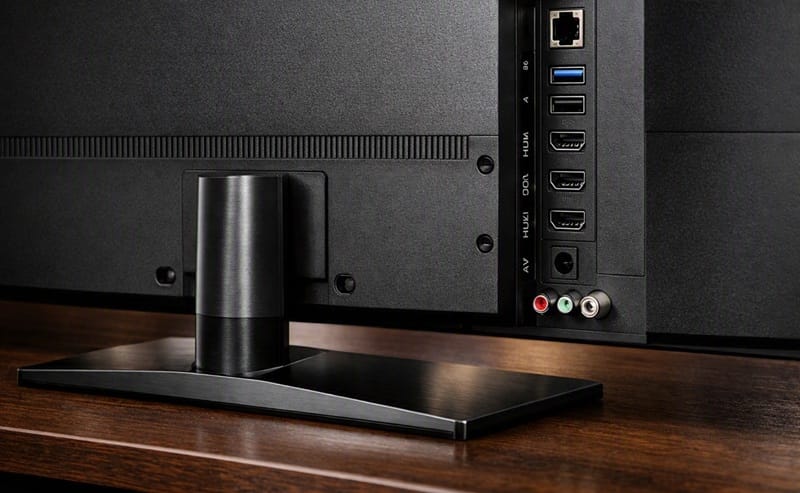
At 100 inches, design conversations stop being about bezels and start being about logistics. Based on Hisense’s published specifications, the panel uses a slim-profile frame with a centered pedestal stand built to support the extra weight and width a screen this size carries.
According to Hisense’s 2026 ULED Mini-LED lineup announcement, the U6 Pro is positioned as the accessible entry point in the series, built to bring the same anti-reflection, glare-free screen treatment used across the step-up U7 and U8 series down to a lower price tier. On a 100-inch panel, that coating covers a lot more surface area than it would on a 55-inch set, so a stray window or lamp has more glass to reflect off of before it becomes a problem.
At this footprint, panel weight and mounting also become part of the design conversation in a way they aren’t on smaller TVs. A 100-inch installation is realistically a two-person job, and VESA wall mounting should use hardware rated well above the panel’s listed weight rather than cutting the margin close.
Ports & Connectivity
The 100U6SF Pro runs Fire TV, not Google TV or Android TV — worth confirming before you buy if you’re set on a specific app ecosystem, since Hisense sells this same size class across several different smart-TV platforms. HDMI inputs support the panel’s native 144Hz signal for both console and PC sources, and Alexa+ voice control is built in rather than remote-only.
Performance & Real-World Use
Sports and Bright-Room Viewing
Hisense’s official product page for the 100U6SF Pro highlights the glare-free, anti-reflection screen as a design priority specifically for daytime sports viewing, positioning it as a bright-room set rather than a dedicated dark-room home theater display. Based on manufacturer specifications, the Mini-LED backlight is built to stay watchable with lights on rather than needing a fully darkened room.
A screen this size sits further back from most seating positions than a 55-inch set would, which changes how reflections show up in daily use — a lamp or window that would sit outside your sightline on a smaller TV can land squarely on-screen once the panel is this wide. Hisense doesn’t publish a room-specific glare rating, so treat this as a reasonable expectation based on the coating spec rather than a tested result.
Movie Nights and HDR
Dolby Vision IQ and HDR10+ are both supported, and according to Hisense’s published specs, Dolby Vision IQ specifically means the picture adjusts its tone mapping to ambient room light rather than assuming a dark room every time. For a TV explicitly built for bright-room use, that’s a more relevant spec than a peak-nits figure Hisense hasn’t published for this model.
Gaming at 144Hz
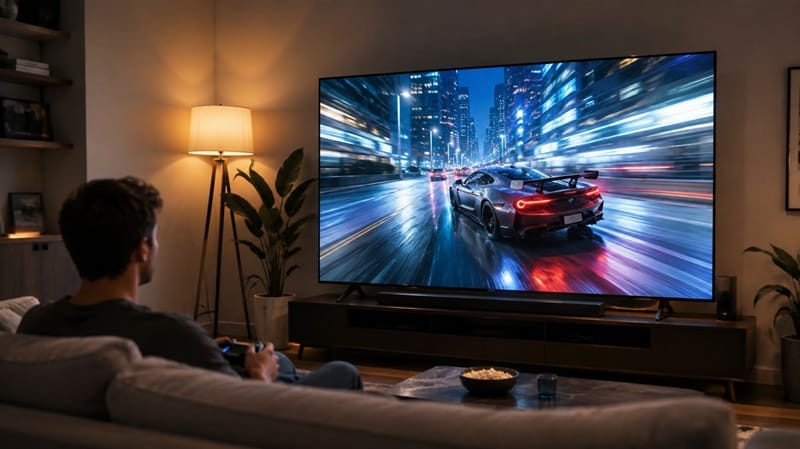
The native 144Hz panel is the standout spec on paper, and it’s shared across the whole U6 Pro size range rather than cut down for the 100-inch model. Unlike the backlight’s zone count — a spec covered in more detail below — refresh rate is one of the few gaming-relevant numbers actually confirmed to carry over unchanged at this scale.
For gamers weighing this against a smaller, pricier flagship purely for motion handling, that consistency is the practical takeaway: the lineup doesn’t reserve full 144Hz for its most expensive size.
Key Features Breakdown
Full Array Local Dimming at 100 Inches
Local dimming is what separates a Mini-LED TV from a basic backlit LED set, and it’s also the spec most sensitive to screen size — the same zone count has to spread its light over a much bigger surface once the panel grows. Hisense hasn’t published a size-specific zone count for the 100U6SF Pro, so treat contrast performance at this size as based on the series’ general spec sheet rather than a confirmed number — the practical impact of that gap is worth weighing before you buy, which is where the Ugly section below picks up.
Built-In Subwoofer
A dedicated subwoofer is unusual at this price tier, where most competing sets rely on small downward-firing drivers alone. Hisense’s spec sheet lists it alongside Dolby Atmos support, which suggests low-end output the flatter speaker arrays on cheaper 100-inch TVs typically can’t produce — though without a published wattage figure for the subwoofer itself, that’s a directional claim rather than a measured one.
The Good, the Bad, and the Ugly
Pros
- ✅ Cheapest 100-inch Mini-LED in Hisense’s 2026 lineup — undercuts the 100E7SF and 100U7SG while keeping the same screen size.
- ✅ Native 144Hz across the full size range — the gaming panel spec isn’t cut down for the largest model.
- ✅ Anti-reflection, glare-free coating — carries over from Hisense’s pricier U7/U8 series rather than being tier-exclusive.
Cons
- ❌ No published size-specific dimming-zone count — makes it hard to confirm contrast performance at 100 inches versus smaller sizes in the same series.
- ❌ Fire TV only — no Google TV option at this size in the Pro line — worth checking if you specifically want a different app ecosystem.
The Ugly
Backlight density is the real open question with any Budget-tier Mini-LED at 100 inches. Hisense’s own step-up 100E7SF exists specifically because a larger panel needs more zones to keep local dimming looking controlled rather than blocky in high-contrast scenes — and since neither model’s zone count is public, price tier is the closest thing to a signal a buyer has for how far apart they actually perform.
If your typical viewing involves bright highlights next to deep shadows in the same frame — space footage, nighttime sports under stadium lights, dark cinematography — that’s the scenario most likely to expose a Budget-tier panel’s limits at this scale.
Who Should Buy This — and Who Shouldn’t
Buy This If
The 100U6SF Pro makes the most sense for buyers who’ve already decided 100 inches is the size they want and are shopping by price first. It’s a similar trade-off to buying the base-storage version of a phone instead of the model with more headroom — the core hardware is the same, you’re just working with fewer reserves at the edges.
If gaming at 144Hz matters more to you than squeezing out every last nit of brightness, this Hisense 100U6SF Pro review lands on a clear buy. Our OLED vs Mini LED comparison covers how this backlight approach stacks up against OLED at a similar budget.
Comparing budget-tier picks across brands before committing? Our Samsung Crystal UHD buying guide lines up similar-price alternatives outside Hisense’s own catalog.
Skip This If
Skip it if you watch primarily in a bright living room and want the strongest HDR highlights Hisense can offer at 100 inches — that’s a stronger case for stepping up to the Hisense 100E7SF review, which sits one tier above this model in the same 2026 lineup.
Final Verdict
Is It Worth Buying?
The Hisense 100U6SF Pro earns its place as the budget entry point into 100-inch Mini-LED, not as the best-performing TV Hisense makes at this size. If your priority is screen size and a real 144Hz gaming panel, it delivers both without flagship pricing.
Buyers who specifically want Hisense’s strongest picture quality at 100 inches should compare this against the pricier 100E7SF before deciding. If you’re still weighing panel types more broadly, our OLED vs Mini LED for sports breakdown looks specifically at fast-motion viewing, which is where this TV’s 144Hz panel is meant to earn its keep. 🛒 Check Availability on Amazon
Frequently Asked Questions
Is the Hisense 100U6SF Pro worth buying in 2026?
Based on manufacturer specifications, it’s a reasonable buy if you’re prioritizing screen size and 144Hz gaming over flagship-level brightness and dimming precision. It’s the cheapest way into Hisense’s 100-inch Mini-LED range for 2026.
How does the 100U6SF Pro compare to Hisense’s 100E7SF?
The 100E7SF sits a tier above the 100U6SF Pro in Hisense’s own 2026 lineup and is positioned as the stronger picture-quality option at the same screen size. According to Hisense’s official product page, the U6 Pro series is built as the more accessible option rather than a direct feature-for-feature match.
Does the 144Hz panel actually work for PS5, Xbox, and PC gaming?
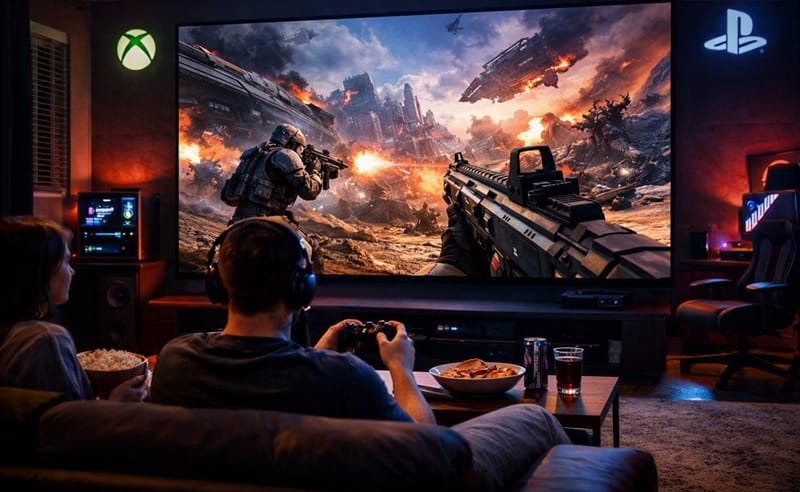
Yes — the native 144Hz refresh rate is a series-wide spec rather than a feature exclusive to smaller models, based on Hisense’s published spec sheet. It supports fast-paced console and PC gaming without the panel being downgraded for the larger 100-inch size.
Who should avoid the Hisense 100U6SF Pro?
Buyers who watch mostly in bright rooms and want maximum HDR highlight brightness, or anyone who wants the most local-dimming zones Hisense offers at 100 inches, should look at the step-up 100E7SF instead.
What’s the best way to set up a 100-inch TV like this?
Plan on professional wall mounting or a media console explicitly rated for a panel this large — unboxing and lifting a 100-inch panel solo isn’t realistic, so budget for help or installation either way. It’s also worth measuring doorways and stairwells against the box dimensions before delivery day, since large-panel returns are logistically painful for both sides.

iYaiii
Editor, GearPulse360
iYaiii is the editor and founder of GearPulse360, specializing in TV reviews and consumer electronics. He researches every recommendation before publishing.
✅ Based on spec analysis and Hisense’s official data — last verified August 2026.