Sony Bravia 7 Reflection Problem: Why This Mini-LED Glares in Bright Rooms (and What Actually Helps)
Last updated: July 2026 / 🕒 7 min read
Disclosure: As an Amazon Associate I earn from qualifying purchases. This article contains affiliate links — we may earn a small commission if you buy through them, at no extra cost to you.
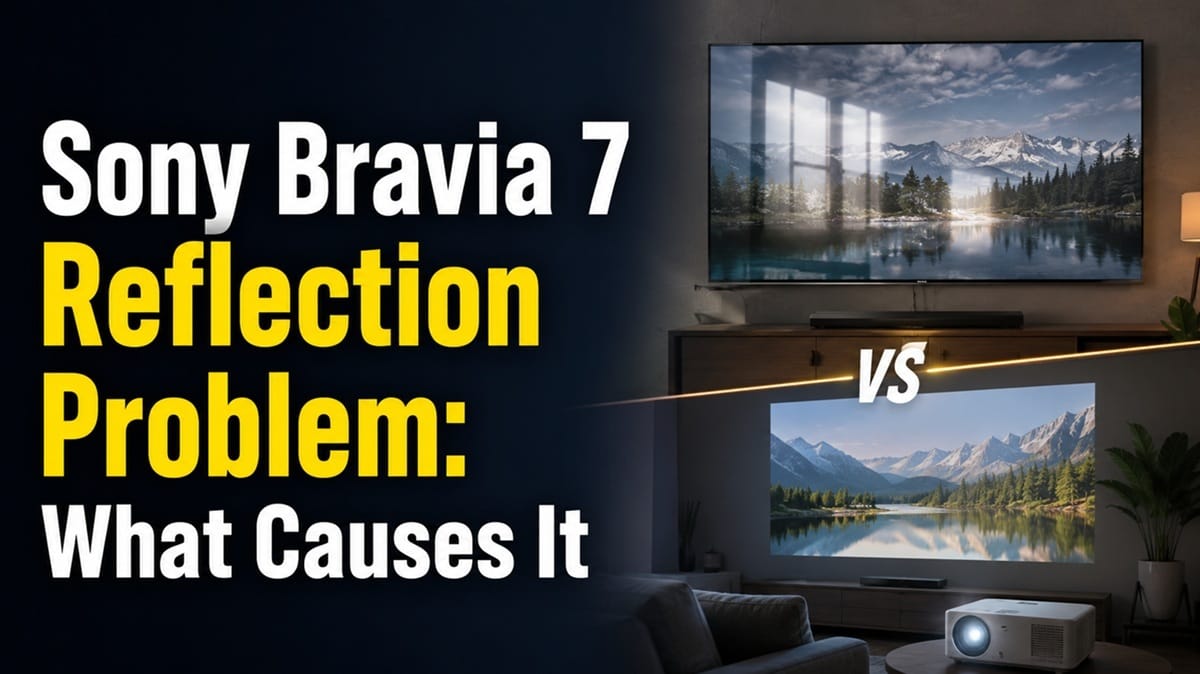
If you’ve been reading owner threads before buying, you’ve probably run into the same complaint over and over: the Sony Bravia 7 reflection problem. People describe a hazy, mirror-like glare that shows up the moment a lamp, window, or overhead light hits the screen at the wrong angle. It’s not a defect or a bad unit — it’s a deliberate design choice Sony made to hit this TV’s price point, and it’s worth understanding before you decide whether it’s a dealbreaker for your room.
Independent testing and Sony’s own spec sheets agree on the cause: the Bravia 7 uses a semi-gloss panel finish without Sony’s X-Anti Reflection layer, which is reserved for the pricier Bravia 9 and a couple of older X-series models. That single omission explains almost everything owners report about glare.
Table of Contents
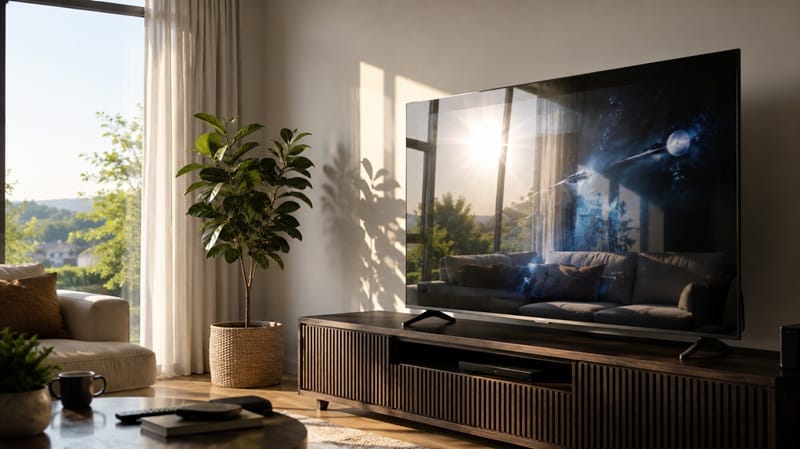
The Short Answer: What Causes the Sony Bravia 7 Reflection Problem
The Bravia 7 reflects more light than Sony’s higher-tier mini-LED and OLED models because it ships without an anti-reflective coating. Its screen is described by Sony as semi-gloss, and based on manufacturer specifications, that finish sits below the X93L, X95L, and Bravia 9, all of which include Sony’s X-Anti Reflection filter. In a room with any meaningful ambient light, the panel behaves more like a dark mirror during bright or daytime scenes.
Why the Bravia 7’s Panel Reflects So Much Light
No X-Anti Reflection Filter
Sony’s X-Anti Reflection technology works by scattering and canceling incoming light before it bounces back at the viewer. Checking the Sony BRAVIA 7 specifications page against Sony’s higher-tier mini-LED models confirms this filter is limited to sets sitting above the Bravia 7 in the lineup. Without it, light from windows, ceiling fixtures, or even a bright wall behind the seating area reflects fairly directly off the screen instead of being diffused.
A Glossy, Not Matte, Surface Finish
There’s a real tradeoff here. A glossy panel generally preserves deeper black levels and sharper contrast than a matte, anti-glare-coated one, since diffusing coatings can slightly wash out shadow detail. Sony appears to have prioritized that contrast advantage on the Bravia 7 rather than adding a coating that would have pushed the price closer to the Bravia 9. In other words, the Sony Bravia 7 reflection problem isn’t an oversight — it’s the flip side of a deliberate picture-quality tradeoff.
How Bad Is It, Based on Independent Testing?
What RTINGS’ Reflection Testing Shows
According to RTINGS’ Total Reflected Light testing methodology, TVs are measured on how much direct and indirect light bounces off the panel under controlled lighting. RTINGS’ own test results for the two models show the flagship Bravia 9 handling reflections noticeably better than the Bravia 7 on this metric, which tracks with the X-Anti Reflection gap between them. That doesn’t mean the Bravia 7 is unwatchable in daylight — it means Bravia 7 picture quality becomes far more dependent on where the TV sits relative to light sources than it does on the better-shielded Bravia 9.
Where It Matters Most
Dark, moody scenes are where the reflection problem is most noticeable, since even a dim reflection stands out against a near-black frame. Bright, high-key content is far more forgiving, because the reflected light gets lost against the picture itself. Streamers who watch a lot of prestige drama or horror in the evening tend to notice the Sony Bravia 7 reflection problem far more than someone who mostly watches sports or sitcoms with the lights on.
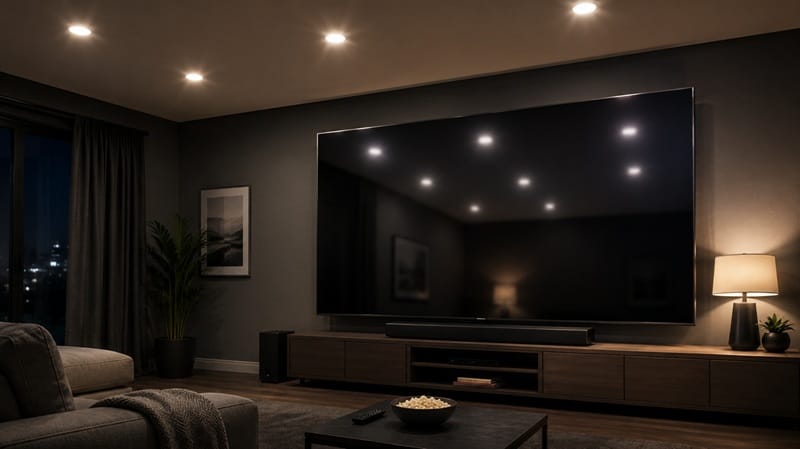
Room lighting ends up being a bigger factor in day-to-day satisfaction here than most spec sheets suggest. If you’re already close to a buying decision and want to see how the Bravia 7 stacks up against other options, our best OLED TVs in 2026 roundup ranks the top picks by picture quality, gaming performance, and value.
If reflections turn out to be more of a concern for your room than the Bravia 7’s contrast and brightness can offset, it’s worth stepping back and comparing panel types altogether — our OLED vs Mini LED comparison breaks down how the two technologies handle glare, black levels, and brightness differently, since the right choice really does depend on how much ambient light your room gets.
What This Means for You in Practice
Who Should Pay Attention to the Bravia 7 Reflection Problem
If your living room has a window facing the TV, bright overhead lighting you can’t dim, or a wall of glass nearby, this is genuinely worth factoring into your decision. Evening and nighttime viewing largely sidesteps the issue, but daytime sports or movie nights in a sunlit room will show it clearly. Anyone shopping specifically because they’ve read about the Sony Bravia 7 reflection problem online should weigh their actual room layout more heavily than the spec sheet.
Shopping the current lineup instead of this generation? The same tradeoff carries over — our Sony K-75XR70M2 review found the newer True RGB Mini LED model still struggles with daytime glare on its glossy panel, even with the backlight upgrade. The smaller Sony K-65XR70M2 review confirms the same glare shows up at 65 inches too, since Sony carries the same glossy panel coating across every size in the BRAVIA 7 II line.
Who Doesn’t Need to Worry About This
If the Bravia 7 is going into a dedicated media room, a basement, or any space where you already control the lighting — blackout curtains, dimmable lamps, no direct window line to the screen — this issue mostly disappears in daily use. It only becomes a real problem when the room’s lighting fights the screen.
Still unsure whether a mini-LED like the Bravia 7 or a glossy OLED panel will handle your specific room better? Our OLED vs QLED for bright rooms guide walks through how each panel type performs under real ambient light conditions.
None of this makes the Bravia 7 a bad TV — it just means the room it goes into matters as much as the TV itself. A few minutes spent thinking about where the seating and light sources sit relative to the screen usually settles whether the reflection problem will actually bother you day to day.
Own Sony hardware long enough and you’ll eventually run into more than one quirk like this — screen glare here, or something unrelated like a Sony OLED that keeps shutting down on its own elsewhere in the lineup. Most of these trace back to a specific, fixable cause rather than a failing unit, which is worth keeping in mind before assuming the worst about any one symptom.
FAQs: Sony Bravia 7 Reflection Problem
Why does my Sony Bravia 7 have a reflection problem?
The Sony Bravia 7 reflection problem happens because the TV doesn’t include Sony’s X-Anti Reflection filter, which is reserved for the Bravia 9 and select older X-series models. Based on independent testing data from RTINGS’ Bravia 7 review, its glossy panel reflects noticeably more ambient light than Sony’s higher-tier sets.
Is the Bravia 7’s screen glare a sign of a defective unit?
No. The Sony Bravia 7 reflection problem is a design characteristic that applies to every unit, not a manufacturing defect. If your specific TV seems worse than what’s described here, it’s worth checking placement and room lighting before assuming there’s a hardware issue, since two identical TVs in two different rooms can look very different on this front.
Does an anti-glare screen protector fix the Bravia 7’s reflection issue?
Third-party screen protectors can reduce some surface glare, but they often soften sharpness and can introduce their own visible texture under bright light. Adjusting room lighting and TV placement is generally the more reliable first step before adding anything to the screen itself.
Should I buy the Bravia 7 if my living room has a lot of natural light?
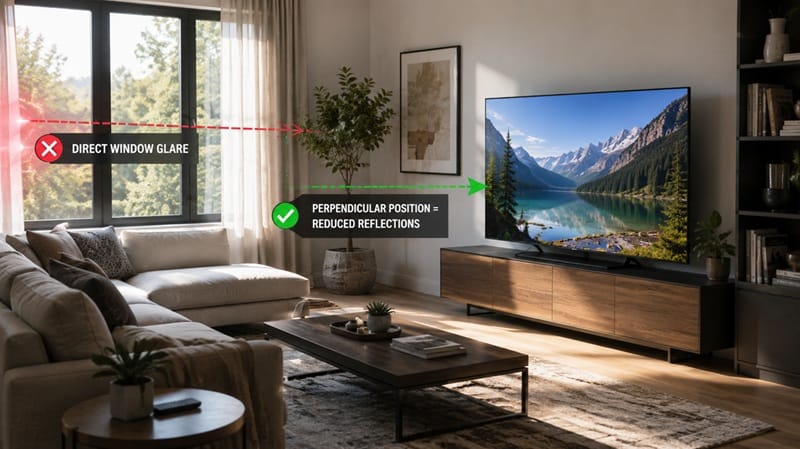
It depends on where the light comes from relative to your seating area. If you can position the TV so windows aren’t directly opposite the screen, or you’re able to use curtains or blinds during peak daylight hours, the reflection problem becomes much less noticeable in daily use.
Do OLED TVs have the same reflection problem as the Bravia 7?
Glossy OLED panels can reflect light too, but many OLED models pair that glossy surface with better native contrast and off-angle performance, which changes how noticeable reflections feel in practice. Our best OLED TVs for bright rooms picks cover models specifically chosen for handling ambient light well.

iYaiii
Editor, GearPulse360
iYaiii is the editor and founder of GearPulse360, specializing in TV reviews and consumer electronics. He researches every recommendation before publishing.
✅ Based on spec analysis and RTINGS data — last verified July 2026