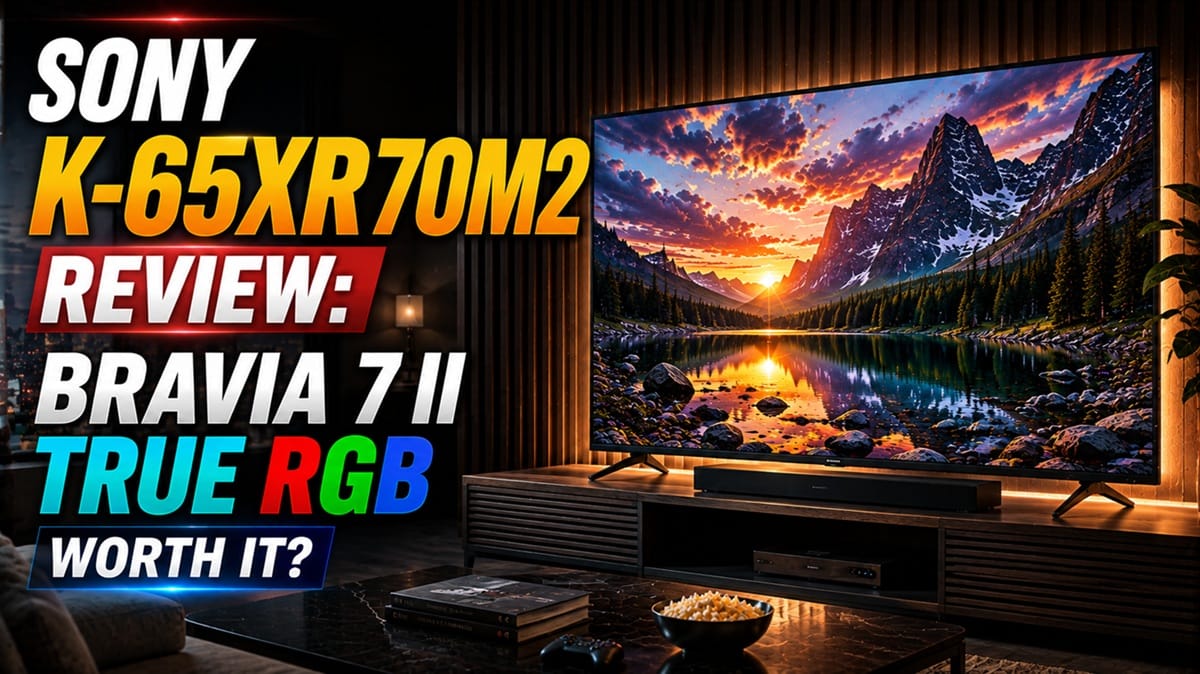
Sony K-65XR70M2 Review: Is the 65-Inch BRAVIA 7 II Worth It?
Last updated: August 2026
🕒 9 min read
Disclosure: As an Amazon Associate I earn from qualifying purchases. This article contains affiliate links — we may earn a small commission if you buy through them, at no extra cost to you.
Picking a size in a six-SKU lineup usually comes down to one question: does the model you’re actually buying perform the same as the one that got reviewed? In this Sony K-65XR70M2 review, that question has a clean answer — RTINGS bought and tested the 65-inch BRAVIA 7 II directly, not a different size with the numbers carried over.
Shoppers land here comparing Sony’s True RGB Mini LED against conventional Mini LED sets from TCL and Hisense, trying to work out whether the RGB backlight name on the box translates into a picture-quality difference you’d actually notice.
Drawing on RTINGS’ published lab data and Sony’s own specifications, the short version is that the color gains are real, but the RGB backlight isn’t always doing the work its name implies. For the wider field of 65-inch options this year, our best 4K TVs of 2026 roundup lines up how this Sony stacks up against the rest.
Table of Contents
Quick Verdict
At a Glance
★★★★★ 7.4 / 10
At a Glance
Picture Quality
Gaming
Audio
Value
👍 Best For: Mixed-usage living rooms that want OLED-adjacent color and contrast without burn-in risk.
👎 Skip If: You want a dedicated dark-room theater set or you’re a competitive gamer sensitive to motion blur.
One-Line Verdict: A bright, color-rich Mini LED with excellent input lag, held back by weak reflection handling and motion clarity that trail the rest of its picture quality.
🛒 Check Availability on AmazonProduct Specs at a Glance
Product Specs
Sony K-65XR70M2 (BRAVIA 7 II)
RGB Mini LED (VA) · Google TV · 4K/120Hz Gaming
| 💡 Peak HDR Brightness (measured) | ~2,097 cd/m² (25% window) |
| 🔌 HDMI 2.1 Ports | 2 of 4 (incl. eARC) |
| 📺 Panel Type | RGB Mini LED, VA sub-type |
| 🎮 Refresh Rate | 120Hz native, VRR |
| 🌈 HDR Formats | Dolby Vision, HDR10 |
| 🎯 Backlight Tech | RGB Backlight Master Drive Pro |
| 🖥️ Smart Platform | Google TV 14 |
| 📐 Class Size Tested | 65″ (64.5″ actual) |
Design & Build Quality
Materials & Finish
The K-65XR70M2 follows the design language Sony’s official product documentation lays out for the whole BRAVIA 7 II lineup: thin, uniform bezels on all four sides. RTINGS’ hands-on assessment found the build feels sturdy despite being made largely of plastic, with no quality-control issues reported on the review unit.
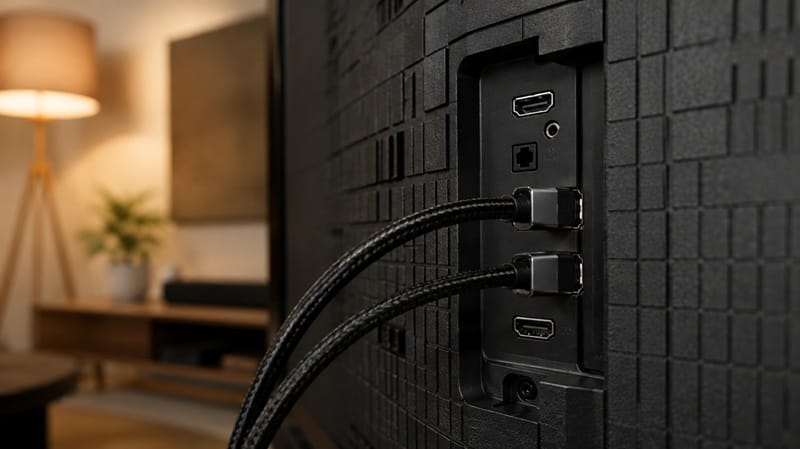
The center-mounted pedestal stand uses a semi-opaque lens panel to hide cables routed through the back, a detail RTINGS called out specifically for keeping the setup tidy. The back panel skips the checkerboard texture of older high-end Sony sets for a plainer finish, with built-in cable clips for basic management.
Ports & Connectivity
Connectivity is where the K-65XR70M2 shows its mid-flagship positioning rather than true flagship spec. Of the four HDMI ports, only two carry full HDMI 2.1 bandwidth, and one of those doubles as the eARC port — so a receiver hookup effectively uses up one of your two high-bandwidth inputs. The other two ports are limited to HDMI 2.0, which matters if you’re running more than one 4K/120Hz source at once.
Performance & Real-World Use
Movie Nights and Dark-Room Viewing
This is where the True RGB backlight’s reputation and its real-world behavior diverge a little. Sony’s own documentation markets the RGB Backlight Master Drive Pro as three independently controlled red, green, and blue LEDs replacing the older blue-LED-plus-quantum-dot approach.
According to RTINGS’ testing, though, with the default “Medium” local dimming setting the panel actually falls back to a plain white backlight for the large majority of real content, only switching into full RGB mode with more saturated scenes — a different behavior than rival RGB Mini LED sets like the Samsung R95H or Hisense UR9SG, which stay in RGB mode more often.
What that means in practice: black levels and contrast hold up regardless. Native contrast is strong, local dimming leaves minimal light bleed into neighboring zones, and black uniformity is excellent — dark scenes stay convincing once the room itself is dark. Zone transitions keep pace with fast motion, too, though Sony’s dimming algorithm runs conservative, leaving more zones lit than strictly necessary.
Daytime & Bright Room Viewing
SDR and HDR brightness are both excellent on the numbers — RTINGS measured real-scene SDR brightness around 950 cd/m² and HDR peaks over 2,000 cd/m² in a 25% window, more than enough to cut through daytime glare on typical content.
The screen finish is the catch: the glossy coating does very little to tame direct reflections, and total reflected light only rates as decent, with a visible rainbow smear around bright light sources. The effect is specific rather than general — dark scenes are the one type of content that gets noticeably harder to watch during the day, even though brightness elsewhere handles daylight fine.
Gaming with PS5 and Xbox
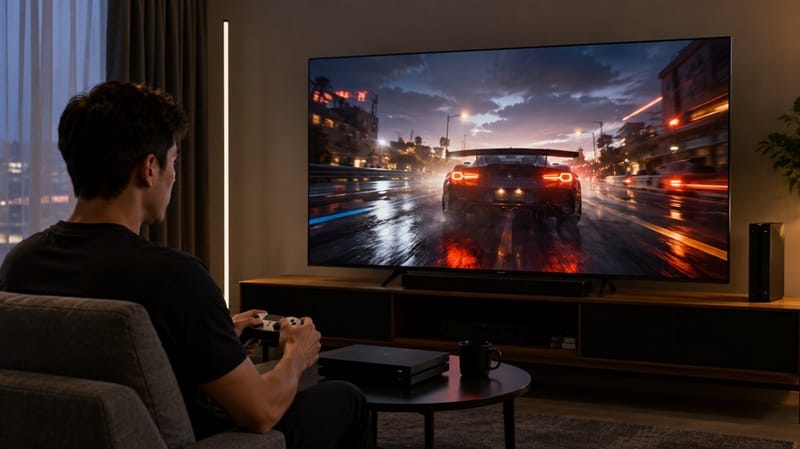
Input lag is a clear strength: RTINGS measured excellent responsiveness across every supported Game Mode refresh rate, and the K-65XR70M2 is fully compatible with PS5 and Xbox Series X|S features including 4K/120Hz, HDR, ALLM, and VRR (both HDMI Forum VRR and G-SYNC compatibility, though not FreeSync). Auto Low Latency Mode means you don’t have to manually switch into Game Mode either.
Motion clarity is the weaker half of the gaming story. RTINGS’ motion testing found disappointing clarity-and-detail results at the TV’s 120Hz maximum refresh rate, and outright blurry motion at 60Hz — a real consideration for anyone gaming on the more common 60fps titles on PS5. The optional black frame insertion mode helps with judder but introduces faint secondary images due to slightly off pulse timing.
Key Features Breakdown
True RGB Backlight (RGB Backlight Master Drive Pro)
The headline feature earns its keep on color volume — RTINGS’ color volume testing found excellent, vivid results in both SDR and HDR, with high peaks and clean separation between red, green, and blue that give the panel real color purity when the RGB mode is active. The caveat, covered above: a lot of everyday viewing runs on the fallback white backlight rather than the full RGB configuration, so that color purity doesn’t show up in every scene.
XR Processor and Google TV
The XR Processor (built on a MediaTek Pentonic-class chipset) handles upscaling and low-quality content smoothing well, according to RTINGS — older broadcast and DVD-quality sources look notably cleaner without obvious over-sharpening. Google TV 14 runs smoothly with no reported bugs during testing, though it does carry ads in the interface; opting out of Google sign-in during setup removes most smart features but also removes the ads.
The Good, the Bad, and the Ugly
Pros
- ✅ Strong black levels and contrast — minimal haloing and excellent black uniformity make dark scenes convincing once the room itself is dark.
- ✅ Excellent brightness in both SDR and HDR — bright enough to punch through daytime glare, with HDR highlights that stand out clearly against the rest of the image.
- ✅ Excellent input lag and console compatibility — PS5 and Xbox Series X|S get full 4K/120Hz, VRR, and ALLM support.
Cons
- ❌ Weak reflection handling — the glossy finish does little to cut direct glare, which specifically hurts dark scenes during the day.
- ❌ Mediocre viewing angle — colors and brightness fall off gradually off-axis, so it’s not ideal for wide seating arrangements.
The Ugly
If motion clarity is the main concern going in: RTINGS rated the K-65XR70M2’s 60Hz motion as outright blurry, and even at its 120Hz ceiling, results were disappointing rather than just average. For movies and most TV, the slower response time isn’t a dealbreaker. Fast-paced 60fps gaming is where it shows up most, and no picture setting resolves it.
Who Should Buy This — and Who Shouldn’t
Buy This If
The Sony K-65XR70M2 makes the most sense for a mixed-usage living room — think of it as a generalist rather than a specialist, closer to an all-terrain vehicle built to handle several different jobs reasonably well instead of one job perfectly.
If you want picture quality that gets meaningfully closer to OLED’s color and contrast, without OLED’s theoretical burn-in risk, and your room sees real daylight rather than blackout curtains, this is a legitimately strong pick in the mid-flagship Mini LED bracket.
It’s also a sensible choice if you game casually on PS5 or Xbox and care more about input lag and HDR gaming support than chasing the smoothest possible motion — and if you’re still comparing Mini LED against other budget-friendly 4K options, our Samsung Crystal UHD buying guide is a useful contrast point for buyers weighing a step-down price tier.
For a deeper look at whether Mini LED or OLED fits your room better in the first place, see our OLED vs Mini LED comparison.
Skip This If
Skip it if you’re building a dedicated dark home theater room — the reflection handling and viewing angle limitations matter less there, but you’d still get more consistent black-level performance from an OLED at a similar price.
Skip it too if competitive or fast-paced 60fps gaming is your priority; based on RTINGS’ testing, the TCL 65QM8L is the better fit for gaming specifically, with a wider selection of gaming features and full HDMI 2.1 bandwidth across all four inputs rather than just two.
Final Verdict
Sony K-65XR70M2 Review: Is It Worth Buying?
Sony K-65XR70M2 Review: Is It Worth Buying?
For most mixed-usage households, the Sony K-65XR70M2 is worth buying. Brightness, contrast, and color volume are strong for the mid-flagship Mini LED tier, and gaming responsiveness holds up even where motion clarity doesn’t. Buyers who specifically need gaming-tier motion handling or wider HDMI 2.1 support are better served elsewhere; the 75-inch sibling in this lineup, covered in our Sony K-75XR70M2 review, carries the same tradeoffs at a larger size if you’re deciding between the two. 🛒 Check Availability on Amazon
Frequently Asked Questions
Sony K-65XR70M2 Review: Is It a Good TV in 2026?
For most mixed-use living rooms, yes. RTINGS’ lab testing found strong contrast, excellent brightness, and vivid color for its price tier — the tradeoffs are reflection handling in bright rooms and motion clarity at higher frame rates, both of which trail more expensive or gaming-focused alternatives.
Does the True RGB Backlight Actually Make a Visible Difference vs. Standard Mini LED?
RTINGS’ testing found excellent color volume when the RGB backlight mode is active, but also found the panel defaults to a plain white backlight for most everyday content at the recommended local dimming setting. The difference is real — it just isn’t visible in every scene you watch.
Is the K-65XR70M2 Good for PS5 and Xbox Gaming?
For responsiveness, yes — input lag is excellent and it supports 4K/120Hz, HDR, ALLM, and VRR on both consoles. For fast-motion clarity specifically, based on RTINGS’ testing, it’s a weaker performer, especially at 60Hz.
Who Should Avoid the K-65XR70M2?
Buyers building a dedicated dark home theater room, anyone highly sensitive to motion blur in fast games, and shoppers who need full HDMI 2.1 bandwidth on more than two ports should look elsewhere in this price bracket.
Does Screen Size Affect Which BRAVIA 7 II Performs Best?
Based on RTINGS’ published testing, the results measured on the 65-inch model are stated to extend across the entire BRAVIA 7 II lineup, from 50 to 98 inches — local dimming zone counts scale with panel size, but the underlying picture behavior doesn’t meaningfully change based on size alone.

iYaiii
Editor, GearPulse360
iYaiii is the editor and founder of GearPulse360, specializing in TV reviews and consumer electronics. He researches every recommendation before publishing.
✅ Based on spec analysis and Sony’s official and RTINGS data — last verified August 2026