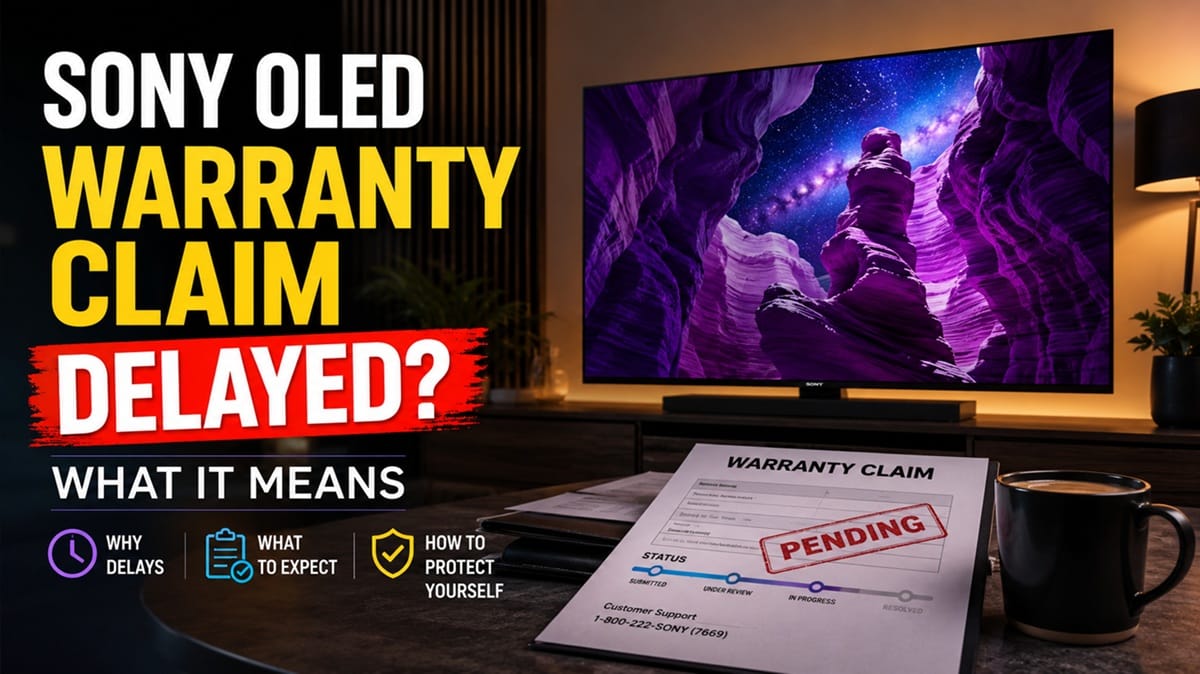
Sony OLED Warranty Claim Delayed? Here’s Why It Happens and What To Do Next
Last updated: July 2026
🕒 7 min read
Disclosure: GearPulse360 participates in the Amazon Associates Program. This particular article contains no affiliate links; other content on our site may.
You filed a Sony OLED warranty claim, followed every instruction on the form, and then — nothing. No status update, no callback, not even a confirmation email saying the case is still open. A week goes by, then two, and you’re left wondering whether the claim is quietly being processed or quietly being ignored.
Based on Sony’s own published warranty documentation and the patterns owners describe, a Sony OLED warranty claim delayed like this can look identical to a claim that’s quietly being denied — but the two situations call for very different responses.
A delayed claim and a denied claim aren’t the same problem, and treating them the same way wastes time either way. So the denial side gets set aside here entirely — what follows is only about the wait itself: the reasons a claim stalls, what counts as a normal processing window, and the point where waiting stops being the right move. If your claim has already come back as a flat refusal rather than silence, our breakdown of Sony OLED warranty denied cases walks through the specific exclusions Sony leans on instead.
Table of Contents

The Short Answer: Why a Sony OLED Warranty Claim Gets Delayed
Most delays trace back to one of three things: missing or incomplete proof-of-purchase documentation, a scheduling bottleneck at an authorized service facility, or a parts-sourcing wait for a repair rather than a straight replacement. None of these mean the claim has been rejected — they mean it’s sitting in a queue somewhere in Sony’s process, and it’s on you to find out where.
How Sony’s Warranty Process Actually Moves
What Happens Between Filing and Resolution
According to Sony’s published limited warranty terms, coverage runs for one year from the original purchase date (ninety days for commercial use), and the manufacturer reserves the right to repair with new or refurbished parts, or to replace the unit outright. A dated purchase receipt or bill of sale is required to open a claim at all — a missing receipt is one of the most common reasons a case sits unprocessed before a technician is ever assigned.
For OLED screens thirty inches or larger, Sony’s documentation specifies in-home diagnostic service during the warranty term through an authorized facility. Smaller screens, or claims where in-home service isn’t available in your area, require shipping the unit to a specified service center in its original packaging (or equivalent protection) at the owner’s cost of freight. That shipping and inspection step alone can add a week or more before anyone even confirms the defect.
Where the Clock Actually Starts
A case number being assigned isn’t the same as a technician being scheduled. Owners sometimes assume the countdown to resolution starts the moment they call support, when in practice it often doesn’t start until the unit (or its documentation) physically reaches the service facility Sony designates for that claim.
Delayed Claim vs. Denied Claim: Why the Difference Matters
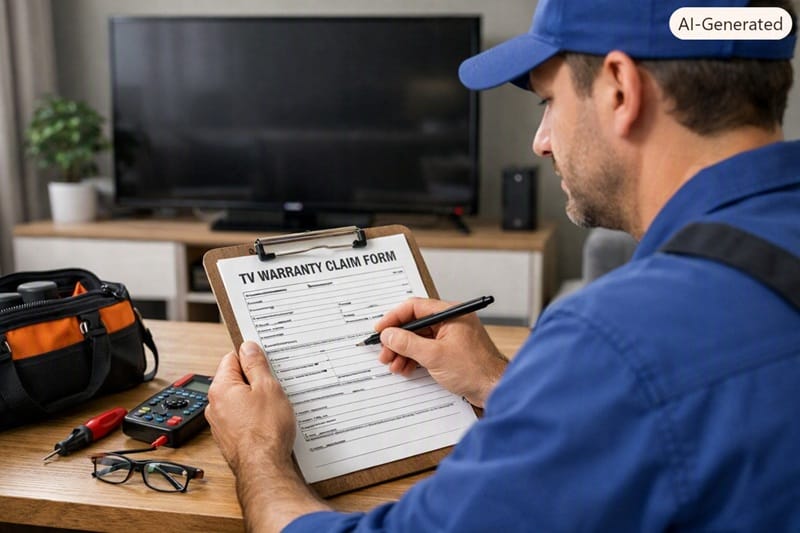
A denied claim comes with a stated reason — Sony’s terms exclude damage from misuse, unauthorized modification, or ordinary wear, and a denial letter or call will usually cite one of those categories directly. A delayed claim comes with no reason at all, just silence, which is exactly what makes it harder to plan around.
Weighing Your Options While the Claim Sits
A repair that drags on long enough starts to feel like a decision by default — the set just stays broken until Sony acts. If you’d rather make that call on your own terms, our best OLED TVs in 2026 roundup lays out how this year’s models stack up on picture quality and value, so a replacement isn’t a decision made purely out of frustration with the wait.
Owners who’ve been through this before also flag a pattern worth knowing about power-related failures specifically: our piece on Sony OLED power board failure after warranty covers a related failure mode where the repair-vs-replace math looks different once you’re outside the coverage window entirely.
Normal Processing Window vs. a Claim That’s Actually Stuck
A normal Sony warranty claim, once a technician or shipping label has been assigned, typically resolves within a few weeks — longer if a specific part isn’t in stock at the regional service center. That’s a real wait, but it’s a moving one: you should be able to get a status update each time you call, even if the update is just “still waiting on the part.”
A stuck claim looks different. The signs to watch for are a case number that was never followed by a scheduling call, the same documentation being requested a second or third time after you already sent it, or a callback promise that’s been missed more than once without explanation. Any one of those on its own could be a scheduling slip; two or more together is a pattern worth escalating past the first-line support queue.
What This Means for You in Practice
Who Doesn’t Need to Worry
If you filed recently, have a case number, and a technician visit or shipping label is already scheduled, you’re likely inside a normal window — the practical move is to keep a simple log of dates and names for each contact, not to escalate yet.
Who Should Pay Attention to This
If it’s been several weeks with no case number, no scheduled visit, and repeated requests for documents you’ve already submitted, that’s the point to stop waiting and ask specifically for a supervisor or a case escalation, referencing your original claim date each time. Anyone deciding whether the wait is worth it against just replacing the set can compare this year’s Sony OLED lineup on its current merits rather than judging the whole brand on one slow claim.
FAQs: Sony OLED Warranty Claim Delayed
Why is my Sony OLED warranty claim delayed?
Most Sony OLED warranty claim delays come from a documentation gap, a scheduling backlog at the authorized service facility, or a wait for a specific replacement part. Based on Sony’s published warranty terms, a receipt or bill of sale is required before a case can even be assigned to a technician, so an incomplete submission is a common early-stage holdup.
Does a delay mean Sony is going to deny my claim?
No. A delay and a denial are different outcomes with different signals — a denial comes with a stated reason tied to an exclusion in the warranty terms, while a delay is just an unresolved case sitting in the queue. Silence on its own isn’t evidence of a coming rejection.
How long should I wait before contacting Sony again about a delayed claim?
If you haven’t heard anything within about two weeks of filing, or a promised callback was missed, it’s reasonable to follow up rather than continue waiting. Reference your case number and original filing date on every call so the timeline is on record if escalation becomes necessary.
Should I buy an extended warranty because Sony’s claims process is slow to begin with?
An extended plan doesn’t speed up the underlying process — the same documentation and scheduling steps still apply, it just changes what’s covered once the standard year is over. If the concern is specifically claims-processing speed, the more useful habit is keeping your receipt and case correspondence organized from day one, since that’s what removes the most common cause of an early-stage hold. The bigger factor in whether an extended plan is worth it usually comes down to the specific exclusions in Sony’s coverage, which is a separate question from processing speed entirely.
How do I know if my Sony OLED warranty claim is just slow or actually stuck?
Go by the signals in the section above rather than the calendar — time alone doesn’t tell you much. What does help is exactly how you frame the follow-up call: reference your case number and original filing date every time, ask specifically whether a technician or shipping label has been assigned yet, and if the answer is no for a second consecutive call, ask to be transferred to a supervisor rather than repeating the same request to the front-line queue again.

iYaiii
Editor, GearPulse360
iYaiii is the editor and founder of GearPulse360, specializing in TV reviews and consumer electronics. He researches every recommendation before publishing.
✅ Based on spec analysis and Sony’s official warranty data — last verified July 2026