Samsung QN75LS03HE Review: Is The Frame Worth It Without the Pro?
Last updated: July 2026
🕒 10 min read
Disclosure: As an Amazon Associate I earn from qualifying purchases. This article contains affiliate links — we may earn a small commission if you buy through them, at no extra cost to you.
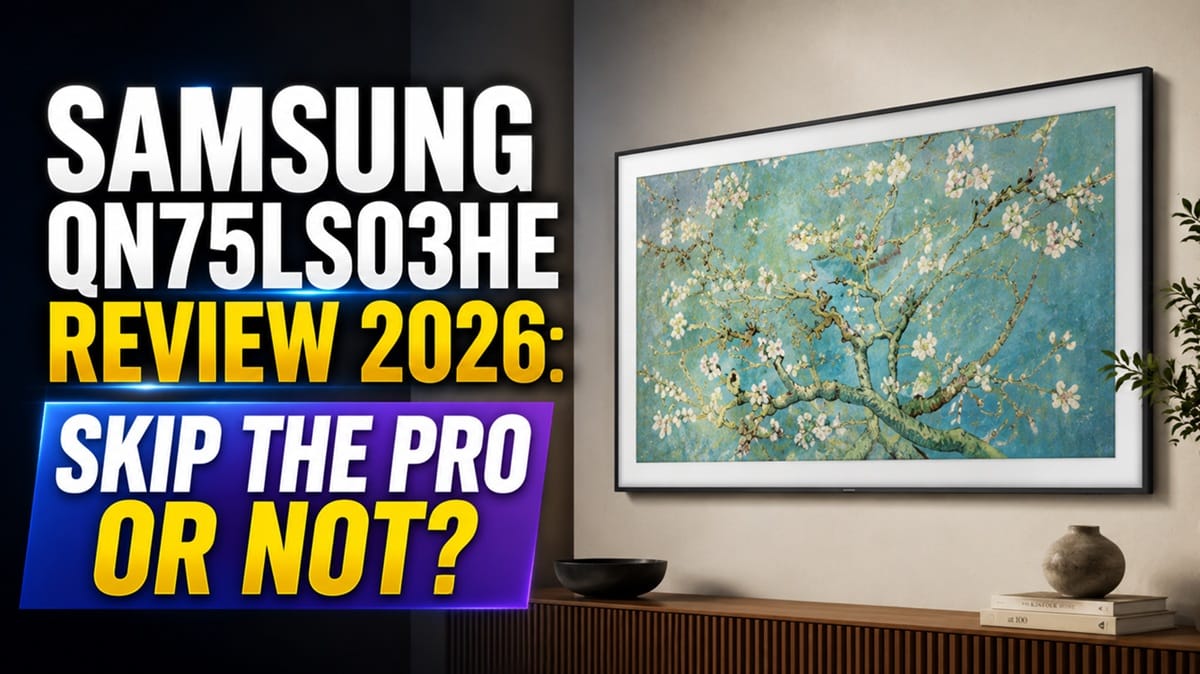
Search “Samsung QN75LS03HE review” and you’ll quickly run into pages that mix up specs and impressions from two different TVs — because Samsung sells two versions of The Frame this year, and it’s easy to land on information written about the wrong one. The cheaper QN75LS03HE drops the Mini LED backlight and the Wireless One Connect box that make the step-up Frame Pro feel like a more serious home theater set. So the real question isn’t whether The Frame looks good on the wall — it’s whether the standard 75-inch LS03HE gives up too much picture quality to get there.
Based on RTINGS’ independent lab testing of the 2026 lineup plus Samsung’s own published specifications, this review breaks down exactly what that trade-off costs you before you decide between this and our best 4K TVs of 2026 picks.
Table of Contents

Quick Verdict
At a Glance
★★★★★ 6.8 / 10
At a Glance
Picture Quality
Gaming
Audio
Value
👍 Best For: Design-focused buyers who want the Art Mode look in a well-lit living room and don’t need deep, home-theater-grade contrast.
👎 Skip If: You watch mostly in a dark room, or you specifically want the Frame Pro’s local dimming and Wireless One Connect box.
One-Line Verdict: A strong daytime and gaming TV that trades real contrast for a lower price and a cleaner install than the Frame Pro.
🛒 Check Availability on AmazonProduct Specs at a Glance
Product Specs
Samsung QN75LS03HE (The Frame, 2026)
QLED (VA LCD) · Matte Glare-Free Display · Tizen Smart TV
| 📺 Panel Type | QLED (VA LCD, edge-lit) |
| 🔄 Refresh Rate | 144Hz native (4K) |
| 🎮 HDMI 2.1 | 4 ports, full bandwidth |
| 🖼️ Screen Finish | Matte, Glare-Free certified |
| 🌈 HDR Format | HDR10, HDR10+ (no Dolby Vision) |
| 🔌 Connections | Built-in, rear-mounted |
| 📅 Model Year | 2026 |
Design & Build Quality
Materials & Finish
Design is the entire reason someone picks the QN75LS03HE over a standard-shaped TV, and Samsung mostly delivers on it. The bezels are the same thickness on all four sides and snap on and off to match different bezel colors, and the panel ships with a slim wall mount designed to sit nearly flush against drywall. According to Samsung’s own 2026 lineup announcement, this year’s Glare Free coating was upgraded across both the standard Frame and the Frame Pro, and independent testing backs that claim up — the matte finish does an excellent job cutting down daytime reflections, which is the entire reason someone chooses a Frame TV over a glossy standard set in the first place.
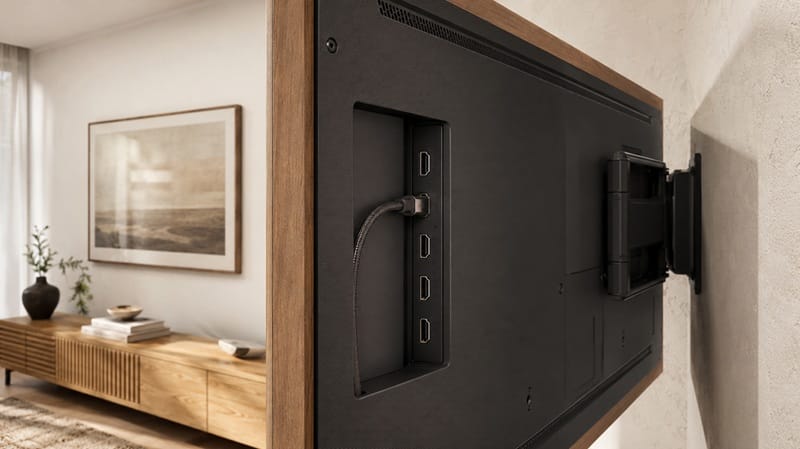
Build quality holds up too. It’s mostly plastic, but there’s no obvious flex or gap anywhere in the chassis, and the back panel includes proper VESA mounting points alongside cable-management channels if you’d rather not use the included wall mount at all.
Ports & Connectivity
This is the biggest structural change for 2026, and it cuts both ways depending on what you’re comparing against. Every input on the QN75LS03HE now sits directly on the back of the panel instead of routing through a separate box — a switch from the old One Connect design, and a simpler setup than anything Samsung has shipped in this line before. The catch is that this is also exactly what you’re giving up versus the Frame Pro, which still uses a Wireless One Connect box so all your cables can sit somewhere other than directly behind the TV. All four HDMI ports here support full HDMI 2.1 bandwidth, so that part of the spec sheet isn’t compromised at all.
Performance & Real-World Use
Watching TV in a Bright Room
This is the category the QN75LS03HE’s matte coating is actually built to win. Based on RTINGS’ lab testing, peak SDR brightness is enough to handle moderate glare, and RTINGS specifically found it does a better job maintaining picture quality in a sunlit room than the LG Gallery 2026, one of its closest lifestyle-TV rivals. If your main use case is a living room with a window facing the screen, this is a real, measurable advantage over a standard glossy TV at this price.
Art Mode itself gets its own brightness range. RTINGS measured a peak of 290 cd/m² on a checkerboard pattern in Art Mode, dimming down to a minimum of 8.1 cd/m² — a wide enough spread that artwork stays readable in daylight without turning glaring at night.
Contrast and Dark Scenes
The compromise shows up as soon as the lights go down. The QN75LS03HE has no local dimming feature at all — instead, Samsung relies on a basic global dimming trick (called CE Dimming) that only helps in near-black scenes. RTINGS measured a strong native contrast ratio on the panel itself, but without any zone-based backlight control, black levels stay raised and read as dark gray rather than true black regardless of what’s on screen.
In HDR, RTINGS’ real-scene testing topped out around 427 cd/m² in the brightest sample and dropped to 178 cd/m² in a dimmer landscape scene — enough for highlights to register, but well short of what a Mini LED or OLED panel produces, which is why RTINGS’ own verdict describes the HDR experience here as flat rather than impactful. Color performance is more of a mixed bag: RTINGS measured about 86% coverage of the DCI-P3 gamut but only around 59% of the wider BT.2020 space, typical for a QLED at this tier.
Gray uniformity is also a weak point — RTINGS found multiple visible bright and dark bands across the panel, patchy enough to notice during sports broadcasts and other large areas of flat color. Viewing angle is mediocre as well, so the picture washes out if you’re seated well off-center, which matters more on a 75-inch set than it would on something smaller.
Gaming
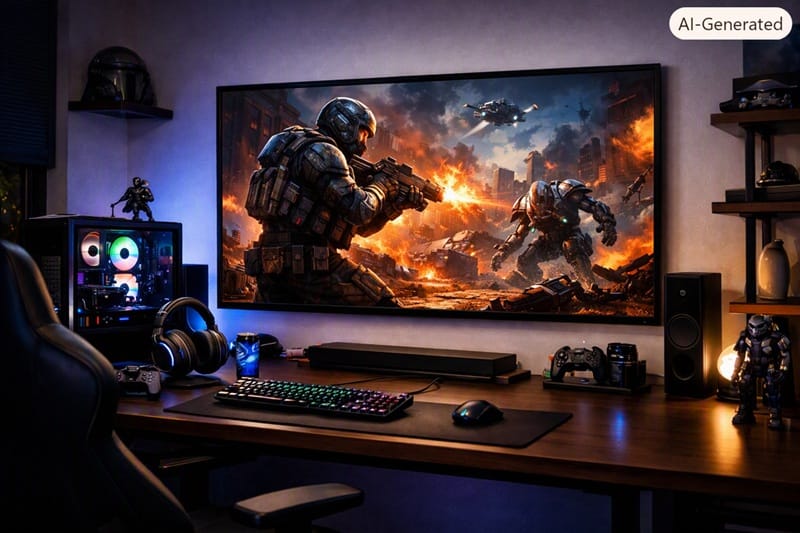
This is the category where the QN75LS03HE’s spec sheet outruns its design-first reputation. RTINGS’ testing found excellent input lag across every supported mode, along with full support for FreeSync, HDMI Forum VRR, and G-SYNC Compatible — including Low Framerate Compensation, so frame pacing stays smooth even when a game’s frame rate dips. The panel natively supports 4K at up to 144Hz, and every HDMI port carries the full HDMI 2.1 bandwidth, so there’s no need to hunt for “the gaming port” like on some competing TVs. Both the PS5 and Xbox Series X|S get full compatibility, including Auto Low Latency Mode, 4K/120Hz, and VRR. For a TV marketed around Art Mode, that’s an unusually capable gaming feature set.
Key Features Breakdown
Art Mode & the Samsung Art Store
Art Mode is the one feature that has to work well on a TV like this, and the QN75LS03HE’s execution holds up. The built-in gallery rotates roughly 30 curated pieces monthly at no extra cost, with a paid subscription unlocking a much larger library, or you can skip both and load your own photos over USB. A motion sensor wakes Art Mode when someone walks into the room instead of running the display constantly, and a brightness sensor adjusts tone and intensity so artwork looks consistent regardless of the room’s lighting — a small detail, but one that makes the “framed art” illusion hold up over time rather than just on day one.
What You Actually Lose Without the Pro Tier
Beyond the connection box, the real gap between the QN75LS03HE and the Frame Pro is the backlight. The Frame Pro adds a Mini LED (Neo QLED) panel with a basic local dimming implementation, which gets it meaningfully brighter and better at controlling glare in HDR content. It’s a real difference, but according to RTINGS’ side-by-side testing it isn’t a night-and-day one — the Pro’s local dimming is described as fairly basic and doesn’t transform the picture the way local dimming does on a dedicated home-theater TV.
The Good, the Bad, and the Ugly
Pros
- ✅ Matte Glare-Free display — excellent at cutting daytime reflections, based on RTINGS’ direct-reflection testing, and one of the better options for a bright room at this price.
- ✅ Unusually strong gaming spec sheet — excellent input lag, full VRR support, and 4K/144Hz on every HDMI 2.1 port, rare for a design-first lifestyle TV.
- ✅ Simpler install than past Frame models — built-in rear connections mean one less box to hide, even if it’s a step down from the Frame Pro’s wireless setup.
Cons
- ❌ No local dimming — black levels stay raised across the board, so contrast never gets close to what an OLED or a Mini LED set delivers.
- ❌ Patchy gray uniformity — RTINGS found visible banding that’s most noticeable on sports and other flat, large areas of color.
The Ugly
If your main concern going in is whether the QN75LS03HE’s lower price costs you a worse everyday picture — not just wireless convenience — the honest answer is yes, in two specific, RTINGS-measured ways: the patchy gray uniformity visible across the panel, and a viewing angle narrow enough to wash out anyone not sitting close to dead-center on a 75-inch screen. Neither one ruins the TV for its intended bright-room, casual-viewing job, but both are real picture-quality compromises versus the Frame Pro’s Mini LED panel — not just a difference in cable management. If your primary use case is a dedicated, lights-off home theater, this isn’t the panel that’s going to satisfy you no matter how good it looks powered off.
Who Should Buy This — and Who Shouldn’t
Buy This If
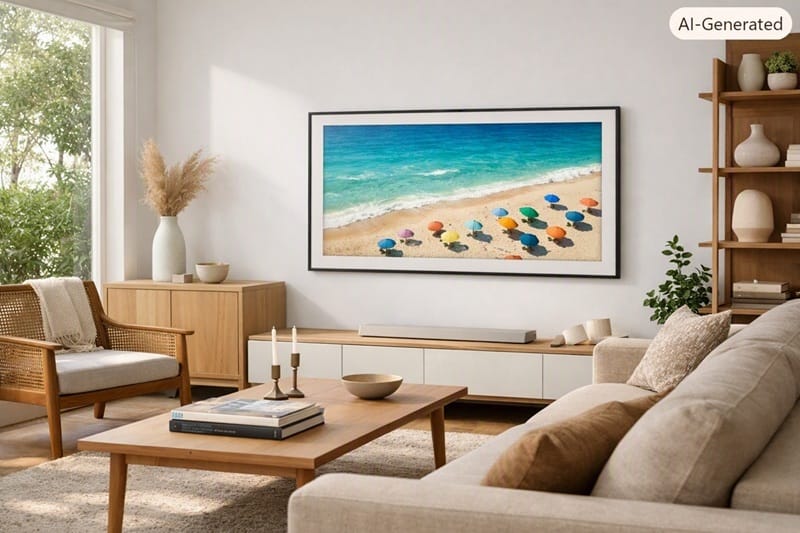
You want the Art Mode look in a living room that gets real daylight, and picture quality on your priority list ranks somewhere below “looks like a framed print when it’s off.” Think of it less like a TV competing with your neighbor’s OLED and more like a piece of furniture that happens to stream Netflix extremely well — measured against that job, it does exactly what it’s built for. The QN75LS03HE is also a legitimate pick if you game casually, since the input lag and VRR support are better than the Frame’s reputation would suggest.
If you’re weighing this against a standard-design set instead, our OLED vs QLED for bright rooms comparison lays out how a display like this stacks up against glossier alternatives in daylight.
Our best OLED TVs for bright rooms roundup is also worth a look if daytime performance is your main priority and the Art Mode gimmick isn’t a requirement.
Skip This If
You watch mostly at night, in a room you can darken, and you actually care about deep, inky blacks — no amount of matte coating fixes the QN75LS03HE’s lack of local dimming. In that case, the step-up Frame Pro is the more sensible upgrade within the same design language, since Mini LED backlighting gets you real (if modest) local dimming. Thinking bigger too? Our Samsung QN85LS03H review covers the largest Frame Pro size Samsung sells. If the wall-art aesthetic matters less to you than outright picture quality, a standard-design LG or Hisense set will simply outperform this one for the same money.
Final Verdict
Is the Samsung QN75LS03HE Worth Buying?
For the specific buyer it’s built for — someone who wants a convincing art-frame look in a bright living room and doesn’t need home-theater-grade contrast — the Samsung QN75LS03HE delivers, and its gaming feature set is a legitimately pleasant surprise. If you’re on the fence about whether the step-up model is worth the extra cost, our Samsung QN65LS03H review covers exactly what the Frame Pro’s Mini LED backlight and Wireless One Connect box add over this model, so you can decide which trade-off actually matters for your room. 🛒 Check Availability on Amazon
Frequently Asked Questions
Is the Samsung QN75LS03HE worth buying in 2026?
The Samsung QN75LS03HE is worth buying if you specifically want the Art Mode design and plan to use it mostly in a bright room. If picture quality in a dark room is your top priority, the lack of local dimming makes it a weaker pick than a standard-design TV at a similar price.
How does the Samsung QN75LS03HE compare to the Frame Pro?
According to RTINGS’ side-by-side testing, the Frame Pro gets noticeably brighter and adds a basic local dimming feature via its Mini LED backlight, plus a Wireless One Connect box for cable management. The standard Frame gives up both of those in exchange for a lower price.
Can I game on the Samsung QN75LS03HE?
Yes — the QN75LS03HE supports 4K at up to 144Hz, full HDMI 2.1 bandwidth on all four ports, and complete VRR compatibility (FreeSync, G-SYNC Compatible, and HDMI Forum VRR), with excellent measured input lag. Both PS5 and Xbox Series X|S are fully supported, including ALLM.
Is the Frame LS03HE good for a dark home theater room?
Not especially. Without local dimming, the QN75LS03HE’s black levels stay raised in dark scenes regardless of content, and the mediocre viewing angle makes off-center seats look washed out. A Mini LED or OLED set will handle a dark room noticeably better.
Does the Frame LS03HE need the One Connect box?
No — for 2026, Samsung moved all connections directly onto the back of the standard Frame panel. The separate Wireless One Connect box is exclusive to the step-up Frame Pro model.

iYaiii
Editor, GearPulse360
iYaiii is the editor and founder of GearPulse360, specializing in TV reviews and consumer electronics. He researches every recommendation before publishing.
✅ Based on spec analysis and Samsung’s official data plus RTINGS — last verified July 2026