TCL 75F7D Review: Is the Entry-Level QLED Worth It at 75 Inches?
Last updated: August 2026
🕒 9 min read
Disclosure: As an Amazon Associate I earn from qualifying purchases. This article contains affiliate links — we may earn a small commission if you buy through them, at no extra cost to you.
TCL puts the QLED label on this TV, then skips the one feature that label is supposed to come with — local dimming. At 75 inches and an entry-level price, that gap between what’s printed on the box and what’s inside the panel is the whole story here.
This TCL 75F7D review breaks down what the QLED branding delivers at this price — quantum dot color without a dimming zone behind it — and where that trade-off shows up once the picture is running. TCL also sells a step-up F8D series with local dimming at a similar size, so the two names are easy to mix up if you’re comparing listings quickly.
Based on TCL’s official specifications and Amazon’s verified product listing, the F7D is built for buyers who want a large screen and Fire TV’s ecosystem without paying for picture-quality extras. Anyone weighing this against the rest of TCL’s catalog can start with our best 4K TVs of 2026 roundup, which sorts this year’s picks by size and panel technology instead of price alone.
Whether the F7D fits your room comes down to one thing: how much of your viewing happens after dark, since that’s where the missing local dimming has the biggest effect on the picture.
Table of Contents
Quick Verdict
At a Glance
★★★★★ 6.4 / 10
At a Glance
Picture Quality
Gaming
Audio
Value
👍 Best For: Budget buyers who want the biggest screen for the money and don’t need premium contrast or deep dark-room performance.
👎 Skip If: You watch mostly in a dark room, or you’re already comparing it against Mini-LED rivals in a similar price range.
One-Line Verdict: An affordable way to get 75 inches of 4K, as long as you don’t expect QLED color to come with QLED contrast.
🛒 Check Availability on AmazonTCL 75F7D Review: Product Specs at a Glance
Product Specs
TCL 75F7D
QLED (no local dimming) · Fire TV · Dolby Vision
| 📺 Panel Type | QLED, Direct LED backlight (no local dimming) |
| 🎬 HDR Support | Dolby Vision, HDR10, HDR10+ |
| 🖥️ Refresh Rate | 60Hz native, Motion Rate 240 (MEMC) |
| 🎮 Gaming Features | Game Accelerator 120, Auto Game Mode (ALLM) |
| 🔊 Audio | Dolby Atmos, DTS Virtual:X |
| 📡 Smart Platform | Fire TV, Alexa+ built-in |
| 🔌 Connections | 4x HDMI (1 with eARC) |
Design & Build Quality
Materials & Finish
TCL hasn’t published detailed build or materials information for the F7D series beyond the core spec sheet, and no independent lab review of this specific model exists yet to confirm fit and finish first-hand.
What’s confirmed from TCL’s own documentation is the feature set the hardware has to support: quantum dot color and full HDR format coverage in a panel large enough that measuring your media console or wall space matters more here than it would with a smaller TV.
TCL’s Dolby Vision certification is the standout line on that spec sheet. Full HDR format support — Dolby Vision, HDR10, and HDR10+ together — is the one area where TCL didn’t cut corners to hit this price, even without local dimming behind it.
Ports & Connectivity
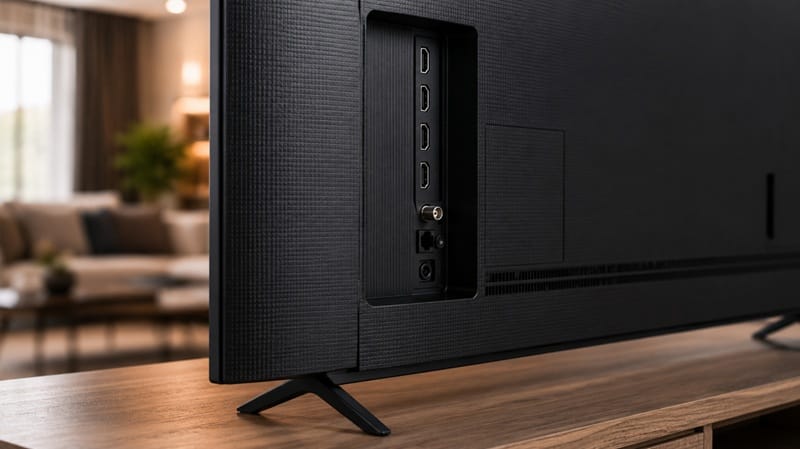
The 75-inch and 85-inch F7D models get 4 HDMI ports, one with eARC for a soundbar or receiver — smaller F7D sizes ship with fewer. That’s a detail worth checking if you’re comparing sizes within the same series, since TCL doesn’t hold the port count consistent across the whole lineup.
Performance & Real-World Use
Everyday Streaming
According to TCL’s official F7D series documentation, the panel pairs QLED’s quantum dot color layer with a direct-lit LED backlight that has no local dimming zones. Color should hold up regardless — quantum dots do that job independently of backlight design.
Contrast and black levels are a separate question, since the whole backlight brightens or dims together instead of adjusting zone by zone.
For daytime streaming, sitcoms, and general Fire TV browsing, that’s rarely a dealbreaker — most everyday content doesn’t demand deep, zone-controlled blacks to look good.
Movie Nights
This is where the missing local dimming becomes the main story. Without zone control, a night scene with a single bright object — a streetlamp, a phone screen — tends to wash out the surrounding darkness instead of isolating the highlight. Dolby Vision’s dynamic metadata helps optimize the signal scene-by-scene, but it can only work with the backlight hardware it’s given.
Sports & Bright-Room Viewing
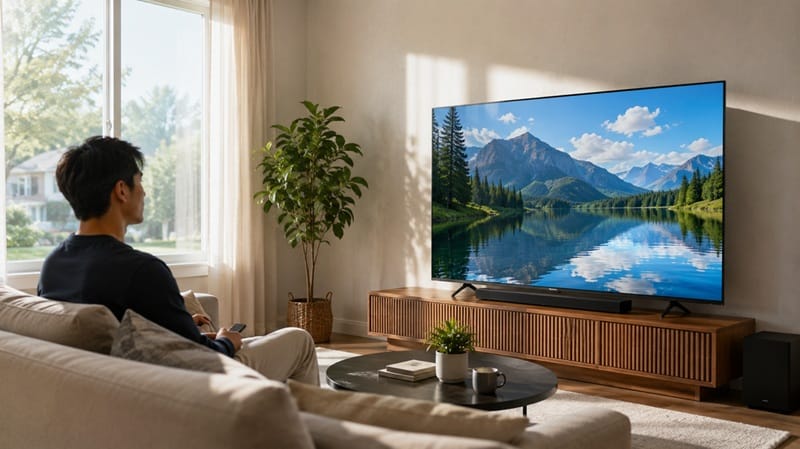
Direct-lit LED backlights are typically brighter and more even than budget edge-lit alternatives, which plays in the F7D’s favor for daytime sports or a living room with a lot of natural light. This is arguably the F7D’s strongest real-world use case relative to its price tier.
Key Features Breakdown
Fire TV with Alexa+ Built In
Instead of Google TV, the F7D runs on Fire TV with Alexa+ voice assistant built directly into the remote. For anyone already inside the Amazon ecosystem — Echo speakers, Alexa routines, Prime Video — that’s one less device to pair, since voice control works without a separate smart speaker connected to the TV.
Game Accelerator 120 and Auto Game Mode
The F7D supports Game Accelerator 120 alongside Auto Game Mode, which switches the TV into low-latency mode on its own the moment it detects a console or PC input. That saves a manual trip through the picture-mode menu every time you swap between streaming and gaming on the same TV.
The Good, the Bad, and the Ugly
Pros
- ✅ 75 inches at a true entry-level price — few TVs this size undercut it on cost.
- ✅ Dolby Vision support — uncommon at this price tier, where HDR10-only is the norm.
- ✅ Fire TV with Alexa+ built in — no separate smart-speaker pairing needed for voice control.
Cons
- ❌ No local dimming — the QLED name promises color the backlight hardware can’t fully back up with contrast.
- ❌ 60Hz native panel — Motion Rate 240 is a processed marketing figure, not a true refresh rate, so fast motion won’t match an actual higher-Hz panel.
The Ugly
The naming problem isn’t unique to this one TV. TCL uses “QLED” across its entire 2026 catalog, from the F7D up through the QM8L flagship with thousands of local dimming zones. That’s technically accurate — quantum dots are quantum dots either way — but it means the label alone tells a shopper nothing about where a given model sits in that range, and the F7D sits at the bottom of it.
A buyer who assumes QLED implies a specific contrast tier, rather than just a color technology, is the one most likely to feel misled once the TV is set up and running.
Who Should Buy the TCL 75F7D — and Who Shouldn’t
Buy This If…
The 75F7D makes the most sense for buyers who care about screen size and price first, and picture-quality nuance second. Think of it less like a home-theater centerpiece and more like a big, functional window — it’s there to deliver a large, watchable 4K picture for streaming, sports, and casual gaming without asking you to spend flagship money to get there.
If you want a step up in contrast without leaving the same price bracket, the TCL 75F8D review covers TCL’s QLED tier that actually includes local dimming — worth a look before you commit if picture quality is a bigger factor than price alone.
For a deeper look at what to expect from TCL’s entry tier specifically, our TCL budget TV picture quality and HDMI features guide goes further into the picture-quality tradeoffs and HDMI limitations that show up across TCL’s whole budget lineup, not just this one model.
Skip This If…
Dark-room movie watchers should look elsewhere — the lack of local dimming is the F7D’s clearest limitation, and it shows up most in exactly that viewing scenario.
Buyers who can stretch their budget slightly should also compare the Hisense 75U6SF Pro, which brings Mini-LED backlighting at a similar size and a modestly higher price — Mini-LED backlights typically support zoned dimming, which would make it a stronger pick specifically for the dark-scene contrast the F7D can’t deliver.
Final Verdict
Is the TCL 75F7D Worth Buying?
This TCL 75F7D review comes down to one trade-off: the QLED name here describes the color technology, not the contrast tier — the local dimming that usually justifies that name isn’t included at this size or price. For bright-room streaming, sports, and casual gaming, that trade-off barely registers. For a dedicated movie-night setup, it’s the one spec that shows up clearly on screen.
Compared with the step-up TCL 50F8D review, which trades screen size for local dimming at a similar price, the F7D runs that trade the other direction — more inches, less contrast control. Which side makes sense depends entirely on where the TV ends up in your room. 🛒 Check Availability on Amazon
Frequently Asked Questions
Does this TCL 75F7D review confirm Dolby Vision support?
Yes — based on TCL’s official product listing, the F7D series supports all three major HDR formats: Dolby Vision, HDR10, and HDR10+. That’s the full set, confirmed directly from TCL’s own spec sheet for this model.
How does the TCL 75F7D compare to the TCL 75F8D?
The F8D sits a tier above the F7D in TCL’s own lineup and adds local dimming, which is the upgrade that matters most for dark-scene contrast — the two otherwise share a similar QLED color foundation. Neither model currently has an independent RTINGS lab review, but RTINGS’ TCL coverage is worth checking periodically, since TCL adds new reviews throughout the year as its lineup turns over.
Is the TCL 75F7D good for gaming?
It covers the basics well for casual and console gaming — Game Accelerator 120 and Auto Game Mode both help keep input lag low. Competitive gamers chasing high refresh rates should note the native panel is 60Hz; Motion Rate 240 is processed motion smoothing, not a true higher refresh rate.
Who should avoid the TCL 75F7D?
Anyone who watches primarily in a dark or dim room should look at a set with local dimming instead, since that’s where the F7D’s backlight limitation is most noticeable. The Hisense 75U6SF Pro is a reasonable step-up alternative for that specific use case.
Does the TCL 75F7D work well with Alexa and other Amazon devices?
Yes — the F7D runs Fire TV with Alexa+ built directly into the remote, so it pairs naturally with existing Echo speakers and Alexa routines without needing a separate smart-speaker connection.

iYaiii
Editor, GearPulse360
iYaiii is the editor and founder of GearPulse360, specializing in TV reviews and consumer electronics. He researches every recommendation before publishing.
✅ Based on spec analysis and TCL’s official data — last verified August 2026.