Best OLED TVs Under $900 2026: Top 3 Picks
Last updated: June 2026
🕒 8 min read
Disclosure: As an Amazon Associate I earn from qualifying purchases. This article contains affiliate links — we may earn a small commission if you buy through them, at no extra cost to you.
Most “OLED TV under $900” lists online are quoting prices from when these TVs launched, not what they actually cost today. We checked live pricing across Amazon, Best Buy, and Walmart in June 2026, and the list of OLED TVs that actually clear a $900 ceiling right now is shorter than you’d expect — just three models.
Our top pick is LG’s 65-inch B5, the largest screen that still lands under this budget. If richer color out of the box matters more to you than screen size, Samsung’s 55-inch S85F swaps in a QD-OLED panel instead. And if space or budget is tight, LG also makes a 48-inch B5 that’s the cheapest real OLED panel sold anywhere right now.
Table of Contents
Best OLED TVs Under $900: Quick Comparison
| Pick | Model | Panel | Best For | Price |
|---|---|---|---|---|
| Best overall | LG B5 (65″) | WOLED | Largest screen at this price | Amazon ↗ |
| Best QD-OLED | Samsung S85F (55″) | QD-OLED | Richer color in a smaller size | Amazon ↗ |
| Best value | LG B5 (48″) | WOLED | Small rooms, desks, gaming setups | Amazon ↗ |
Prices checked at time of publishing. Amazon prices change frequently — click through for current pricing.
Badges above reflect our independent editorial assessment — they are not Amazon customer reviews.
Best Overall OLED TV Under $900: LG B5 (65-inch)
The LG B5 was already our top pick for tight OLED budgets in 2025, and it still is. LG’s 2026 lineup has moved on to the B6 as its new entry-level OLED, but that just means more retailers are clearing out 65-inch B5 stock — which is exactly why this model can dip under $900 in the first place.
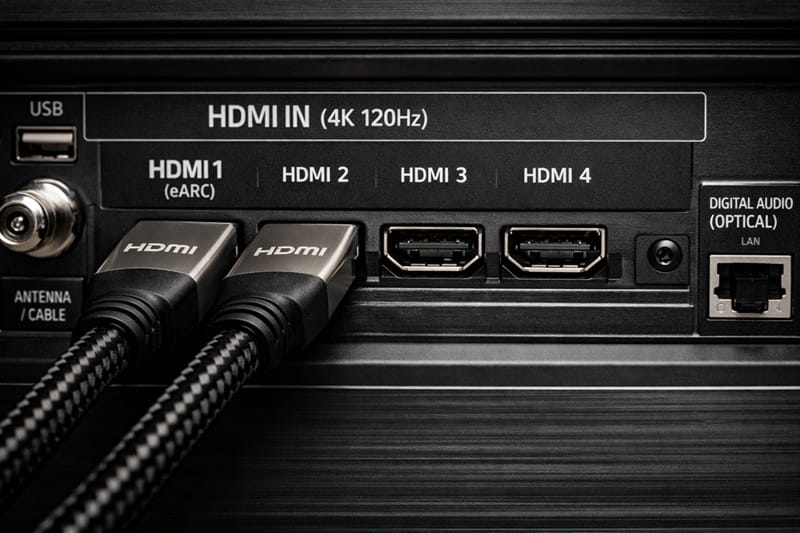
What you get for that price is a genuine WOLED panel with infinite per-pixel contrast, Dolby Vision support, and a 120Hz refresh rate with NVIDIA G-Sync and AMD FreeSync Premium compatibility. Four HDMI 2.1 ports mean you’re not choosing between a PS5, an Xbox Series X, and a soundbar — there’s room for all three.
The trade-off is brightness. Independent testing has measured the B5 well below LG’s step-up C-series and G-series models, so it can struggle against glare in a sun-facing living room. If your room has heavy curtains or you mostly watch at night, this is a non-issue. If you’ve got a wall of windows, it’s worth weighing that brightness gap before buying — we link directly to LG’s own brightness figures further down.
For the price, it’s still the largest real OLED screen you can get without crossing into mid-range territory.
Best QD-OLED Color Under $900: Samsung S85F (55-inch)
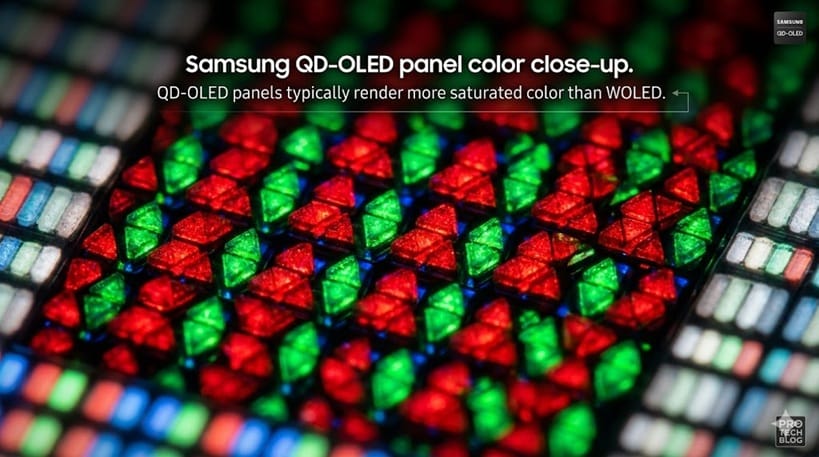
Samsung’s S85F swaps LG’s WOLED panel for a QD-OLED panel, and the difference shows up immediately in color saturation — reds and greens in particular look more vivid straight out of the box, without needing a full calibration pass. Samsung’s NQ4 AI Gen2 processor also handles upscaling well for a budget-tier chip, and the panel carries Pantone Validated color certification.
Gaming-wise, it matches the LG on paper: a 120Hz native refresh rate, Motion Xcelerator processing, and FreeSync Premium support across four HDMI 2.1 ports. Where it falls short is brightness and sound — RTINGS’ independent S85F review notes weaker built-in speakers than its pricier Samsung siblings, and peak brightness that sits behind the step-up S90F and S95F.
It’s also worth noting Samsung skips Dolby Vision entirely in favor of HDR10+, so if your other devices and streaming habits lean on Dolby Vision, factor that in before choosing this over the LG.
At 55 inches, you’re trading some screen size for that color advantage — a fair trade if accurate color matters more to you than maximum screen real estate.
Best Value / Smallest Size Under $900: LG B5 (48-inch)
This is the same B5 panel and Alpha 8 AI Processor Gen2 as our top pick, just shrunk down to 48 inches — and that’s exactly the point. LG doesn’t currently make an OLED smaller than 48 inches, which makes this the cheapest genuine OLED panel sold anywhere right now.
Nothing is cut to hit that smaller size: you still get Dolby Vision, all four HDMI 2.1 ports, and the same 120Hz refresh rate with G-Sync and FreeSync Premium support as the 65-inch model above. That makes it a legitimate option as a PC monitor or gaming display, not just a “small TV” compromise.
The catch is the same one that applies to its 65-inch sibling — limited peak brightness compared to LG’s pricier OLEDs — but it matters less at 48 inches, since smaller screens are typically viewed closer and in more controlled lighting, like a bedroom, office, or dorm room.
Budget OLED isn’t the only path to a better picture at this price — sometimes a same-price QLED is the smarter buy depending on your room. We break down exactly when OLED wins and when QLED wins in our full OLED vs QLED comparison. For now, here’s what actually matters when shopping in this specific price bracket.
What to Look for in a Budget OLED TV
WOLED vs QD-OLED at this price
Two of our three picks use WOLED panels and one uses QD-OLED, and at the budget tier, the practical difference comes down to color versus brightness consistency. QD-OLED panels like Samsung’s tend to produce more saturated color without extra calibration, while WOLED panels like LG’s B5 have historically been more consistent in how they age and handle near-black detail. Neither technology has a clear overall winner at this price — it’s closer to a style preference than a spec war.
Refresh rate and gaming features
All three picks here run a native 120Hz panel with four HDMI 2.1 ports, which is the real minimum bar for a usable gaming TV in 2026, not a budget-tier compromise. You’re getting full 4K/120Hz support on PS5 and Xbox Series X, plus variable refresh rate support through either NVIDIA G-Sync or AMD FreeSync Premium depending on the model. The one feature missing across the board at this price is a refresh rate above 120Hz, which only shows up on LG’s and Samsung’s pricier OLED tiers.
Brightness trade-offs at this price
Every budget OLED gives up something to hit this price, and it’s almost always peak brightness. Manufacturers reserve their brightest panels for flagship and mid-range tiers, which is why all three picks here read dimmer on a light meter than their step-up siblings. In a dim or moderately lit room this barely registers. In a bright, sun-facing living room, that’s where it’ll show up most. Check LG’s and Samsung’s own spec pages for each model’s official brightness figures before buying if this matters to you.
How long will a budget OLED last?
OLED longevity questions almost always come back to burn-in, and the honest answer is that normal, mixed-content viewing is very unlikely to cause it on any of these three models. We go deeper into real-world OLED lifespan and what actually causes burn-in in our dedicated guide on how long OLED TVs last, if you want the full picture before buying.
Is a Budget OLED Worth It vs QLED at the Same Price?
At $900 and under, you can also find capable QLED and Mini LED TVs — so the real question isn’t whether OLED is good, it’s whether OLED beats the QLED alternative at this exact price.
For most living rooms, it really comes down to your room’s lighting. OLED’s per-pixel black levels and contrast are simply better than anything QLED can do at this price point, which matters a lot for movies, dark games, and night viewing. But a same-price QLED or Mini LED TV will usually get noticeably brighter, which matters more if your room gets direct sunlight during the day.
If your viewing is mostly evening and nighttime, in a room you can dim, the OLED picks above are the better buy. If you’re fighting glare from windows most of the day, it’s worth weighing that brightness gap carefully — budget OLEDs feel it more than flagship ones do. For the bigger-picture case for and against OLED in general, see is OLED worth it in 2026.
💡 Budget stretching a little? If you can go up a tier, here’s what we’d recommend instead: Best OLED TVs Under $1,000 →
How We Picked These TVs
We started by pulling every current-generation OLED TV from LG’s and Samsung’s official 2025 and 2026 lineups, then checked live pricing against each manufacturer’s site plus at least one major retailer — Amazon, Best Buy, or Walmart — rather than relying on launch-day MSRP. Only three models actually cleared a strict $900 ceiling at the time of writing.
For each one, we cross-referenced the manufacturer’s published spec sheet against RTINGS’ independent test data for that exact model, not a predecessor. Where a spec wasn’t independently testable yet, we noted that explicitly rather than guessing.
We re-check pricing on this guide regularly, since OLED prices at this end of the market move often — models that don’t qualify today can drop under $900 within weeks, and ones that do qualify can climb back above it just as fast.
📍 Not sure $900 is your ceiling? See how every OLED size and price tier stacks up in our full best OLED TVs of 2026 roundup.
Budget OLED TV FAQs
Which OLED TV under $900 is the best overall pick?
The LG B5 (65-inch) is our top pick for most buyers, since it’s the biggest genuine OLED panel that consistently clears a $900 ceiling. If color accuracy matters more to you than screen size, Samsung’s 55-inch S85F is the better pick instead.
Is a budget OLED TV actually worth it over a QLED or LED set?
For dark-room viewing, yes — OLED’s per-pixel black levels beat any QLED or LED set at a comparable price. If your room is bright during the day, a similarly priced QLED or Mini LED set will likely look better in daylight, since OLED brightness is the first thing manufacturers cut to hit a lower price.
Are budget OLED TVs dim or prone to burn-in?
They are dimmer than flagship OLEDs — that’s the main trade-off at this price — but burn-in from normal, varied viewing is very unlikely on any current OLED panel. RTINGS’ independent testing backs this up across the models in this guide.
How does a budget OLED compare to mid-range OLED or QLED options?
Mid-range OLEDs like LG’s C-series or Samsung’s S90 series get noticeably brighter and add features like higher refresh rates, but you’re paying significantly more for it — see our best OLED TVs under $2,000 picks if you want to go there. Against a same-price QLED, the budget OLEDs here win on contrast and black levels but lose on peak brightness — see our OLED vs QLED comparison guide above for the full breakdown.
What size OLED should I get for under $900?
Go with the 65-inch LG B5 if you have a dedicated living room or media space — it’s the better fit for typical seating distances. The 48-inch B5 makes more sense for a bedroom, office, or desk setup where you’re sitting closer to the screen.

iYaiii
Editor, GearPulse360
iYaiii is the editor and founder of GearPulse360, specializing in TV reviews and consumer electronics. He researches every recommendation before publishing.
✅ Based on spec analysis and LG’s and Samsung’s official data plus RTINGS — last verified June 2026