OLED TV Trends to Watch in 2026: What’s Changing and Why It Matters
Last updated: July 2026 | 🕒 8 min read
Disclosure: As an Amazon Associate I earn from qualifying purchases. This article contains affiliate links — we may earn a small commission if you buy through them, at no extra cost to you.
In the space of about twelve months, the two companies that make almost every OLED TV panel on the market went from claiming 4,000 nits of peak brightness to claiming 4,500 nits. That’s just one thread in a year where panel technology, pricing, gaming features, and AI processing all shifted at roughly the same time.
If you’re trying to figure out whether 2026 is a smart year to buy an OLED TV, or whether you should wait for what’s next, it helps to see the whole picture at once rather than chasing each headline separately. Here’s a full look at the OLED TV trends 2026 buyers actually need to know about, and what each shift means for someone shopping right now.
Table of Contents
OLED TV trends 2026: panel technology splits into more directions
For years, OLED TVs meant two basic choices: LG’s WOLED panels or Samsung’s QD-OLED panels. In 2026, both of those categories have branched further, and a handful of new panel structures are pushing into the space between “flagship” and “mainstream.”
Brightness claims are climbing on both sides
According to LG Display’s own published specifications, its latest Tandem OLED panel structure is built to reach a peak brightness of up to 4,500 nits, alongside a sharply reduced screen reflectance. Samsung Display has published a nearly identical claim for its 2026 QD-OLED TV panel, also citing optimized organic materials pushing peak brightness to 4,500 nits.
Those are panel-spec numbers, not measured results in a finished TV — and that gap matters. Independent, side-by-side testing from RTINGS on 2026 flagship models is the more useful reference point, since lab-measured performance in a finished TV routinely lands below what a panel spec sheet promises. That doesn’t make the underlying trend fake; it just means the honest way to read these brightness numbers is as a ceiling, not a guarantee.
This pattern — panel makers publishing an aggressive spec number, then real-world units landing meaningfully below it — has repeated every year for the past several generations. It’s worth keeping in mind every time a “record-breaking” brightness number shows up in a press release.
We’ve gone deeper on where this technology race is actually headed in our piece on whether QD-OLED is the future of the category, and in our breakdown of next-generation OLED panels coming after Tandem WOLED and QD-OLED.
The newest panels aren’t going into every model
One trend that’s easy to miss: manufacturers are increasingly reserving their most advanced panel structures for flagship and near-flagship tiers, while mid-range models keep an older panel generation paired with a newer processor. That means two TVs in the same lineup can share a brand name and a similar price bracket while using meaningfully different underlying panel hardware.
Practically, this means the panel generation printed in a spec sheet now matters more than it used to when comparing models within the same series — checking which specific panel a given size and tier actually ships with is a better habit than assuming the whole lineup shares one panel.
Brightness and picture quality keep climbing
Panel-spec numbers aside, the real-world picture quality trend in 2026 is measurable: this year’s mid-range and flagship OLEDs are noticeably better at handling bright, high-contrast scenes than the sets from just two or three years ago. Anti-reflective coatings have also improved across multiple brands, which matters more for everyday viewing than peak nit counts do.
We covered the full scope of these gains — and where the improvements are more marketing than substance — in how OLED TVs improved in 2026.
Prices are trending toward this
The pricing story in 2026 is less dramatic than the panel-tech story, but it’s arguably more relevant if you’re actually shopping. Entry and mid-tier OLED models have continued sliding down in price as production scales. Flagship models with the newest panels, by contrast, appear to be holding their pricing more steadily — consistent with past product cycles, though exact year-over-year pricing varies by retailer and region.
In other words: OLED isn’t uniformly getting cheaper. It’s getting more affordable at the bottom of the lineup while staying pricier at the top, which is a different trend than most headlines suggest.
Watch the discount window, not just the price tag
There’s also a seasonal pattern worth knowing, based on how past OLED launch cycles have typically played out: the previous year’s flagship model often sees its steepest discount shortly after a new lineup launches, as retailers clear shelf space. For buyers who don’t need the absolute newest panel, that discount window has historically been one of the better value moments in the OLED calendar year — though timing and depth of discount varies by retailer and region.
We break down exactly where the pricing is heading, and whether waiting makes financial sense, in will OLED prices drop in 2026.
Gaming features are becoming standard, not premium
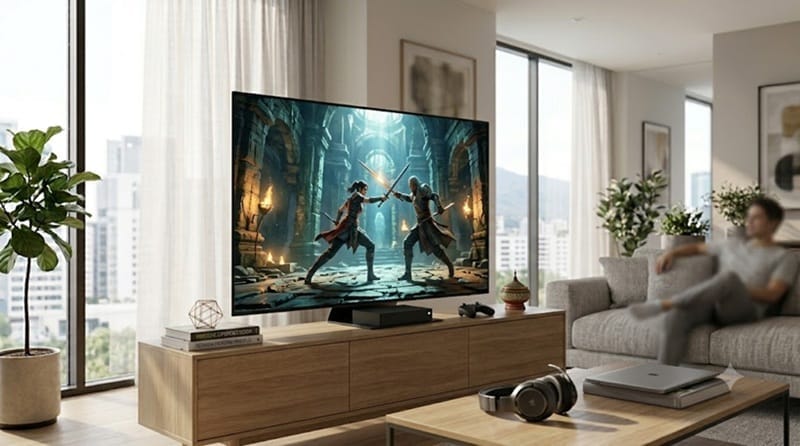
A few years ago, 4K 120Hz support, VRR, and low input lag were flagship-only perks. In 2026, those features have filtered down into mid-range OLED models as a baseline expectation rather than a selling point.
What’s newer this year is deeper cloud-gaming integration built directly into TV software, plus faster processors handling upscaling for lower-resolution game streams. Several 2026 models also added lower-latency wireless controller support, which matters specifically for cloud gaming where every extra millisecond of round-trip lag is more noticeable than it is on a local console.
Refresh rate ceilings keep climbing too
Higher native refresh rate support has continued pushing upward on flagship and upper-mid-tier models, mainly benefiting PC gamers connecting a high-end graphics card rather than console players, who remain capped by what the console itself outputs. If you’re a console-first gamer, this particular spec matters far less than the marketing around it suggests.
For anyone who games as much as they watch movies, the combination of standard-tier VRR, better cloud integration, and lower input lag is arguably the most practically useful shift in the entire 2026 lineup — even though it gets less attention than brightness numbers.
AI processing is doing more of the work
Every major OLED manufacturer shipped a new processor generation in 2026, and the marketing language around all of them leans heavily on “AI.” In practice, what’s actually improved is scene-by-scene picture optimization, sharper real-time upscaling of lower-quality streams, and — on some models — automatic calibration that adjusts for room lighting without a separate calibration tool.
This is a real, tangible win for casual viewers who will never manually calibrate a TV, even if the “AI” framing oversells what’s really incremental processing improvement.
Where the AI label is doing real work
The clearest practical win is content-aware upscaling — older shows, lower-bitrate streams, and standard-definition sources look noticeably cleaner on 2026 processors than they did even two generations ago. That’s a bigger day-to-day difference for most households than any brightness figure, since the majority of what people watch isn’t native 4K to begin with.
Voice-driven search and content discovery also got a meaningful upgrade this year, though that’s less about the display itself and more about the smart TV platform running on top of it.
Competing technologies are catching up
OLED isn’t the only display technology moving fast this year. MicroLED has continued closing the gap on brightness and color, though it remains far more expensive and mostly limited to very large screen sizes. For most home theater setups, OLED still wins on price-to-performance, but the gap with MicroLED is narrower than it was even a year ago.
If you’re weighing the two technologies against each other for a home theater purchase, our detailed breakdown in MicroLED vs OLED compared covers exactly where each one wins.
RGB Mini LED enters the picture
A newer entrant worth watching is RGB-backlit Mini LED, which several brands introduced in 2026 as a brighter, LCD-based alternative aimed at rooms with heavy ambient light. It doesn’t match OLED’s per-pixel contrast or viewing angles, but it’s a sign that the pressure on OLED is coming from more than one direction this year, not just MicroLED at the high end.
What this means for buyers right now
None of these trends individually should scare you off buying an OLED TV in 2026. Panel brightness claims will keep climbing every year regardless of when you buy — that’s not a reason to wait indefinitely. The more useful question is whether the specific model you’re considering already has the gaming features, processing, and price point that matter for how you’ll actually use it.
Match the trend to your actual use case
If your priority is gaming, the standardization of VRR and low input lag across mid-range models means you likely don’t need a flagship to get a solid experience. If your room has heavy ambient light, matte-screen QD-OLED options or the newer RGB Mini LED alternatives are worth weighing more heavily than raw peak-brightness numbers alone. And if you mostly watch streaming content rather than native 4K sources, this year’s upscaling improvements may matter more to your day-to-day experience than any panel generation upgrade.
If you’re still narrowing down which model fits your budget and room, our best OLED TVs in 2026 roundup breaks down the current top picks across every price tier.
FAQ: OLED TV trends 2026
Is OLED technology still improving every year?
Yes. Brightness, reflectance handling, and processing have all measurably improved year over year, though the pace of visible, real-world improvement is slower than manufacturer marketing suggests.
Will OLED TVs get cheaper in 2026?
Entry and mid-tier models are trending cheaper as production scales. Flagship models with the newest panel technology have stayed roughly flat in price.
What’s the next generation of OLED technology?
Panel makers are pushing brighter Tandem and QD-OLED structures further, while competing technologies like MicroLED close the performance gap from a different direction. Neither represents a clean “replacement” for current OLED yet.
Is 2026 a bad time to buy an OLED TV?
Not particularly. Because brightness and processing improve incrementally every year, waiting for “the next big jump” usually just means waiting indefinitely. Buying based on today’s actual needs and budget tends to be the more practical approach.

iYaiii
Editor, GearPulse360
iYaiii is the editor and founder of GearPulse360, specializing in TV reviews and consumer electronics. He researches every recommendation before publishing.
✅ Based on spec analysis and LG’s and Samsung’s official data plus RTINGS — last verified July 2026